The Outsider by Colin Wilson

Wilson_TheOutsider_2001There’s a small list of books I’ve immediately re-read after first reading them, and Colin Wilson’s The Outsider is on it. At the time (I must have been 21 or 22), I’d never read any philosophy, nor much literature outside of SF, fantasy & horror, and part of the impact the book had on me came from its introducing me to subjects I’d never looked into before, but which I soon realised I had a great hunger for. It’s humbling to realise Wilson himself was 24 when he wrote it. By that point he’d already read more books than I, at twice my then-age, have managed even now — and he’d not only read them, but thought about them.

It’s a hallmark of Wilson’s writing that he’s deeply and infectiously engaged in anything he’s writing about, something that’s even more true of this, his first book. What, then, is it about? A general study of the figure of ‘the Outsider’ in literature would be too diffuse; this is the study of a selection of figures that enable Wilson to ask the questions he most wants to ask. So what is a Wilsonian Outsider?

‘…the Outsider is a man who cannot live in the comfortable, insulated world of the bourgeois, accepting what he sees and touches as reality. “He sees too deep and too much,” and what he sees is essentially chaos. For the bourgeois, the world is fundamentally an orderly place, with a disturbing element of the irrational, the terrifying, which his preoccupation with the present usually permits him to ignore. For the Outsider, the world is not rational, not orderly. When he asserts his sense of anarchy in the face of the bourgeois’ complacent acceptance, it is not simply the need to cock a snook at respectability that provokes him; it is a distressing sense that truth must be told at all costs, otherwise there can be no hope for an ultimate restoration of order. Even if there seems no room for hope, truth must be told.’

What it comes down to is a basic question asked of life itself: ‘Ultimate Yes, or Ultimate No?’ The non-Outsider says, ‘Ultimate Yes, obviously,’ but this is the dismissive reaction of someone who’s never had to make the choice. The Outsider, who ‘sees too deep and too much’, has to ask the question every moment of every day, either recoiling in horror at the suffering in the world (‘Ultimate No’), or discovering, once again, in moments of intense affirmation, his own particular ‘Ultimate Yes’ — but always in spite of all that could lead to an ‘Ultimate No’:

‘The way lies forward, into more life… accept the ordeal… “ever further into guilt, ever deeper into human life”… Life itself is an exile. The way home is not the way back.’

A Voyage to Arcturus, Ballantine Books, cover by Bob Pepper

A Voyage to Arcturus, Ballantine Books, cover by Bob Pepper

(Those last two sentences can’t help reminding me of the journey towards our ‘true home’ in David Lindsay’s A Voyage to Arcturus, a book I also first read, and immediately re-read, around the same time, without knowing Wilson had written about it. Re-reading The Outsider now, I’m struck by how similar the two books are, both in subject matter and basic form. Both begin by rejecting the idea of normal, ‘bourgeois’ reality: in Arcturus, this is the gathering described in the opening chapter, ‘The Séance’; in The Outsider, this is in Wilson’s opening sentence — ‘At first sight, the Outsider is a social problem’ — and his discussion of Henri Barbusse’s novel, L’Enfer, in particular the dinner table scene, which is, like Arcturus’s séance, a social gathering where something shocking — the story of a local murder — is presented for entertainment. Both books then go through a series of explorations and rejections of possible answers to the questions they’re asking, leading, ultimately, to a more visionary conclusion.)

In 2001, The Outsider, having been constantly in print since its first publication in 1956, was re-published with some additional after-thoughts by Wilson, in which he summarises the Outsider’s position:

‘…it still seems to me that the whole “Outsider problem” is epitomised in the contrast between Van Gogh’s painting The Starry Night and the words of his suicide note: “Misery will never end.”’

Manic_Street_Preachers-The_Holy_Bible_album_cover“La Tristesse Durera” — not coincidentally the title of one of my favourite songs by one of the most Outsider-ish (in the Wilsonian sense) bands, the Manic Street Preachers. (Their Holy Bible is a modern ‘Outsider document’ if ever there was one, highlighting all the ‘Ultimate No’s’ of the 20th century, from serial killers to eating disorders to concentration camps — issues not touched upon by Wilson in his first book, though serial killers were a speciality of his later work. The energy of the music itself acts as an ‘Ultimate Yes’. Of course, the fate of Richey Edwards, who disappeared after the album’s release, touches on the question that made Wilson start his book in the first place: why did so many young men of genius in the 19th and early 20th centuries end up killing themselves?)

The Outsider was published in 1956. There’s something about that era, the mid-1950s to mid-1960s, that had a much more serious intellectual air about it. Writers could expect their public to have a basic familiarity, and interest in, both new scientific ideas and experimental art. The era also had its dark side, as when ‘the Establishment’ grew defensive. Perhaps sensing this non-university-educated upstart was getting too confident, Wilson’s sequel, Religion and the Rebel (1957), was reviewed as scornfully as his first book was praised. He went on to write a total of six books in his ‘Outsider sequence’, but it wasn’t until the 1970s, with the success of his massive tome, The Occult, that he was once more taken seriously as a writer in his homeland (other countries were far more enthusiastic, and less duplicitous).

Colin Wilson, from the back of Dreaming to Some Purpose

Colin Wilson, from the back of Dreaming to Some Purpose

For me, The Outsider stands alongside other books such as the already-mentioned A Voyage to Arcturus, Alan Garner’s Red Shift, Hermann Hesse’s Steppenwolf, J G Ballard’s The Atrocity Exhibition, that are a form of ‘crisis literature’, in that they’re both about, and are often the result of, a crisis in the author and the culture. They seem to call for an intellectual response — the need to decode, categorise, ‘solve’ — but more and more I think these books are primarily emotional statements than steps towards some sort of rational answer. The Outsider describes a stage we can all come to — and hopefully pass through — each time we find ourselves seeing ‘too deep and too much’, beyond the comfortable myopia of our personal boundaries, or those of our times. The distress of alienation (from self, or old ideas, or from family, or society, or culture), and the need to move forward into a newer, stronger certainty, make these into books of ‘crisis’, and each solution must be new-found, new-made, by each individual. But at least some such individuals leave guidebooks for us; and Wilson’s could be the arch-guidebook, or certainly the vital first step, composed as it is of fragments of others’ — a guidebook of guidebooks.
^TOP

High-Rise by J G Ballard

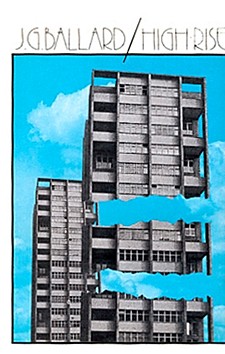
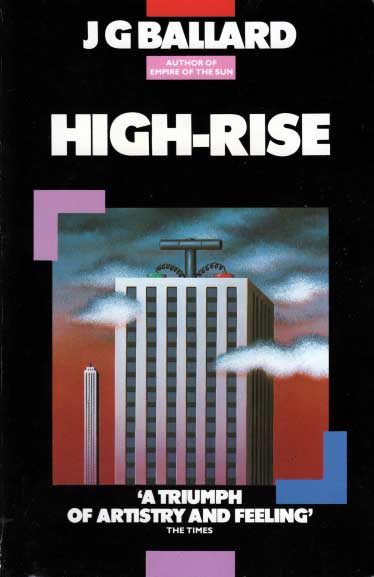
Cover to 1985 release of Ballard's High-Rise, by James Marsh

Cover to 1985 release of Ballard’s High-Rise, by James Marsh

As with 1966’s The Crystal World, there’s a feeling that High-Rise (published in 1975) grew from a single image that could have been a surrealist painting — in this case, that of a well-to-do middle-class man crouching on his apartment balcony, roasting a dog over a fire made of telephone directories — and that the rest of the novel is merely a Ballardian extrapolation of that one image.

High-Rise is J G Ballard’s insistence that the utter breakdown of society to be found in Lord of the Flies needs neither an isolated island, nor children without adult supervision to take hold. We can have it here and now, in modern England, in a fully-populated high-rise tower block, tenanted entirely by the most educated, professionally responsible classes. In fact, Ballard seems to be saying, we can not only have it, but we secretly long for it.

tarot_towerThe novel kicks off at the moment the newly-built tower block reaches ‘critical mass’, as the last of its residents move in. From that point, a slow but steady escalation of petty social tensions, technical teething troubles and Ballardian psychopathology takes its grip, as the residents of the building — ‘a virtually homogeneous collection of well-to-do professional people — lawyers, doctors, tax consultants, senior academics and advertising executives, along with a smaller group of airline pilots, film-industry technicians, and trios of air hostesses sharing apartments’ — become increasingly violent, territorial, and tribal. At first maintaining a flawless facade towards the world outside, going to work each day in immaculately pressed suits, the residents return each night to spend more and more time engaging in vandalism and violence, finally forgetting the world outside altogether, to concentrate on their new, almost entirely primitive existence enclosed within the self-contained forty-storey apartment block, whose corridors, garbage chutes, elevator shafts and swimming pools are clogged at first with rubbish sacks, then, towards the end, human bodies.

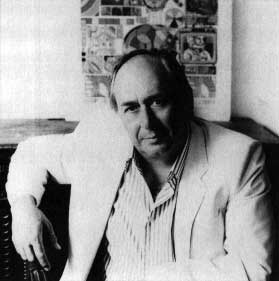
jg_ballardHigh-Rise follows not one but three protagonists, chosen from the three social tiers into which the forty-storey apartment block divides itself — a division that can’t help seeming arbitrary, homogeneous as the residents are. We start with medical lecturer Robert Laing, who lives on the 25th floor (throughout the book, as well as the usual Ballardian habit of identification-by-profession, minor characters are labelled by their floor of residence — so we get ‘a 28th floor account executive’, ‘a radiologist from the 7th floor’, ‘a newspaper columnist on the 37th floor’ — thus emphasising the social surface, in contrast to the violent or irrational behaviour they’re engaging in). We then switch to Anthony Royal, the high-rise’s architect, living in its penthouse apartment, who, like some sort of Bond villain, wears a white safari jacket while being accompanied by an arctic-coated Alsatian dog. He also has a walking stick, thanks to a recent car crash, which makes him seem, as well as a Bond villain, like an image of the author himself: Ballard, who wears a white suit in his author photograph, had also recently been through a car crash of sorts — the writing and publication of his 1973 novel Crash. Third in this trio of protagonists is Richard Wilder, a pugnacious TV documentary maker from the lower floors. Of the three, Wilder is the only one who has a real story, as such — a determination to climb the high-rise and inveigle himself into the top floors, under pretence of making a documentary. Laing, is, generally, too languorous to do much other than forage for food and join in with the occasional sortie against other floors, while Royal soon loses any sense of being a Bond villain, and retreats into a mix of traumatised detachment and a feeble longing to see the high-rise in terms of some sort of transformation:

‘…the present breakdown of the high-rise might well mark its success rather than its failure. Without realising it, he had given these people a means of escaping into a new life, and a pattern of social organisation that would become the paradigm of all future high-rise blocks.’

But you don’t read Ballard for the story. It’s the ideas, the images and the writing that ensure High-Rise is never static. Throughout Ballard’s works, there’s a longing for the outer world to match the trauma, chaos and perversity of his characters’ inner worlds, as though he were egging us on to become the people he knows we really are beneath the civilised surface — or at least the people he’s seen us becoming, in his prison-camp childhood in Shanghai during the Japanese occupation. But also, there’s a sense of striving for a new sort of freedom, even if it takes violence to reach it.

HighRiseBut is that what the residents of this high-rise achieve? Towards the end, as tribal divisions break down and the residents retreat individually into their barricaded apartments, there’s a sense of stagnation — ‘sometimes [Laing] found it difficult not to believe that they were living in a future that had already taken place, and was now exhausted’ — or reversion, as the social breakdown, at first presented as a sort of inner fulfilment of what these over-conventionalised professionals really need to live fuller lives — ‘All this brought them together, and ended the frigid isolation of the previous months’ — starts to feel more like a regression, a retreat. Laing reforms his childhood ménage with his sister, and settles into petty power games with her and another bedridden woman he rescues from a nearby apartment; while Wilder, finally reaching the roof, sees children playing in the sculpture garden and doffs his clothes to join them. (Royal’s ending is the most disappointing of all — I was really expecting him, Ballard fashion, to be eaten by his beloved gulls, or perhaps to think he was one of them and attempt to fly off the tower-block roof.)

High-Rise was the first of Ballard’s novels that I read — thanks, of course, to Hawkwind’s song of the same name (whose lyrics paint a more science-fictional and socially rebellious picture of the same theme), released a bare four years later (but recorded in 1977, only two years after the novel came out). It is, I think, the perfect Ballardian novel. The story may at times feel static, but the writing never flags, with Ballard still pulling new images, ideas, and angles out of this situation right up to the final chapters. It also represents something of a change in Ballard’s writing. Before it, despite the careening handbrake-turn from his early disaster novels (The Drowned World, The Drought, The Crystal World) into the transitional, highly experimental work of the late 60s and early 70s (The Atrocity Exhibition, Crash) his writing focused on the individual’s response to a disaster, however worldwide or (in the case of The Crystal World) universe-wide, that disaster was. Here, though, we get to see more of the response of a whole section of society, which is more the style of Ballard’s latter novels (Cocaine Nights, Super Cannes, and I haven’t yet read Kingdom Come, but I’m assuming that’s similar).

Apparently, before starting the novel, Ballard penned a 25,000 word summary, ‘in the form of a social worker’s report on the strange events that had taken place in this apartment block…’ — which I’d love to read, though in the same quote, Ballard says: ‘I wish I’d kept it; I think it was better than the novel.’ !

^TOP

The Crystal World by J G Ballard

The Crystal World coverJ G Ballard’s fourth novel, The Crystal World, seems to have grown like a crystal. Before the novel (published 1966), there was the novella “Equinox” (in two parts in New Worlds between June and August 1964), and before the novella there was the short story “The Illuminated Man” (in F&SF, May 1964), and at the very start of the short story — topping and tailing it, in fact, as it’s repeated at the end — is a brief, italicised paragraph that’s like the seed-crystal of all that follows, a description of a Surrealist painting that never was:

“By day fantastic birds flew through the petrified forests, and jewelled alligators glittered like heraldic salamanders on the banks of the crystalline rivers. By night the illuminated man raced among the trees, his arms like golden cartwheels, his head like a spectral crown…”

In the novel (where this paragraph appears in the final chapter), the alligators are now crocodiles, as the location has shifted from Florida to a more Heart of Darkness-ish “isolated corner of the Cameroon Republic”, but the main story is the same. The protagonist, Dr Sanders (a first-person narrator named James B—— in the story) finds himself at one of several points on the Earth which are being transformed by the “Hubble Effect”:

“…an actual proliferation of the sub-atomic identity of all matter. It’s as if a sequence of displaced but identical images of the same object were being produced by refraction through a prism, but with the element of time replacing the role of light.”

The upshot is that everything is becoming encased in (or turned into) crystal, and the crystallisation is spreading in waves that pulse through the affected zones, turning rivers into roads of glass, and roads into pathways furred with foot-high crystal spurs. Everything, from the vegetation to the buildings to the water is becoming a prismatic version of itself, and that includes the animals and people. It’s when describing this effect — when painting it before our eyes in sparkling, rainbowed light — that Ballard’s writing is at its precise, vivid, hallucinogenic best:

“From the elbow to the finger-tips it was enclosed by — or more precisely had effloresced into — a mass of translucent crystals, through which the prismatic outlines of the hand and fingers could be seen in a dozen multi-coloured reflections. This huge jewelled gauntlet, like the coronation armour of a Spanish conquistador, was drying in the sun, its crystals beginning to emit a hard vivid light.”

The Crystal World, another coverTime has crystallised my own view of The Crystal World. On a first reading I found it to have passages of beautiful, precise poetry punctuating (after a nicely-paced moody beginning) an otherwise dull story. A recent re-read has only confirmed me in this opinion. The moments that stand out are like shards of the original short story — they’re all in “The Illuminated Man”, often in the same words: the helicopter that slews then crashes as it tries to fly when the Hubble Effect has taken hold of its rotor blades, the half-vitrified crocodile suddenly whipping into life from its bed in a solidified river. But these intensely imagined, visually shocking moments speckle a story of mostly rather unconvincing, lacklustre characters who seem to be standing around in the presence of all this cathedral-like jewelled wonder waiting for the Ballardian spark to wake their inner worlds. Only, it never happens. Ballard provides us with a pair of love triangles — the protagonist Sanders, Suzanne Clair & Max Clair, and Ventress, Thorensen & Serena — both centred around a male rivalry for a dying woman, though this doubling only waters the effect of the same single-triangle situation in the original short story, which itself only seemed to be pointing out how meaningless such human motives as love and revenge are in contrast to the time-defying crystallisation process. Why, then, go to the bother of actually duplicating this meaningless situation, particularly when neither, ultimately, resolves in any interesting way?

The Crystal World, Max Ernst coverThe protagonist Sanders is much less inwardly connected to the catastrophe when compared to, say, Kerans of (my favourite Ballard novel) The Drowned World. I can’t help feeling that in writing The Crystal World, Ballard was perhaps stuck in the formula of his previous two books, and while his inventiveness as it related to the transformed landscape had blossomed — even, effloresced — he had less to say about the human side of the equation. He even, at one point, has his main character discuss the possible themes of the very novel he’s in, as Sanders starts going on about the profusion of doubles in a plot Ballard seems to be struggling to get some meaning out of. It results in some very un-Ballardian psychological truisms (“Of course there’s a dark side to the psyche, and I suppose all one can do is find the other face and try to reconcile the two — it’s happening out there in the forest”, and “Each of us has something we can’t bear to be reminded of.”). But the sheer audacity, strangeness, and poetry of the fantastic idea at the heart of the novel conquers, in the end, and those few scattered jewels of Ballardian poetry that break through the tedium of the novel’s unconvincing characters make it all worthwhile. (Though I can’t help feeling that, apart from the moody equinoctial darkness of the opening chapter, which I love, you’d be better off reading “The Illuminated Man”.)

The feeling that Ballard was tiring of his initial formula and on the verge of an artistic breakthrough is perhaps confirmed by what came next: as well as his almost continuous outpouring of short stories at the time, there was, a few years later, a quantum leap to a very different type of fiction with the “condensed novels” of The Atrocity Exhibition, and then Crash. (A novel very much like The Crystal World, in that it comes to life entirely through its intense, rather inhuman poetry, rather than its short story’s worth of story.)

The novel does, though, at least touch on a human meaning behind the Hubble Effect:

“The beauty of the spectacle had turned the keys of memory, and a thousand images of childhood, forgotten for nearly forty years, filled his mind, recalling the paradisal world when everything seemed illuminated by that prismatic light…”

And:

“…this illuminated forest in some way reflects an earlier period of our lives, perhaps an archaic memory we are born with of some ancestral paradise where the unity of time and space is the signature of every leaf and flower.”

Which makes me realise how much the catastrophes in catastrophe novels are all about a need to halt time, to end the forward rush of modernity and pause, perhaps regress, to something a little more humanly manageable. Perhaps, in this, Ballard’s Crystal World is the ultimate expression of the SF catastrophe.

The Crystal World also, perhaps, contains a hint of autobiography:

“It seems to me, Max, that the whole profession of medicine may have been superseded — I don’t think the simple distinction between life and death has much meaning now.”

Ballard spent a year studying as a doctor (his descriptions, in Miracles of Life, of his time dissecting cadavers in anatomy classes easily equals the poetry of The Crystal World’s more jewelled moments), but gave up, perhaps because of a very similar realisation: that it all meant nothing compared to the immensities to be explored in his own imagination — visions like the life-and-death-annulling crystallisation of the world — which were themselves attempts to resolve the very intense plunge into catastrophe, violence and upheaval of his teen years in WWII China. Like Lovecraft’s “The Colour Out Of Space” — a very similar story in some ways — The Crystal World could well be the purest expression of what its author was aiming at:

“…the response to light is a response to all the possibilities of life itself.”

Whatever its faults, The Crystal World is still an amazing piece of fiction for the sheer strangeness of its vision alone.

^TOP