
 I’ve just finished reading J G Ballard’s autobiography, Miracles of Life, having reached the halfway point yesterday, then giving in to the urge to just keep reading. As it moves towards his declaration that he has been diagnosed with advanced prostate cancer, it seems less and less like an autobiography, more like a final statement he wants to make to the world, an affirmation of his life, and a series of thank-you’s to the people who have meant most to him in his life. But this is no criticism at all.
Ballard spends most of the book on his early, and extremely formative, years in Shanghai, both as the only son of a wealthy family, and as a borderline feral teen in a prison camp during the Japanese occupation. He’s at his most poetic when describing the time he spent dissecting human cadavers in anatomy classes during the two years he studied for a medical degree. But he is at his most moving when writing in simple terms about how much raising his three children (who give the book its title) has meant to him. In a way, the second half of the book, and the latter half of his life, seems to have been a means of coming to terms with the amazing clash of near-decadent luxury, fantastic exoticism, casual brutality and too-easy mortality of those early years, as well as the tragically early death of his wife. The fact that he can speak so eloquently about the happiness he later found in the simple, human things of life proves how successfully he overcame those early, dehumanising influences. Following him on this journey is wonderfully moving. And this is from the pen of the man who plumbed the depths of human psychopathology in Crash — a man supposed to be “beyond psychiatric help” (as one early reader of Crash had it)? But I’m primed to sympathise with Ballard, as he’s one of my favourite writers, whose originality of mind and imagination, as well as his peerless prose style, have been a constant joy in my reading life. (If this sounds a bit elegaic, it’s only because I’ve caught the mood from his book.)
I have to admit, right away, that I’ve never read his most famous book, Empire of the Sun. Having devoured so many interviews with him (and, of course, having watched the film — yes I know it can’t be any sort of substitute), I haven’t quite been able to sum up the enthusiasm. (Reading Miracles of Life has only put the event off even longer, of course, as it covers a lot of the same ground.) And, as far as Ballard’s most notorious book is concerned, I’ve read Crash, and felt that while it was doubtlessly an amazing writing achievement, and although it was obviously a personal milestone for Ballard, a very necessary confrontation with the “dark powers that propelled the novel” (Miracles of Life, p. 242), it’s not a book I’m ever intending to re-read. As the most intense part of Crash is its prose, Cronenberg’s 1996 film struck me as curiously flat and literal, lacking the intense obsessive poetry that made the book worth reading at all. (The film only approaches the experience of reading the novel once, when, in the midst of a conversation between the two lead male characters, we get a seemingly inconsequential close-up of some details of the car they’re driving, as if James Spader’s mind has wandered, distractedly, to mentally caress the car’s wing mirrors.) No doubt this puts me beyond the literary pale, but my favourite Ballard novels are the earlier, more obviously fantastic ones: The Drowned World, The Crystal World, and, from his post-Crash period, The Unlimited Dream Company.
 The Crystal World contains his best writing. Just reading the opening page never fails to impress me, again and again, with the precision and vividness with which Ballard uses words, and never fails to enthuse my own writing. The Crystal World is, aside from its incredible premise (in the most surreal of his early disaster novels, the world becomes supersaturated with time itself, and a slowly-spreading infection starts to crystallise everything, whether plant, animal, or mineral), a book infused with the conjuring up of light from language itself, in a way that means even the darknesses and shadows Ballard describes become somehow luminous. This is the second paragraph of the first page:
“At intervals, when the sky was overcast, the water was almost black, like putrescent dye. By contrast, the straggle of warehouses and small hotels that constituted Port Matarre gleamed across the dark swells with a spectral brightness, as if lit less by solar light than by some interior lantern, like the pavilion of an abandoned necropolis built out on a series of piers from the edges of the jungle.”
 But the plot is weaker (a minor fault in such a poetic book) than in my favourite Ballard novel, The Drowned World. I was gratified, in reading Miracles of Life, to find Ballard was fond of film noir, because there’s something about the prose of The Drowned World that makes me feel it’s a mix of surrealist painting and film noir thriller. Ballard’s skill as a writer isn’t only in his use of language, but the ideas behind it. This description always strikes me as one of his most perfect:
“Looking up at the ancient impassive faces [of the giant iguanas], Kerans could understand the curious fear they roused, re-kindling archaic memories of the terrifying jungles of the Paleocene, when the reptiles had gone down before the emergent mammals, and sense the implacable hatred one zoological class feels towards another that usurps it.” (p. 18)
That “implacable hatred one zoological class feels towards another” is the most incredible idea, and one that could only be found in science fiction, yet it so perfectly captures something about the stony-faced malice of lizards. This description, from the same book, of starting a suited dive into a lagoon has always remained with me as startlingly evocative and vivid:
“The water was hotter than expected. Instead of a cool revivifying bath, he was stepping into a tank filled with warm, glutinous jelly that clamped itself to his calves and thighs like the foetid embrace of some gigantic protozoan monster.” (p. 104)
 The Unlimited Dream Company — a book whose only disappointment is that the title seemed to me to promise a far different story — has to be one of Ballard’s strangest. A young man steals a light aircraft and promptly crashes into a river in Shepperton. Escaping the wreck, he finds he has gained a transformative power over the inhabitants of the suburb, which eventually leads to them being able to fly. He, however, cannot leave the area of his submerged plane. It seems, to my mind, to be the anti-Crash among Ballard’s novels, combating the “dark powers” of modern technological death-wish with the transformative powers of the human imagination. It is one of the few books to have directly entered my dream world upon reading it — only three days after finishing it, I was also teaching people to fly.
These are my favourite Ballard novels, but the book of his I’m fondest of is the short story collection The Disaster Area — or should that be The Four-Dimensional Nightmare — or perhaps it’s The Overloaded Man? Maybe I should just settle for that literary brick, The Complete Short Stories, which contains them all. But then there’s High Rise, the first Ballard book I read (I bought it because of the Hawkwind song), and Concrete Island, and his book of essays and reviews, A User’s Guide to the Millennium. Or even Miracles of Life…
 In the words of Futurama’s dithery Professor Farnsworth, “Good news, everyone!” — apparently, I am incredible. At least, I am according to this rather fatuous report,
  I haven’t always been like this. I used to be un-incredible, at least most of the time. (Except as a kid. All kids demand re-reading of the books they like. They’re not stupid.) I can’t actually pinpoint when my incredible, perhaps even mythical, status kicked in, but aside from re-reading favourite
 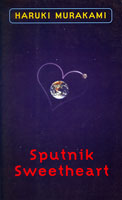 The main objection to re-reading a book is that there’s no point because you know what’s going to happen. But, to me, knowing what’s going to happen not only doesn’t matter, it actually makes it better. Exposed to stories as much as we are, we’ve all developed enough of a “story sense” to second-guess where a story is going anyway, and the real pleasure of a twist-in-the-tale is not so much the twist itself, as how skilfully it’s handled. My two most recent re-reads are both minor books by favourite authors — Sputnik Sweetheart by Haruki Murakami, and The Violet Apple by David Lindsay. The first time I read Sputnik Sweetheart was when I’d just discovered Murakami. At the time, I’d only read his massive (genuinely tome-like) The Wind-Up Bird Chronicle, and in comparison found the slim Sputnik Sweetheart a bit disappointing, though with a strikingly weird bit in the middle (where a young woman gets stuck at the top of a Ferris wheel for the night and has an experience that turns her hair completely white), mainly because I wasn’t sure how to understand the end. Re-reading it, knowing how it ended, everything fell into place and made sense, and I had time to relax and understand other things about the book, like how each of the three main characters faces the same sort of strange crisis, but one evades it, one falls before it, and one — maybe — triumphs. With The Violet Apple, I found that knowing what was going to happen at the end only made the build-up much more poignant and emotionally powerful. (That’s how tragedy always works. Macbeth’s downfall was only a surprise for Macbeth himself.)
 To end off, a not-necessarily-complete list of books I’ve read four times or more (with no explanations or apologies — though, to intensify my weirdness, I’ll say that at least two in this list are books I’ve re-read straightaway after reading them for the first time): Moving Zen by C W Nicol, The Belgariad by David Eddings, A Voyage to Arcturus by David Lindsay, The Outsider by Colin Wilson, The Tombs of Atuan by Ursula Le Guin, Steppenwolf by Hermann Hesse, The Influence by Ramsey Campbell, The Drowned World by J G Ballard, V for Vendetta by Alan Moore & David Lloyd… Not to mention the countless short stories I’ve re-read many more times than four or five. Short stories are, after all, so much more re-readable. But simply reading short stories nowadays is enough to commit you to a very dark and dingy corner of the asylum reserved for book-readers. Catch you re-reading the things, and they throw away the key. Before you eat it, or do yourself an injury with it or something.
 I read Bret Easton Ellis’s American Psycho without being aware of any of the controversy surrounding its release. My reaction to it was similar to how I felt about J G Ballard’s Crash: an incredible writerly achievement, but not a book I was ever likely to re-read, not just because of the extreme subject matter, but because neither book had enough story to justify its length. (I think Ballard happily admits Crash was a short story extended to novel length, as a sort of balance to the novel-squashed-into-a-short-story approach of his “condensed novels” from The Atrocity Exhibition.) Of the two, I enjoyed American Psycho slightly more, as there were brief hints of real human despair in the isolation of its protagonist, despite the fact he was a monstrous serial killer. It also had its funny moments, which can’t exactly be said of Crash.