The Possessors by John Christopher

SYLE Press edition

If the “cosy catastrophe” is the archetypal post-WWII English SF story, surely the quiet invasion comes a close second (The Midwich Cuckoos or Quatermass II being prime examples). They’re quiet because they either occur in an isolated location (a cut off village in Cuckoos) or by hiding in plain sight (an industrial processing plant in Quatermass II). John Christopher’s The Possessors (first published in 1965) is of the former type, being set in a ski-chalet high in the Swiss Alps, which is further isolated from its nearest village when an avalanche blocks the one mountain road leading to it.

At first, the holidaymakers (all Brits, having chosen this chalet for the English-American couple who run it) continue as normal, expecting the pass to be cleared in a couple of days. They’re a hung-up bunch, many of them recovering (or not recovering) from a variety of losses: Jane Winchmore is a widow in her thirties, Douglas Poole is on the rebound from an abruptly ended affair, while hostess Mandy Hamilton left the three children from her first marriage behind in America. Others have clear compromises or unbalances in their relationships: plastic surgeon Selby Grainger is the eternal dallier-with-women, while his wife, the cooly beautiful Elizabeth, puts up with it, confident he won’t actually leave her, and Ruth Deeping clearly favours her younger son Andy over ten-year-old Stephen, whom she constantly nags. Perhaps the only fully happy one of the bunch, in fact, is eight-year-old Andy, so beloved by his mother, which is perhaps why he’s the first victim of the alien invasion. Thinking he’s found a glowing blue ball in the snow, he touches it and instantly drops to the ground. Selby declares him dead, and he’s put in a makeshift coffin in the cellar—only for him to get up and leave the chalet sometime in the night. Everyone joins in the search, though only his mother, Ruth, has any faith that a boy in so few clothes and no shoes can survive for any length of time in the snow. But he does return—only, not quite himself. Significantly colder to the touch and slightly less human, he has (as we, the readers, know from the book’s opening section) been taken over by an alien spore, flung out from its dying home planet millions of years ago, which landed by chance on the Earth and was uncovered by the recent avalanche.

US edition from 1964, cover by Paul Bacon

The alien—symbiotic or parasitic, depending on whether you take its point of view or ours—needs to isolate the humans, one by one, so as to infect them. And of course the humans take a long time working out what’s happening, speculating first of all that it’s some new kind of illness, or an infectious mass hysteria, or even demonic possession. And all the time, the survivors are becoming increasingly besieged in the chalet, boarding themselves up against the possessors trying to get in, get them alone, and take them over.

For most of the book the story is driven by suspense and the increasing tensions between the already flawed characters. In this, there’s an obvious contrast to be drawn between the aliens (who work effortlessly together, and tempt in at least one character with the promise of an end to human struggles) and the humans, whose only working relationships are those founded on long-held compromises. Chalet owner George Hamilton, for instance, is a good husband to his wife Mandy because he ignores the bottles of gin she’s got stashed about the place, and is pretty much an alcoholic himself. (There’s a lot of drinking in the book. Interviewed in a special issue of Interzone, Sam Youd—the real name of John Christopher, and meant to rhyme with “cloud”, apparently—admitted: “It’s the way I live, yes, I do drink alcohol, and quite a bit of alcohol, though only wine…” Though it seems to have been pretty much part of the times anyway.)

1965 edition

It’s hard not to compare Christopher with his contemporary John Wyndham, both of whom were the face of general-readership SF in Britain at the time. Christopher’s characters are much more evidently flawed, and come with a greater dose of cynicism about human relationships, a sense that there can never be anything more than a “total failure of comprehension” between people. Offered the slightest sign of sympathy for her widowhood, young Jane just wants to escape, and instantly regrets it the one time she shares her feelings of despair with someone else. The sense is that isolation and compromise are built-in to the human condition, whereas the characters in, say, Day of the Triffids, though they have to overcome external difficulties and the occasional dangerous human, will eventually find some sense of community, even family, in the end. For Wyndham, decency is a struggle but a worthwhile one; for Christopher it feels, at times, like a lost cause.

But there are resonances with other SF-horror, too. The most obvious to me was The Thing, for its icy setting and its alien that takes on human form, but also for its sense that if the invasion isn’t stopped here, the whole of the human race is at risk: “there can be no question of toleration between it and us. We have to wipe it out, if we are not going to be assimilated by it.” Invasion of the Body Snatchers is another, as is one of my favourite Doctor Who serials, The Horror of Fang Rock (where, as here, the isolation is prolonged by a lingering thick fog).
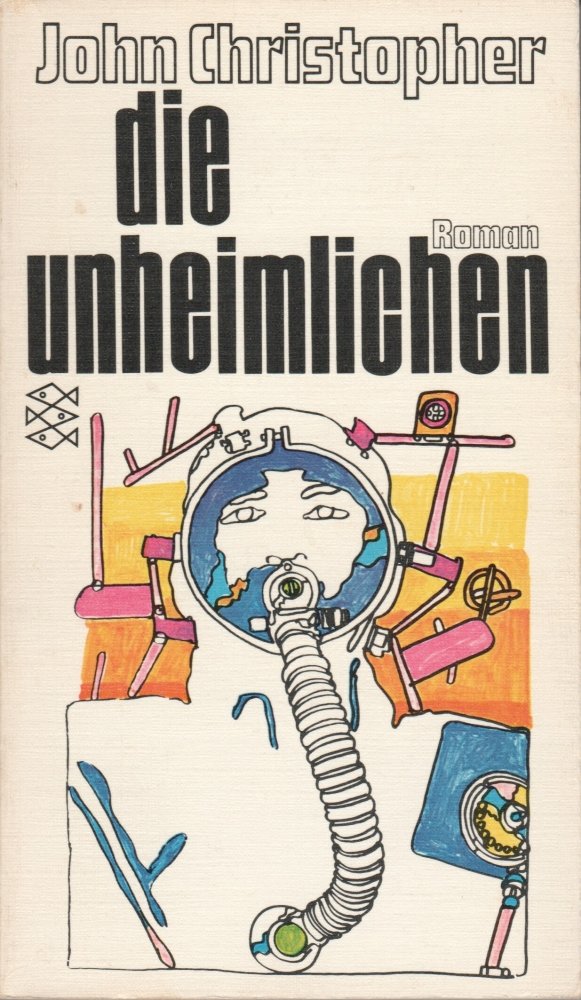
1970 German edition, art by Hans Mainer

It’s certainly a suspenseful read, and I’m surprised it hasn’t been filmed (it was optioned, apparently), because it could surely be made on a reasonable budget. (Special effects: one glowing blue sphere.) It perhaps has less of the weird feeling I might have liked—I’d have preferred more of what seems to be promised by the German translation of the book, titled Die Unheimlichen (“The Uncanny Ones”). This is far more of an adventure/disaster tale (and the cast of flawed characters, each with their cross to bear, recalls the set-up to so many 70s disaster movies), and a successful one, at that. I’d definitely like to read more by Christopher. I’ve been meaning to read The Tripods since around the end of the 1970s…

^TOP

The Death of Grass by John Christopher

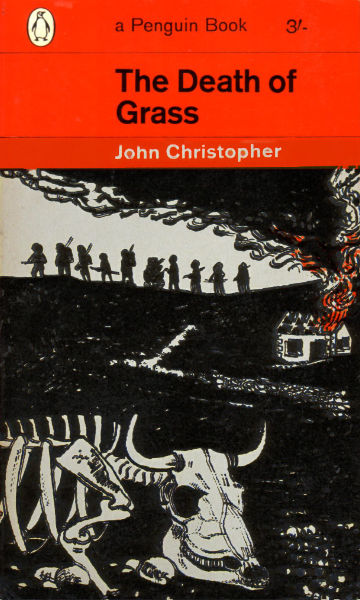
John Christopher’s Death of Grass (published 1956) came out five years after John Wyndham’s Day of the Triffids. Both are about how the precariousness of modern life can so easily give way to a tooth-and-claw battle for survival when civilisation breaks down. Christopher’s chosen disaster — a virus that destroys all grass-related plants, including wheat, rye, barley, oats and rice, and which soon threatens the world with starvation — isn’t as instantaneous as Wyndham’s, but that’s only to give its English characters a brief chance to look on in combined pity and superiority as China, where the virus originates, descends into chaos. As the virus spreads, the Brits tighten their belts and roll their eyes at the thought of going back to war-time rationing, sure they’ll handle the situation with the same dignity:

“Yet again,” a correspondent wrote to the Daily Telegraph, “it falls to the British peoples to set an example to the world in the staunch and steadfast bearing of their misfortunes. Things may grow darker yet, but that patience and fortitude is something we know will not fail.”

But when our hero, John Custance, learns the government’s latest efforts to combat the virus aren’t working, he, his family, and a small but growing band of taggers-along, head for his brother’s farm in the north. Situated in a narrow-entranced valley, it should be easy to defend as the country goes feral — as long as they can get there in one piece.

They certainly can’t do so peacefully. Leaving London, they’re faced with a military roadblock. By this point, Custance is convinced the government are planning to drop hydrogen bombs on the major cities, including London, to bring the population down to the sort of levels that can be maintained with new levels of food production, so he knows it’s a matter of kill or be killed. This close to WWII, Custance is the sort of man who has had some experience of this:

He brought the rifle up and tried to hold it steady. At any fraction of a second, he must crook his finger and kill this man, unknown, innocent. He had killed in the war, but never from such close range, and never a fellow-countryman. Sweat seemed to stream on his forehead; he was afraid of it blinding his eyes, but dared not risk disturbing his aim to wipe it off. Clay-pipes at a fairground, he thought – a clay-pipe that must be shattered, for Ann, for Mary and Davey. His throat was dry.

The most significant addition to Custance’s group is Pirrie, an older man whom they encounter when they try to first buy, then rob, guns for their trip up north. After the robbery fails, they explain what they know and Pirrie agrees to provide them with guns in exchange for him and his wife being able to come along. He proves to be a crack shot, and soon becomes their most valuable asset. He is also quite ready to take advantage of the new lawlessness to his own advantage — not to the point of betraying the group, but certainly in getting his own, sometimes brutal, way. His pragmatism quickly becomes the embodiment of what this new world is going to be like. John Custance comes to rely on, and trust him, more and more.

There’s an uneasy air of compliance, in the book, in Custance’s shift from civilised man to survivalist leader. Perhaps because we started it off by taking his side — he was the reasonably-sounding, civilised one in the early chapters, as opposed to his friend Roger’s pessimism — but as we rarely get to see inside his head, we don’t witness the inner moments when he gives in to the way the world is going to be. We just see his actions getting darker and darker. At times it’s hard to tell if Custance is taking a certain pride, or grim satisfaction when, for instance, he finds his children being that much more obedient to him — and the women too — now he’s taken on the role of leader of a band of survivalists.

So, it’s an uneasy book. But, of course, it’s meant to be.

Day of the Triffids was far more about the ecological disaster, the loneliness of the survivors, and the many different types of challenges they’d have to face in order to survive. Although it addresses the same sort of moral issues as Christopher’s book, Christopher’s is more wholly, and brutally, about the moral issues alone. In Death of Grass, there’s no real concern for the idea of trying to preserve civilisation, or mourning its loss, just a cold looking on as it dies. As Roger says, “We’re in a new era… Or a very old one…” and everyone seems quite happy, after an initial inner tussle, to take that as read and join in:

“It’s force that counts now. Anybody who doesn’t understand that has got as much chance as a rabbit in a cage full of ferrets.”

It’s easy to see Christopher’s characters as the sort Wyndham’s might meet, try to talk to, and quickly need to escape from. Wyndham had no illusions about the depths human beings could sink to, but he did believe that some might (successfully) choose not to sink all the way — which is, after all, the basis of civilisation. Christopher’s book doesn’t really debate the point. The pragmatists are the most eloquent, and they are the ones with the guns. They survive, but we do, at the end, get to see some of the cost of that survival. (It should also be said that Christopher’s characters suffer more than Wyndham’s. Not only do they kill others, but two of the women are, early on, kidnapped and raped, something that Wyndham would never have included in a book. It’s not dwelt upon, but it certainly sets a grim tone for the mental state the group falls into.)

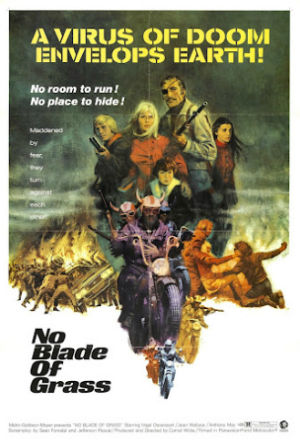
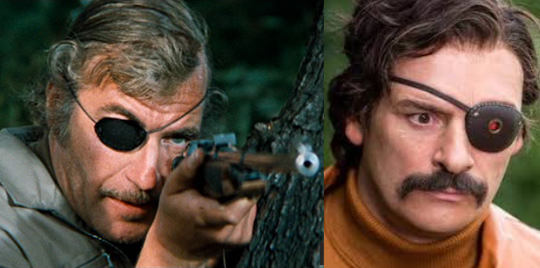
There was a 1970 film adaptation, named No Blade of Grass (after the US retitling of the novel), which is mostly faithful, and fits in neatly with the 70s fascination with ecological disasters and survival scenarios. The smaller cast changes the dynamics of the group, even improving on Christopher’s plot at one point, when Pirrie (here a younger rather than an older man) chooses Custance’s daughter Mary to replace his wife (instead of, in the book, another young woman picked up on the way), which makes Custance’s acquiescence all the more damning — or it would, if only Custance (played by Nigel Davenport) wasn’t so stolid and matter-of-fact throughout the film. The whole mood of the film really depends on how Custance is portrayed, and Davenport doesn’t bring the slightest hint of moral doubt to the role. The group might as well be out for a country stroll, for all the horrors (made all the more horrific by being depicted in lurid 70s fashion) they meet with, and perpetrate. (It doesn’t help that, with his eyepatch, jacket, and moustache, he’s the mirror image of Julian Barrett’s 80s action-star parody Mindhorn.) Plus, there’s a rather silly stand-off near the end with a motorcycle gang, who seem to be there simply to use up the film’s stunt budget. You can see its trailer at Trailers from Hell.

Nigel Davenport’s Custance, Julian Barrett’s Mindhorn

^TOP