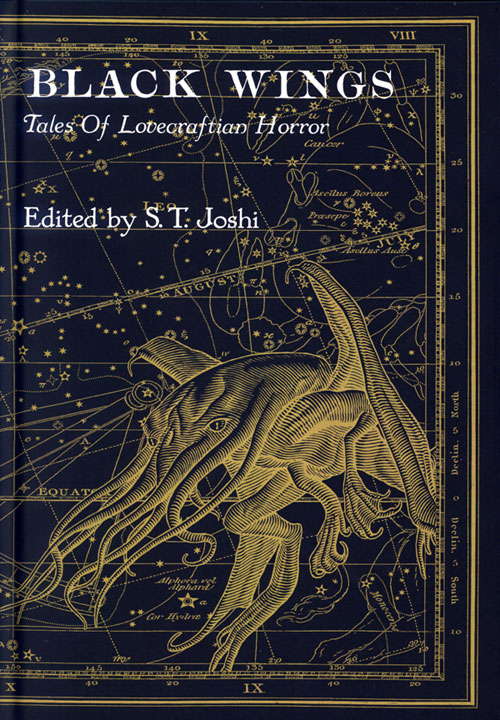
What is “Lovecraftian horror”? Lovecraft scholar S T Joshi’s new anthology from PS Publishing, Black Wings, attempts to answer the question by offering 21 examples of the form, plus a quote from the master himself (from which the title of the anthology derives):
“The one test of the really weird is simply this — whether or not there be excited in the reader a profound sense of dread, and of contact with unknown spheres and powers; a subtle attitude of awed listening, as if for the beating of black wings or the scratching of outside shapes and entities on the known universe’s utmost rim.” — from “Supernatural Horror in Literature”
 But you always have to be wary when dealing with a writer’s own definition of their chosen genre. It’s certainly not the same as a critic’s definition, because a writer will be trying to encapsulate what they are aiming for when they write, not to provide an objective summing up that can be applied to all authors working in that genre. Even when the writer in question is moonlighting as a critic — as Lovecraft was when he wrote “Supernatural Horror in Literature” — he’s still being led on a leash by his muse. What Lovecraft was really defining in the above quote wasn’t weird fiction but Lovecraftian horror — or to be properly pedantic (because any reader who responds to Lovecraft’s fiction has a right to form their own idea of what works in it and what doesn’t) it is Lovecraft’s idea of Lovecraftian horror. All this is just a preface to saying that answers to the question “What is Lovecraftian horror?” can only ever be subjective, and I’m sure no two readers of Black Wings will come up with the same list of which stories in the anthology they think ought to be called Lovecraftian and which don’t.
Nevertheless, it’s interesting to see what Joshi’s chosen writers made of the term. It was, I assume, deliberately selected as not “Cthulhu Mythos fiction”, and it’d be interesting to know what Joshi’s brief to his authors was. He certainly didn’t say “No mythos fiction!” because some of the stories collected in the book are mythos stories. Perhaps it was simply down to the selection of writers with taste that meant there were no lists of Eldritch Entities’ names, nor effusions of Necronomicons, scattered like yesterday’s bestsellers amongst the libraries of occultists the world over. (“Oh, you have a first edition arabic text, too?”) The Cthulhu Mythos had its origins in two factors: one was Lovecraft’s attempt to realise his fictional ideal, the other was as a name-swapping game for a group of jobbing writers. And, let’s face it, it’s really only the first factor that we, as readers, want more of. The second is just a bit of fun.
So, what is Lovecraftian horror? To judge by the content of Black Wings, here are a few possible answers:
Cthulhu Mythos stories. Of course. The best Cthulhu Mythos tales, after Lovecraft’s own are, for me anyway, the subtlest in declaring their allegiance. Here, there are plenty whose reticence means you could shoehorn them into the mythos if you wanted to — identifying this or that glutinous god with one of Lovecraft’s entities — but that would be beside the point. Michael Shea’s “Copping Squid”, though, has its feet firmly placed in the Mythos camp — it’s one of the few tales in the book to mention a Lovecraftian entity by name — but provides an essentially modern twist on Lovecraft’s approach. One of the things that, I think, Lovecraft would never have done, is admitted the desirability of actually embracing the nihilism represented by Cthulhu, Azathoth, and so on — for him, that direction lead to nothing but madness and death. The aestheticisation of horror — turning it into something the protagonist wants to become part of — was something that had to wait for the likes of Clive Barker and Thomas Ligotti. It still ends in madness and death, of course, but in the hands of those writers, that’s not necessarily presented as a bad thing. Shea’s story is closer to this approach, and it certainly worked for me.
Stories featuring other (non-Mythos) characters from Lovecraft’s fiction. Three in Black Wings make reference to Pickman, none of which necessarily end up as Cthulhu Mythos stories. Caitlín R Kiernan’s “Pickman’s Other Model (1929)” is the most directly a sequel to Lovecraft’s original, whereas W H Pugmire’s “Inhabitants of Wraithwood” makes the most subtle use of Pickman while still making him (or his art) central to the plot. My favourite of the three, though, is Brian Stableford’s “The Truth About Pickman”, which manages to be at once a scientific explanation of the horrors of Lovecraft’s original tale, and an effective horror on its own. Unlike the Ann Radcliffe school of Gothic (and Scooby Doo), where all the fantastical elements are explained away at the end, in this case the explanation doesn’t detract from the horror, but rather gives it a straitening twist.
Stories featuring Lovecraft as a character. There’s surprisingly little of this in Black Wings, considering how readily Lovecraft’s personality and biography lend themselves to fictionalisation, and how many people (ahem) have used him in this way. In two stories, we have Lovecraft as a ghost, dream, or hallucination, but my favourite to brush up against Lovecraft the person was Ramsey Campbell’s “The Correspondence of Thaddeus Nash”. I love Campbell’s writing anyway, but it’s always nice to be surprised by an author into liking them even more. Here, Campbell presents a tale for Lovecraftians, written in a form Lovecraftians will be familiar with: the collection of letters, in this case those of one Thaddeus Nash, addressed to the Old Gent from Providence himself. On the way towards telling a suitably vastating horror tale, Campbell’s Thaddeus Nash has a few snipes at Lovecraft’s writing, so this story manages to raise a smile as well as a shudder.
Stories about people who have a strong relationship with Lovecraft’s fiction. Sam Gafford’s “Passing Spirits” was the most affecting tale in the book, for me, and the one I’d least want to describe as horrific, even though its subject matter is certainly dark. A man dying of a brain tumour starts hallucinating Lovecraft, and various characters from his writings. The contrast between Lovecraft’s pulpy horrors and the real-life horror of dying from a terminal illness was powerful in a much more than horrific way. Gafford’s tale even ends with the traditional Lovecraftian climax, but transcends the mere imitation of a narrative device by turning Lovecraft’s crescendoes of horror into a kind of redemptive attainment of meaning in the face of death. Definitely one of the stories that will stay with me.
 Stories doing what Lovecraft did, but without explicit reference to the Mythos. These, to me, were among my least favourites in Black Wings, but it would be unfair to blame them for not meeting my expectations. But I felt that, generally, those stories that were about vastly powerful but hidden monsters, lurking behind the paper-thin veil of human ignorance, then making a brief appearance only to submerge once again — always with the threat that they are at any moment going to come back and wipe us all out with the flick of a tentacle — weren’t doing anything Lovecraft hadn’t already done, and done much better, and moved on from. Having said that, one of my favourites in the book — “The Broadsword” by Laird Barron — might just as easily fall under the same description. The main difference between Barron’s tale and the ones that failed to grip me was down to how he presented the horrors. (I actually found Barron’s tale, perhaps thanks to its build-up of mundane detail, the scariest in the book — and not in a pleasantly scary way, it really did scare me!) “The Broadsword”s horror elements had that weird irrationality you find in, for instance, tales of alien abduction — surreal as much as frightening — and this, for me, gave them the necessarily unbalancing twist that separated them from the more traditional Mythos approach of merely trying to convince you it’s all real. Here, the weirdness of the horror was powerful enough, without any need for realism.
Stories about dreams. This tends to be an overlooked area of Lovecraft’s fiction — it gets swept into the dustpan of Dunsany’s influence, and it’s all too easy to think of these tales as not really being Lovecraftian at all. But dreams pervade Lovecraft’s non-Dunsanian fiction, too — “The Call of Cthulhu” starts off being about dreams, of course, but even something like “The Shadow Out of Time”, with its transportation of the mind into another time (and body), and its final nightmare journey through a subterranean ruined city, owes so much to the peculiarities of the experience of dreaming. Darrell Schweitzer’s “Howling in the Dark” was, I think, the story to get closest to Lovecraft’s blending of the laws of dreams to the laws of reality, and the way that dreams, for Lovecraft, could be at once greatly desired and greatly feared. The case could be made for “Howling” being a Mythos tale, but I think its Lovecraftian roots are just as close to those stories which exist on the borderlands of Dunsany’s influence, such as “The Other Gods”. I tend not to like tales about dreams — all too often it’s an easy way for the writer to be surreal without being meaningful — but Schweitzer’s was one of the more powerful stories in Black Wings, and all the more so because it surprised me into liking it.
Others. Some of the tales are less obviously Lovecraftian. In a way, as Lovecraft’s own experiments with horror, the weird and macabre, covered so much ground, and as Lovecraft is such a pervasive influence on all 20th Century horror — indeed, his contribution may be said to be the defining element that separated 20th century horror from what came before — any piece of weird, horrific, or macabre fiction could be called, to some degree, Lovecraftian, barring a pastiche Victorian ghost story. There were a few stories in Black Wings whose Lovecraftianism wasn’t obvious to me. They might well have worked had I read them elsewhere, but as I was expecting a Lovecraftian element, I tended to finish them feeling a little let down. But, as I say, that’s all down to my own personal definition of what “Lovecraftian horror” might be, and how it differs from that of the contributors to Black Wings. Overall, there were definitely more hits than misses.
Lovecraft is certainly a phenomenon in 20th and 21st century literature. There aren’t many writers you can imagine inspiring this sort of anthology. I could picture a Borgesian anthology (and Borges himself could have contributed his “There Are More Things” to Black Wings), or a Kafkan anthology, but what others? What other body of writings could be built on in this way, without resorting to mere imitation? And, more importantly, would anyone buy them? They certainly will buy this Lovecraftian volume, and I very much doubt anyone who does so will be disappointed.
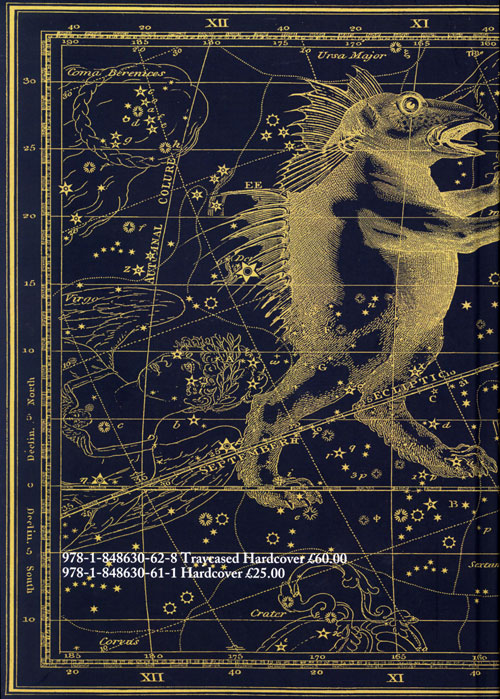
Only one more thing needs to be said — that cover (by Jason Van Hollander, whose story “Susie” rounds off the book) is worth the cover price alone. Now that is Lovecraftian art!
GOD SAVE THE KING!

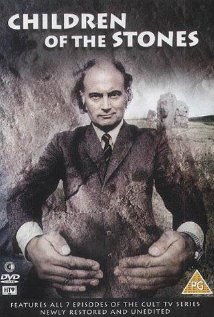 Oops, a bit more 70s TV. This 1977 series belongs to that subgenre of horror/science fiction stories (which includes John Wyndham’s The Midwich Cuckoos, Ramsey Campbell’s The Hungry Moon, and the Jon Pertwee Doctor Who story The Daemons) in which a village is isolated by a magical barrier, so that some evil/alien force can gather its strength before moving on to take over the rest of the world. With Children of the Stones, the evil force is, oddly enough, happiness; those villagers affected greet each other with a “Happy Day”, know what each other is thinking, and tend to be inordinately good at maths. But of course the reason this happiness is evil is that it’s one man’s idea of happiness, imposed on its subjects without their consent.