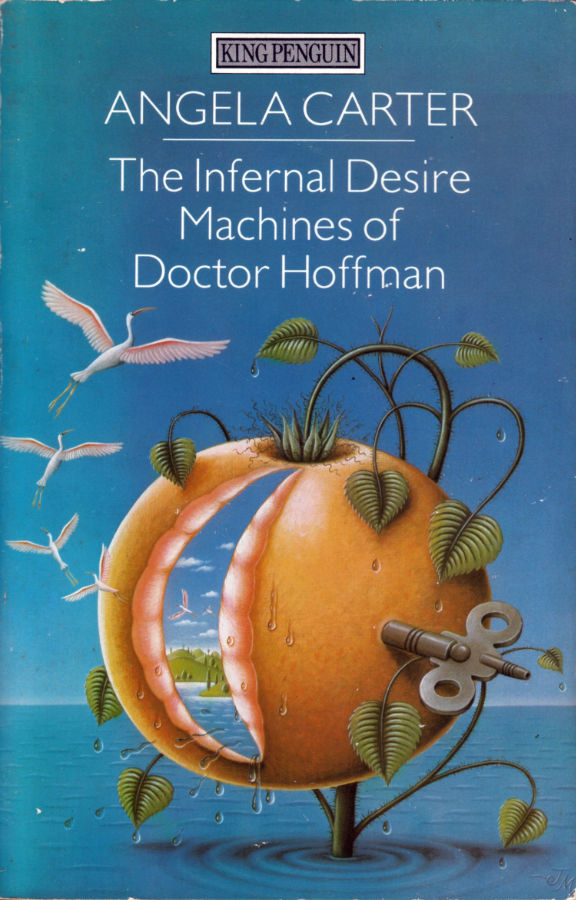
1987 PB art by James Marsh
Begun while Carter was still living in Japan, and first published in 1972 (after her return to the UK), The Infernal Desire Machines of Doctor Hoffman is Carter’s most outrightly fantastic novel, and deservedly finds a place in Moorcock & Cawthorn’s Fantasy: The 100 Best Books and David Pringle’s Modern Fantasy: The Hundred Best Novels. (It was retitled The War on Dreams in the US.)
It begins in an unnamed city in an unnamed South American country. The narrator is Desiderio (“the desired one”), writing the memoir of his young life, when he was branded a hero for his role in ending the war that Doctor Hoffman launched upon the people of that unnamed city—and upon reality itself. Hoffman’s assaults warp time, space, and reason, causing people to sprout peacock feathers, warehouses to turn into palaces, and apparitions of the dead to appear. As Desiderio writes: “in the early days of the war, life itself had become nothing but a complex labyrinth and everything that could possibly exist, did so… the city was no longer the conscious production of humanity; it had become the arbitrary realm of dream.”
The Minister for Determination (to whom Desiderio is private secretary), constitutionally resistant to unreality (he’s convinced Hoffman has released a virus “which causes a cancer of the mind, so that the cells of the imagination run wild”) attempts to counter this encroachment of dream with a series of futile measures, from the use of radar to the use of torture as a means of forcing the unreal to differentiate itself from the real. Sensing they’re losing the war, the Minister gives Desiderio a secret mission: to find and assassinate the elusive Doctor Hoffman.
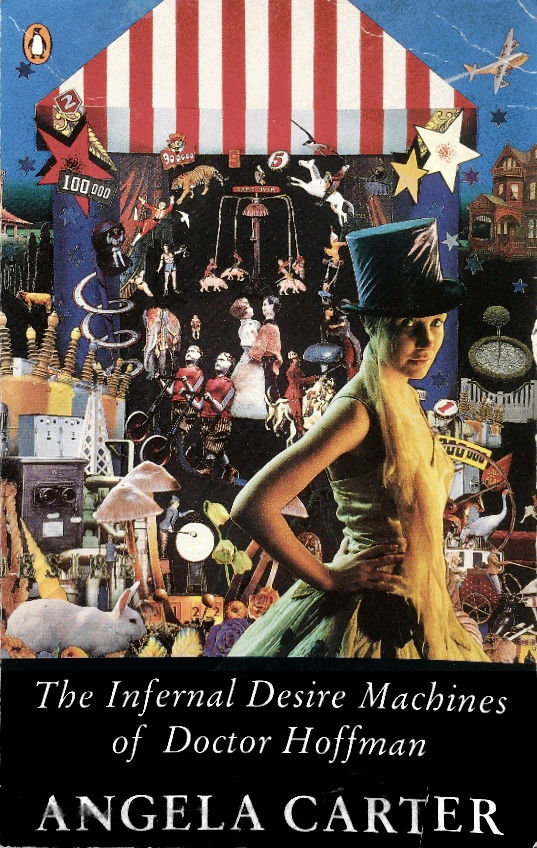
1990 PB, cover art by Andrew Wyatt
Desiderio leaves the city for the town of S, where the proprietor of a travelling peepshow is rumoured to be one of Hoffman’s disciples. Thus begins a series of picaresque adventures that see our young hero living with the native river people (with whom he, having part native parentage, seamlessly blends), working with a circus, travelling with a monstrous libertine known as the Count, stranded with a tribe on the coast of Africa and, finally, dwelling amongst a community of centaurs—before finally arriving at the “Wagnerian castle” of Doctor Hoffman. Throughout, Desiderio is haunted by, and often accompanied by (in a series of disguises he always sees through) Hoffman’s beautiful daughter Albertina, with whom he has, of course, fallen in love.
Just as Heroes and Villains was about the conflict between desire and need, this novel is about the conflict between dream and reason, or desire and reality. At first it seems the Minister (“not a man but a theorem, clear, hard, unified and harmonious”, who “had never in all his life felt the slightest quiver of empirical uncertainty”) represents reality and Doctor Hoffman dream, but when we finally meet Hoffman, he is an equally unimaginative patriarch (“cold, grey, still and fathomless—not a man; the sea”, who “had examined the world by the light of the intellect alone”). Both form a type with other such controlling paternal figures (which includes Doctor Donnelly from Heroes and Villains and Uncle Philip from The Magic Toyshop—what Lorna Sage, in her Writers and their Work volume on Carter, calls “Carter’s puppet-masters”). Contemplating Hoffman, this supposed unleasher of dreams, in all his disappointing rationality, Desiderio writes: “I did not think he knew what desire was.” (And, he muses, perhaps of Carter’s work as a whole: “Were all the potential masters the world held for me to be revealed as nothing but monsters or charlatans or wraiths?”)
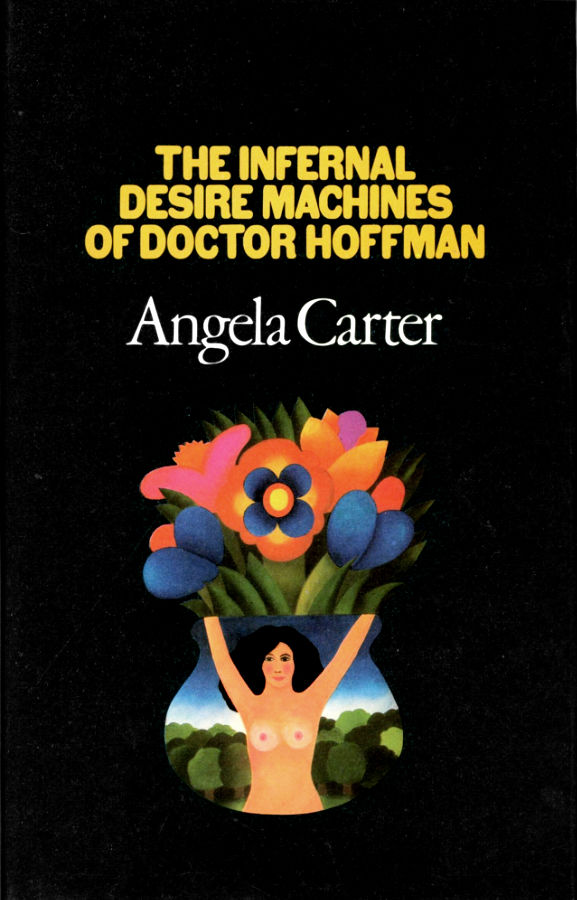
1972 HB, art by Martin Leman
If these are the dark fathers, balancing maternal figures seem absent—Desiderio’s mother was a prostitute who left him to be raised by nuns, Albertina’s mother (Hoffman’s wife) is dead (though she was, at least, a poet). Rather, the presiding maternal force is even more implacable and desire-less than those two male figures: mother nature, at her most arbitrary and indifferent. When the entire circus with which Desiderio has been travelling is killed in a freak natural event, he notes that “the landslide could only be a simple assertion of the dominance of nature herself”. On the coast of Africa (later revealed to be a fantastic coast, and an emanation of the monstrous Count’s desire for self-destruction), Desiderio meets a people who represent “Man in his constitutionally vicious, instinctively evil and studiously ferocious form—in a word, in the closest possible harmony with the natural world”. Mother nature, then, is no refuge from dark puppet-master fathers.
Desire and dream come across as perhaps the only humanising elements in a world otherwise caught between the polarities of cold intellect and a starkly uncaring nature. But even then, desire in The Infernal Desire Machines of Doctor Hoffman is no romantic fantasy. In Carter’s hands, it’s full of casual brutality, tragedy and the darker extremes of perversity. Desiderio’s story takes him through a series of episodes, in each of which he enters a period of narrative stasis, where he lingers among a group of people and experiences their way of life. When he’s with the river-people, we get a disquisition on their beliefs and customs (outwardly placid, they prove to include cannibalism and paedophilia); we learn the histories and nature of the various people who make up the circus, some poignant (as with Madame la Barbe, whose beardedness raised her from being an ordinary girl to being “immensely handsome, widely travelled”, but, nevertheless, “the loneliest woman in the world”) others grotesque (the all-male troupe known as the Acrobats of Desire, who are capable of exchanging body parts with one another, and who gang-rape Desiderio). As far as trigger warnings go, this novel should come with a submachine gun logo on the cover.
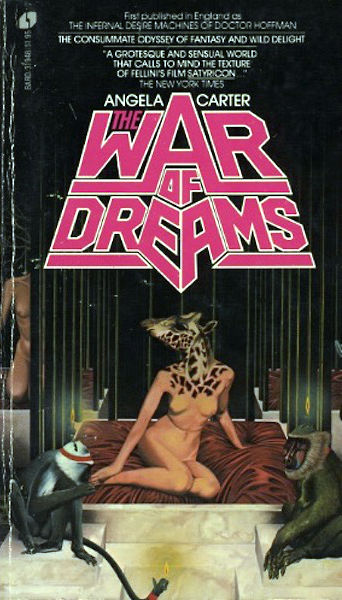
1977 US PB, art by Peter Goodfellow
Perhaps the most notable episode is that of the Count, a figure I can’t help feeling is based on de Sade (and Carter would go on to write a study of de Sade a few years after The Infernal Desire Machines). So incredibly self-centred he never seems to speak to anyone but himself, the Count is “a connoisseur of catastrophe”, “a blasphemous libertine, a blood-thirsty debauchee”, who claims to have “devoted my life to the humiliation and exaltation of the flesh”. Perhaps it’s characteristic of all the male “father” figures in the novel that Desiderio at one point thinks the Count might be the Minister, then later that he might be Doctor Hoffman…
The Infernal Desire Machines has been called a Surrealist novel, but I think that though Hoffman’s efforts are creating a surrealist reality, the novel doesn’t have Surrealist fiction’s lack of narrative coherence. Carter isn’t just letting “psychic automatism” (as the Surrealists have it) take over; rather, her narrative is a balance between the strange images of Surrealism and a conscious engagement with the more nebulous forces of the human condition: desire, dream, imagination, cold reason. Unlike pure Surrealism, it comes with thought applied.
Set as it is in South America, it naturally feels as though it might be called Magical Realism, but I think it’s one of those novels that absorbs so many genre labels—Gothic, Fantastica, Picaresque—without entirely belonging to any of them. (It’s tempting to read the “War on Reason” as sourced in the same media-frenzied, accelerated 1960s as Ballard addressed in The Atrocity Exhibition. But Carter isn’t presenting a dystopia, here. Hers is a world in constant conflict, though the feeling is not of warning about how things might become, it’s about how, for her, the world simply is.)
Carter is generous with her references, and has obviously absorbed a lot of imaginative literature and cinema—far more than would have been admitted in your standard English literary novel of the day: The Cabinet of Dr Caligari and Rotwang’s laboratory in Metropolis get a mention, as does Gulliver’s Travels and Freud. And there’s a distinct air of Kafka, de Sade, ETA Hoffmann and Borges too. There’s a certain Moorcock-ishness to the Law-versus-Chaos conflict between Reason and Dream/Desire, though it’s probably not down to influence. To my surprise, Lovecraft gets a direct quote (“the oldest and strongest emotion of mankind is fear”). And I’d even throw in the 007 films, as Hoffman’s castle, with its high-tech inner chambers, represents nothing so much as a Bond villain’s lair.
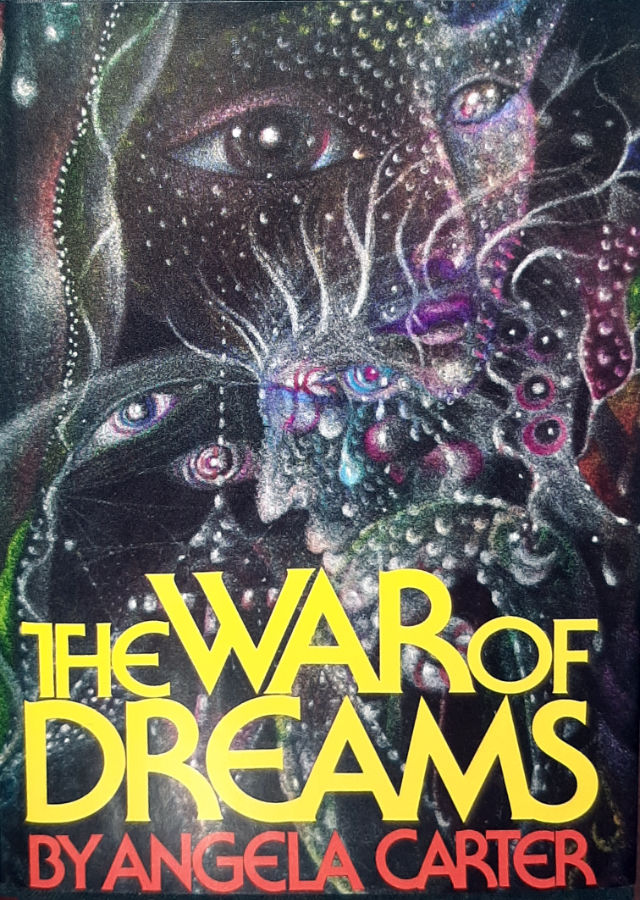
US HB, art by Linda Gardener
Me being me, I even suspected David Lindsay’s A Voyage to Arcturus might have been part of the mince fed into this particular sausage-machine, not just for their shared picaresque form which leads to a disillusioning/mind-opening revelation (which goes back at least to Apuleius’ The Golden Ass), but some specific details. For instance, shortly after meeting the monstrous Count, Desiderio says “His quality of being was more dense than that of any man I have ever met”, which instantly reminded me of Lindsay’s Spadevil, another larger-than-life figure met on the road whom the protagonist takes up with, and whose “body seemed to be composed of some substance heavier and denser than solid matter”. Later, Carter gives us a vision of nature at its most chaotically creative, mixing animal and plant forms: “nature had absolved her creations from an adherence to the formal divisions so biology and botany were quite overthrown and the only animals we saw… seemed more an ambulant vegetable than anything else.” Lindsay’s Matterplay (coming at a similar point in his novel) has a walking tree spontaneously forming from mid-air, before noting “Pure plants and pure animals by degrees disappeared, and their place was filled by singular creatures which seemed to partake of both characters.” Later still, Desiderio meets a hermaphrodite in Hoffman’s castle, with “a voice like a sexual ’cello”; Lindsay’s third-sex Leehallfae has an equally musical voice, “oddly suggestive of a mystical forest-horn, heard from a great distance.”
Throughout, Desiderio is led on by Hoffman’s Fah Lo Suee-like daughter—but is she like Muspel fire drawing Maskull on, or like Crystalman in one of his many deceptive forms? Their relationship is less fraught than that of Marianne and Jewel in Heroes and Villains—unless you read the messiness of that pairing as being externalised in all the horrors and brutality that surround them on their journey—but ultimately it ends as all such highly-strung desire must end: Desiderio tells us early on that Albertina is dead, and that he killed her, even as he loved her.
There is so much going on in The Infernal Desire Machines, it would be impossible to say it was trying to say one thing. It’s not saying desire is good or bad, or that reason is good or bad, rather it’s exaggerating both, and the conflict between them, and laying them out in all their messy, tangled complexity, with lashings of casual brutality, surreal imagery, and a lot of good writing. (My favourite line in the book is early on in the dream-beleaguered city, where Desiderio falls into “a sleep which had now become as aesthetically exhausting as Wagner”.)
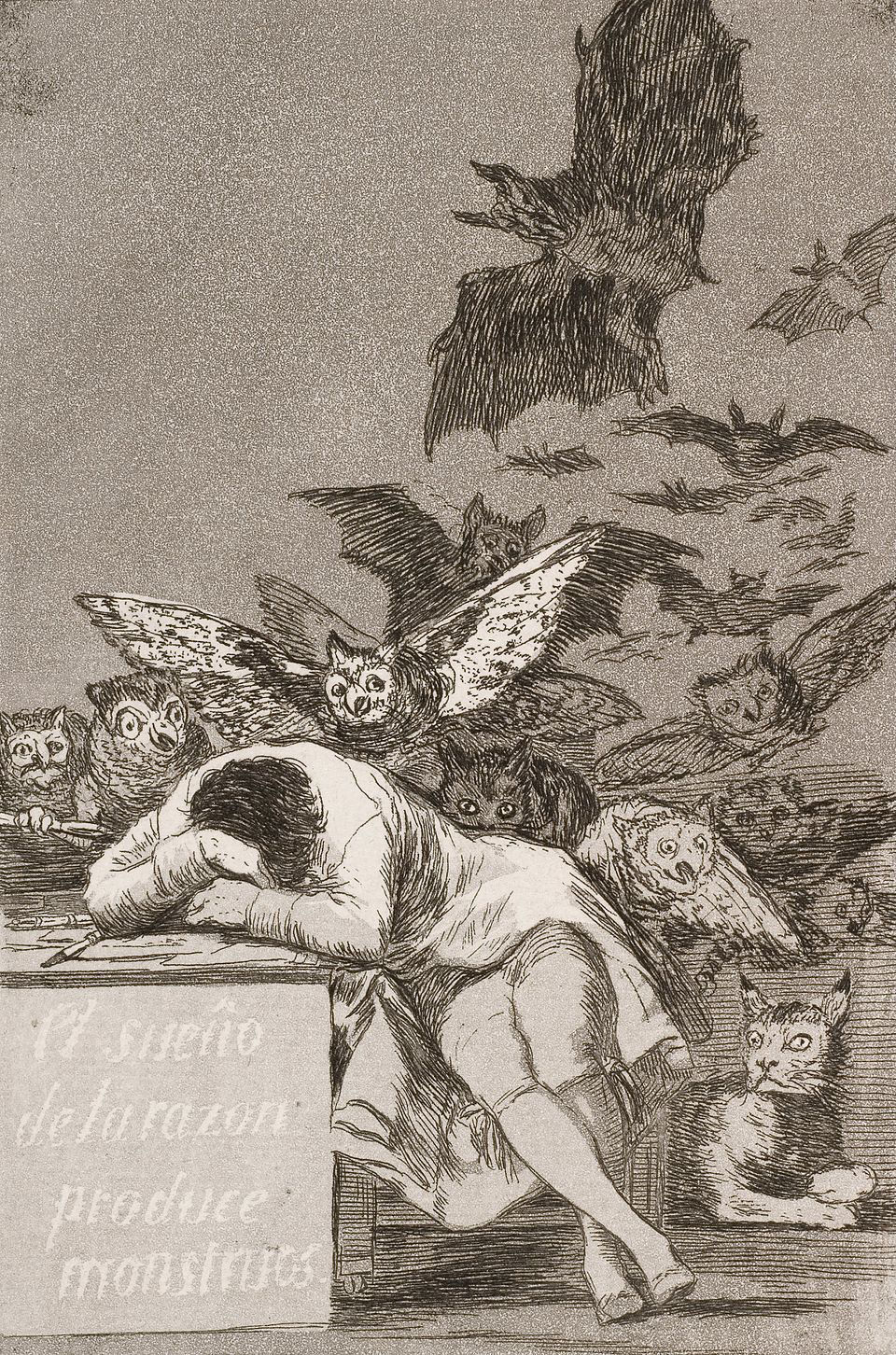
Goya, “The sleep of reason breeds monsters.”
From what I’ve read, there’s a lot more going on in The Infernal Desire Machines than I would be aware of: references to continental philosophy (are the principles of Hoffman’s philosophy to be taken as philosophy, or a satire upon such attempts to intellectualise the unintellectualisable?). At one point Albertina says: “the most monstrous aberrations are bound to flourish in soil once it has been disinfected of the imagination”, which seems the complimentary opposite of Goya’s “The sleep of reason breeds monsters.” Which is true? If both are, and the ideal is balance, then The Infernal Desire Machines of Doctor Hoffman is not a book about finding a balance. Although, as Albertina says, “Love is the synthesis of dream and actuality”, The Infernal Desire Machines itself pursues both to the point of breakage, leaving poor Desiderio old and alone, living with the memories of the desires of the past, plus a hot drink at bedtime. Perhaps “the time of actualised desire”, as he calls the invasion of the real by dream, was simply his youth.
Lorna Sage notes that The Infernal Desire Machines of Doctor Hoffman was “ignored, or treated with incomprehension and contempt, by most mainstream critics”, perhaps because the taint of the fantastic—particularly in a novel that so evidently takes a glee in its own imaginative fecundity—wasn’t generally considered acceptable at the time by the British literary establishment.
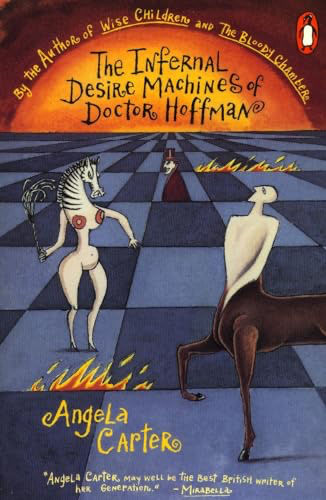
cover art by Roxanna Bikadoroff
Although I am ultimately impressed, I wasn’t always engaged by the book. When the narrative slowed to examine, at length, the lives of the river-people or the brutal centaurs, I was puzzled as to what it was doing. Maybe another read might make it fit together, but for now I have to think of such moments as sparks of imagination given free reign, jewels thrown into this bag of strange riches. It’s part of this novel’s character that it contains such a cornucopia of ideas, scenes, characters, and even longueurs.
(And the jewel image reminds me of Fritz Leiber on Clark Ashton Smith, who said Smith’s tales were “Innsmouth Jewellery; like strange ornaments, the metal elaborately inlaid and fired, studded with unknown semi-precious stones, from an unknown and timeless culture.” And Leiber, oddly, is another fantasist I found contained in Carter’s capacious novel, in the image of a night-time visitor to Desiderio’s rooms—Albertina, again, in yet another guise—a being with transparent flesh, so she appears as a “miraculous bouquet of bones”. Like the ghouls of Leiber’s Llankhmar. Had Carter read Leiber, too? Or was it just that her imagination was so wild, in this novel, it lapped on all these far shores of the fantastic?)