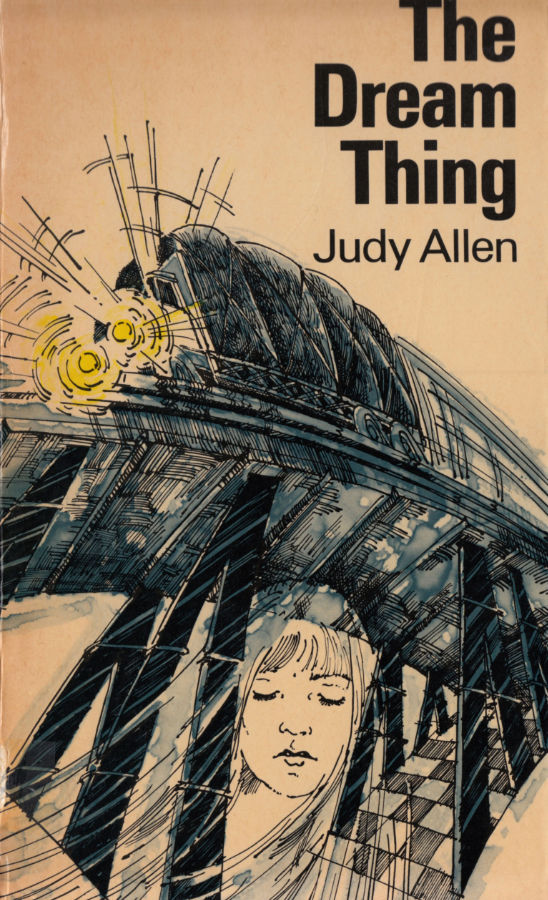
cover art by Rowan Barnes-Murphy
As the 1970s moved towards the 1980s, and as punk rock replaced prog, it seems the inner city began to replace the countryside as the standard location for YA novels. Where formerly the natural world had been the more closely associated with childhood (endless summer holidays spent mucking around in fields), the inner city, with its more evident social problems, came to seem the more authentic, or at least relevant. Judy Allen’s first two YA books, The Spring on the Mountain and The Stones of the Moon, were firmly set not just in the country, but in the Earth Mysteries-flavoured country of Janet and Colin Bord’s Mysterious Britain—stone circles, ancient tracks, Merlin, Arthur, druids and so on. With her next two YA fantasies, Lord of the Dance (1976) and The Dream Thing (1980), the action moved to the town/city, and the fantasy element was no longer ancient forces in the landscape but dreams and the inner world.
(After writing on her first two YA fantasies a while back, I was hoping to review her next book, Lord of the Dance, but it’s been impossible to find a copy. Eventually, I gave in and read the ebook version that’s currently available, only to find something odd. It was originally published in 1976, but the ebook contained references to things like CDs and horror films on home video. I looked up some reviews for the original release, and even their brief plot summaries made me realise it must have been extensively rewritten at some point, presumably in the 1980s.)
The Dream Thing starts with its teen protagonist Jen sitting down to write a school essay about what matters most to her, and realising what she’s most concerned with is hate. Some gypsies have recently moved into a patch of unused land under a nearby motorway flyover, and she wants nothing more than for them to go away. She herself is half-gypsy—her father was a gypsy, though he was killed in a fight with his cousin before he could marry her mother, and before she herself was born—and now everyone at school is taunting her about “her relatives” having moved in, and asking if she’s going to join them.
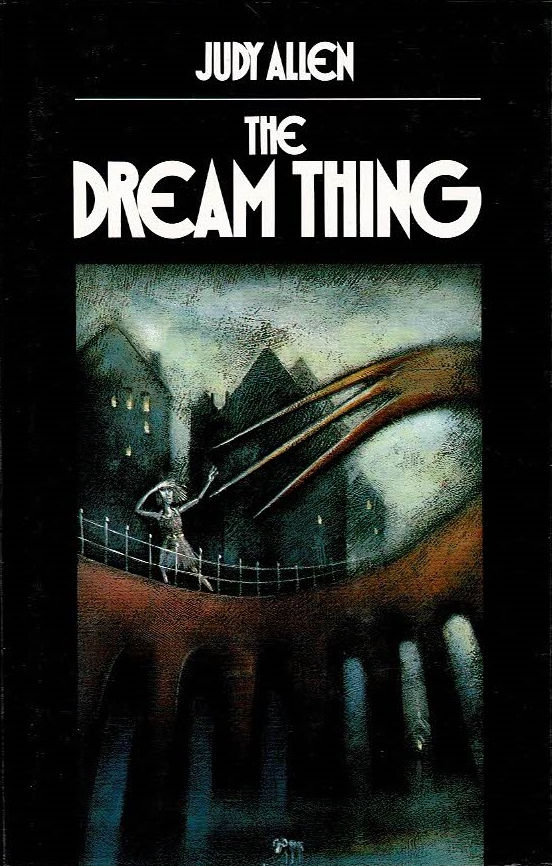
1990 reissue
She starts to have a frightening dream dominated by some monstrous thing, all sharp metal scales and a big tail spike. Convinced the gypsies (whom she early on confronts, telling them they’re not wanted round here) have put a curse on her—she also feels random sharp pains all the time, is convinced she’s going to die, and thinks she’s being followed—she draws this dream monster, in an attempt to work out what it might be. Having finished the drawing, she realises this dragon-like thing has no eye, so she puts one in, to finish it—and, like the old rabbi putting the final letter on the golem’s forehead, she feels something change, as though it has now come alive. Soon after, one of the gypsy caravans seems to have been attacked, with a large dent and suggestive scratches along its side, as though something big and rough had scraped against it.
Jen learns from her friend Tom (whose fascination with Native Americans, and his understanding of their persecution by European settlers, makes him sympathetic to the gypsies) that the land the travellers are on was bequeathed to the public over a century ago. Researching the exact wording of the bequest in the local library, she finds the land was actually given to the residents for their use, which, strictly speaking, excludes the gypsies; she brings the book to Tom’s and accidentally-on-purpose lets his parents (who are very much anti-gypsy) see it. Soon after, the police turn up in force to tell the gypsies to move on. They can’t immediately—one of them has recently given birth—so they’re given a week. Jen, weirdly open and honest about her dislike of them, takes the opportunity to let the head gypsy know that she was the one who provided the clue that meant they were going to have to move. But when she finds herself still gripped by nightmares of the dream-thing, her mother says the only thing to do is go to the gypsies and ask if they, with their knowledge of such things, can help.

Judy Allen, from the 1990 reissue
Jen is plainly not what you’d call an entirely sympathetic character. Having decided it’s the gypsies’ fault she’s being bullied at school, she focuses entirely on wanting rid of them. In a way, the reader is left in the position of watching the car crash she’s making of the situation, how she’s letting this hatred of the gypsies take over her life, to the point where it acquires a supernatural life of its own. (And mentioning car crashes, I couldn’t help wondering if the patch of wasteland the gypsies occupy might be near the one where Maitland is stranded in Concrete Island, while Crash’s Robert Vaughan perhaps cruises by on the motorway above. Such hemmed-in remnants of the natural world took on a certain resonance in this time of cultural handover from countryside to city.)
But as an adult reader, I couldn’t help being aware of Jen as a troubled child (a teen, yes, but still a child) under serious pressure. The gypsies didn’t just kick off a spate of isolating bullying at school—which even her supposed friend Tom joins in with—their presence brings up Jen’s buried feelings about her father, whom she never knew, and his violent death. And all this is packed into the dream-thing: not only is it a scaly metal dragon-thing intent on attacking the gypsies, it’s also an armour-plated symbol of Jen’s own spiky self-protectiveness covering her emotional vulnerability. It’s also a thing that persecutes her, through nightmares and a sense that she’s being followed, just as this melange of hatred and fear is persecuting her. She’s a girl in serious need of guidance.
Her mother does make some attempts at help, but I can’t help feeling they’re woefully inadequate (though perhaps up to 1970s standards). Learning that Jen is being bullied at school, her mother says “they tease you because you rise to it”, as though it were basically her fault. In a midnight talk after one of Jen’s nightmares, after which Jen admits to feeling she’s going to die, her mother does at least talk about Jen’s father’s death, but goes on to say that Jen is too young to think about death and should just not do it. (Despite the fact that Jen’s father clearly died too young.) There’s a distinct sense of the adults giving one piece of cool advice, with an air of, “Well, I’ve told you how to deal with it, the rest is up to you.” (Jen’s best friend Tom, meanwhile, tells her “You share the Führer’s views on gypsies.” True—if exaggerated—but also perhaps a little unhelpful.) It’s the how of dealing with it that Jen clearly doesn’t have, and nobody guides her towards it.
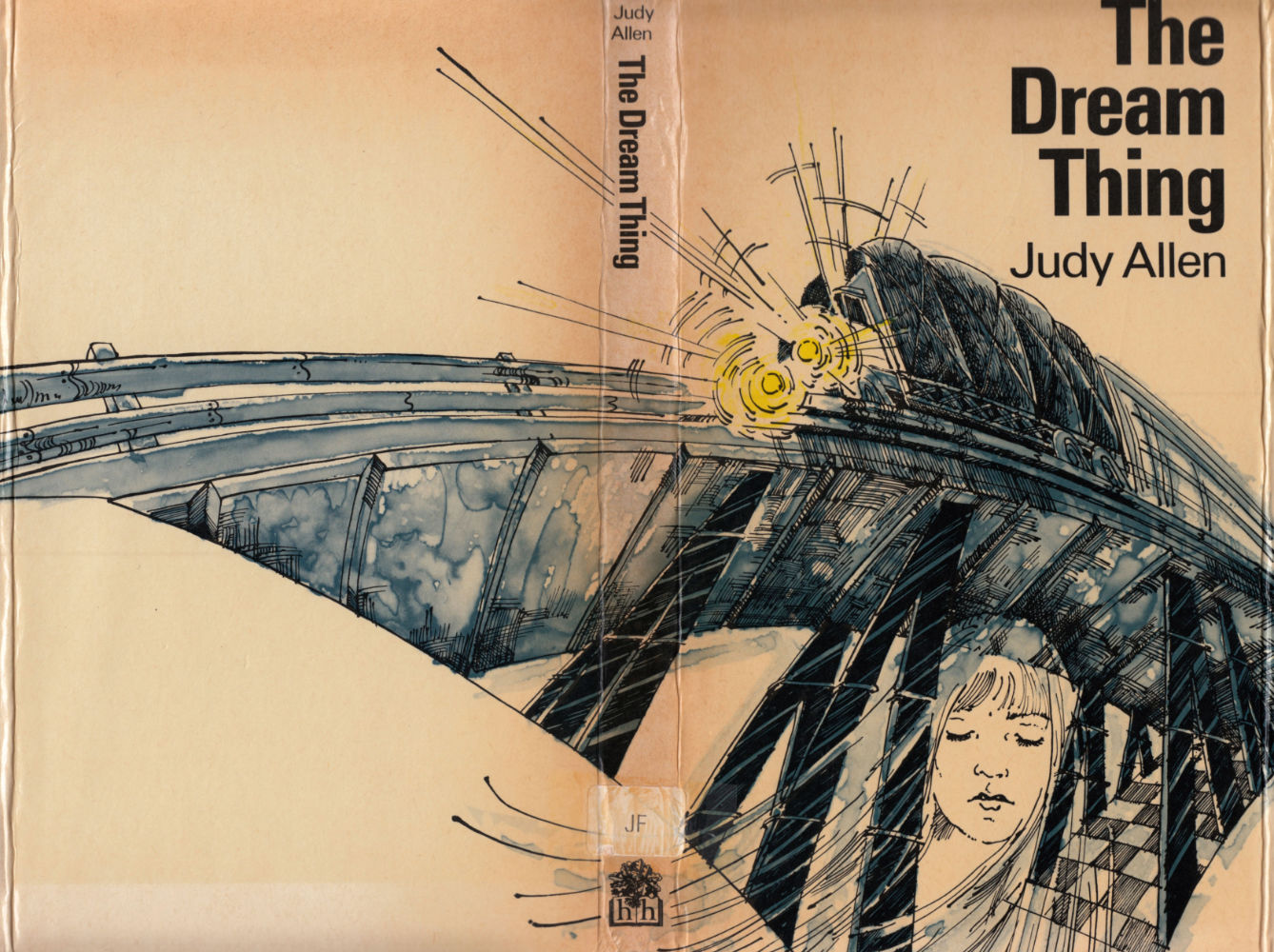
full wraparound from the UK first edition, art by Rowan Barnes-Murphy
Dream-fantasy like this, with a clear psychological grounding, can easily turn into straightforward allegory: Jen’s hatred of the gypsies gains a monstrous autonomy in the dream-thing dragon-scorpion whatever-it-is. Her hatred is monstrous, and the monster is her hatred. But that symbol, of the armour-plated spiky monster, has a lot more resonance than that—as I said above, it’s as much about Jen’s self-protection and self-persecution as it is her hatred. But I can’t help feeling that The Dream Thing resolves by treating it entirely as Jen’s hatred, and nothing else. The head gypsy tells her “Your dream… is born of your venom. It has nothing to do with us…” Which is perhaps a truth Jen needs to be told, but it’s also not the whole truth. The symbol of the dream-thing itself is far more eloquent than any of the reductive explanations, but there’s an air, at the end, of tying it to this too-simple explanation, and so leaving its many resonances unexplored. We’re left with a simple message: hate is bad, and it can take you over. But the roots of that hatred in fear and loss and isolation aren’t addressed.
(To give another example. Jen lives with her mother in a small flat, and the building is surrounded by a black metal fence with semi-ornamental spikes. The fence is only a short distance from the building itself, so what it’s protecting is a basically useless strip of land, and anyway, the fence can just be walked around, so its protecting nothing. It is, instead, an embodiment of the feelings people have about their homes, the need that they have a certain space around them, and an air of protection. In the limited space of a city, this has to be formalised into an ornamental fence and a tiny strip of land, but the psychological value is still there. The metal of the railings, and the spikes of the ornaments, clearly tie in with the metallic spikiness of the dream-thing, and bring out the feelings of self-protection rather than hatred in the dream-thing—though, such self-protection can also spill into hatred: the gypsies offer no threat, but so many people want them “not in my back yard”.)
I can’t help feeling that if the fantasy element had been given freer reign instead of being tied down to one interpretation, the ending might have been richer and more satisfying—a true resolution rather than a lesson only apparently learned. If, for instance, Jen had seen her own dream-thing in the metal/flesh, she might have seen herself in it, both her vulnerability and her spikiness. (A situation handled far better, and also with a dragon-sized thing of hate, disgust, and vulnerability, in William Mayne’s A Game of Dark.) But she doesn’t face it like that, it’s explained away. The fantasy loses its resonance, and becomes an allegory.
The Dream Thing’s ending does have a certain bleakness of realism. The gypsies are forced to move on. Jen’s friend Tom is no longer speaking to her, but she has a female friend in reserve, so it’s not the end of the world. It’s all part of the messiness of growing up.
It’s an interesting book, praised in its day for the realism of its characters, and certainly unafraid to take its main character through some uncomfortable emotions. It was reissued in 1990 (and, from a quick comparison of the text thanks to an Archive.org scan, it seems the same as the 1978 version, rather than being rewritten as with Lord of the Dance).