
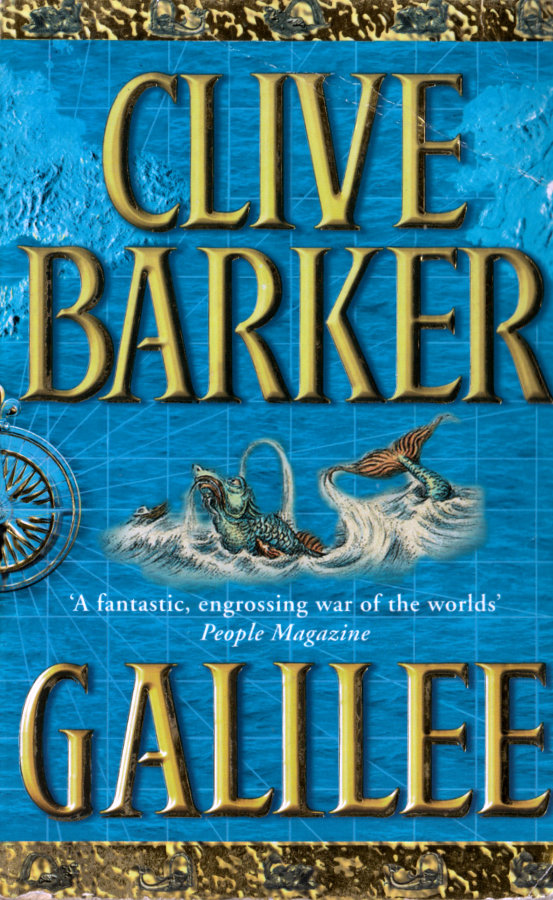
 I started this read-through of Barker’s fiction wondering why it was I’d stopped reading him the first time round, and I’m pretty sure I’ve found it. I think I’d have bought and started reading Galilee (1999) when it first came out in paperback, but I can’t remember finishing it. Reading it this time, I came to a point where I was absolutely ready to give up (as I’m sure I actually did, back then), and it was only my determination not to bail out on this Barker read-through that meant I broke through to the later (better) parts of the book. Maybe this one just isn’t for me—it certainly had mixed reactions among its initial reviewers—but I think there are parts of it that just aren’t up to Barker’s usual standards. And, this being a long book (his second-longest, after Imajica; in some pre-interviews, he talks about it being a two book series) those parts are as long as other people’s actual novels.
Galilee is also the furthest Barker has got from the Books of Blood-style horror that initially made his name. Even in the novels that followed, where he took pains to point out that what he was writing was fantasy, not horror, the darkness was still there, and was still weird, demonic, and grandiose in that very Barkerish way. Galilee is subtitled “a romance”, and although it’s a romance tinged with fantasy, it’s not, to my tastes, tinged enough. (For me, romance needs something else to make it work—Jane Austen levels of wit and social satire, for instance—or should boil along in a subplot alongside adventure, mystery, horror, or whatever.)
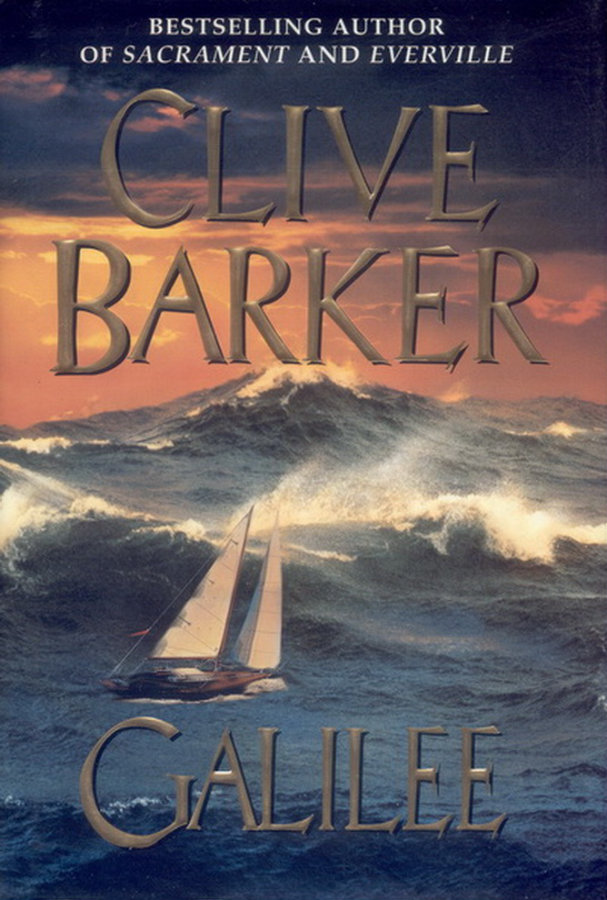
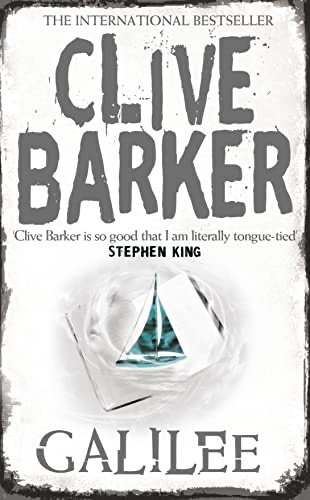
cover art by Phil Heffernan
Galilee is the tale of two families whose destinies became entwined in the dying days of the American Civil War. On the one hand, we have the Barbarossas, whose roots lie in Africa, but whose generations are few, because their central line are immortal divinities. As the titular Galilee explains, he has no grandparents, because his parents weren’t born. (There are “those creatures God made, but also those who made themselves by force of will or appetite”, and Cesaria and Nicodemus Barbarossa are two such. Though, it has to be said, Nicodemus has managed to get himself killed over a century ago, leaving only the fearsome matriarch Cesaria to preside over the family.)
The Barbarossas live hidden away in their house called L’Enfant des Carolinas (designed for Cesaria by her one-time lover Thomas Jefferson), and it’s there that one of Nicodemus’s bastard sons (the half-divine, half-human Maddox) sets out to write this book, the history of his family. But he realises he can’t write about the Barbarossas without also writing about the Gearys.
The Geary clan are, we’re told, “American royalty”, “As rich as the Rockerfellers and as influential as the Kennedys”. Where the Barbarossas have magical power, the Gearys have worldly power—and a dark heart, for they are “fierce in love, and fierce still in hatred… iron-willed and long-lived… casually cruel and just as casually charismatic”:
“There was a dark, bloody spirit in their collective soul, a Geary daemon if you will, who invested them with an authority out of all proportion to their secular rights.”
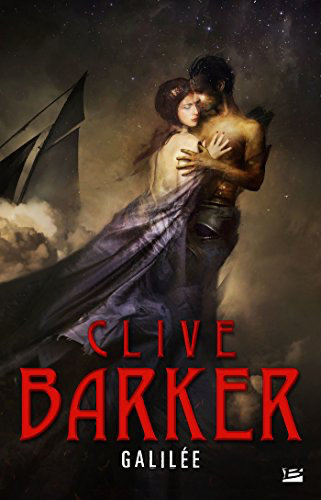
cover art by Bastien Lecouffe Deharme
Although it starts out sounding as though it’s going to be a dynastic history, chock-full of events from the past, Galilee really just focuses on one event from the present, the marriage of Rachel Pallenberg and Mitchell Geary. Mitchell—rich, handsome and single—is the most eligible bachelor in the USA; Rachel is just an ordinary (but beautiful) girl from an ordinary background, who catches Mitch’s eye while working in a jeweller’s shop. He asks her out, they go on dates, they get engaged and married—it all sounds like a fairy tale. Then Rachel realises how shallow Mitch is—charming, but shallow—and how loveless their relationship is. But the Geary women are used to this, and have a solution. Rachel is told to go for a stay at a certain house on the island of Kaua’i, which only the Geary women are allowed into. There, she’s visited by Galilee Barbarossa, who, it turns out, provides a certain service for all the Geary women when their marriages prove empty. One night with him gives them “A taste of an emotion that struck deep into their being, and offered them a glimpse of what their souls needed to stay bright.” After which they can return to their empty lives. Only, Rachel doesn’t want to return. She and Galilee fall in love, and that love will destroy the delicate balance of hatred and power that exists between the Gearys and the Barbarossas.
Quoted in Clive Barker’s Dark Worlds (by Phil & Sarah Stokes), Barker says, of this novel:
“What I tried to do is take what I learned about writing about the real world in Sacrament and marry it to what I learned about writing a sort of poetic, almost religious fantasy in Imajica. I wanted those to be put side by side.”
He goes on to add: “it’s much easier to relate to some of the chief characters, because there they are, living in our world”.
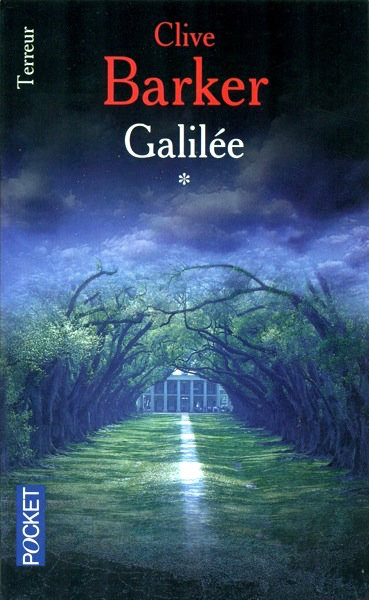
cover art by Wolfgang Kaehler
It’s always been an archetypal situation for Barker—and one of his strengths as a writer—presenting the effect on ordinary people of encountering the fantastic, and having it transform their lives. It was only while reading Galilee that I realised this “encounter with the fantastic” occurs in other ways in Barker’s fiction, too: people are also transformed in his stories by encounters with super-heated passion (think of Julia’s one-night-stand with her husband’s brother Frank in The Hellbound Heart). That’s what happens in this novel, too—Galilee is, in a sense, the novel-length version of novella-length Frank—but Rachel’s life is also transformed by her encounter with another sort of the unordinary, the world of the incredibly wealthy. (Only, that’s not a positive transformation.)
And it’s here where one of my complaints about the book lies. Barker says this is a novel where it will be easier to relate to the characters because they’re living recognisable lives, but, aside from a couple of minor back-story characters, none of these characters is living a life that could be described as normal. Even Rachel, who comes from an ordinary background, is obviously beautiful enough to attract the country’s most eligible bachelor, so she’s already out of the ordinary. And once she’s swept up into the world of the ultra-rich (which doesn’t take long) her life is not ordinary, and nor are the people around her. That wouldn’t matter, but these characters are all so uninteresting. They are what I imagine the ultra-rich to be: spoiled, festering in their own insecurities, hang-ups and (this being Barker) perversities, but so very shallow, and I just don’t care about them or, sadly, Rachel. Compared to them, the plainly dysfunctional but gleefully Bohemian Barbarossas are by far the more “normal” people, despite being semi-divine. (Though, for all but the fearsome force of nature that is Cesaria, that divinity extends to nothing more than being long-lived. And being long-lived hasn’t exactly imparted wisdom on these messed-up beings.)
 This wouldn’t matter, perhaps, if it wasn’t for my other complaint about Rachel’s story (which takes up most of this book). The non-fantastic parts—dealing with Rachel’s wooing, her marriage, the breakdown of that marriage—are boring. Nothing surprising happens, and the dialogue is just platitudes and clichés. Perhaps this is an expression of the emptiness of the Geary family, but the limpness of the dialogue extends to Rachel herself, and even to the most lively of the Geary wives, the down-to-earth and frankly alcoholic Margie, who becomes Rachel’s closest ally. This section of the book just had nothing to offer me, as a reader—no wit, no character, no surprises, no ideas. It’s certainly where I’d have stopped reading on my first go at this novel.
But this time I pushed on through, and things got a little better. If nothing else, I was driven by my interest in the themes Barker has developed throughout his fiction, and how they play out in this book. (Though I have to say, I found Galilee the most devoid of the sort of metaphysical and philosophical ideas that can usually be found in his work.)
Fictionally, the stand-out moments for me were two background stories. Both, notably, are about genuinely ordinary people encountering the fantastic. The first was the tale of the fisherman Zelim who meets Cesaria and Nicodemus as they’re baptising their first-born, Galilee. This one moment is enough to upend his life, and he eventually becomes a renowned storyteller. (Which echoes Sacrament’s tale of an encounter with a fantastic couple leading to a life driven by imagination and creativity, making me think this may be Barker’s own version of the artistic initiation story.)
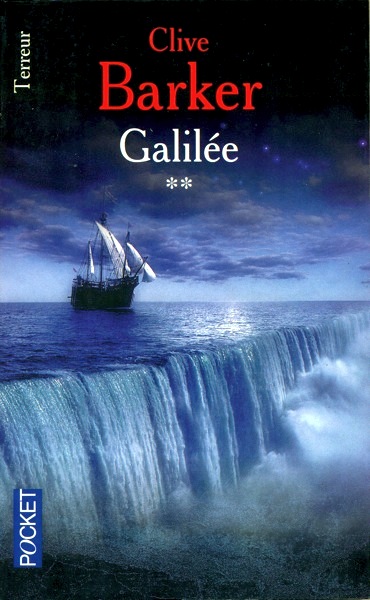
cover art by Wolfgang Kaehler
The other is the story of Captain Holt, who meets Galilee in the final days of the American Civil War, a moment which recalls another Barker trope, this one from his first novel, The Damnation Game: the Faustian pact made in the aftermath of a war. There, it was a deal made in the ruins of WWII-era Warsaw that led to a man becoming fabulously wealthy; here, it’s a deal made in the Civil War-ravaged south that leads to the Geary clan becoming fabulously wealthy. In both cases the deal turns toxic, as Faustian pacts do.
As I say, there’s a lot of another Barker archetype—Uncle Frank from Hellraiser—in the character of Galilee. Not only does he spice up the lives of the Geary women, and Rachel in particular, with his skills in the bedroom, but he goes through something of Frank’s painful reconstruction when Rachel nurses him back from near-death following a shipwreck. (This makes me start to see this painful-return-to-life trope in Barker’s fiction as something almost shamanic. In some traditions, the shaman’s visionary initiation sees them being torn apart, stripped to the bones or cooked in a big pot, then reconstituted before their return to the world.)
Just to tick off another Barker theme I’ve noted in his fiction since The Books of Blood, here we also have the situation where women are allied to fantastic males or monsters, as opposed to human males, who are presented, in this trio, as murderous and toxically powerful. It’s been there since “Skins of the Fathers”; the Geary women and Galilee versus the nasty Geary men (most of whom are murderers and abusers of women) are just the latest version of it.
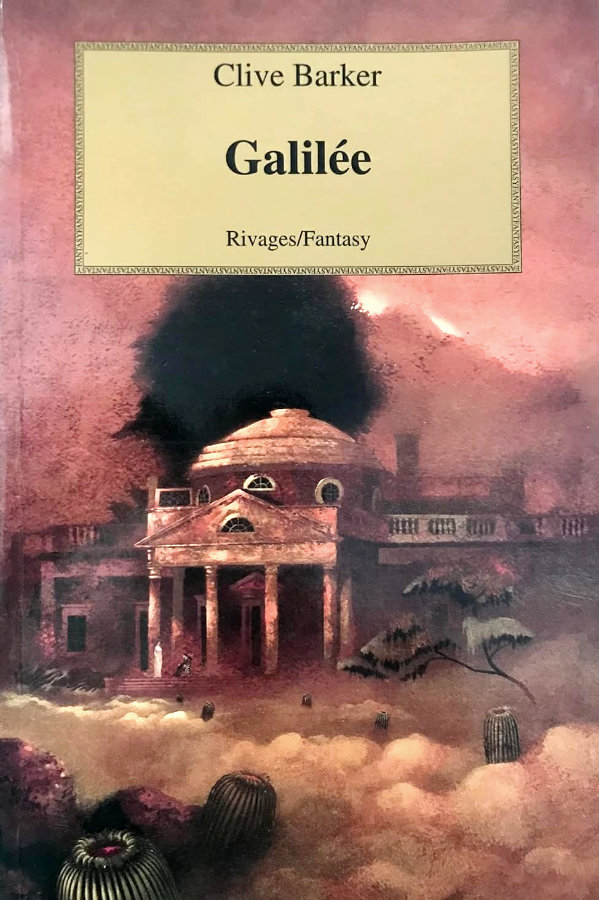
cover art by Vincent Froissard
It may be that Galilee just isn’t my type of book. Contemporary reviews I’ve been able to find have certainly been polarised. Kirkus Reviews said it was “Overheated and intermittently risible, but the thing is entertaining”; The Birmingham Mail said “This is Barker’s greatest achievement—an addictive read that is nigh-impossible to put down.” But The Bookseller said, “We’ve all been waiting for another Weaveworld, but sadly this isn’t it… It’s a fan’s book, I feel—not one to expand his readership.” And Maxim magazine (not one I’d usually go to for literary analysis) called it “well-written Jackie Collins with a dose of X-Men,” but went on to note that “Loyal Barker fans will feel cheated.”
Barker himself was certainly in a happy place when he wrote it (the character of Galilee was based on his new partner at the time, and the house on Kaua’i was inspired by Barker’s holiday home on the same island). And he deliberately chose to make the book narrated—in fact, written—so he could freely comment on his own creative process. So, we get some glimpses of how he feels when he’s writing:
“Nothing is beyond my ambition right now, and nothing is beneath my notice. I will attempt to conjure common divinities and show you the loveliness of filth.”
As well as perhaps his most explicit echo of William Blake:
“I suspect, by the way, that in the creation of divinities we see the most revealing work of the human imagination. And of course in the life of that imagination, the most compelling evidence of the divine in man.”
My own reading of Galilee was more powered by my interest in Barker’s work as a whole than the book itself, but I’ve found my enthusiasm for this Barker read-through undampened. For some reason I’ve got my heart set on reading Coldheart Canyon no matter what, perhaps because I bought it but never read it when it first came out. Here’s hoping it’s a return to the sort of Barker I like.
