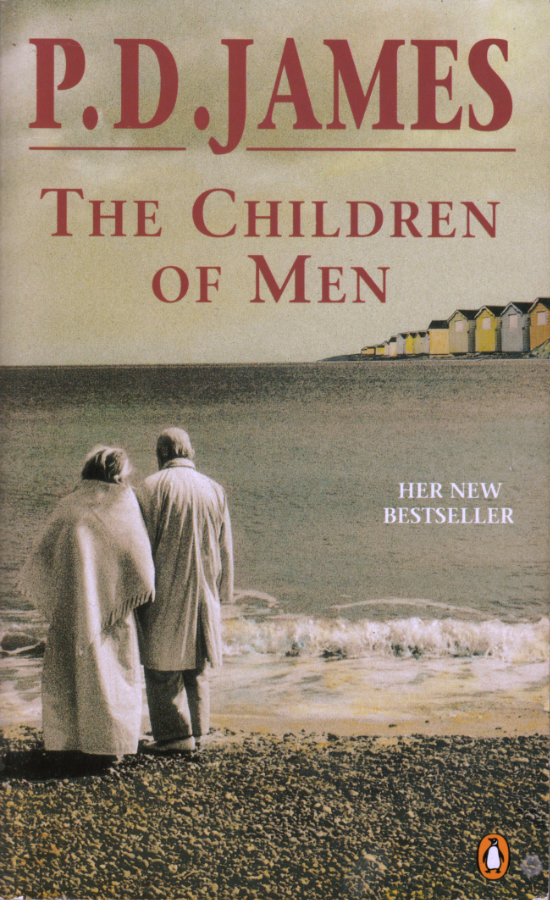
 First published in 1992, The Children of Men was P D James’s first non-crime novel, written when she was 71 and recently made a life peer. It was sparked off by her reading an article about a drop in male fertility, which led to her wondering what the world would be like if children simply stopped being born. I decided to read it thinking of it as part of the British tradition of post-apocalyptic fiction—“cosy catastrophes”, even—along the lines of John Wyndham and John Christopher. (And, of course, Brian Aldiss, who not only coined the term “cosy catastrophe”, but wrote Greybeard, a 1964 novel about, well, a future in which children stopped being born…)
The Children of Men is set in the year 2021, 25 years after the last human birth. Since then, men have produced no fertile sperm—and, oddly, all the sperm stored in fertility banks has been found to be infertile, too. (A detail that may have been added simply because someone pointed it out as a loophole in James’s set-up, but it actually has quite an implication for what sort of novel this is. Without it, if men had simply become infertile from one date onwards, this would be SF. But with that detail, it implies a sort supernatural—even divine—cause to the infertility, backdated as it is. This is, then, perhaps a religious fantasy.)
The sometime narrator (via his occasional diary), otherwise protagonist, Theo Faron, is a lecturer on Victorian history at Oxford. (His pupils, now, aren’t young undergraduates, but adults taking evening classes. There aren’t any young to teach, anymore.)
He’s divorced, his wife having left him after the death of their 18-month-old daughter, whom he killed, not realising she was behind him when he reversed their car. But that death, devastating though it was, just seems to have confirmed the general air of emotional distance and lovelessness in his life: his mother was distant, his father was ill, and died when Theo was 12, and Theo has since come to admit that he never really loved his wife. Now, he’s perhaps one of the few people to be glad there are no children around to act as a reminder of what he lost.
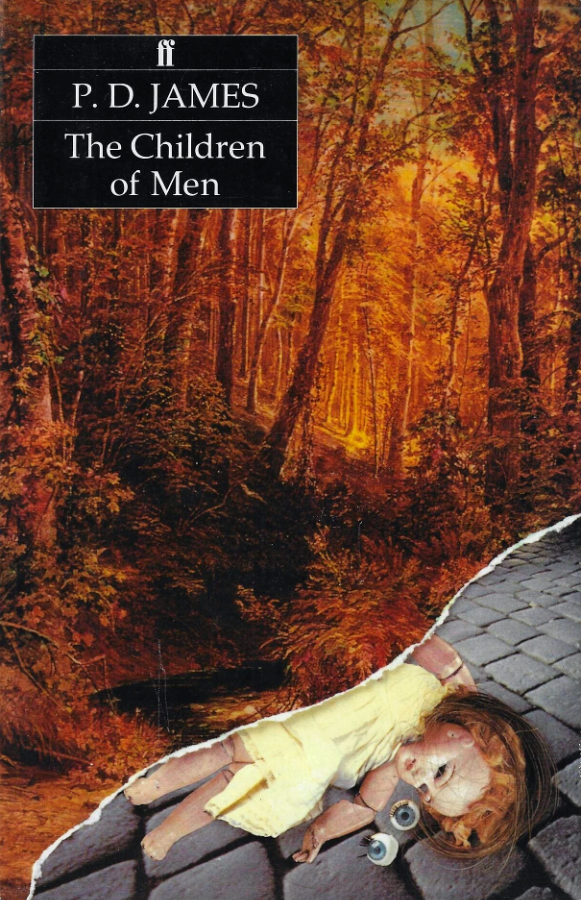 Although the human race basically knows it’s heading for extinction, things are, in general (in England, anyway), pottering along much the same, or at least putting up with the slow erosion of a way of life—with resignation and a quiet sort of despair, rather than the rushing around and violence associated with your more dramatic apocalypse. Slowly, and mostly by their own volition, the populace is moving into the cities, as outlying villages become harder to maintain and supply with power. The old and infirm are encouraged to end their own lives (their partners receive an enhanced pension), and there are even mass events known as the Quietus, in which coach-loads of the elderly are sent out into the ocean on boats that are then sunk. Elsewhere, there’s a fashion among some women for pushing expensive dolls about in prams—dolls which can be updated every six months, to provide some illusion of growth—and the social convention is to treat these dolls as real babies, with people stopping to coo at them in their prams. (Though one early shocking incident in the novel has a woman snatch such a doll and dash it to pieces, leaving its owner as distraught as if it had been real.) Others treat their pets a little more like human babies, with Christening ceremonies and kittens in prams.
There are darker aspects, too. The last generation of humans to be born have become known as the Omegas. Now in their mid-twenties, they have a marked psychopathic character. Often handsome and intelligent, they’re also “cruel, arrogant and violent”. Some abandon society to form gangs. One such, known as the Painted Faces, attack travellers in an oddly ritualistic way, dancing round their cars and chanting, before burning the vehicle and sometimes killing one or more of the passengers, while the others are allowed to go. They are, in a sense, the ultimate lost generation: “Their unspoken question, ‘What is the point of all this?’”
 And then there’s the government. While the majority of the ageing populace do their best to get on with a slowly failing normality (“the small domestic concerns of a shrinking world”), the Warden of England, Xan Lyppiatt, keeps things in check through a subtly tightening totalitarian grip. The SSP—the State Security Police—are able to make dissenters disappear, while criminals are sent to the (Isle of) Man Penal Colony, which seems to have been left to run wild. Foreign workers (known euphemistically as “Sojourners”) are imported to do manual labour, but are given no right to stay in the country once their stint is over, and are kept in camps.
Xan, as it happens, is Theo’s cousin, and the two spent a deal of time together growing up, though only enough to recognise a certain shared emotional coldness in one another. Theo was, for a time, on the Council of England as Xan’s advisor, but gave the position up, as he knew his advice was never followed.
Then one day Theo is contacted by a group of five people who ask him to take their message to his cousin. They want certain political changes—a proper oversight of the Man Penal Colony (as it’s pretty much run by internal gangs), an end to the Quietus, and rights for Sojourners. Theo does as he’s asked, more because he likes the young woman who first approached him, Julian (the spelling she insists on, rather than Julianne). Xan and the Council patiently explain to Theo that they’re doing the best they can in a changing world. “I’m not a tyrant, but I can’t afford to be merciful,” Xan says. Which is probably what all tyrants say.
 But then, some time later, the group contacts Theo again. They had been blowing up the platforms used in the Quietus, and one of their group has been caught. Knowing it’s only a matter of time before he’s forced to reveal the names of the rest of the group, they have to go into hiding, and need Theo’s help. The clincher is that Julian is pregnant, and does not want her baby to be handed over to Xan, as will surely happen if they’re caught. Theo at first believes they’re deluding themselves, but Julian has him lay his hand on her belly and he feels the baby kick…
The Children of Men is, in a way, the cosiest of catastrophes: it allows everyone to continue their middle-class lives pretty much as before, only with the added knowledge that with them, the human race will die out. The likes of Wyndham’s Day of the Triffids and Christopher’s Death of Grass are about the fragility of civilisation, and how easily it can descend into barbarism and amoral chaos—written by a generation who had survived the Second World War and walked the precipice beside such a descent. James’s slow apocalypse, on the other hand, is a slip into despondency and resignation—it’s “a world overcome with ennui”, “a world with no future”—while a totalitarian dystopia takes hold. With its promises of “security, comfort, pleasure”, the Warden provides:
“…the illusion of democracy to people who no longer have the energy to care how or by whom they are governed as long as they get what the Warden has promised: freedom from fear, freedom from want, freedom from boredom.”
It’s perhaps notable that the world of Children of Men is wholly middle-class. Physical labour in the England of 2021 is carried out, it seems, entirely by the “Sojourners”, who are basically treated as temporary slaves. (We only glimpse them once in the book, and no mention is made of any working classes among the English.) In a way, then, the novel could be seen as a sort of exaggerated view of England from an over-anxious middle-class viewpoint, where physical labour is invisible, conformity is assured, foreigners are used but kept out of sight, and the rebellious element among the youth are a sort of nightmare of what frightened pensioners think punk rockers must be: barely rational murderous savages loose in the wilds. (The Omegas even feel a little like grown-up versions of the children from The Midwich Cuckoos: alien, and more than slightly inhuman.)
 Perhaps it’s a telling remark when James said, in an interview from the time of the book’s publication: “I didn’t want it to be science fiction. I accept that there is some excellent writing in science fiction … but it’s not a genre I personally enjoy. I like to be in a world I know.” The Children of Men is, perhaps then, a picture not of a possible future, but of the world she knew. I don’t know if the point she was making, back then, was that middle-class life in the Britain of the 1990s was unsustainable in the face of increasingly harsh global and economic realities (which would be odd, considering she was a Conservative peer). She doesn’t really provide a glimpse outside her characters’ class bubble to really bring that home (making me wonder if she herself didn’t consider it, either). But, reading the novel today, that’s what it feels to me that it’s about. (It’s certainly the direction the film adaptation takes.)
There is a religious strand to the novel, though mostly in Theo’s worrying about whether other characters believe in God, in a world where most people (including him) don’t. Julian, though, does, as does the father of her baby—a significant detail? Is the mass infertility an equivalent of the Biblical flood, and this new birth a miracle? The novel ends before that can be decided.
In fact, the ending is even ambiguous about what will happen politically now hope might just have returned to this dying world. There is a regime change, but how much is it a case of “meet the new boss, same as the old boss”? Any remotely SF or fantasy writer would no doubt turn this book into the first of a trilogy; P D James returned to her detective novels, so there’s no way of telling where things in her version of 2021 would have headed.
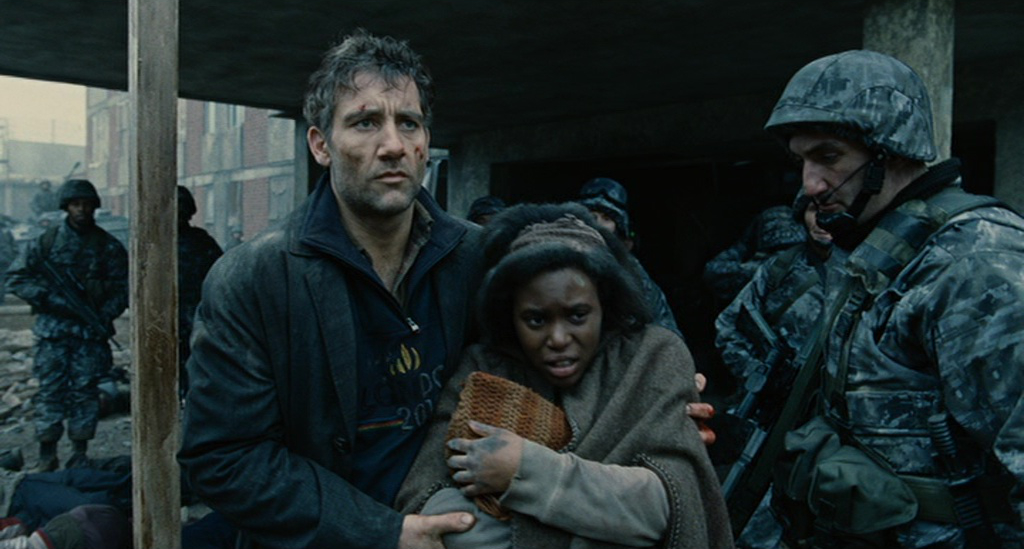
Alfonso Cuarón’s film version, released in 2006, is a world apart from the novel, much more hard-hitting and unquestionably dystopian. A small detail—it’s women who are infertile in this future, not men—does away with that awkwardly supernatural-feeling point about sperm banks, and the focus is far more on the “fugees”, the refugees who flock to Britain, and how they’re treated (not just camps but cages). It’s a very powerful film, and certainly no cosy catastrophe.