
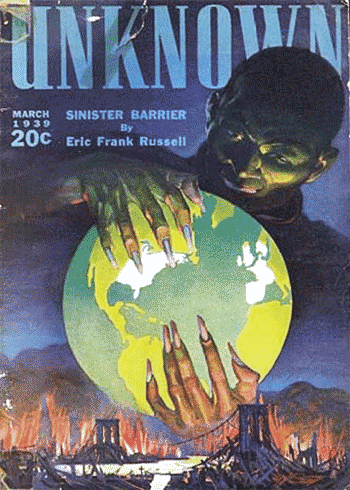
Unknown Magazine

Cover to the first issue of Unknown Magazine (March 1939), art by H W Scott

The fantasy, SF and horror pulps remembered most fondly are those that made a name for publishing a particular type of story — often a specific sub-genre, rather than a broad genre. Weird Tales, for instance, is most remembered for Lovecraftian-style “weird” horror, even though it published a lot more besides, including the more traditional type of ghost story, and sword & sorcery. Unknown, which was for a brief time Weird Tales’ only serious rival in the world of fantasy pulps, was better known for a much lighter type of tale, one so characteristic to the magazine that it became known as the “Unknown school” (though it had had its precedents in the likes of humorous fantasists F Anstey, Thorne Smith, and Richard Garnett). As Weird Tales came first, Unknown defined itself against the older pulp: “No more houses of dripping blood, grinning harridans with butcher knives, bodies dangling from razor-bladed rafters”, as Ray Bradbury wrote in a letter to Unknown. Isaac Asimov characterised WT as “grim” as opposed to Unknown’s “impudent” — “with the accent on the imp”.

There are a few factors which gave Unknown its specific character, but chief among them was its editor, John W Campbell Jr, who supposedly started the magazine as a means to publish stories which had been submitted to Astounding, but which didn’t fit that magazine’s hard-SF style. As a result, a lot of the writers published in Unknown were SF writers with ideas for fantasy stories, and they approached fantasy in a more science-fictional manner. For them, fantasy was something to be confronted with a modern, logical and analytical approach. The most characteristic tales of the “Unknown school” feature an Average Joe confronted by a single instance of the supernatural or magical (rather than being transported to an entire other world, for instance), usually with humorous results.
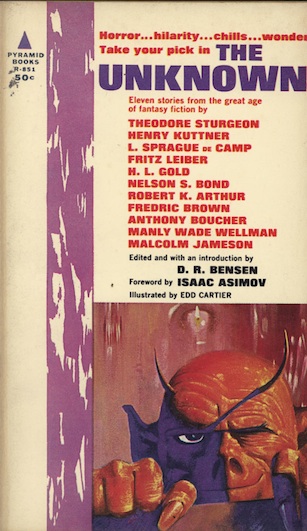
The Unknown, edited by D R Bensen, Pyramid Books 1963

There are a good few examples in The Unknown, a 1963 anthology of stories that appeared in the magazine during its brief life (39 issues in total, from March 1939 to October 1943, when the company’s limited wartime paper allocation was given over entirely to Astounding). Henry Kuttner’s “The Misguided Halo”, for instance, has a young advertising executive mistakenly given a halo by a novice angel, because of a confusion between him (Kenneth Young of Tibbett, North America), and a momentarily-lapsed holy man (Kai Yung of Tibet). Comic shenanigans ensue as Young tries to maintain a normal life despite this holy glow. Similarly, in H L Gold’s “Trouble With Water”, the Average Joe is Herman Greenberg, proprietor of a beachside hotdog & drinks stand, who insults a Water Gnome and is cursed so that “water and those who live in it will keep away from you” — with the result that he cannot wash, or shave, or drink anything but beer, and also (in a momentary boost for his business) cannot be rained upon.

A theme begins to develop, as these average Kenneths and Hermans inevitably go to doctors and psychiatrists for an answer to their problems, only to be dismissed with sedatives, or looked upon as an interesting case for further study, but never actually helped. (The one psychiatrist to star in his own story in The Unknown, in Nelson S Bond’s “Prescience”, actually pursues such an odd case, despite his disinterest, but with disastrous results.) But there is always a solution to be found, and usually it’s by the hero accepting the fantastic situation and working with its own peculiar logic, rather than by trying to attempt any kind of rationalisation. In fact, there are whole subgenres of fantasy which deal with this sort of approach — deal-with-the-devil stories, for instance, one example of which is here, Anthony Boucher’s “Snulbug”, in which the devil dealt with is a very minor imp with limited powers. Boucher’s hero, Bill Hitchens, is notable for not being an Average Joe, but a scientist, who summons the imp Snulbug to try and make some money to fund his research. Bill’s idea — for the devil to bring him a newspaper from tomorrow, so he can make a profit from its information — has, the imp points out, been tried before, and is limited in its usefulness, but Bill pursues his own (logical) approach to the magical situation, and comes through in the end.
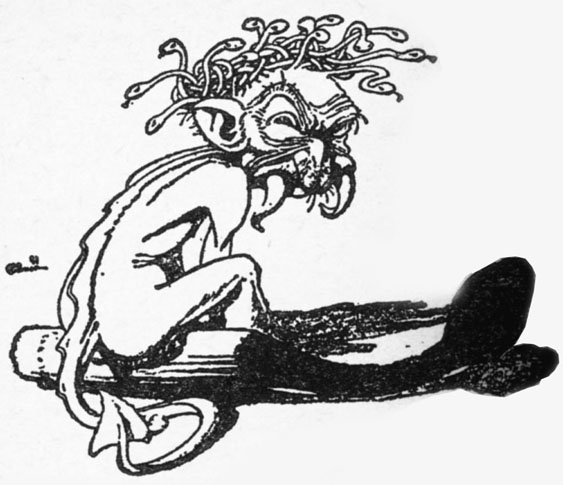
Edd Cartier illustration for Anthony Boucher’s “Snulbug”

Unknown featured other types of story, of course. Some — such straight horror tales as Manly Wade Wellman’s Poe-versues-Vampire tale “When It Was Moonlight” — are no doubt here because Unknown paid better rates than Weird Tales, and so got the chance to accept or reject them first. Another far more WT-style writer, who got his first professional sale in Unknown, was Fritz Leiber. Unknown published the first five Fafhrd & Gray Mouser stories, as well as some of Leiber’s Lovecraftian/M R James-inspired ghost and horror stories, including “Smoke Ghost”, which Ramsey Campbell cites as being important for making its ghost a thoroughly integrated part of a modern urban environment. (It’s his Fafhrd & Gray Mouser tale, “The Bleak Shore”, that gets included in The Unknown.)

Even when Unknown folded, the effect of its take on the fantastic lingered. Poul Anderson’s fantasy novel Three Hearts and Three Lions (first published in 1953, in F&SF), for instance, has its hero (from our world) defeating giants and dragons by working out the scientific rationale behind their fantastic nature, and his contribution to the first Thieves’ World anthology, “The Gate of the Flying Knives” (in 1979) is resolved by the hero’s use of an abstruse snippet of mathematical knowledge, which Anderson can’t quite hold back from naming, entirely anachronistically. A piece of parchment holds a gateway to another dimension, and to prevent its denizens from chasing through to our world after a heroic escape, the hero gives the parchment a “half twist and brought the edges back together”, meaning it now has only one side:

Air rushed in where the gate had been, crack and hiss. Cappen heard that sound as it were an alien word of incantation: “Möbius-s-s.”
^TOP

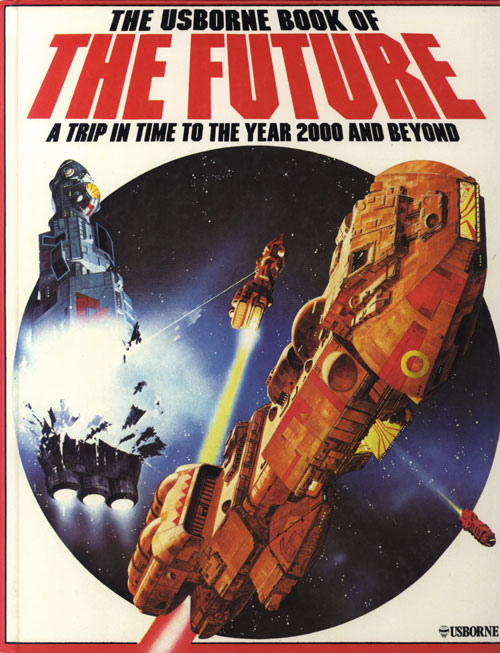
The Usborne Book of the Future

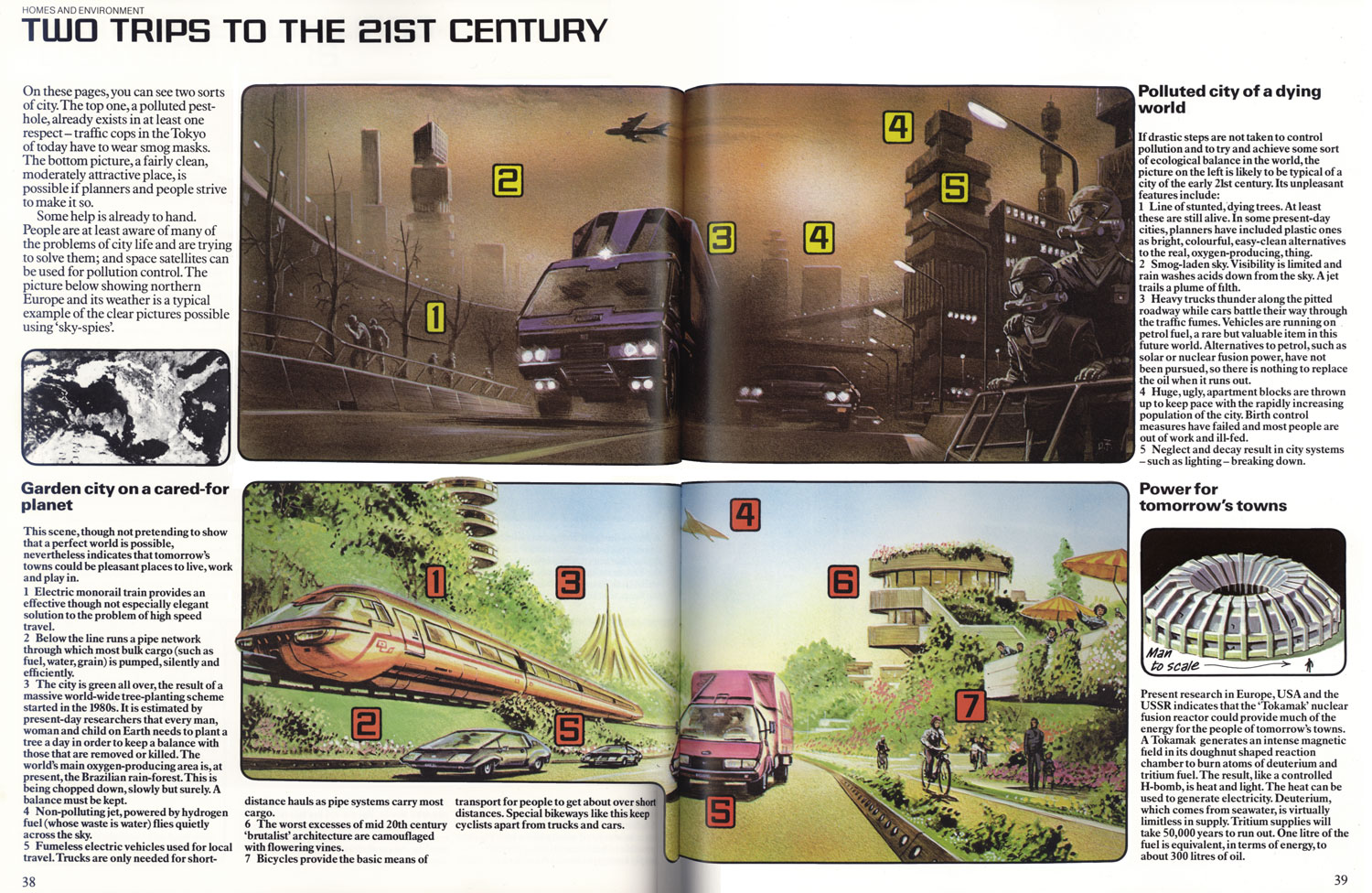
“Now read on… into the fantastic world of the future!” That’s how each of the three sections of The Usborne Book of the Future (on Robots, Future Cities, and Space Travel) begins, after a brief look at these subjects (tool-use, cities, and transport) in history. It was published in 1979. I don’t think I owned it, but must have got it out of the local library — certainly, I pored over it enough for some of its images and ideas to really stick in my mind. I mentioned the key one in a previous Mewsings a while back (writing about William Gibson, whose latest novel I am, by coincidence, reading at the moment), which showed two possible views of how the future might be, one good, one bad. It was titled “Two Trips to the 21st Century”, and I remember really worrying that I might end up living in the nasty, polluted, breathing-apparatus one. I recently gave in to a bout of curiosity/nostalgia and bought it, perhaps mainly so I could have a second look at that image. Here it is (click on it for the full double-page spread, including key to the numbers):

“Two Trips to the 21st Century” from The Usborne Book of the Future (1979)

And then, of course it struck me — here I am, living in the 21st century!

Usually, nothing dates as fast as people’s ideas about how their future is going to be, but having a browse through the Usborne Book from the privileged standpoint of living in the era it was talking about, I was pleased to see how well it stands up. This may be partly thanks to the fact that it wasn’t just based on someone’s speculations having read a few topical SF novels, or on what would look the most visually interesting to Star Wars-hungry kids, but because it was based on the research and speculation of scientists and groups like Bell Aerospace, Boeing, and NASA, which get mentioned in the acknowledgements (alongside Arthur C Clarke and Omni magazine). In fact, the most dated thing about it is, perhaps, a single reference to “housewives” — which also led to my noticing how few women are taking an active part in the jumpsuited future the book depicts.

But generally, the thing that works in The Usborne Book of the Future is that it isn’t talking down to its young audience. It’s not setting out to paint a picture of the sort of future the kids of the day would have wanted, but it really looks at how technical advances might affect day-to-day life, and how the problems of an ever more energy-hungry civilisation might be overcome (gathering solar energy in space and sending it down to Earth in a concentrated microwave beam, for instance — is this still a possibility?). There are far more bicycles (even if occasionally solar-powered) than jetpacks in the book, and the one technological advance that most excited me at the time, I now realise is decades old:

The “risto”, or wristwatch radio-telephone.

Here is how the living room of the 1970s future was going to look:

The living room of a house of the future, from The Usborne Book of the Future (1979)

And, apart from the fashions (futuroid, for the man watching TV, retrograde for the footballer he’s watching), and the drinks-serving robot, it’s all come true. We have video cameras, we have home shopping, we have films on video discs, we have electronic mail, we even have video phones and — gods! — we have flat-screen TVs. I think we all deserve a pat on the back for now, officially, living in the future.

The one thing I wonder, looking at this picture, is why man number 2 is so keenly filming his neighbours. The politics of the future is not discussed in The Usborne Book, and this may prove to have been its one major blind spot. Most of its more optimistic ideas (and it generally takes the optimistic view, though doesn’t ignore the problems) have perhaps not come about because there just isn’t the level of political unity required to change the way we live.

Also, of course, there’s the annoying problem of the way the past doesn’t disappear the moment we hit the future — so much of it is left lying around, clogging up the pathways to futurological advancement. The real reason we don’t have superfast cool-looking monorails is because it’s far more cost-effective to adapt our existing dual rail systems to new advances (if we even bother to do that), and the same goes for all technological advances. They have to be bolted onto the present, upgraded step-by-step. But cost, and the sheer tonnage of existing hardware, are two things it’s easy to ignore when you’re reclining in your semi-spheroid easy chair in your sparkly new jumpsuit, speculating on what the future will bring.

Still, I’m so glad it wasn’t that “polluted city of a dying world”. Not yet, anyway.

(Some credits: The Usborne Book of the Future was written by Kenneth Gatland and David Jefferis, and the artwork was by Gordon Davies, Terry Hadler, Brian Lewis, Michael Roffe and George Thompson.)

^TOP

The Influence by Ramsey Campbell

The Influence by Ramsey Campbell (Legend 1989)

Ramsey Campbell has three books in my personal selection of all-time favourite novels. There’s the (relatively) recent Grin of the Dark, which I reviewed in a previous Mewsings, though I’ve only read that one once (it’s on my long list of want-to-re-reads). The House on Nazareth Hill is another favourite, read several times. But The Influence, which may well have been the second Ramsey Campbell book I ever read (The Hungry Moon was first), is, I think, my absolute favourite (though Nazareth Hill really is so very close). I remember reading The Influence over a period of about three days, that first time, totally gripped by the closely intertwining narratives and subtly cliffhanging chapter endings. From reading other people’s comments about it, it doesn’t seem to be generally considered among Campbell’s best, but to me it sums up all the reasons I keep reading him, and it draws me back to itself, being one of those rare books that gets better, and gives more, on each reading.

The basic premise is simple. Two generations of the Faraday family have been quietly terrorised by the ageing Queenie, a supremely strong-willed, Victorian-minded spinster, who has, in the past, succeeded in convincing at least two of the younger Faraday generation that she has slightly witchy powers. Queenie dies (much to everyone’s secret relief), but not before developing something of a bond with the first of the new generation of Faradays, eight-year-old Rowan. Then Rowan makes a new friend whose influence starts making her act in ways that remind the more sensitive members of the family of the newly-departed Queenie.

The Influence by Ramsey Campbell (Centipede Press, 2008)

One of the best things about The Influence is how its supernatural horror elements combine with Campbell’s very honest, very intimate view of his characters to heighten the difficulties of their already complicated human situations. The Faraday family, though it doesn’t exactly have screaming relatives locked up in the attic, does have enough hints of mental disturbance (a pedophile cousin, a sister who’s had something of a breakdown) to tint their experience of the supernatural with enough self-doubt and emotional isolation to give it a very real edge.

This isn’t to say, though, that all the supernatural elements are of the subtle, ghostly variety. (Though they are all very skilfully handled.) One of the things that lingered from my first reading of the book was the long, nightmare journey young Rowan takes at one point in the narrative, which is pure, paranoid-hallucinogenic Campbell territory. (Though, again, it could also be read as a heightening of the realistic situation, as Rowan’s view of the world is, at the time, skewed enough by trauma and fear to make it seem that strange a place.)

But this isn’t a book that plays games with its reader; it has its feet firmly planted in the supernatural. It’s just that the supernatural is so intimately tied in with the psychological that it works seamlessly, and simultaneously, as both. The dual-image cover of the paperback copy I own (despite the fact it depicts a Rowan about twice the age she is in the story — see pic at top of this post) is a good metaphor for the book itself, in this sense. At any one point in The Influence, you know you’re reading a ghostly, supernatural horror novel, but a slight shift in perspective reveals it to be addressing just the sort of concerns that a non-supernatural family novel could be about — the fear of hereditary taints (madness, or simply meanness) emerging in a child, the fear a parent has of hurting their child, to the extent of feeling guilt about the hereditary, genetic, and historical baggage a parent lumbers their vulnerable child with simply by having brought them into the world through this particular family. So, at any one moment, you can see the ghostly, grinning skull, and the human face at the same time.

The Influence by Ramsey Campbell (US HB)

And this is what I think fantasy can do, when it’s used so skilfully alongside such very real characters: it can bring out the subtleties of the human situation in ways a realistic novel never can. Campbell’s best fiction is, for me, his most rooted in recognisable human beings, who already have enough to deal with in their own lives, even their own minds, without having to put up with the incursions of the supernatural that, ultimately, serve to confront them with those very same inner difficulties.

The result is a book that keeps its meaning well after you close the covers. It’s not just a selection of thrills, but a statement about what it means to be human. The Influence is all about the fine lines that exist between heredity and individuality, between emotional openness and emotional manipulation, between very human fears & self-doubts and the dangers of madness. It’s about the vulnerability of children, and the fears of parents (and vice versa). It really ought to be valued more in the Campbell canon, and was deservedly reprinted recently in a super-luxury edition by Centipede Press, complete with some wonderfully haunting J K Potter photos.

^TOP
