
Bob Johnson & Pete Knight’s The King of Elfland’s Daughter
books • fantasy • music • Alexis Korner • Bob Johnson • Christopher Lee • Hope Mirrlees • Kate Bush • Lord Dunsany • Mary Hopkin • P P Arnold • Pete Knight
26th September 2010
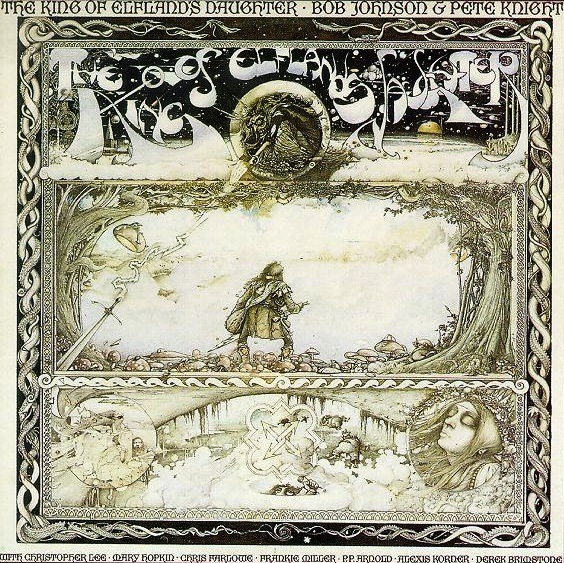 I can’t believe there’s never been a prog rock band called Edward John Moreton Drax Plunkett, but if there had been, this is the album they’d have released. Based on the 1924 novel by the real-life Edward John (etc.) Plunkett — better known, of course, as Lord Dunsany — The King of Elfland’s Daughter, released in 1977, was actually helmed by two ex-members of folk-rock band Steeleye Span, accompanied by a small cadre of vocal talent including the likes of P P Arnold, Mary Hopkin, Alexis Korner and Christopher Lee — yes, Christopher Lee, ex-Dracula, ex-Lord Summerisle, and Saruman-in-waiting. Lee has quite a prominent role on the album, in fact, providing the narration linking the tracks (taken from Dunsany’s own prose), as well as singing/performing (it is the most actorly piece on the album, verging between being sung and spoken) “The Rune of the Elf King”.
I’ve been trying to get hold of this album for some time, even going so far as to make my one and only (entirely unsuccessful) venture into the world of BitTorrents (which I try to avoid, as I much prefer the artists involved to get their dues). Fortunately, a recent Amazon search turned up a CD reissue from Second Harvest
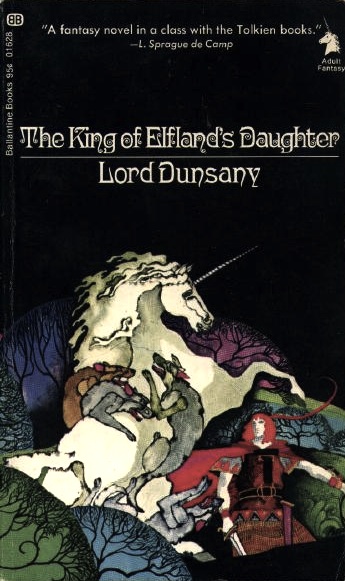 Dunsany’s novel is written in that fairy-tale-for-grownups mode that was one of the cultural casualties of the Second World War (along with the more fantastic aspects of Art Nouveau, which it could be said to embody in prose), and, like Hope Mirrlees’s Lud-in-the-Mist (another example of the genre, from 1926), is as much about fantasy as it is a tale of fantasy. It opens with the men of Erl approaching their lord with a request that, I can’t help feeling, many would like to make of our current administration: “We would be ruled by a magic lord.” (Or at least one who can make us suspend our disbelief in politicians.) And so the Lord of Erl sends his son, Alveric, into nearby Elfland, to woo Lirazel, the King of Elfland’s daughter. This Alveric succeeds in doing, much to the dismay of Lirazel’s father, who does not want to see her made mortal. And so he sends a troll with a rune to fetch her back.
Johnson & Knight retell Dunsany’s novel in nine songs and nine brief pieces of narration (which are, annoyingly, joined to their respective tracks on the CD reissue. I spent a bit of time dividing them up before importing it into iTunes.) The style veers between the delicate folkiness of Mary Hopkin (who provides the voice of Lirazel, and sings the album’s anthemic closing piece, “Beyond the Fields We Know”), the bluesiness of Alexis Korner (as the Troll), and the weird wildness of P P Arnold (as the Witch), whose vocal acrobatics on “Witch” would recall Kate Bush’s “Wuthering Heights”, if only they didn’t precede them by a year. Christopher Lee’s “Rune of the Elf King” is the most dramatic, though least song-like piece, with Lee’s delivery of the line “Why should my daughter be taken by pitiless years?” achingly desperate and expressive. Catchiest tune of the lot, though, must be “Too Much Magic”, sung by the wonderfully-named Derek Brimstone, along with a chorus of school children. It’s a cheery mix of hand-clamped-to-his-ear folkish lilt and old-time singalong. You could imagine the mock-Edwardian audience of The Good Old Days joining in with its chorus:
Magic, magic everywhere,
Magic in the very air
Elfin horns are blowing, there is
Too much magic.
We dare not go a-wandering
For fear of what the night may bring
A curse upon all elvish things,
Too much magic.
(For full lyrics, and details of the album’s release, see this page.)
The Roar of Love
books • fantasy • music • 2nd Chapter of Acts • Blue Oyster Cult • C S Lewis • Fantasy-themed Concept Albums • Hawkwind • Jane's Addiction • Narnia • Ursula Le Guin
19th September 2010
As a follow-up to my top five fantasy concept albums, covered in Mewsings a while back, over the next few entries I’m going to look at a few more fantasy albums I’ve come across recently (one of which I’ve been trying to get hold of for some time). These are slightly different in that they’re adaptations of (or inspired by) existing fantasy books, not original fantasies in themselves.
First up is The Roar of Love by a band called 2nd Chapter of Acts. Now, did you pick up on the subtle cultural signals tucked away in the band’s name to guess they’re a Christian group? I admit that, at first, this put me off buying the album. Then I told myself to stop being silly. After all, I don’t let the fact that I don’t ride a motorbike stop me from listening to Blue Öyster Cult, do I? (Nor does the fact that I don’t use drugs stop me from listening to Hawkwind; nor does the fact that I don’t use the word motherf—! stop me listening to Jane’s Addiction, either.) I was just a little wary of the music being a bit too happy, not to mention clappy.
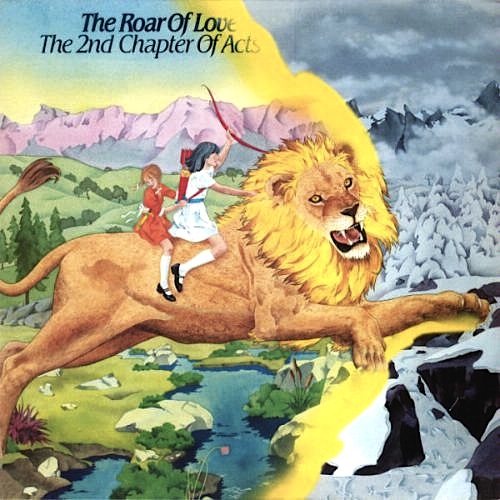
The Roar of Love

But, that aside —
The Roar of Love is fun. The music is, at times, sort of Yes-lite: full of energy, vocals in close harmony, lots of contrasting proggish sections going from classically-inspired to bombastic (light) rock to easy listening and funky pop. There was only one real trip-up moment for me (in the opener, “Are You Goin’ To Narnia”, which contains the lines “To meet the lamb that is a lion/I want to learn to love him too”), but that was more than made up for by the songs themselves being so very listenable. “Tell the Truth” became an immediate favourite with its “Turkish Delight” chorus. (It is followed by the funky guitars and soul-style vocals of a song, confusingly called “Turkish Delight”, about Edmund’s love for the White Queen. Soul, I can’t help feeling, is diametrically opposed to the fantastic. Nevertheless it will pop up again in another of the albums I’m going to cover.)
I’m always interested in how music can be used to capture the feeling of the fantastic, but I don’t think The Roar of Love is as concerned with conjuring another world as it is with just telling a story. The second track, “Lucy’s Long Gone”, covers the whole disappearance into another world with the line “I slipped right out of this world”, which doesn’t give it the awe, excitement and mystery I’d have liked. But the track does have a bouncy playfulness that reflects Lucy’s status as the youngest of the four children in The Lion, the Witch and the Wardrobe — complete with circus-style calliope, at one point — which may be far more appropriate, anyway. Elsewhere, there’s enough lushness in the vocals to give the album a touch of the truly immersive feel of fantasy.
2nd Act of Chapters don’t do darkness, really. Even the track “Aslan is Killed”, though it has some lovely interweaving, almost fugal, vocal lines, doesn’t quite capture the devastating moment when Aslan is humiliated and sacrificed so much as provide a moment of sober reflection. But that’s more than made up for the truly uplifting mood of the album generally. Particularly “Witch’s Demise” with its chorus I at first misheard as: “And then He unmasked her/Then He cast her/to disaster/What a bastard!” (It’s actually “What a Master!” Oh, if only…)
Overall, great fun. It certainly captures the child-friendly fun elements of the The Lion, the Witch and the Wardrobe without overdoing the allegory.
