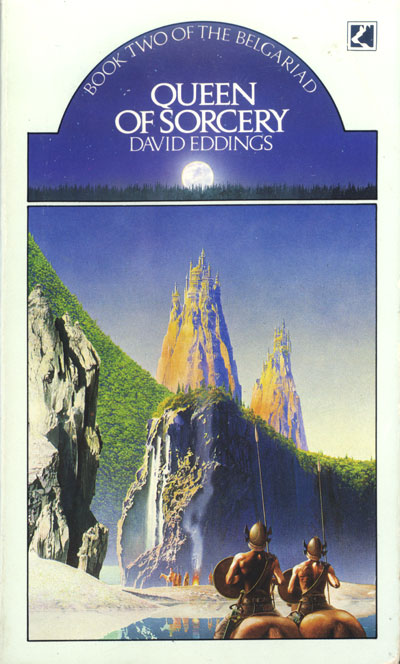
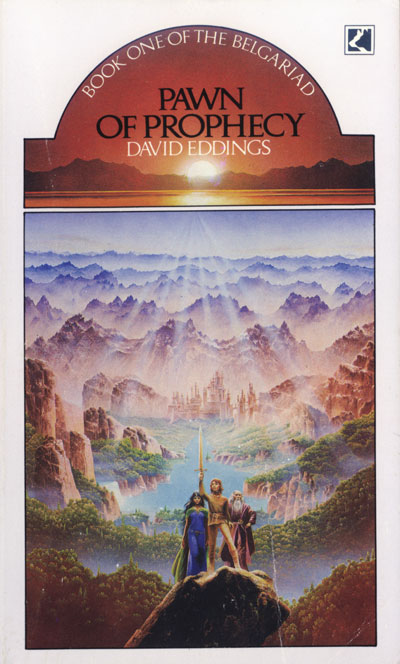
 There must be a word for that sense of dislocation you feel when you see a different cover on a much-loved book and it just seems wrong. I remember what a shock it was, for instance, to come across the US covers for David Eddings’ Belgariad series, which I’d read and re-read when I was thirteen, and whose UK covers (by Geoff Taylor, who seemed to have a monopoly on fantasy covers in the UK at the time), perfectly summed up the epic scale of the books while leaving their main characters either unrepresented, or distant enough to keep their details blurred — something I thought showed a proper respect for the reader’s interpretation of what the characters looked like. When I saw the US covers, with the main characters up-front and in detail, it seemed wrong, almost slightly indecent.
 It wasn’t that I’d formed my own idea of what the characters looked like, I just knew they didn’t look like that. And this is true of how I picture characters in fiction generally. I don’t form a full, photographic representation in my head. I tend not to like it when the author provides a detailed summary of a character’s features — this sort of nose, that sort of mouth, that sort of chin — because I usually end up just juggling the elements in my head trying to make them stick, and it all gets a little cubist. When confronted by such a physiognomical checklist, I opt for one feature and stick to that. Forget the beetling brow and cleft chin, if he’s got a big nose, that’s enough for me. (When in doubt, always pick the nose… That could have been better phrased…)
 Far more important to me is getting a idea of what the characters sound like. After all, in fiction, you don’t get much description of what a character’s nose is up to, but you do get a lot of dialogue. If a big-nosed character fails to detect a particularly subtle odour in one scene, I’m not going to complain; but if a previously laconic character suddenly starts spouting paragraphs, or a well-spoken chap drops into the demotic, it’s more likely to jar. (Unless, of course, there’s a reason for the change — such as the laconic man revealing a hidden passion for what he’s talking about, or the well-spoken chap’s well-spokenness being just an act, soon dropped under pressure.)
 I think it comes down to my just wanting one simple peg to hang the character’s later actions and internal development on. With those US covers for The Belgariad, though, it’s just that the characters seemed too damned heroic — all the flowing hair, Constructivist-style poses, and, for god’s sake, body-builder’s muscles on the boy Garion! In my mind they were a bumbling, ordinary-looking lot, and that was part of their charm.
But how’s that ever going to sell books?