The Hobbit by J R R Tolkien

The thing that stuck with me from my first reading of The Hobbit (nearly forty years ago, now), was Mirkwood. A place of darkness, where so little sunlight filters through from above it’s a shock when Bilbo climbs a tree and gets a reminder of what daylight looks like (plus a glimpse of Mirkwood’s weird, black butterflies). It’s as much a psychological gloom as a lack of light, with Bilbo and the dwarves having for the first time to do without Gandalf (who so far has been the one to rescue them from trolls, goblins, wolves, and hunger), and soon finding themselves helplessly lost in an unforgiving and almost alien environment, where even the water is dangerous. Mirkwood has its roots pretty clearly in classic fairy tales, but for me it’s the moment when Tolkien’s particularly Tolkien-ish invention kicks in. As he himself wrote in a letter to Stanley Unwin in 1937, the year the book was first published:

“Mr Baggins began as a comic tale among conventional and inconsistent Grimm’s fairy-tale dwarves, and got drawn into the edge of it [i.e., his Silmarillion mythology] — so that even Sauron the terrible peeped over the edge.”

Even before the spiders appear, Mirkwood feels like a ramping up of peril for Bilbo and the dwarves. But it’s not yet the sort of peril — the quality that leant its name to Tolkien’s term for Faërie, “the Perilous Realm” — that you find in The Lord of the Rings, which combines mortal danger with an addictive draw, and whose physical threat is secondary to its moral, psychological, or even spiritual danger. In The Lord of the Rings it’s embodied in the One Ring, but in The Hobbit, you feel it most around treasure, and in particular gold “upon which a dragon has long brooded”.

As I found out when recording The Adventure Film Podcast with my brother, gold pops up with surprising frequency in adventure stories, and almost always with the same result: it lures you on the adventure, but once you’ve acquired it, a whole new set of troubles begin. Adventure-gold has the uncanny ability to bring out the worst in people. (As in The Treasure of the Sierra Madre, or The Man Who Would Be King.)

Tolkien’s treasures come with an added dimension, though, as we find out when Bilbo & co. discover a cache of valuables acquired by the trolls. Casually lying there in a wayside cave are two legendary swords, Orcrist and Glamdring. Elrond, who identifies them, suggests how they might have ended up in such a lowly hoard:

“…one may guess that your trolls had plundered other plunderers, or come on the remnants of old robberies in some hold of the mountains.”

Treasure, in Tolkien, does not just have monetary value, it comes laden with historical associations, and in a world like Middle Earth, where old songs and stories are constantly being retold — often by long-lived beings who themselves witnessed them, or have family ties to their protagonists — historical weight can be just as compelling as monetary value, and can take on both deeply personal and highly political ramifications.

The basic effect is initially the same. Just as the One Ring makes you paranoid, secretive, and ashamed, so treasure, in The Hobbit, isolates, makes you selfish and suspicious. Gollum is the first example of this we see, a creature debased by “endless unmarked days without light or hope of betterment, hard stone, cold fish, sneaking and whispering”. Smaug is a dragon, therefore solitary and vengeful by nature, but he dwells in the heart of a place called the Lonely Mountain, just to underline the point. It’s when the “dragon-sickness” takes grip of Thorin we really see this effect at work. Thorin and company think of Smaug’s treasure as having been plundered from them, and so rightfully theirs, but as Bard points out, the dragon added to his horde over the years, so if they’re genuinely interested in restitution, some of it belongs to the descendants of Dale. It’s at this point Thorin starts calling everyone a thief:

“But none of our gold shall thieves take or the violent carry off while we are alive.”

The question of theft — of how treasure is acquired — is a complex one in The Hobbit. Every treasure has a history, of being discovered in its raw state (mined by dwarves or goblins), of being formed into objects of beauty by craftsmen, of being given or bought, of being used in heroic deeds, of being honoured in songs and stories. To whom does it belong? Is not all ownership — of treasure, at least — the result of theft, in Middle Earth? (Except for things freely given, such as Bilbo’s mithril shirt.)

Tolkien, though, finds a shade of difference. Dragons, for instance, are nothing but rapacious thieves:

“Dragons steal gold and jewels, you know, from men and elves and dwarves, wherever they can find them; and they guard their plunder as long as they live (which is practically for ever unless they are killed), and never enjoy a brass ring of it. Indeed they hardly know a good bit of work from a bad, though they usually have a good notion of the current market value; and they can’t make a thing for themselves, not even mend a little loose scale of their armour.”

Cover art by Tove Jansson

Bilbo is several times called a thief, and in some cases (Gollum’s ring, for instance), may be acting as one, but he comes to think of himself as a burglar, and though it’s only a nicety that works in the fairy-tale world of Middle Earth, a burglar, here, is one who acquires treasure through a modicum of craft or skill, and perhaps bravery, and certainly through deeds around which a story might be told. This isn’t to say Bilbo doesn’t feel the “dragon-sickness” at times — as when he first sees the Arkenstone and is “drawn by its enchantment” (and how literally does Tolkien mean that “enchantment”?) — but crucially, he doesn’t give way to it when it comes to losing friendships or causing strife.

After all, Bilbo has no heroic notions about himself. All he wants, once the adventure is underway, is to get back home to his comfortable hobbit-hole, with perhaps a new tale or two to tell, and a nice-looking memento on the mantlepiece to dust off and reminisce about. He has no intention of installing himself as a king somewhere, and knows he has no chance of transporting a fourteenth-load of dragon’s gold all the way back to the Shire on his own, so he can’t see himself as a legendary hero. He knows he’s vulnerable, and still needs to rely on others. And this despite the fact that, once Gandalf leaves the dwarves, Bilbo is the one who takes over the heroic role, by saving the party every time they’re in danger. But whereas Gandalf saved them thanks to his magical power and wide-reaching knowledge, Bilbo does it through “some wits, as well as luck and a magic ring — and all three are very useful possessions”. Bilbo saves the dwarves not through Gandalf-style confrontations, but through using his wits, wits honed by knowing how helpless and unheroic he is, and so in full knowledge that only burglar-style tactics (or “sneaking”, as Gollum might put it) will work.

It’s almost impossible to read The Hobbit without feeling the weight of The Lord of the Rings bearing down on it. But it’s a fun book, and a neat little adventure which really starts to warm up once the dwarves and Bilbo get to Mirkwood, and then again once Smaug is dead and the Battle of the Five Armies draws near. It may be a toe-dip in the worlds of corruption and power that saturate the later trilogy, but I think that was all it was ever meant to be — there and back again, in time for tea.

^TOP

Terminal Boredom by Izumi Suzuki

Cover by Araki

Izumi Suzuki was part of what sounds like Japan’s post-60s New Wave of Science Fiction, in which (as in the UK at the same time) the country’s authors made a conscious attempt to move away from the commercial American style. Hers in particular became known as the “SF of manners”, though I’ve a feeling that phrase loses a lot through translation.

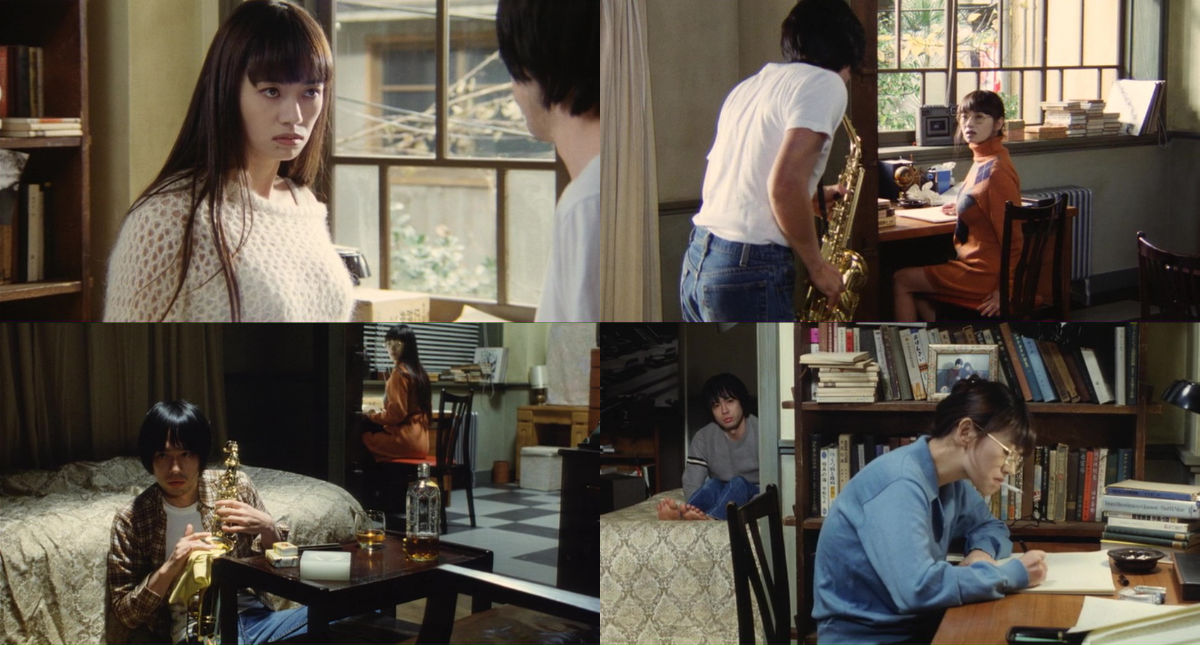
Born in 1949 (making her a contemporary of Haruki Murakami, whose world of jazz cafés and disaffected twenty-somethings she shares), she moved to Tokyo after winning recognition for some of her early writing, and there became a stage and film actor, as well as posing for the art-and-bondage photographer Araki. (That’s her, by him, on the cover of Terminal Boredom.) She was apparently introduced to SF in 1970, and began publishing it starting with “Trial Witch” in S-F Magazine in 1975. Her writing career seems to have gone into overdrive after the death of her ex-husband, the experimental jazz saxophonist Kaoru Abe, with whom she had a daughter. (A 1992 novel and 1995 film, Endless Waltz, depicted a fictionalised version of the couple’s stormy relationship.) Her health declined, though, and she eventually took her own life in 1986.

Scenes from Endless Waltz (1995) – much honking of free jazz, but little about Suzuki’s writing

Terminal Boredom, published this year by Verso Books, is her first English-language collection, with seven stories by almost as many translators (Daniel Joseph, David Boyd, Sam Bett, Helen O’Horan, Aiko Masubuchi, and Polly Barton). There’s no indication of when the Japanese originals first appeared, which is a pity, as I like to at least guess at a writer’s development from knowing which are the earlier stories, but perhaps seven stories is too small a selection for that, anyway.

The opening story, “Women and Women”, is set in a future where “Women have been left carefully husbanding the scant resources of a planet stripped bare by men.” The few remaining males — essential for purposes of reproduction — are housed in an area known as the GETO, the Gender Exclusion Terminal Occupancy Zone. Suzuki gets round the traditional SF exposition problem by having her narrator, a teenager in this mostly-manless world, share the sort of wildly speculative myths about adulthood teenagers in any age do. To her, “Men are an offshoot of humanity… but they’re a deviant strain. They’re freaks…”

“Which is exactly why the males have to be kept in the GETO. If they were allowed to roam free, the radiation or whatever it is they emit would make all the women around them pregnant.”

But when she sees what she just knows to be an actual boy, of her own age, passing her home one night, she’s fascinated, and starts leaving messages for him to find.

Suzuki, from the cover of a Japanese collection

Male-female relations — always of a distinctly ambivalent kind, making me think of a less intense version of that from Angela Carter’s Heroes and Villains — form the core of the book’s preoccupations, but it soon becomes clear the emotional disconnection that characterises these relationships extends to those between women, too. For instance, in “You May Dream”, the narrator too-casually agrees to the request of a friend, whom she spends most of the time feeling vaguely irritated by, to enter her dreams. This is a future where over-population has resulted in lottery-chosen people being suspended in cryosleep until enough spaceships can be built to take them off-world. Sleepers can bond with one chosen person and take up residence in their dreams. The narrator thinks of her friend as her opposite, even her Jungian shadow, which might make her sound like ideal dream material, but it turns out they’re totally incompatible: “She infused a syrupy wetness into my world.” The narrator soon finds herself reluctant to sleep, because of the burden of her friend’s too-different personality.

Perhaps the best story for capturing Suzuki’s tone is the last one, “Terminal Boredom”, set in a future where mass unemployment has resulted in a habitually bored young populace too unmotivated to remember to even feed themselves regularly. “Everyone,” the narrator says, “lives in a happy-go-lucky depression”, more (but only slightly more) engaged in what they see on TV than in reality:

“Ever since I’ve been old enough to really understand the world (these past two years or so), I’ve never once cried at a scene in real life. Whenever something serious happens, I just convince myself it’s no big deal… I’ve been fooling myself this way for long enough that it’s become a habit, and now nothing affects me.”

When a woman is murdered right next to her and the boyfriend she mostly can’t be bothered to meet, they can’t quite grasp what has happened, until they see it again, on camera. It starts to feel like the sort of world J G Ballard was always predicting — a future of boredom through enforced leisure relieved by explosions of violence — only, it doesn’t have the levels of wealth he assumed would go with it.

Suzuki’s is a world that seems particularly post-counter-cultural. The book flap describes her stories as “punky and pitch-black”, but the punkiness is most definitely of the “pretty vacant” rather than pogo-dancing variety. Characters don’t have friends so much as people they habitually hang out with, and get vaguely irritated by, though not enough to make them seek out other people:

“What are your relationships usually like?”
“Totally throwaway. I anticipate the break-up and hint towards it to prepare for a smooth exit.”

Japanese cover to her 1978 collection, Women and Women

Some of Suzuki’s characters (if not all of them, at some level) are just as dissociated from themselves. In “Smoke Gets In Your Eyes”, one of the narrators is a woman prematurely aged by a drug she overused, who approaches the still-young man she once had a relationship with, only to find he doesn’t recognise her, or at most thinks she might be his ex-girlfriend’s mother. In “That Old Seaside Club”, the narrator says she’s 19, but is haunted by a failed adult life she surely has not yet lived. “Night Picnic” is about a family who think of themselves as the last surviving human beings on a distant, non-Earth planet, desperately trying to cling to supposedly authentic human ways my mimicking what they see in old movies and read in old books. (As all the cultural references in this story were American, I wondered if this might have been a satire on US culture taking over Japan’s.) In “Forgotten”, the key difference the narrator’s alien boyfriend notes between humans and his own kind is that humans forget while Meelians don’t, which is why “we haven’t had a war on my planet for two millennia”. “Whose life is this? It’s completely empty,” says one narrator, of her own life, and it’s a quote that could fit any of her stories.

I’d like to read some more stories by Suzuki, though perhaps I wouldn’t read them back-to-back, as that malaise of disaffection can be hard to read too much of. A biographical introduction would be nice, too.

(Another story, “The Walker”, translated by Daniel Joseph, is available at Granta, though it’s quite different in feel from all the stories in Terminal Boredom.)

Suzuki’s 1978 collection, Teatime Anytime, in the only scene from Endless Waltz that shows her books

^TOP

Joyland and Later by Stephen King

Hard Case Crime was founded in 2004, to revive the good old days of hard-boiled crime fiction, bringing out obscure books from the genre’s classic authors and new works from current writers, packaged with painted covers in a gleefully lurid pulp look. Publisher Charles Ardai thought a cover-quote from Stephen King would draw readers to their stable of what were mostly little-known names, and sent him (via his accountant, apparently) a parcel of their books. King came back not with a quote but an offer to write a novel for them. The Colorado Kid (which I’ve not read) came out from Hard Case in 2005, followed by Joyland in 2013, and Later in 2021. While The Colorado Kid is purely a crime story, the latter two novels feature at least a touch of the supernatural (it’s mostly peripheral in Joyland, but central to Later), and I recently read these two, intrigued to see what King made of the hard-boiled crime genre.

cover by Glen Orbik

Joyland is set in the summer of 1973, when 21-year-old Devin Jones, newly heartbroken after his first serious girlfriend dumps him, gets a summer job at Joyland, a North Carolina amusement park. He mucks in with everything from mopping out ride-cars to “wearing the fur” (dressing up as the park’s mascot, Howie the Happy Hound), and during his time there saves two lives thanks to skills picked up in a basic first-aid course. He also learns that the park’s Horror House ride (“There’s no Tunnel of Love at Joyland, but Horror House is most definitely the Tunnel of Grope”) is haunted by the ghost of Linda Gray, killed by a recently-acquired older boyfriend — a man who, it turned out, had killed other women at other amusement parks over the preceding years and comes to be dubbed the “Carny Killer”. All that’s known about him is he had a bird’s-head tattoo on his hand, and wore two shirts on the night so he could cast off the blood-soaked one after cutting Linda’s throat.

When his friend Tom sees Linda’s ghost, love-gloomy Dev puts off college and stays on at Joyland after the tourist season, intent on seeing her for himself. He gets to know Annie, daughter of a wealthy radio-preacher and faith healer, and her son Mike, who has Duchenne Muscular Dystrophy and is unlikely to see out his teenage years. Annie has broken with her father (who saw Mike’s disease as God’s punishment for Annie’s sinful ways), and was, in her youth, a prize-winning sharp-shooter — something you just know is going to come in handy plot-wise. Mike, meanwhile, has second sight. His mother calls it his “intuitions”, but Mike knows there’s a ghost at Joyland without having been there, and thinks he can free her.

cover art by Paul Mann

In Later, the ghost-seeing kid is not a secondary character but the narrator. This is Jamie Conklin, who regularly sees dead people. They look just like normal people, but only he can see and talk to them. They linger for a few days after they die (looking exactly as they did at the moment of death, gruesome wounds and all), and always answer truthfully when asked a question. This proves an advantage when Jamie’s mother, a literary agent hit hard by the financial crash of 2007–2008, has her one cash-cow author, Regis Thomas, die before he’s finished the last book in a bestselling series. She gets Jamie (whose ability she believes in but doesn’t usually encourage) to quiz Thomas about what was going to happen in the book, then writes it herself and claims Thomas finished it just before he died, thus saving herself from bankruptcy. Also present at that moment is Jamie’s mother’s then-lover, cop Liz Dutton. Liz gets ousted from Jamie’s mother’s life after she brings drugs into the house (she’s couriering it for extra cash), but turns up to “borrow” Jamie when she needs to use his talents. A serial bomber, known as Thumper, has recently died, but not before planting one final time-bomb. Liz gets Jamie to quiz the dead man’s ghost so she can come up with the goods and save her failing police career, and Jamie learns that what he thought he knew about the dead isn’t true all the time, and that this dead man might be more than a little demonic…

hard back cover art by Glen Orbik

Thematically, Joyland is perhaps best summed up in the narrator’s own words: “Love leaves scars.” Dev is scarred by the loss of his first girlfriend; Annie is scarred on the one hand by a severe lack of parental love, and on the other by her deep love for a son who’s going to die; and Linda Gray, of course, is more than scarred by the secret new “boyfriend” who took her into the Horror House then cut her throat — after which she lingers, a love-scar on Joyland itself, a ghostly reminder of the dark side of fun-land.

Later is about the scars of life — particularly adult life — generally, and how some survive what life throws at them, while others go under. Jamie’s mother is hit by both the financial crash and her own alcoholism, though she fights both and gains a new, surer stability at the end. Liz Dutton, however, goes the other way, graduating from the alcoholism she initially shares with Jamie’s mother to drug addiction, then corruption, and finally becoming part of the dark side, the drug-supply network itself. Jamie, a kid at the start of the novel, who progresses to early teens by the end of it, is faced with a too-early introduction to all these adult secrets and life-messiness. He certainly sees some pretty dark things in the book’s final section, in the home of a drug baron with some nasty predilections.

In both books, I think, the most interesting character isn’t the narrator, nor the kid-who-sees-ghosts, but one of the female characters. Annie Ross in Joyland is spiky at first, and slow to warm to Dev, but obviously devoted to her dying-but-full-of-life son. It’s the hard-won characters who are often the most intriguing. Liz Dutton in Later is a woman making her unintended way down the path of evil, but is never too far gone that she isn’t a recognisable human being (when most of King’s more villainous types, once they become evil, also become pretty much inhuman). She’s always working on a plan to set everything right, if she can just get her head above water, but instead only gets in deeper and deeper every time.

art by Gregory Manchess

It’s interesting King started off his involvement with Hard Case Crime by writing a straight crime novel, but soon brought on the kids who see dead people, as if he just couldn’t hold back the Stephen King-ness any more. In fact, I’d say neither book really fits what I assumed was the hard-boiled crime narrative Hard Case seems to peddle, and are closer to just normal King novellas, like those collected in Different Seasons. (“Apt Pupil” from that book would certainly make a better fit with Hard Case, I think.) But, they’re still fun — and short (for King) — novels. Later even seems to join up with It when it brings in the “tongue-wrestling match” of the Ritual of Chüd as a means for defeating demonic entities. (And this is, apparently, based on an actual idea in Tibetan Buddhism, of “Chöd”, a means of achieving enlightenment through self-induced terror.)

Neither book has the mystery-thriller-style tight plot I was expecting from Hard Case Crime’s pulp styling — Joyland is still setting up characters at the halfway point, and Later feels quite episodic, though both have satisfying conclusions — but they’re certainly readable in the usual King manner. I’m tempted to try out a book or two from Hard Case’s other writers, if only for more of those wonderful covers.

^TOP