The Turn of the Screw by Henry James

Henry JamesThe first time I read The Turn of the Screw, I hated it. I hated the over-stuffy prose, which seemed to be hiding a good ghost story behind thickets of Victorian verbiage so tangled the only emotion to get through was the most insistently hysterical. The characters seemed nothing more than embodiments of the era’s most conventional attitudes: the oh-so-angelic children, the distant, paternalistic gentleman-employer who of course knows best about everything, the loyal housekeeper with an unquestioning faith in her superiors, and the governess, a wide-eyed innocent country parson’s daughter on her first adventure out into the world…

And then, on a recent re-read, I realised this was, of course, the point. The story, told by the governess (that country parson’s daughter on her first adventure into the world) is infused with her hysterical insistence that things be as the Victorian world liked to pretend they should be, precisely when they’re revealing themselves to be the opposite. Those thickets of Victorian verbiage are her way of trying to keep a destabilised world in check, a world in which children aren’t little angels but human beings (and so can seem, at times, like devils); a world in which distant paternalistic gentleman-employers don’t know best, but simply don’t care; a world in which some servants aren’t so unquestioning and loyal.

turn-of-the-screw-01I suppose what wrongfooted me on that first read was I expected The Turn of the Screw to be a ‘straightforward’ ghost story (which was the only type I’d read, at the time). By this I mean a story in which a normal world is invaded by the supernatural. To make this sort of ‘straightforward’ ghost story work, you need characters who are straightforwardly normal, whose very normality acts as a baseline to which the abnormality of the supernatural can be compared. But The Turn of the Screw isn’t of this type. It is, I’d say, one of the first truly modern ghost stories, whose characteristic is that they tangle the supernatural with the psychological to such a degree it’s impossible to unravel the two.

The Turn of the Screw is the famous example of a ghost story that can be read entirely psychologically (the governess, coming apart at the seams, hallucinates ghosts as an expression of her own super-heated repressions) or supernaturally. As someone who doesn’t like their ghosts to be explained away, but who also likes the fantastic to feel psychologically significant, I prefer to read it as the perfect meeting of haunters and haunted — a pair of ghosts who, though real, fit exactly into the dark cracks of an unhinged, still-living mind. The governess, in The Turn of the Screw, is as much a monster as that ‘horror’, the dead manservant Peter Quint, only she’s a monster of the opposite extreme: Quint is ‘much too free’; the governess is as tight-laced and primly judgemental as any inexperienced, over-romantic Victorian pastor’s daughter can be. And whereas Quint is transgressive of all boundaries — between the classes, between the sexes, between adult and child, and, now, between life and death — the governess insists on everything being filed way into the absolute, binary opposites of her age: people are either ‘gentlemen’ or they are ‘horrors’, children are ‘angelic’ and innocent or ‘corrupt’. While eight-year-old Flora is at first ‘the most beautiful child I had ever seen’, she is, at the end, ‘hideously hard… common and almost ugly’.

It’s the governess’s relationship with the housekeeper, Mrs Grose, that’s key to both her personality, and my own initial reaction against the novel. Once the governess realises she can, effectively, bully Mrs Grose into agreeing with her, she’s constantly finishing Mrs Grose’s sentences, forcing her own (often wild and illogical) interpretations on what Mrs Grose has seen, heard, or suspects, as though they were the only possibilities:

‘He was looking for someone else, you say – someone who was not you?’

‘He was looking for little Miles.’ A portentous clearness now possessed me. ‘That’s whom he was looking for.’

‘But how do you know?’

‘I know, I know, I know!’ My exaltation grew. ‘And you know, my dear!’

Turn_of_the_screw_02This is what I found so repellent about the book that first time I read it — the governess isn’t merely hijacking Mrs Grose’s point of view, she’s hijacking the reader’s too. No room is left for any doubt that those infamous horrors, Peter Quint and Miss Jessel, are seeking to corrupt the children, and that the children are willing accomplices. And, while the governess herself freely corrupts Mrs Grose with her own hysterical insistence, she knows she can’t put words into the children’s mouths. The Turn of the Screw becomes a battle with silence — with, in a way, a sort of tortured social propriety, in which the only way to find out if something awful has happened to the children is to suggest that awfulness, but to do that is to potentially ruin what is (to the governess’s mind) most valuable about them, their innocence. So they must be made to speak without prompting, and the more they refuse to do so, the more the governess, in her twisted way, takes the children’s silence as proof of their corruption. Silence, in The Turn of the Screw, becomes a palpable thing, identical both with the ghosts (‘the silence itself — which was indeed in a manner an attestation of my strength — became the element into which I saw the figure disappear’) and with horror, too:

‘Not a word – that’s the horror. She kept it to herself! The child of eight, that child!’

The governess herself is bound to silence: by the children’s uncle, who wants someone to look after his niece and nephew and not bother him, but also by her society, that expects women to have no voice, and children to be ‘seen and not heard’. Miles’s expulsion from school is because of his saying unspecified ‘things’ (and he later steals a letter, from the governess to the uncle, which was itself an attempt to break a silence). Words are how innocence is corrupted. But, at the same time, confession — breaking silence — is linked with salvation:

‘I’ll get it out of him. He’ll meet me. He’ll confess. If he confesses he’s saved.’

The governess exists in a weird duality with the ghosts. She first sees Quint standing in the tower where she was standing some time before; when she next sees him, through a window, she feels compelled to go outside and stand where he stood, looking in, like two chess pieces chasing one another round a board. She sees Miss Jessel at the foot of the stairs, crying, then later finds herself in the same place, in the same turmoil. When she sees Miss Jessel sitting at the teacher’s desk of the schoolroom where she herself usually sits, the words she comes out with — ‘You terrible, miserable woman!’ — could be her own judgement of herself. Quint is the shadow image of her over-romanticisation of the children’s uncle; Miss Jessel is an image of her own possible ruin. The governess’s utter inability to see herself for what she is (those windows she keeps seeing Peter Quint through could be acting as mirrors), her inability to break a silence she shares with herself, are what makes her monstrous.

OWC DraculaLike the other great horror stories that came out at the time — that embarrassment of graveyard blooms from The Strange Case of Dr Jekyll and Mr Hyde, to Dracula, The Picture of Dorian Gray, and H G Wells’ science-fictional horrors, The War of the Worlds, The Invisible Man, and The Island of Doctor MoreauThe Turn of the Screw gets its power from a new awareness of how our inner lives can entangle us with dark powers, creating far more complex relationships with the horrific and supernatural than merely that of fear. The end of the Victorian era thus saw the creation of a set of stories that have proved fertile for more than a century of ongoing adaptations and reimaginings. Thanks to Freud and co., those Victorian times came to symbolise, in a way, repression itself. The governess of Henry James’s The Turn of the Screw is perhaps, then, the perfect Victorian monster, so deeply does she embody the strictures, mores, prejudices, idealisations and judgements of what we now tend to look on as an over-straitened age; but she also presents a rich portrait of human self-blindness that continues to be relevant well into the present.

^TOP

Dark Matter by Michelle Paver

Something I learned from Michelle Paver’s Arctic ghost story, Dark Matter, is that the word ‘haunted’ derives from the Old Norse ‘heimta’, meaning ‘to bring home’, and the Old English ‘hamettan’, ‘to give a home to’. Which adds a certain significance to the words of her protagonist, Jack Miller, as he writes in his diary:

‘I never expected this, but I feel at home here. I love Gruhuken. I love the clarity and the desolation. Yes, even the cruelty. Because it’s true. It’s part of life. I’m happy.’

dark-matter-by-michelle-paverGruhuken is an isolated spot on the Arctic coast, where Jack Miller has travelled as part of a scientific expedition (ill-fated from the start, as accidents and bereavements prevent two of its five members from reaching it). For four of the five — public school friends Gus Balfour, Algie Carlisle, Hugo Charteris-Black and Teddy Wintringham — it’s something of a jolly adventure, but for middle-class-and-failing Jack Miller it’s a last chance. Stuck in an eight-year Slough of Despond since the pre-World War II financial slump meant that the best he could do with his degree in physics was land a place as a stationer’s clerk, Miller is perhaps on the edge of contemplating suicide, which may be why he feels so at home when he finally reaches the bleak Arctic (‘That first sight of it. Like a blow to the heart. The desolation. The beauty.’): it looks like the world feels to him. But by the time he reaches it, his resentment has started to thaw, as he finds something in the rather boyish expedition leader, Gus, to like, even admire, despite his own bitterness at Gus and co.’s cheery acceptance of their own privilege.

Of course, it can’t last. Gruhuken is haunted. Like Elizabeth Hand’s Wylding Hall, Paver solves the two main problems of the haunted house story: she’s got her mixed bunch of people to her ghost-friendly, isolated location, thanks to their embarking on this scientific expedition to a land where it becomes solid night for four months of the year, and where they’ll be too remote from the nearest human settlement for immediate help; and she’s going to keep at least one of them there no matter what, as Jack Miller feels this is his only shot at fixing the dreary despair his life has slipped into, a feeling that mixes inextricably with a need to win boyish Gus’s admiration — plus, of course, a rational man’s sense that an ordered life and a strict routine ought to be all he needs to keep him from going doolally.

Dark MatterThe Arctic is established as a place that brings out the bleakly practical, if not the basely savage, in man. We see Algie skin and gut a still-living seal, then talk casually about bashing out the huskies’ back teeth to stop them chewing through their leashes. This is a world on the brink of the Second World War, which will be full of man’s (industrialised) savagery to man, but human nature’s no different here, far away on the Arctic coast, as Miller begins to sense. A man came here some time ago, and ‘He was ugly, and he had that abject manner which brings out the worst in people, particularly men.’ As such he might be an exaggerated image of Miller’s own idea of himself, downtrodden and feeling that he deserves what life has thrown at him; while the rage he senses emanating from the thing that lingers in Gruhuken could well be his own resentment towards what life has done to him. Ultimately, you’re only ever haunted by yourself; you bring your own ghosts with you, that’s why you feel so at home.

Like so many modern ghost stories, here the haunted are surrounded by scientific paraphernalia — usually this is deliberately for the sake of detecting the ghost, as in, for instance, Nigel Kneale’s The Stone Tape (1972), or 2011’s The Awakening. In Dark Matter, the scientific equipment is for taking measurements related to the weather, and nothing to do with the ghost at all, but it’s perhaps significant that Miller’s final descent into all-out terror begins when an accident destroys his last remaining timepiece, Gus’s travel clock, which simultaneously breaks his connection to Gus, the civilised world, rationality, and time itself.

It’s the descriptions of the Arctic that really make Dark Matter work. It really feels like a land of extremes, so wild and bleak and inhuman it might be as far as away Mars, and just as inhospitable — where a single mistake, like forgetting to light a lamp, or knocking one over, can lead to a stark and inevitable death. The one thing I can’t get out of my head, though, is the ‘bear post’ — a relic of a previous encampment, it seems to embody everything the book’s about, from Algie’s rather casual cruelty to animals, to other men’s un-detailed cruelty to one of their own kind (‘When men know they won’t be found out, they will do anything.’). Never fully explained, this brutally simple object accrues far more horror than even the ‘gengånger’ — ‘the one who walks again’ — with its ‘wet round head’ does.

^TOP

The Whispering Swarm by Michael Moorcock

michael-moorcockI’ve never really got Michael Moorcock, not in the same way I feel I ‘get’ my favourite authors, like Ballard, Lovecraft, Ramsey Campbell, David Lindsay or Clark Ashton Smith. I feel I know where, for instance, Ballard is coming from, what drives his writing, even though Ballard’s upbringing in pre-World War II China, and his adolescence in a Japanese POW camp, is utterly unlike my own — perhaps even because of this difference, as then the story is so much more easily presented as a ‘myth of writerly origin’, and so therefore more understandable. Perhaps it’s because I don’t know Moorcock’s ‘myth of writerly origin’ that, though I’ve read a fair smattering of his books — Wizardry and Wild Romance, the early Elric books, the Corum books, the Hawkmoon books, the Kane of Old Mars books, The Black Corridor, Gloriana, The Golden Barge, The War Hound and the World’s Pain, The Brothel in Rosenstrasse, The Deep Fix, The Coming of the Terraphiles, and the interview book Death Is No Obstacle — I still don’t have a sense of where he’s coming from, as a writer, what he means as a writer. (This is perhaps just a peculiarity of mine, but I do respond better to authors who seem to be writing as a means of dealing with the aftermath of some originating crisis, however vague. Moorcock has always seemed free of this, leaving me feeling I’ve got nothing to grab hold of.)

The Weird of the White Wolf, Michael Whelan cover

The Weird of the White Wolf, Michael Whelan cover

Nevertheless, Moorcock’s been a constant presence. When I began to venture away from the Doctor Who books in our local WH Smiths to the adult SF & Fantasy section, I found it fully stocked with Moorcock. Moorcock introduced me to Hawkwind — he mentioned them in an interview in Imagine, the D&D magazine, so I checked them out. (An interview in which he also seemed to be rather dismissive of role-playing games, just as he seemed, on a first read, to be dismissive of fantasy in Wizardry and Wild Romance. I was beginning to feel Moorcock wasn’t entirely on my side.) Hawkwind got me into Ballard, though I could have got into Ballad just as easily from Moorcock himself; and Moorcock was also the reason I read Fritz Leiber and Robert Holdstock and Mervyn Peake. Plus, how could I resist those Elric books, with their Michael Whelan covers — and titles like The Weird of the White Wolf or Sailor on the Seas of Fate?

Nevertheless, he remained a mystery. Which is why, when I heard he was writing a mix of autobiography and fantasy trilogy beginning with The Whispering Swarm, I knew I had to read it. Perhaps the answer to Michael Moorcock was to be found in there.

And… some answers were. (But it is only the first in a trilogy, after all.)

Let’s start with the obvious one. Perhaps one of the reasons Moorcock never quite snapped into focus for me like the more monomaniacal Ballard is that he’s always been switching between states. He bashes out sword and sorcery novels in three days, then spends years on long literary series, like the Colonel Pyat books (which I gave up on). Which is he, then, the fantasy pulpster or the literary novelist? Why, both of course:

“I was already conscious of two different kinds of author in me. One was practical, able to make money commercially. The other was predominantly analytical, experimental and not at all commercial!”

(He also says, “Balzac was one of my heroes because he did reams of hackwork before doing reams of ambitious, innovative fiction.”)

It should be obvious, really, that Moorcock is all about swinging between two opposites — just think of the eternal battle between Law and Chaos in the Eternal Champion books. Is this the image of Moorcock’s own inner world? It quickly becomes clear that Moorcock, in The Whispering Swarm, is also struggling with a need to achieve a balance of sorts. He even achieves it at one point in the novel:

“By 1969 I had everything in some sort of balance. Two lives, two wives, two children, two careers…”

michael_moorcock_whispering_swarm_gollancz_coverOf course, this isn’t necessarily Michael Moorcock the writer speaking; it’s the narrator of The Whispering Swarm. Who is also called Michael Moorcock, and who shares a lot of biography with his author. Both grew up in post-WWII London, both begin editing Tarzan Adventures at the age of 17, both go on to write SF and sword & sorcery, and to edit New Worlds. Precisely where the real and the fictional Michael Moorcock part ways it’s difficult to tell. Mostly, Moorcock is free with his use of real people’s names — and there are plenty he rubs shoulders with in 50s and 60s London, from Colin Wilson (“People had brought Colin and me together because they saw us as enfants terribles but we didn’t have a lot in common. I got on better with Colin’s friend Bill Hopkins”), Barrington Bayley, actor Jon Finch — which is perhaps why it took me a moment to work out who Jack Allard was. Jack Allard, who in the book is a close ally in Moorcock’s vision for the revamped New Worlds, Jack Allard who’d spend his childhood in German-occupied Guernsey… And then there’s Rex Fisch, and Jake Slade… JG Ballard, Thomas M Disch, and John Sladek, of course! Why this slip into such obvious pseudonyms? Perhaps so Moorcock is a bit more free to talk about them, though why a judgement such as this, of Allard:

“I eventually realised that the only fiction he liked was his own. Meanwhile, he wrote brilliant, lyrical, existentialist stories which were a bit like Ray Bradbury, a bit like Graham Greene and were as original as anything the genre had ever seen…”

— shouldn’t be made quite freely of the real J G Ballard, I don’t know. It doesn’t surprise me that Ballard would only really be interested in his own fiction, monomaniac of the imagination that he was. Moorcock does provide an interesting insight into my own ability to ‘get’ Ballard but not Moorcock, though, when he says of Allard:

“He had read very little, preferring to get his culture via the screen or from the radio…”

It’s obvious, from reading the early chapters about Moorcock’s youth, that I’ve more experience of Ballard’s cultural background than I do of Moorcock’s, even though Moorcock was raised in London (where “It seemed as if I could live my entire life in a bubble less than half a mile across and find everyone I wanted to meet, everything I wanted to do!”). In an odd way, Moorcock’s culture, so thoroughly rooted in the ephemeral indigenous literature of the day, is more distant, because of the Hollywood-isation of culture generally. Moorcock grew up reading about all sorts of dashing heroes, from highwaymen to schoolboys to cowboys, I’ve never heard of, whereas I’ve seen many of the films Ballard grew up on.

But there’s something more fundamentally different in the type of artist — or imagination — that Moorcock has. As opposed to those monomaniacs of the imagination, like Ballard, who I find it easier to ‘get’, Moorcock is deliberately diffuse:

“I was already fascinated by the way modern mythology took characters from different eras and put them together.”

After all, the fundamental symbol of Moorcock’s imagination is the Multiverse — or, as it’s presented here, ‘Radiant Time’:

“Most philosophers see time as a line disappearing into infinity, past, present, future… Others have it as a circle, which is much the same thing, except theoretically you return to the beginning and start all over again. All representations of time are some variation on this simple idea. But the truth is time radiates, just as light does. Let the physical world be thought a dimension of time!”

Whereas the likes of Ballard or Lovecraft or Clark Ashton Smith are constantly honing a single idea, a single obsession, Moorcock seems to be going the opposite way. As someone says in The Whispering Swarm of the forces opposed to Alsacia:

‘They see their salvation in simplicity and purification, but the world is not simple. Nor is it easily purified. God made it complex and mysterious. They want to obey man’s rules, not God’s.’

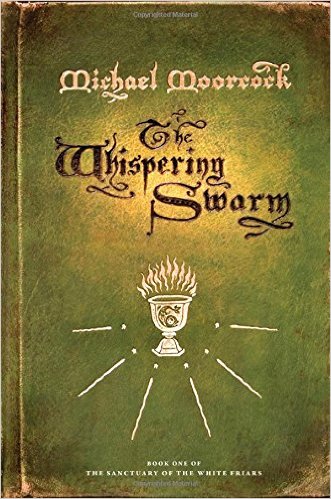
WhisperingSwarm_USAh, yes, Alsacia. All this rambling, and I haven’t got started on what the book’s about. Woven in amongst the autobiography in The Whispering Swarm is a fantasy. In this fantasy, young Michael Moorcock finds an area of London untouched by the blitz, peopled by a ragtag group of ‘Actors, vagabonds, cheapjacks, rum pads and balladeers’, most of whom dress like figures from English history, including highwaymen and cavaliers, not to mention a certain well-known trio of French Musketeers. There’s also a bunch of monks, the White Friars, who have a number of interesting treasures in their possession, including a chalice which, when lit by sunlight, seems to contain a sort of dancing hologram fish, and a vast cosmolabe which fills a room. Alsacia is also known as Sanctuary, which is what it offers to people of all beliefs and persuasions — not to mention time zones — but it is not always there. Once he’s visited it, Moorcock finds that, when he’s not in it, his hearing is bothered by a sort of tinnitus, a constant muttering of voices he comes to term ‘the whispering swarm’. Alsacia becomes a second home — literally, as he sets up a ménage there with the highway-robber Moll Midnight, when he needs to escape from his ‘real’ home life. It is, like Tanelorn in the Eternal Champion books, a neutral ground, a longed-for place of balance.

But it is not a place of escape. Throughout the book, Moorcock is constantly questioning the nature of Alsacia, and whether he should be going there. Is it a delusion? Is it immoral? It gives him almost as much domestic trouble as he’s escaping from in his real family — a family he longs for when he’s away from them as much as he longs for Alsacia when he’s not there. It’s difficult to decide, in fact, what Alsacia represents, as it isn’t a fantasy refuge from reality (he quite often spends his time there hacking out fantasy books, just as he does in the real world).

Wizardry & Wild Romance cover

Wizardry and Wild Romance, Gollancz (1987), cover by Les Edwards

But, this is only book one. After rather too much (in my opinion) questioning the nature of Alsacia, then going there, then vowing to give it up, then giving in and going back only to start questioning again, Moorcock gets involved in a trans-temporal adventure to rescue King Charles from execution in Oliver Cromwell’s day — something Moorcock enters into despite his own political beliefs (‘the day a tyrant was made answerable to his people, the world was set on a very different course. The idea of the modern democratic republic was born’), but more from a feeling of fellowship with the various highwaymen and exiled cavaliers he falls in with. They need Moorcock for his ability to travel the ‘Moonbeam Roads’ that connect Alsacia with various bits of our history — as well as histories not ours (as evinced by an early adventure where Moorcock aids Moll Midnight in highway-robbing an armoured tram).

My favourite parts of The Whispering Swarm were the obviously autobiographical elements I could recognise: Moorcock’s time taking over the reins of New Worlds and gathering a stable of like-minded writers around him, while participating gleefully in swinging-sixties London. The fantasy novel part took longer to fire, for me, and it was only really at the adventurous conclusion that it really hit upon a story, rather than an endless questioning of the nature of Alsacia, and Moorcock’s own moral doubts about his relationship with it. I look forward to the second volume, though, in the hope it will illuminate, if not the mystery of Alsacia, then at least the mystery of Michael Moorcock.

^TOP