Marianne Dreams and Paperhouse

Marianne Dreams, from Faber & FaberCatherine Storr’s 1958 novel Marianne Dreams contains a perfect example of what Humphrey Carpenter calls the “Secret Garden”, found in so many classic kids’ books from Alice in Wonderland onwards — those Arcadian pocket-worlds that encapsulate an idealised childhood, part fantastic imagination, part golden-tinged nostalgia. In Storr’s book, the “Secret Garden” is a dream world 10-year-old Marianne creates through drawings made in her waking life. Bed-bound for weeks after an unspecified illness, she finds a special pencil (“one of those pencils that are simply asking to be written or drawn with”), thereafter referred to as The Pencil, in her grandmother’s button box. With it, she draws a standard child-style house, and when she sleeps, dreams of walking up to this very house, but being unable to get in. When she wakes, she adds a knocker to the door, and, for someone to answer it, a face at an upper window. Both details have been added to the house when she next dreams, but the boy at the window can’t answer her knock because the house has no stairs inside and (something he doesn’t admit immediately) he can’t walk. So Marianne starts working on interior drawings, too. In her waking life, because she can’t attend school till she’s well again, she’s being taught by a governess, who mentions another home-visit pupil, a boy called Mark whose illness has left him too weak to walk. When Marianne learns the boy in the dream-house is also called Mark, she realises her dream world isn’t entirely her own.
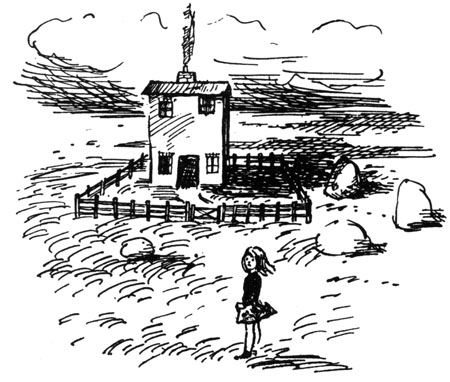
Marianne in the dream-world. Illustration by Marjorie-Ann Watts

Marianne in the dream world. Illustration by Marjorie-Ann Watts

In the dream world, though, the two children don’t exactly hit it off. Both are tetchy from being bed-bound for so long, and Mark is resentful of the idea he might be living in a world Marianne has created. After a particularly heated spat, she punishes the dream-Mark by scribbling him out (though this only puts bars over his window) and, worse, by adding a single, watching eye to each of the boulders she drew outside the house. When she next dreams, she finds Mark terrified of “THEM”, the watching rock-creatures crowding the house. Regretting her anger, but unable to undo it (what she draws with The Pencil can’t be erased), the story comes to be about Marianne encouraging Mark to regain the physical strength and will to walk so they can escape the house and the watching, threatening presences.
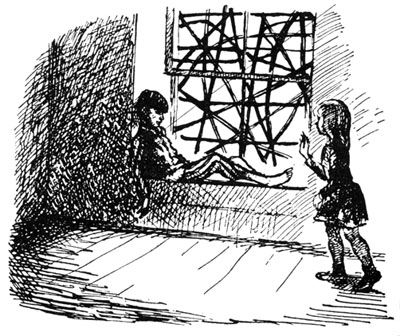
Marianne and Mark. Illustration by Marjorie-Ann Watts

Marianne and Mark. Illustration by Marjorie-Ann Watts

Aside from its dream world fitting neatly into Humphrey Carpenter’s idea of the “Secret Garden”, Marianne Dreams has other similarities to Frances Hodgson Burnett’s 1911 novel from which Carpenter got the name. In Burnett’s book, the slightly spoiled 10-year-old Mary Lennox, orphaned and sent to live with a reclusive uncle, discovers an abandoned, walled rose garden and in it comes to not only befriend her withdrawn and seemingly crippled cousin Colin (who, like Mark, can’t, or won’t, walk), but to engage in a wholesale healing of the family: Colin of belief in his physical frailty, herself of her spoiled nature, and her uncle of both his extreme grief over the death of his wife and his estrangement from his son. The main difference between the two novels is that, while Mary Lennox of The Secret Garden is basically working at healing the adult world (where Uncle Archibald’s mourning for his wife is the cause of all the other problems) in Marianne Dreams the focus is entirely on the children, not just in recovering from their illnesses, but in their working together to overcome the self-centredness which their long periods of convalescence have led to. There’s a feeling that they’re taking a step away from the dependence of childhood towards taking a fuller responsibility for their own lives.
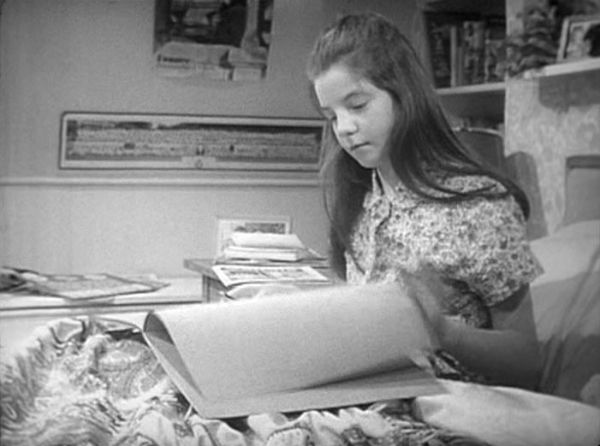
Vikki Chambers as Marianne in Escape into Night

Storr’s book has been adapted a few times. The author turned it into an opera libretto in 1999. In 1972 it was adapted for television as Escape into Night (made in colour, but only surviving in black & white). This six-part series stuck faithfully to the book — perhaps too faithfully, as the story of Marianne’s coming to understand the relationship between her drawings and the dream world inevitably leads to a lot of similar-seeming scenes, though perhaps I only feel this because I watched them back-to-back — but it also comes across as slightly darker, as, somehow, showing the bizarre one-eyed stones surrounding the house makes them that much creepier. My first encounter with the story, though, was in a very different form, the 1988 film Paperhouse.
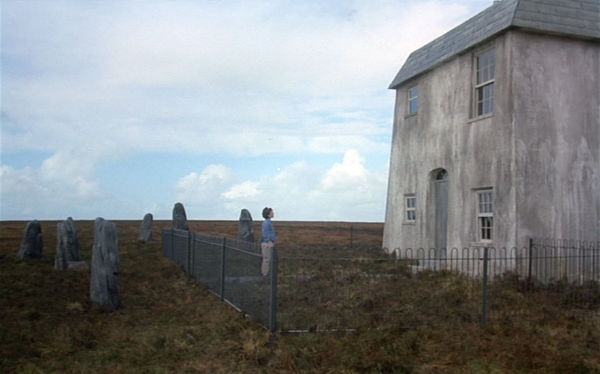
Charlotte Burke as Anna in Paperhouse

I can’t think of many children’s books which, when adapted, turn into films for adults — and I wonder if that was always the intent for Paperhouse (rated 15 in the UK), because, though it ups the scares of Catherine Storr’s novel, it doesn’t do the usual horror cliché of turning childhood itself into a scary world — there’s no tinkly toy piano music, or ghostly nursery rhymes echoing down empty corridors — so it’s still a story that’s for children rather than being about them. In fact, apart from the level of scares (always a difficult thing to judge), I think it would actually be a good film for young adolescents, as it’s very much about their experience — about the first tentative moves towards forging deeper emotional attachments away from mum & dad, and about the tug-of-war between growing up and remaining a child. (Now I come to think of it, the two main characters’ lingering in bed after their illnesses could well be a metaphor for lingering in a state of dependent childhood, putting off the first steps into independence and adulthood.)
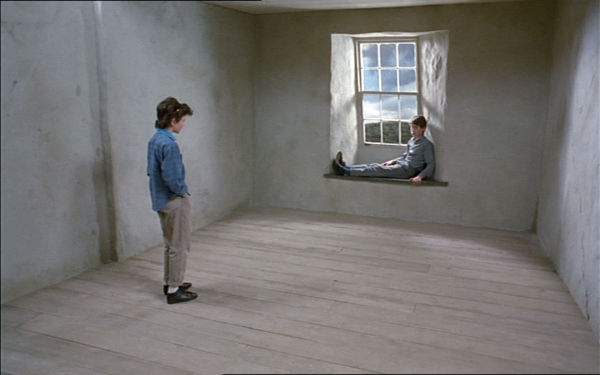
Anna and Marc (Elliott Spiers)

Marianne from Storr’s novel is now Anna, a girl very much on the verge of adolescence. One moment she’s bunking off school to try on makeup and ask her friend about snogging (“Like kissing a vacuum cleaner”), the next she’s playing hide-and-seek. In contrast to the book (where the mother is pretty much a cipher), in the film, Anna’s relationship with her mother is strained by some very teenage tantrums. The real transformation from novel to film, though, is the father. In the novel, though he’s living at home, the father is all but absent — he pops into the story only briefly, to do those things a standard father of the 1950s was expected to do, i.e., authorise a few key decisions and knock in a nail. In Escape into Night, his irrelevance to the plot is smoothed over by having him working abroad. In Paperhouse, not only is he working abroad, but Anna is torn between feeling abandoned by him and being grateful he’s not there because of how he scares her sometimes when he drinks. In the film’s dream world, the stones-with-eyes (“THEM”) central to the novel’s sense of threat are replaced by a blinded father figure wielding a hammer. (This, more than anything, must be what makes it a 15 certificate, the way it turns the threat into a very real, domestic one, rather than a generalised, fantasy version of anxiety.)
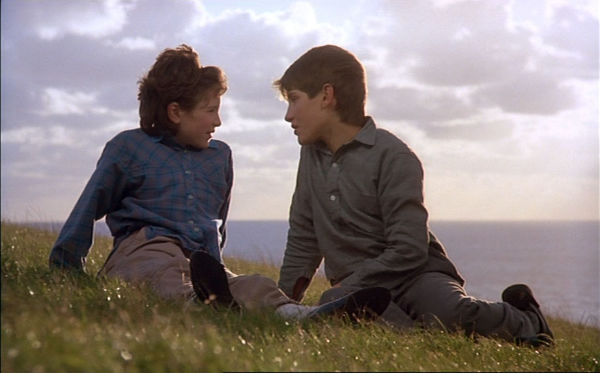
All this brings a muted aspect of the novel to the fore. Anna’s ambivalence about her father is an ambivalence about males in general. Sitting up in bed after a checkup from the doctor (here, a woman — Anna’s world, including teachers and friends, is almost entirely female), she says, “I don’t like boys,” then immediately adds one at the window of the house she’s drawing, as though her unconscious has other things to say on the matter. Far more powerful than the horror element of the film is the sense that Anna is learning to transfer the complex feelings she has for her father to a more fitting male figure of her own age. Paperhouse’s scares and dream world shocks can seem a bit over the top — as can Anna’s teenage histrionics, though “OTT” may well be the definition of teenage histrionics — but the film ends with a real sense of combined loss and gain, all because of how Anna has matured from a self-centred child to someone who can start to have fuller, more mature relationships.

Catherine Storr was, at the time she wrote Marianne Dreams, married to Anthony Storr, author of some of my favourite books about psychology — his The Dynamics of Creation (1972) and Solitude (1988) are both very readable and interesting delves into the complexities of two subjects Marianne Dreams also touches on: creativity (Marianne, in the novel, is not great at drawing, and her frustrations at how her lack of skill has a real effect on the dream world make up one of the novel’s strands), and the pleasures and pains of being alone.

^TOP

The Insanity of Jones and other tales by Algernon Blackwood

Algernon Blackwood, photo by Douglas

Algernon Blackwood, photo by Douglas

Of all those early-20th century weird writers (Arthur Machen, M R James, Lord Dunsany, H P Lovecraft, Clark Ashton Smith), Algernon Blackwood seems the most difficult to really know. Reading Lovecraft — the very type of the weird writer — you can’t help being aware that HPL has a definite idea of what a weird tale should be, and that he’s doing his best to capture it in form, content, style and idea, honing his approach tale by tale, in theory and in practice. Blackwood doesn’t seem to have an aesthetic ideal; his fiction is an outpouring of all sorts of stories and styles, ghostly, adventurous, romantic, comedic. (Lovecraft himself calls Blackwood’s work “voluminous and uneven”, though says it contains “some of the finest spectral literature of this or any age”.) He does though, like Lovecraft, have a central belief that acts as the DNA that shapes and unites all his fiction — “an interest in the Extension of Human Faculty”, as he puts it — but it seems to me that, in contrast to Lovecraft’s fiction, where the best tales are usually those that most embody Lovecraft’s stated ideals, those where Blackwood most explicitly captures his views on “extended or expanded consciousness” are usually the least successful as fiction. Fortunately, Blackwood has another force driving the production of his stories, and it’s where this is most evident that he’s at his best.

In his introduction to The Insanity of Jones and other tales — a selection of his fiction written between 1906 and 1910 —  Blackwood says:

“I recall, anyhow, that these tales poured from me spontaneously, as though a tap were turned on, and I have often since leaned to the suggestion that many of them derived from buried, unresolved shocks… These ‘shocks’ had come to an exceptionally ignorant youth of twenty who had drifted into the life of a newspaper reporter in New York after a disastrous cattle-farm and a hotel in Canada, and the drifting had included the stress of extreme poverty and starvation… the New York experiences in a world of crime and vice had bruised and bludgeoned a sensitive nature that swallowed the horrors without being able to digest them, and… the seeds thus sown, dormant and unresolved in the subconscious, possibly emerged later — and, since the subconscious always dramatises, emerged in story form.”

The best of the tales in this book are those most obviously rooted in real experience and vividly-created, authentic-feeling settings. The weird desolation of the wilds of the Danube in “The Willows”, and the truly vast and primal wilderness of Canada in “The Wendigo” are two obvious ones, but Blackwood isn’t only a wilderness man. The Insanity of Jones and other tales by Algernon BlackwoodThe New York of “Max Hensig”, with its evocation of the alcohol-sodden, sleep-deprived world of city reporters is just as convincing — and gripping — an environment. Elsewhere, although Blackwood can be poetic (as in, say, “The Dance of Death”, or “The Old Man of Dreams”, which mostly work because they’re short), the difference begins to tell in those stories written purely as stories rather than outpourings of genuine experience (“Miss Slumbubble”, in which an overly-anxious woman finds herself trapped in a haunted train carriage, or “The Insanity of Jones”, where a young clerk is given the chance to enact a karma-free revenge on a man who tortured him to death in a previous life) are the least substantial, and least convincing.

The key (with all weird writers, I suspect, particularly those who have a philosophy to expound) is mystery. Whatever a writer’s beliefs, while they’re conjuring the mystery — the awe, the fear, the terror, the wonder — they include us all, but as soon as the explanation arrives, the portcullis clangs down. The perfect example is Blackwood’s “May Day Eye”, which starts as a vivid evocation of the borderline panic of being lost in a mile or two of English countryside as dark descends — then, suddenly it’s all technical talk of “elementals”, and it’s not convincing. The point at which this tale changes is where the narrator meets with an expert on folklore who has all the necessary explanations. Such a mouthpiece character doesn’t always appear in Blackwood’s fiction, but when he does, he usually spoils it, for me. The most obvious example is the “psychic detective” John Silence (if only he would be silent), one of whose tales, “The Camp of the Dog” is in this book. John Silence is absent for much of the tale, and before he comes we get — again — a great evocation of an environment, in this case a vast collection of tiny islands north of Stockholm, and a growing tension between the small group of campers holidaying there, a tension taking a dangerously lycanthropic turn. Then John Silence arrives and talks all about “vital forces”, “the Subtle Body” and all things “fluidic”, and puts a dampener on what was building up to be a rather hothouse tale of teenage lust at odds with civilised values.

But when Blackwood’s good, he can be very good, and he’s good when his tales are backed up by a solid grounding in real places and situations. In “Max Hensig”, the New York reporter, Williams, gets to interview a psychopathic doctor on trial for the poisoning of his second wife. defagoWilliams is convinced Hensig is dangerous, and writes so in the papers, but Hensig — who is clearly a psychopath, and is openly contemptuous of so unimaginative a way of killing someone as poison — is released, and then Williams knows Hensig is after him. The interviews, with Williams one side of the prison bars and Hensig the other, feel like Hannibal Lecter territory, and when we know Hensig is on the loose once more, hard-drinking Williams’ descent into near-nervous collapse is as thick and sticky as an alcoholic sweat.

But the best tale in the book, for me, is “The Wendigo”. (“The Willows” is here, too, but I think that, despite Lovecraft’s endorsement, it has to take third place after “The Wendigo” and “Max Hensig”.) For a start, the environment is wonderfully realised:

“In front… lay the stretch of Fifty Island Water, a crescent-shaped lake some fifteen miles across from tip to tip, and perhaps five miles across where they were camped. A sky of rose and saffron, more clear than any atmosphere Simpson had ever known, still dropped its pale streaming fires across the waves, where the islands — a hundred, surely, rather than fifty — floated like the fairy barques of some enchanted fleet. Fringed with pines, whose crests fingered most delicately the sky, they almost seemed to move upwards as the light faded — about to weigh anchor and navigate the pathways of the heavens instead of the currents of their native and desolate lake.”

Then there’s the supernatural element itself. Simpson’s hunter-guide Défago is snatched from the very mouth of his tent by the Wendigo — snatched and carried off to race through the woods, then up into the skies, where his cries about his “burning feet of fire” echo down to the terrified Simpson. wendigoBut this isn’t all. Out of sheer boldness, Blackwood has Défago return after several days’ absence for an hour or two — or is it Défago? The thing looks like him, but that likeness could be “a mask that was on the verge of dropping off, and… underneath they would discover something black and diabolical revealed in utter nakedness.” Défago’s comrade Hank shouts that this isn’t Défago, and the thing disappears as mysteriously as it came… Then, later, we find Défago again, only this time, we’re told, it’s the real man, one utterly frostbitten, exhausted, and empty-minded. And so, is the Wendigo an actual creature? Is it a supernatural entity? Or is it a metaphor for “that other aspect of the wilderness: the indifference to human life, the merciless spirit of desolation which took no note of man”? Blackwood — as caught up in the rush of his tale as Défago is in the Wendigo’s grip — doesn’t answer, but lets the mystery remain:

“Out there, in the heart of unreclaimed wilderness, they had surely witnessed something crudely and essentially primitive. Something that had survived somehow the advance of humanity had emerged terrifically, betraying a scale of life monstrous and immature. He envisaged it rather as a glimpse into prehistoric ages, when superstitions, gigantic and uncouth, still oppressed the hearts of men; when the forces of nature were still untamed, the Powers that may have haunted a primeval universe not yet withdrawn.”

A glimpse — this is what a great weird tale should be, not an explanation. And it’s when Blackwood keeps his tales to that glimpse that he most succeeds.

^TOP

Jirel of Joiry by C L Moore

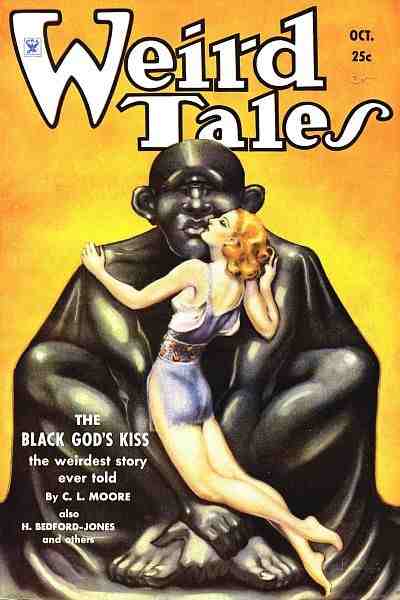
Catherine Lucille Moore wrote six tales featuring her sorcery-fighting swordsmistress Jirel of Joiry, published in Weird Tales between October 1934 (“Black God’s Kiss”) and April 1939 (“Hellsgarde”). The second, “Black God’s Shadow”, appeared in the December 1934 issue alongside Robert E Howard’s “A Witch Shall Be Born”, the story in which a crucified Conan bites back at a vulture.

Weird Tales, October 1934

Margaret Brundage cover to Weird Tales, showing Jirel of Joiry and the Black God

Impetuous, fearless and undaunted by danger, Jirel shares many characteristics with her sword and sorcery stablemate, but her stories are nothing like Conan’s. In each adventure, having been set up as a dynamic “female warrior queen and spitfire of the fifteenth century” (as Sam Moskowitz puts it), Jirel is usually plunged straight into the sort of situation where her physical prowess and combat skills count for nothing. The classic Jirel of Joiry tale, after a brief and deftly sketched actionful introduction, has her being transported to another realm, usually a highly surreal one, where magic and dream-logic replace the straightforward adventure-style jinx you expect from sword & sorcery. This makes Jirel something of a puzzle. Whereas Conan cuts through the pretensions (and the major arteries) of sorcerers, priests and eldritch things with brute force and barbaric common sense, the situations Jirel finds herself in can usually only be solved by fighting fire with fire — by finding some ally, or some weapon, as magically powerful and dangerous as the opponent she’s facing. This means her adventures can feel somewhat arbitrary, bookended as they are by magics that both get her into a fix and out of it. But it’s between these points Jirel’s real heroism comes to the fore, and it’s heroism of a strange sort, though one she shares with most 20th century pulp-style heroes from Conan to James Bond. Although, when you think of, say, Conan or Bond as heroes, you think of their way with a sword, a gun, or a fist, or their general ability at taking down a villain, the point at which these pulpsters really prove their heroism is usually a moment in which they’re being helplessly tortured or tormented — think of Conan nailed to that cross in “A Witch Shall Be Born”, or Bond making his way through Dr No’s torturous and tortuous obstacle course on his way to a date with a giant squid (or the line everyone remembers from Goldfinger: “No, Mr Bond, I expect you to die!”). Moore seems to have refined this moment to make it the centrepiece — almost the entire tale, in fact — of her Jirel stories. As Moorcock & Cawthorn put it in Fantasy: The 100 Best Books:

“C. L. Moore excels in the evocation of a pervasive, miasmic atmosphere of evil. This is achieved to a great degree by her descriptions of the distress and degradation evinced by its victims…”

Jirel of Joiry“Black God’s Kiss” starts breathlessly, with Jirel of Joiry already captured and being brought before her gloating conqueror Guillaume, who has just seized control of Castle Joiry. Delighted to find Joiry’s commander is a woman, he forces a kiss, then has her sent to a dungeon. Jirel, fired up with the need for revenge, travels to another dimension to find a means of getting her own back. Fortunately, Castle Joiry has a House on the Borderland-style trapdoor in its lowest cellar, a strange corkscrew helter-skelter passage to a black-lit world of nightmare visions. The bulk of the story is Jirel’s combined horror and awe as she crosses this land in search of a weapon to revenge herself on Guillaume. She witnesses a stream of weird and frightening sights, but at no point is she required to do anything but witness them:

“Half-way across, she saw one of the white blotches approaching her with slow, erratic movements. It bumped along unevenly, and at first she thought it might be inanimate, its approach was so indirect and purposeless. Then it blundered nearer, with that queer bumpy gait, making sucking noises in the ooze and splashing as it came. In the starlight she saw suddenly what it was, and for an instant her heart paused and sickness rose overwhelmingly in her throat. It was a woman — a beautiful woman whose white bare body had the curves and loveliness of some marble statue. She was crouching like a frog, and as Jirel watched in stupefaction she straightened her legs abruptly and leaped as a frog leaps, only more clumsily, falling forward into the ooze a little distance beyond the watching woman. She did not seem to see Jirel. The mud-spattered face was blank. She blundered on through the mud in awkward leaps…”

This realm Jirel has slipped into seems rather Freudian — that degraded woman hopping frog-like through a swamp could be an image of Jirel’s shame at Guillaume’s treatment, but also a sort of reversed fairy tale transformation, with the dark anti-prince kissing our human heroine and turning her into a frog.

Jirel of Joiry by C L Moore, Stephen Hickman cover

Jirel of Joiry by C L Moore, Stephen Hickman cover

Jirel travels to the centre of this weird realm, and finds a one-eyed statue of the Black God. Kissing it (as she feels compelled to do), she feels “something cold and stunning; something alien beyond any words” enter her. Returning to her own world, she repays her degradation by passing Guillaume the “dreadful, cold bleakness” of the Black God’s kiss — and then, in a very un-Conan-like twist, realises too late that beneath the humiliation and anger she felt attracted to this powerful man. The second tale, “Black God’s Shadow”, sees her trying to right this wrong, and returning to that weirdly black-lit world to free the dead Guillaume.

My main reaction to the Jirel stories is to find them, on the one hand, genuinely weird and wildly imaginative, and on the other, turgid with so many internalised battles with fiercely-felt but abstract emotional tussles, that they were a combination of fantastic thrills and solid drudgery to read. It’s perhaps unfair to quote a sample passage out of context, but this is the sort of thing I mean, when Jirel finds the statue of the Black God:

“Gradually the universal focusing of lines began to exert its influence upon her. She took a hesitant step forward without realising the motion. But that step was all the dormant urge within her needed. With her one motion forward the compulsion closed down upon her with whirlwind impetuosity. Helplessly she felt herself advancing, helplessly with one small, sane portion of her mind she realised the madness that was gripping her, the blind, irresistible urge to do what every visible line in the temple’s construction was made to compel…”

The passion behind even these abstract passages is undoubtable, but it can also feel so much like wading through mud, at times, having to read through so much deeply felt but abstract prose. Sam Moskowitz puts it best, I think, in his chapter on Moore in Seekers of Tomorrow:

“The climax of each story found Northwest Smith [Moore’s other series hero] or Jirel of Joiry in the formless haze of spiritual battle with the unknown. The plot situations were rarely solved by a logical sequence of events, but instead by a burst of rhetorical hypnotism.”

A young C L Moore, from the Teller of Weird Tales blog

A young C L Moore, from the Tellers of Weird Tales blog

Jirel’s adventures feel shamanic. She passes from this world to another, to face some magical evil in a world where none of the logic of this one applies — and so none of the usual action-story resolutions can be applied, either. Perhaps it’s wrong-footing to think of them as sword & sorcery because, although the Jirel of Joiry tales do include swords and sorcery, the swords and the sorcery almost never meet. In fact, the thing the Jirel stories remind me of most are fever dreams — something I thought of only when I read that, when she was young, Moore suffered from ill-health and had to spend a lot of time bed-bound, which is where she developed her love of imaginative stories.

It’s the flashes of (often horrific) imagination for which I’ll remember these tales — as at the beginning of perhaps the best of them, “Hellsgarde”, where Jirel approaches a mist-shrouded castle, expecting it to be abandoned, and finds herself confronted with a small troop of motionless soldiers. Then she realises: the guards are dead, propped into a standing position by having their own spears driven through their throats. She rides gently between them, then:

“Was that motion among the ghastly guard? Her heart leaped to her throat and she gripped the saddle between nervous knees with a sudden reflex action that made the horse shudder. For one of the men in the row before her was slipping silently toward the flagstones. Had the spear-butt slid on the bloody tiles? Had a breeze dislodged his precarious balance? There was no breeze. But with a curious little sigh from collapsing lungs he folded gently downward to his knees, to his side, to a flattened proneness on the stones. And a dark stream of blood trickled from his mouth to snake across the pavement as he lay there… Only in a nightmare could such things happen.”

Only in a nightmare, or in the stories of C L Moore.

^TOP