I’ve never really got Michael Moorcock, not in the same way I feel I ‘get’ my favourite authors, like Ballard, Lovecraft, Ramsey Campbell, David Lindsay or Clark Ashton Smith. I feel I know where, for instance, Ballard is coming from, what drives his writing, even though Ballard’s upbringing in pre-World War II China, and his adolescence in a Japanese POW camp, is utterly unlike my own — perhaps even because of this difference, as then the story is so much more easily presented as a ‘myth of writerly origin’, and so therefore more understandable. Perhaps it’s because I don’t know Moorcock’s ‘myth of writerly origin’ that, though I’ve read a fair smattering of his books — Wizardry and Wild Romance, the early Elric books, the Corum books, the Hawkmoon books, the Kane of Old Mars books, The Black Corridor, Gloriana, The Golden Barge, The War Hound and the World’s Pain, The Brothel in Rosenstrasse, The Deep Fix, The Coming of the Terraphiles, and the interview book Death Is No Obstacle — I still don’t have a sense of where he’s coming from, as a writer, what he means as a writer. (This is perhaps just a peculiarity of mine, but I do respond better to authors who seem to be writing as a means of dealing with the aftermath of some originating crisis, however vague. Moorcock has always seemed free of this, leaving me feeling I’ve got nothing to grab hold of.)

The Weird of the White Wolf, Michael Whelan cover
Nevertheless, Moorcock’s been a constant presence. When I began to venture away from the Doctor Who books in our local WH Smiths to the adult SF & Fantasy section, I found it fully stocked with Moorcock. Moorcock introduced me to Hawkwind — he mentioned them in an interview in Imagine, the D&D magazine, so I checked them out. (An interview in which he also seemed to be rather dismissive of role-playing games, just as he seemed, on a first read, to be dismissive of fantasy in Wizardry and Wild Romance. I was beginning to feel Moorcock wasn’t entirely on my side.) Hawkwind got me into Ballard, though I could have got into Ballad just as easily from Moorcock himself; and Moorcock was also the reason I read Fritz Leiber and Robert Holdstock and Mervyn Peake. Plus, how could I resist those Elric books, with their Michael Whelan covers — and titles like The Weird of the White Wolf or Sailor on the Seas of Fate?
Nevertheless, he remained a mystery. Which is why, when I heard he was writing a mix of autobiography and fantasy trilogy beginning with The Whispering Swarm, I knew I had to read it. Perhaps the answer to Michael Moorcock was to be found in there.
And… some answers were. (But it is only the first in a trilogy, after all.)
Let’s start with the obvious one. Perhaps one of the reasons Moorcock never quite snapped into focus for me like the more monomaniacal Ballard is that he’s always been switching between states. He bashes out sword and sorcery novels in three days, then spends years on long literary series, like the Colonel Pyat books (which I gave up on). Which is he, then, the fantasy pulpster or the literary novelist? Why, both of course:
“I was already conscious of two different kinds of author in me. One was practical, able to make money commercially. The other was predominantly analytical, experimental and not at all commercial!”
(He also says, “Balzac was one of my heroes because he did reams of hackwork before doing reams of ambitious, innovative fiction.”)
It should be obvious, really, that Moorcock is all about swinging between two opposites — just think of the eternal battle between Law and Chaos in the Eternal Champion books. Is this the image of Moorcock’s own inner world? It quickly becomes clear that Moorcock, in The Whispering Swarm, is also struggling with a need to achieve a balance of sorts. He even achieves it at one point in the novel:
“By 1969 I had everything in some sort of balance. Two lives, two wives, two children, two careers…”
 Of course, this isn’t necessarily Michael Moorcock the writer speaking; it’s the narrator of The Whispering Swarm. Who is also called Michael Moorcock, and who shares a lot of biography with his author. Both grew up in post-WWII London, both begin editing Tarzan Adventures at the age of 17, both go on to write SF and sword & sorcery, and to edit New Worlds. Precisely where the real and the fictional Michael Moorcock part ways it’s difficult to tell. Mostly, Moorcock is free with his use of real people’s names — and there are plenty he rubs shoulders with in 50s and 60s London, from Colin Wilson (“People had brought Colin and me together because they saw us as enfants terribles but we didn’t have a lot in common. I got on better with Colin’s friend Bill Hopkins”), Barrington Bayley, actor Jon Finch — which is perhaps why it took me a moment to work out who Jack Allard was. Jack Allard, who in the book is a close ally in Moorcock’s vision for the revamped New Worlds, Jack Allard who’d spend his childhood in German-occupied Guernsey… And then there’s Rex Fisch, and Jake Slade… JG Ballard, Thomas M Disch, and John Sladek, of course! Why this slip into such obvious pseudonyms? Perhaps so Moorcock is a bit more free to talk about them, though why a judgement such as this, of Allard:
“I eventually realised that the only fiction he liked was his own. Meanwhile, he wrote brilliant, lyrical, existentialist stories which were a bit like Ray Bradbury, a bit like Graham Greene and were as original as anything the genre had ever seen…”
— shouldn’t be made quite freely of the real J G Ballard, I don’t know. It doesn’t surprise me that Ballard would only really be interested in his own fiction, monomaniac of the imagination that he was. Moorcock does provide an interesting insight into my own ability to ‘get’ Ballard but not Moorcock, though, when he says of Allard:
“He had read very little, preferring to get his culture via the screen or from the radio…”
It’s obvious, from reading the early chapters about Moorcock’s youth, that I’ve more experience of Ballard’s cultural background than I do of Moorcock’s, even though Moorcock was raised in London (where “It seemed as if I could live my entire life in a bubble less than half a mile across and find everyone I wanted to meet, everything I wanted to do!”). In an odd way, Moorcock’s culture, so thoroughly rooted in the ephemeral indigenous literature of the day, is more distant, because of the Hollywood-isation of culture generally. Moorcock grew up reading about all sorts of dashing heroes, from highwaymen to schoolboys to cowboys, I’ve never heard of, whereas I’ve seen many of the films Ballard grew up on.
But there’s something more fundamentally different in the type of artist — or imagination — that Moorcock has. As opposed to those monomaniacs of the imagination, like Ballard, who I find it easier to ‘get’, Moorcock is deliberately diffuse:
“I was already fascinated by the way modern mythology took characters from different eras and put them together.”
After all, the fundamental symbol of Moorcock’s imagination is the Multiverse — or, as it’s presented here, ‘Radiant Time’:
“Most philosophers see time as a line disappearing into infinity, past, present, future… Others have it as a circle, which is much the same thing, except theoretically you return to the beginning and start all over again. All representations of time are some variation on this simple idea. But the truth is time radiates, just as light does. Let the physical world be thought a dimension of time!”
Whereas the likes of Ballard or Lovecraft or Clark Ashton Smith are constantly honing a single idea, a single obsession, Moorcock seems to be going the opposite way. As someone says in The Whispering Swarm of the forces opposed to Alsacia:
‘They see their salvation in simplicity and purification, but the world is not simple. Nor is it easily purified. God made it complex and mysterious. They want to obey man’s rules, not God’s.’
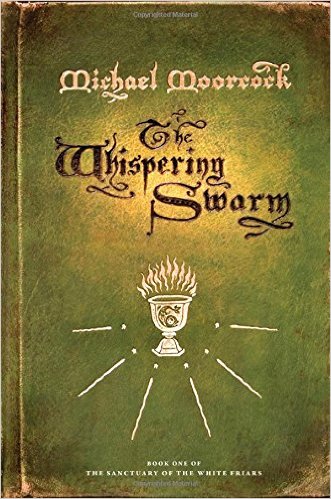 Ah, yes, Alsacia. All this rambling, and I haven’t got started on what the book’s about. Woven in amongst the autobiography in The Whispering Swarm is a fantasy. In this fantasy, young Michael Moorcock finds an area of London untouched by the blitz, peopled by a ragtag group of ‘Actors, vagabonds, cheapjacks, rum pads and balladeers’, most of whom dress like figures from English history, including highwaymen and cavaliers, not to mention a certain well-known trio of French Musketeers. There’s also a bunch of monks, the White Friars, who have a number of interesting treasures in their possession, including a chalice which, when lit by sunlight, seems to contain a sort of dancing hologram fish, and a vast cosmolabe which fills a room. Alsacia is also known as Sanctuary, which is what it offers to people of all beliefs and persuasions — not to mention time zones — but it is not always there. Once he’s visited it, Moorcock finds that, when he’s not in it, his hearing is bothered by a sort of tinnitus, a constant muttering of voices he comes to term ‘the whispering swarm’. Alsacia becomes a second home — literally, as he sets up a ménage there with the highway-robber Moll Midnight, when he needs to escape from his ‘real’ home life. It is, like Tanelorn in the Eternal Champion books, a neutral ground, a longed-for place of balance.
But it is not a place of escape. Throughout the book, Moorcock is constantly questioning the nature of Alsacia, and whether he should be going there. Is it a delusion? Is it immoral? It gives him almost as much domestic trouble as he’s escaping from in his real family — a family he longs for when he’s away from them as much as he longs for Alsacia when he’s not there. It’s difficult to decide, in fact, what Alsacia represents, as it isn’t a fantasy refuge from reality (he quite often spends his time there hacking out fantasy books, just as he does in the real world).

Wizardry and Wild Romance, Gollancz (1987), cover by Les Edwards
But, this is only book one. After rather too much (in my opinion) questioning the nature of Alsacia, then going there, then vowing to give it up, then giving in and going back only to start questioning again, Moorcock gets involved in a trans-temporal adventure to rescue King Charles from execution in Oliver Cromwell’s day — something Moorcock enters into despite his own political beliefs (‘the day a tyrant was made answerable to his people, the world was set on a very different course. The idea of the modern democratic republic was born’), but more from a feeling of fellowship with the various highwaymen and exiled cavaliers he falls in with. They need Moorcock for his ability to travel the ‘Moonbeam Roads’ that connect Alsacia with various bits of our history — as well as histories not ours (as evinced by an early adventure where Moorcock aids Moll Midnight in highway-robbing an armoured tram).
My favourite parts of The Whispering Swarm were the obviously autobiographical elements I could recognise: Moorcock’s time taking over the reins of New Worlds and gathering a stable of like-minded writers around him, while participating gleefully in swinging-sixties London. The fantasy novel part took longer to fire, for me, and it was only really at the adventurous conclusion that it really hit upon a story, rather than an endless questioning of the nature of Alsacia, and Moorcock’s own moral doubts about his relationship with it. I look forward to the second volume, though, in the hope it will illuminate, if not the mystery of Alsacia, then at least the mystery of Michael Moorcock.