Wizardry and Wild Romance by Michael Moorcock

I’d like all the writers I like to like each other. But writers, self-centred and individualistic as cats, are often the worst at being objective about other writers. There’s too much stepping on each other’s toes, too much “You don’t want to do it like that!” and “I was going to do that, and do it better!” As a result, I’ve learned to take a cruel joy in finding out that the writers I like in fact hate each other. There’s M R James on Lovecraft (“whose style is of the most offensive. He uses the word cosmic about 24 times”), Machen on Blackwood (“Tennyson said ‘the cedars sigh for Lebanon’, and that is exquisite poetry; but Blackwood believes the cedars really do sigh for Lebanon and that… is damned nonsense”). Both Tolkien and C S Lewis met and liked E R Eddison, but hated his outlook (Tolkien: “I thought that, corrupted by an evil and indeed silly ‘philosophy’, he was coming to admire, more and more, arrogance and cruelty”); while Fritz Leiber wrote of Tolkien, “He’s not interested in women and he’s not really interested in the villains unless they’re just miserable sneaks, bullies and resentful cowards…”

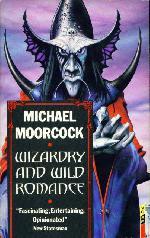
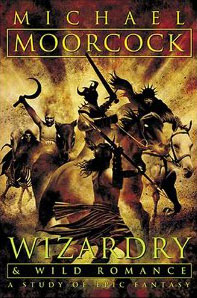
Wizardry & Wild Romance cover

Wizardry and Wild Romance, Gollancz (1987), cover by Les Edwards

Michael Moorcock’s Wizardry and Wild Romance is subtitled “A Study of Epic Fantasy”, but it’s no academic exercise in objectivity. I’ve read it many times, but reading it used to depress me, and it’s taken a good few years (and re-reads) to understand why. It is, of course, that Moorcock is a practitioner of the form he’s examining, and his “study” is more a cry than a critique. One of the reasons I’ve so often come back to reading it is that I wanted it to be like Lovecraft’s “Supernatural Horror in Literature”: a critical history of a genre by one of its major practitioners. But Lovecraft’s essay is, really, a critical history only by way of being a writer’s manifesto, a definition of what Lovecraft himself was trying to do. Because Moorcock shies away from explicit definitions (though he does offer one: “I am referring specifically to that body of prose fiction distinguished from myth, legend and folktale by its definite authorship and not genuinely purporting to be a true account of historical or religious events”), it leaves a sort of gap, the black hole of a definition which can only be inferred from the penumbra of praise and damnation that makes up the bulk of Wizardry and Wild Romance. And one of the problems is that Moorcock is so much better at damnation:

“…a new school is emerging of would-be Romantics, desperately striving to discover fresh sensibilities in the way repressed products of the middle-classes tried to loosen up with drugs and sentimental egalitarianism in the sixties. These people learned the school rules too well, however, and the main impression given by their fabulations is of red elbows and other miscellaneous bits of anatomy poking out through holes they have, with much effort and personal discomfort, rubbed in the straitjacket.”

And:

“Often the prose is little more than a mindless imitation of the euphonious aspects of the verse which, lacking the substance of the original, takes on the aspect of a mute attempting desperately to sing a Mozart song by mouthing an approximation of the sounds he has heard.”

And, most famously:

The Lord of the Rings is a pernicious confirmation of the values of a morally bankrupt middle-class. The Lord of the Rings is much more deep-rooted in its infantilism than a good many of the more obviously juvenile books it influenced. It is Winnie-the-Pooh posing as an epic.”

Like many an internet commentator, he brings the Nazis into the debate early on (mentioning Rudolph Hess in the Foreword). And he has a particular downer on HP Lovecraft:

“An aggressive, neurotic personality, though not without his loyalties and virtues, Lovecraft came under the influence of Poe, Dunsany and the imaginative writers of the Munsey pulp magazines and produced some of the most powerful infantile pathological imagery and some of the most astonishingly awful prose ever to gain popularity, yet his early work, written primarily in homage to Dunsany, from where he borrowed the idea of an invented pantheon of gods, is lighter in touch and almost completely lacking in the morbid imagery of his more successful horror stories in which death, idealism, lust and terror of sexual intercourse are constantly associated in prose which becomes increasingly confused as the author’s embattled psyche received wound after wound and he regressed into an attitude of permanent defensiveness.”

Whew.

That word, “aggressive”, occurs quite often in Moorcock’s little critiques, whether it’s of Lovecraft, John Norman, Tolkien or C S Lewis. But its use does itself come across as, well, quite aggressive:

“One should perhaps feel some sympathy for the nervousness occasionally revealed beneath their thick layers of stuffy self-satisfaction, typical of the second-rate schoolmaster, but sympathy is hard to sustain in the teeth of their hidden aggression which is so often accompanied by a deep-rooted hypocrisy.”

The thing I always failed to notice in my early readings and re-readings of Moorcock’s book (which usually left me feeling how much he must hate the genre, and wondering why he bothered to write a book about it) was his evident passion for it. He swipes so eloquently against the writers he hates precisely because he feels so strongly about what they’re doing — or, to his mind, mis-doing. He does praise writers, some not unequivocally — Clark Ashton Smith, Robert E Howard — others highly — Fritz Leiber, M John Harrison, Robert Holdstock, Mervyn Peake — though never, sadly, as eloquently as his criticisms. But he also presents, if you can spot it amidst the fusillade, evidence of having not only read a great deal of it, but a good deal about it.

Rodney Matthews cover

Rodney Matthews cover

And, of course, he has written a lot of it himself. But here, Moorcock doesn’t discuss his own work, which may account for the key gap I find in Wizardry and Wild Romance (whose title I always assumed was a quote from a genuine poem, till I tried to track it down, and found that the “Wheldrake” it’s attributed to is a Swinburne pseudonym (used, appropriately, to write bad reviews of his own work) as well as, later, a Moorcock character).

Wizardry and Wild Romance was the first book about fantasy I read, and it certainly taught me a lot:

“An intrinsic part of the epic fantasy is exotic landscape…. and no matter how well drawn their characters or good their language writers will appeal to the dedicated reader of romance according to the skill by which they evoke settings…”

And:

“Melodrama and irony work very well together; the best fantasies contain both elements, which maintain tonal equilibrium…”

Moorcock may bash the “morally bankrupt” middle-classes, and he may sometimes present a rather defensive maturismo somewhat reminiscent of Jackie Wullschläger’s in Inventing Wonderland, but you have to admit he does it with style. And if you can stand back far enough not to be splashed by the acid he spits, there’s a good deal of enjoyment to be had from the sheer wit of the book, even if you disagree with the points being made:

“If the bulk of American sf could be said to be written by robots, about robots, for robots, then the bulk of English fantasy seems to be written by rabbits, about rabbits and for rabbits.”

And, perhaps the most revealing statement about Moorcock’s own tastes in fiction:

“If we must be given stories about talking animals, let them at least be sceptical, sardonic and world-weary talking animals.”

While to me, it’s to find recourse from scepticism, cynicism and world-weariness that I turn to fantasy in the first place — that, to me, is what literary magic is all about, what Tolkien called “re-enchantment” — but that, of course, is my own bias.

cover

John Picacio cover

Although it was updated in 2004 for the Monkeybrain Books edition, Wizardry and Wild Romance is, really, a product of its time, and is best read that way. It came from a writer witnessing the commercialisation of what had been, to him and the writers he admired, a deeply individualistic, often revolutionary art form — but that’s a battle that has long been lost, the commercial element of heroic fantasy being here to stay. The updates to the book, to me, feel a bit tagged on and less part of the central, anguished cry that spawned the kernel essay, “Epic Pooh”, back in — when was it? According to the Foreword, parts of Wizardry and Wild Romance were published as early as 1963, and that’s over fifty years ago!

Wizardry and Wild Romance is a book I will come back to and re-read, as I have come back to it many times in the twenty seven years since I first read it. But it’s been a process of learning how to read it: not as objective criticism, more as the expression of a passion, and of an ideal, that Moorcock never clearly states, but certainly defends — in style.

^TOP

The Crystal World by J G Ballard

The Crystal World coverJ G Ballard’s fourth novel, The Crystal World, seems to have grown like a crystal. Before the novel (published 1966), there was the novella “Equinox” (in two parts in New Worlds between June and August 1964), and before the novella there was the short story “The Illuminated Man” (in F&SF, May 1964), and at the very start of the short story — topping and tailing it, in fact, as it’s repeated at the end — is a brief, italicised paragraph that’s like the seed-crystal of all that follows, a description of a Surrealist painting that never was:

“By day fantastic birds flew through the petrified forests, and jewelled alligators glittered like heraldic salamanders on the banks of the crystalline rivers. By night the illuminated man raced among the trees, his arms like golden cartwheels, his head like a spectral crown…”

In the novel (where this paragraph appears in the final chapter), the alligators are now crocodiles, as the location has shifted from Florida to a more Heart of Darkness-ish “isolated corner of the Cameroon Republic”, but the main story is the same. The protagonist, Dr Sanders (a first-person narrator named James B—— in the story) finds himself at one of several points on the Earth which are being transformed by the “Hubble Effect”:

“…an actual proliferation of the sub-atomic identity of all matter. It’s as if a sequence of displaced but identical images of the same object were being produced by refraction through a prism, but with the element of time replacing the role of light.”

The upshot is that everything is becoming encased in (or turned into) crystal, and the crystallisation is spreading in waves that pulse through the affected zones, turning rivers into roads of glass, and roads into pathways furred with foot-high crystal spurs. Everything, from the vegetation to the buildings to the water is becoming a prismatic version of itself, and that includes the animals and people. It’s when describing this effect — when painting it before our eyes in sparkling, rainbowed light — that Ballard’s writing is at its precise, vivid, hallucinogenic best:

“From the elbow to the finger-tips it was enclosed by — or more precisely had effloresced into — a mass of translucent crystals, through which the prismatic outlines of the hand and fingers could be seen in a dozen multi-coloured reflections. This huge jewelled gauntlet, like the coronation armour of a Spanish conquistador, was drying in the sun, its crystals beginning to emit a hard vivid light.”

The Crystal World, another coverTime has crystallised my own view of The Crystal World. On a first reading I found it to have passages of beautiful, precise poetry punctuating (after a nicely-paced moody beginning) an otherwise dull story. A recent re-read has only confirmed me in this opinion. The moments that stand out are like shards of the original short story — they’re all in “The Illuminated Man”, often in the same words: the helicopter that slews then crashes as it tries to fly when the Hubble Effect has taken hold of its rotor blades, the half-vitrified crocodile suddenly whipping into life from its bed in a solidified river. But these intensely imagined, visually shocking moments speckle a story of mostly rather unconvincing, lacklustre characters who seem to be standing around in the presence of all this cathedral-like jewelled wonder waiting for the Ballardian spark to wake their inner worlds. Only, it never happens. Ballard provides us with a pair of love triangles — the protagonist Sanders, Suzanne Clair & Max Clair, and Ventress, Thorensen & Serena — both centred around a male rivalry for a dying woman, though this doubling only waters the effect of the same single-triangle situation in the original short story, which itself only seemed to be pointing out how meaningless such human motives as love and revenge are in contrast to the time-defying crystallisation process. Why, then, go to the bother of actually duplicating this meaningless situation, particularly when neither, ultimately, resolves in any interesting way?

The Crystal World, Max Ernst coverThe protagonist Sanders is much less inwardly connected to the catastrophe when compared to, say, Kerans of (my favourite Ballard novel) The Drowned World. I can’t help feeling that in writing The Crystal World, Ballard was perhaps stuck in the formula of his previous two books, and while his inventiveness as it related to the transformed landscape had blossomed — even, effloresced — he had less to say about the human side of the equation. He even, at one point, has his main character discuss the possible themes of the very novel he’s in, as Sanders starts going on about the profusion of doubles in a plot Ballard seems to be struggling to get some meaning out of. It results in some very un-Ballardian psychological truisms (“Of course there’s a dark side to the psyche, and I suppose all one can do is find the other face and try to reconcile the two — it’s happening out there in the forest”, and “Each of us has something we can’t bear to be reminded of.”). But the sheer audacity, strangeness, and poetry of the fantastic idea at the heart of the novel conquers, in the end, and those few scattered jewels of Ballardian poetry that break through the tedium of the novel’s unconvincing characters make it all worthwhile. (Though I can’t help feeling that, apart from the moody equinoctial darkness of the opening chapter, which I love, you’d be better off reading “The Illuminated Man”.)

The feeling that Ballard was tiring of his initial formula and on the verge of an artistic breakthrough is perhaps confirmed by what came next: as well as his almost continuous outpouring of short stories at the time, there was, a few years later, a quantum leap to a very different type of fiction with the “condensed novels” of The Atrocity Exhibition, and then Crash. (A novel very much like The Crystal World, in that it comes to life entirely through its intense, rather inhuman poetry, rather than its short story’s worth of story.)

The novel does, though, at least touch on a human meaning behind the Hubble Effect:

“The beauty of the spectacle had turned the keys of memory, and a thousand images of childhood, forgotten for nearly forty years, filled his mind, recalling the paradisal world when everything seemed illuminated by that prismatic light…”

And:

“…this illuminated forest in some way reflects an earlier period of our lives, perhaps an archaic memory we are born with of some ancestral paradise where the unity of time and space is the signature of every leaf and flower.”

Which makes me realise how much the catastrophes in catastrophe novels are all about a need to halt time, to end the forward rush of modernity and pause, perhaps regress, to something a little more humanly manageable. Perhaps, in this, Ballard’s Crystal World is the ultimate expression of the SF catastrophe.

The Crystal World also, perhaps, contains a hint of autobiography:

“It seems to me, Max, that the whole profession of medicine may have been superseded — I don’t think the simple distinction between life and death has much meaning now.”

Ballard spent a year studying as a doctor (his descriptions, in Miracles of Life, of his time dissecting cadavers in anatomy classes easily equals the poetry of The Crystal World’s more jewelled moments), but gave up, perhaps because of a very similar realisation: that it all meant nothing compared to the immensities to be explored in his own imagination — visions like the life-and-death-annulling crystallisation of the world — which were themselves attempts to resolve the very intense plunge into catastrophe, violence and upheaval of his teen years in WWII China. Like Lovecraft’s “The Colour Out Of Space” — a very similar story in some ways — The Crystal World could well be the purest expression of what its author was aiming at:

“…the response to light is a response to all the possibilities of life itself.”

Whatever its faults, The Crystal World is still an amazing piece of fiction for the sheer strangeness of its vision alone.

^TOP

Marianne Dreams and Paperhouse

Marianne Dreams, from Faber & FaberCatherine Storr’s 1958 novel Marianne Dreams contains a perfect example of what Humphrey Carpenter calls the “Secret Garden”, found in so many classic kids’ books from Alice in Wonderland onwards — those Arcadian pocket-worlds that encapsulate an idealised childhood, part fantastic imagination, part golden-tinged nostalgia. In Storr’s book, the “Secret Garden” is a dream world 10-year-old Marianne creates through drawings made in her waking life. Bed-bound for weeks after an unspecified illness, she finds a special pencil (“one of those pencils that are simply asking to be written or drawn with”), thereafter referred to as The Pencil, in her grandmother’s button box. With it, she draws a standard child-style house, and when she sleeps, dreams of walking up to this very house, but being unable to get in. When she wakes, she adds a knocker to the door, and, for someone to answer it, a face at an upper window. Both details have been added to the house when she next dreams, but the boy at the window can’t answer her knock because the house has no stairs inside and (something he doesn’t admit immediately) he can’t walk. So Marianne starts working on interior drawings, too. In her waking life, because she can’t attend school till she’s well again, she’s being taught by a governess, who mentions another home-visit pupil, a boy called Mark whose illness has left him too weak to walk. When Marianne learns the boy in the dream-house is also called Mark, she realises her dream world isn’t entirely her own.

Marianne in the dream-world. Illustration by Marjorie-Ann Watts

Marianne in the dream world. Illustration by Marjorie-Ann Watts

In the dream world, though, the two children don’t exactly hit it off. Both are tetchy from being bed-bound for so long, and Mark is resentful of the idea he might be living in a world Marianne has created. After a particularly heated spat, she punishes the dream-Mark by scribbling him out (though this only puts bars over his window) and, worse, by adding a single, watching eye to each of the boulders she drew outside the house. When she next dreams, she finds Mark terrified of “THEM”, the watching rock-creatures crowding the house. Regretting her anger, but unable to undo it (what she draws with The Pencil can’t be erased), the story comes to be about Marianne encouraging Mark to regain the physical strength and will to walk so they can escape the house and the watching, threatening presences.

Marianne and Mark. Illustration by Marjorie-Ann Watts

Marianne and Mark. Illustration by Marjorie-Ann Watts

Aside from its dream world fitting neatly into Humphrey Carpenter’s idea of the “Secret Garden”, Marianne Dreams has other similarities to Frances Hodgson Burnett’s 1911 novel from which Carpenter got the name. In Burnett’s book, the slightly spoiled 10-year-old Mary Lennox, orphaned and sent to live with a reclusive uncle, discovers an abandoned, walled rose garden and in it comes to not only befriend her withdrawn and seemingly crippled cousin Colin (who, like Mark, can’t, or won’t, walk), but to engage in a wholesale healing of the family: Colin of belief in his physical frailty, herself of her spoiled nature, and her uncle of both his extreme grief over the death of his wife and his estrangement from his son. The main difference between the two novels is that, while Mary Lennox of The Secret Garden is basically working at healing the adult world (where Uncle Archibald’s mourning for his wife is the cause of all the other problems) in Marianne Dreams the focus is entirely on the children, not just in recovering from their illnesses, but in their working together to overcome the self-centredness which their long periods of convalescence have led to. There’s a feeling that they’re taking a step away from the dependence of childhood towards taking a fuller responsibility for their own lives.

Vikki Chambers as Marianne in Escape into Night

Storr’s book has been adapted a few times. The author turned it into an opera libretto in 1999. In 1972 it was adapted for television as Escape into Night (made in colour, but only surviving in black & white). This six-part series stuck faithfully to the book — perhaps too faithfully, as the story of Marianne’s coming to understand the relationship between her drawings and the dream world inevitably leads to a lot of similar-seeming scenes, though perhaps I only feel this because I watched them back-to-back — but it also comes across as slightly darker, as, somehow, showing the bizarre one-eyed stones surrounding the house makes them that much creepier. My first encounter with the story, though, was in a very different form, the 1988 film Paperhouse.

Charlotte Burke as Anna in Paperhouse

I can’t think of many children’s books which, when adapted, turn into films for adults — and I wonder if that was always the intent for Paperhouse (rated 15 in the UK), because, though it ups the scares of Catherine Storr’s novel, it doesn’t do the usual horror cliché of turning childhood itself into a scary world — there’s no tinkly toy piano music, or ghostly nursery rhymes echoing down empty corridors — so it’s still a story that’s for children rather than being about them. In fact, apart from the level of scares (always a difficult thing to judge), I think it would actually be a good film for young adolescents, as it’s very much about their experience — about the first tentative moves towards forging deeper emotional attachments away from mum & dad, and about the tug-of-war between growing up and remaining a child. (Now I come to think of it, the two main characters’ lingering in bed after their illnesses could well be a metaphor for lingering in a state of dependent childhood, putting off the first steps into independence and adulthood.)

Anna and Marc (Elliott Spiers)

Marianne from Storr’s novel is now Anna, a girl very much on the verge of adolescence. One moment she’s bunking off school to try on makeup and ask her friend about snogging (“Like kissing a vacuum cleaner”), the next she’s playing hide-and-seek. In contrast to the book (where the mother is pretty much a cipher), in the film, Anna’s relationship with her mother is strained by some very teenage tantrums. The real transformation from novel to film, though, is the father. In the novel, though he’s living at home, the father is all but absent — he pops into the story only briefly, to do those things a standard father of the 1950s was expected to do, i.e., authorise a few key decisions and knock in a nail. In Escape into Night, his irrelevance to the plot is smoothed over by having him working abroad. In Paperhouse, not only is he working abroad, but Anna is torn between feeling abandoned by him and being grateful he’s not there because of how he scares her sometimes when he drinks. In the film’s dream world, the stones-with-eyes (“THEM”) central to the novel’s sense of threat are replaced by a blinded father figure wielding a hammer. (This, more than anything, must be what makes it a 15 certificate, the way it turns the threat into a very real, domestic one, rather than a generalised, fantasy version of anxiety.)

All this brings a muted aspect of the novel to the fore. Anna’s ambivalence about her father is an ambivalence about males in general. Sitting up in bed after a checkup from the doctor (here, a woman — Anna’s world, including teachers and friends, is almost entirely female), she says, “I don’t like boys,” then immediately adds one at the window of the house she’s drawing, as though her unconscious has other things to say on the matter. Far more powerful than the horror element of the film is the sense that Anna is learning to transfer the complex feelings she has for her father to a more fitting male figure of her own age. Paperhouse’s scares and dream world shocks can seem a bit over the top — as can Anna’s teenage histrionics, though “OTT” may well be the definition of teenage histrionics — but the film ends with a real sense of combined loss and gain, all because of how Anna has matured from a self-centred child to someone who can start to have fuller, more mature relationships.

Catherine Storr was, at the time she wrote Marianne Dreams, married to Anthony Storr, author of some of my favourite books about psychology — his The Dynamics of Creation (1972) and Solitude (1988) are both very readable and interesting delves into the complexities of two subjects Marianne Dreams also touches on: creativity (Marianne, in the novel, is not great at drawing, and her frustrations at how her lack of skill has a real effect on the dream world make up one of the novel’s strands), and the pleasures and pains of being alone.

^TOP