Curse of the Cat People

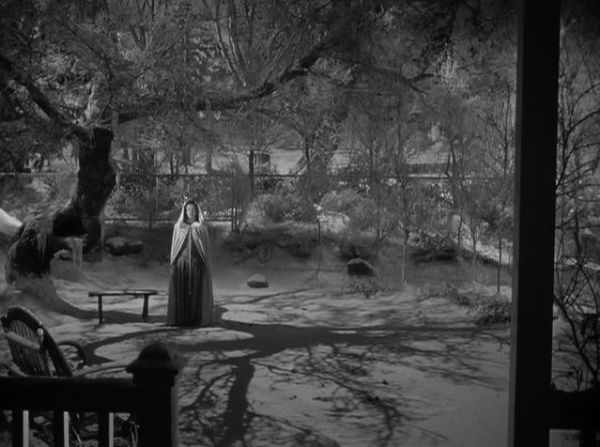
Curse of the Cat People (poster)If you come to Curse of the Cat People (1944) expecting a sequel to Cat People in the usual sense of a horror sequel, you’ll be disappointed (as I was, the first time I saw it). Usually, in a horror sequel, the monster from the first film returns to wreak havoc on a new set of victims; here, the victims from the first film return to wreak havoc on a new monster — only, in this case, the “monster” isn’t a troubled young woman, but an over-imaginative young girl.

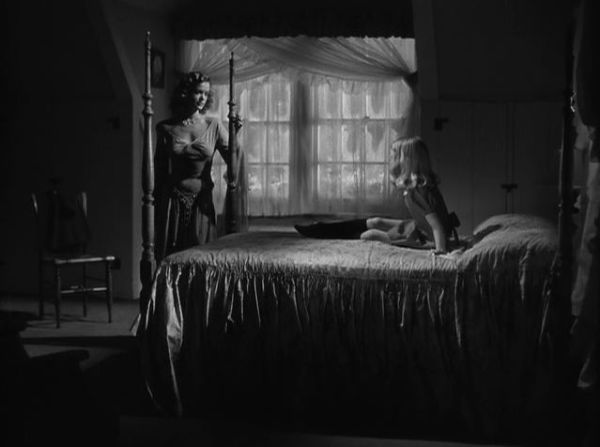
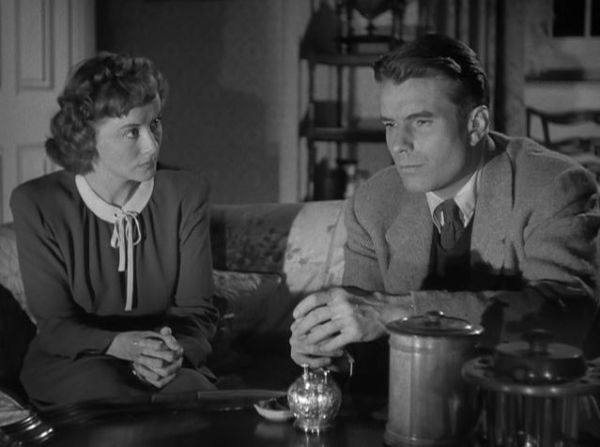
In Curse of the Cat People, all-American lukewarms Alice and Ollie (the couple from Cat People) are now married and have a daughter. Amy is an imaginative child, shunned by other children because she’s apt to forget the game they’re playing and wander off in her own little world. Her father Ollie is worried. His experience with Irena in Cat People has led to him being mistrustful of everything that smacks of his former wife’s mental problems. He thinks there’s “something moody, something sickly” about young Amy’s tendency to go “moping and dreaming” on her own. “She could almost be Irena’s child,” he muses to this wife, who gently reminds him that she’s the one to know this can’t be the case. But when, having been shown a photograph of Irena, Amy identifies this dead woman as her new playmate, Ollie first tries to get her to admit she’s lying, then gives Amy her first smacking. He tells Amy’s teacher that his first wife “told lies to herself and believed them”, and that she then went mad, killed a man, then killed herself. (And so he seems to have forgotten his own last words at the end of the previous film: “She never lied to us.”)

What makes it worse is that Amy’s imaginative friend, played by Simone Simon of the first film, is entirely benevolent. The “curse” of the sequel’s title isn’t the fact that Amy is haunted by her father’s first wife, but that Amy’s father is haunted by a fear of people who show any signs of being different. And although his new-found distrust of imagination does, finally, add a new dimension to his character, at two dimensions he’s still far short of the norm, and really not the best person to be deciding how to bring up a sensitive, imaginative child.

There are none of the shocks or spookiness of the first film, apart from a few moodily-lit Gothic moments thanks to a subplot involving a senile old actress who insists the woman sharing her house is not her daughter but an impostor. Instead, the film goes for gentle family melodrama and moments of lightly enchanting childhood fantasy. It’s a sequel to Cat People more in the thematic sense, as it deals with how those “normal, happy” people (or one of them at least, as Alice has much less of her husband’s phobia) of the first film can deal so badly with those who are a little bit different from them. Thankfully, this time there’s no lecherous Dr Judd to push things too far. Instead, Ollie gets advice from his daughter’s teacher, who points out that, as he builds ships, he’s not trained to deal with children but she is, and that it’s only natural for a lonely, imaginative child to invent a friend.

I think you have to approach Curse of the Cat People prepared for something very different from what you’d expect of a film billed as a sequel to Cat People. It’s not a horror film, and, more importantly, it has none of the first film’s psychological intensity. Ollie’s very slow — and, at the end, not very convincing — coming to terms with the fact that his daughter isn’t as imaginatively shallow as he is (at the end, he refuses to look at where young Amy tells him Irena is standing, but lies all the same, saying he sees her too) isn’t even a truly satisfying resolution, but, as sequels go, at least the film attempts something interesting.

^TOP

The Forgotten Beasts of Eld by Patricia A McKillip

Ballantine edition from 1974, cover by Gervasio Gallardo

Ballantine edition from 1974, cover by Gervasio Gallardo

Beautiful, detached and magically powerful, the young woman Sybel lives atop Eld Mountain, “alone with [a] beautiful white house, a vast library of heavy, iron-bound books, a collection of animals beyond all dreaming, and the power to hold them.” The world outside her small domain may be wracked with conflict, but Sybel is only interested in adding one more fabulous creature to her already fabulous collection (which includes a boar that can answer riddles, and a gold-hungry dragon). She tries to call the Liralen, “a great white bird with wings that glided like snowy pennants unfurled in the wind, a bird that had carried the only Queen of Eldwold on its back in days long before.” And the closest she comes to engagement with the wider world is sneaking out to steal the occasional book of lore from some unsuspecting wizard.

Into this ivory tower fantasy, the real world must come. Coren, a young nobleman of the house of Sirle, which was recently defeated by the Eldwold King Drede, arrives bearing Drede’s baby son — Sybel’s nephew by a sister she never knew. Sybel agrees to look after the child, and comes to love young Tamlorn, though otherwise preserves her aloofness from the affairs of a world that would make young Tam into a political pawn. When he grows old enough to want to see his father, though, Sybel uses her magic to call King Drede, and lets Tam go to live with him.

Rodney Matthews cover (Avon books, 1975)

Rodney Matthews cover (Avon books, 1975)

Up to this point, the book, like Sybel herself, has felt somewhat removed and cool. (Though the fantasy setting is brought alive by sparks of storyishness — it’s a land haunted by wizards, artefacts, hidden caves, ancient battle-sites and ghosts, which we learn about from fragments of stories and riddles.) Both Drede and Coren beg Sybel to use her magic to further their ends, but her power and indifference seem capable of sustaining her in her inviolability. Then suddenly, halfway through the book, things change. She has been feeling a vague tugging at her attention for some time, and realises with horror that she is the victim of the same sort of calling-magic she used for collecting her fabulous animals. In one incredibly dramatic chapter, not only her aloofness and neutrality, but her very ability to be herself, to retain her individuality, is so utterly threatened, it is now she who has to beg:

“There is part of me, like a white-winged falcon, free, proud, wild, a soaring thing that goes its own way seeking the bright stars and the sun. If you kill that bird, I will be earthbound, bound in the patterns of men, with no words of my own, no actions of my own. I will take that bird for you, cage it. Only let it live.”

This chapter hits hard, and absolutely repays the rather aesthete-like wish-fulfilling daydream of Sybel’s existence prior to that. The threat is intense but brief, and after it, The Forgotten Beasts of Eld turns into an intriguing study of the effects of power on its wielder, a moral fable about corruptibility and the near impossibility of anyone who has power preventing themselves from harming even those they love, as soon as they start to use it. For, as much as it allows you to avoid your fears, power also invites you to pander to your wounds, to play up to them rather than heal them. And even a successful revenge affects not just the revenger, but all who are close to them.

The Forgotten Beasts of Eld won the first World Fantasy Award, in 1975. It has a lyrical prose style, a slightly distant, fabled quality, which, whilst evoking the strangeness of a magical land wrought with riddles and fragments of story, can tend to make the characters seem distant. Here, McKillip seems to have a stronger grasp of the psychology of her characters than an ability to evoke their emotions, and I found I believed in Sybel’s desire for revenge far more than I did her love of Coren and Tam. But that chapter 6, at the mid-point, is wonderfully powerful, a near-Shakespearean clash of characters strong in both magic and feeling, each one eloquent in expressing their terrors and desires in a single, superheated encounter.

^TOP

Kingdoms of Elfin by Sylvia Townsend Warner

Sylvia Townsend Warner's Kingdoms of ElfinThe Little People, it seems, have no middle class. They are either the earthy, woodland-living folk of Alan Lee and Brian Froud’s Faeries, or the distant, beautiful, highly-cultured nobles of Tolkien. Sylvia Townsend Warner’s elves are firmly in the Beautiful People category, with something of a Bohemian, perhaps Bloomsbury tinge to them. The Bloomsbury tint is understandable — Warner began writing fiction in the 1920s, having been encouraged to do so by Bloomsbury-ite David Garnett. Cultured, with nevertheless a humanising irony, a slightly disapproving-but-forgiving distance of tone, these stories of the Kingdoms of Elfin were in fact published in the 1970s, in The New Yorker (though two are original to this collection), but you can feel their roots in those earlier days of advanced thinking, self-improvement, and the intellectual rebellion against the remnants of an aristocratic, paternalistic Victorian culture. Not too much of a rebellion, though — Warner’s fairies play golf and cards, they obey the dictates of courtly fashions, they gossip and have that aristocratic mix of disapproval of, and tolerance for, those who are different. Warner’s stories focus on those who are different, but her rebels are rarely different enough to leave off being aristocratic. They dip their toes in rebellion with the air of assuming a new fashion:

“It is widely known that a group of dissident fairies seceded from the Court of Elfhame in order to have more time for self-improvement. The Elfhame Dissidents had sickened of the frivolity of court life: pleasure was a burden to them; so was politeness. Beset with banquetings, love affairs, sonnets, whist drives, masquerades, and lotteries, they had no time to take themselves seriously.”

Leaving the Court of Elfhame, these dissident fairies of “The Occupation” nevertheless fail to truly take themselves seriously: “Conversation persisted, since in the main they talked about themselves, but was repetitive.” They puzzle over the mortals they encounter, taking a quaint interest in church worship and the birth of a mortal baby, before passing on, hardly noticing the tragedy they leave in their wake.

Some of the stories make brief, passing reference to folklore: “The Five Black Swans” contains a glimpse of the story of Thomas the Rhymer from the fairy lady’s point of view, and “Elphenor and Weasel” ends with an allusion to the Green Children of Woolpit. There are references to fairy literature, too: James Hogg appears, as a shepherd (which he was, prior to writing The Memoirs and Confessions of a Justified Sinner) in “The Occupation”, which also has a minister refer to Robert Kirk’s The Secret Commonwealth in an effort to learn about the fairy visitors he suspects are living in his house.

Kingdoms of ElfinThe last story in the book, “Foxcastle”, tells of a mortal scholar who, trying to find evidence that fairies exist, is taken in and studied by them. Here at last we get to see the fairies from a mortal’s point of view rather than, as in the rest of the book, from their own. Which perhaps goes best towards describing the overall tone of the stories in Kingdoms of Elfin: Warner’s fairies, although they have wings and can fly (though the aristocratic ones scorn flight, thinking it only suitable for servants), and although they are long-lived and capable of invisibility, don’t come across as magical in the way of Tolkien’s elves, nor dangerously unpredictable in the way of Froud and Lee’s, because we’re seeing them as they would see themselves: as objects of a wit and irony so light in touch it can seem to fade like fairy gold in mortal hands. But nevertheless these stories are told with a bite, the classic storyteller’s indifference of true fairy tales, that makes these little comic tragedies, and tragic comedies, both subtly knowing and subtly forgiving, but never merely delicate or fey.

^TOP