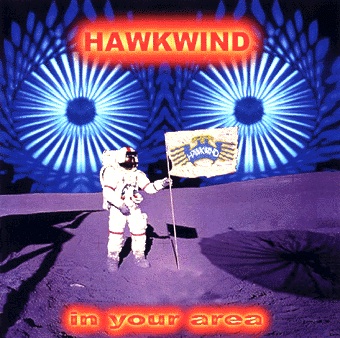
Hawkwind’s 1999 album In Your Area is a bit of a hodgepodge, being half live, half studio, and with most of the original material consisting of instrumentals rather than original songs. As a result it never really creates that unique identity, that particular atmosphere an album needs to bring you back to it again and again. But after buying it I had it on pretty much constant play for a couple of weeks, largely because of a 44-second track halfway through, called “The Nazca”. A typical Hawkwind weirdie, it consists of the usual electronic synth wooshiness and what I thought, at first, must be a sample from some classic sci-fi film:
“Intelligent life is so very rare. The rarest thing in creation, but the most precious. It is the only thing that gives meaning to the universe. Without it, nothing begins, nothing ends…”
Something about that quote grabbed me. It seemed cosmic, tragic, and hopeful all at once. I really wanted to know where it came from, but for once a Google search turned up absolutely no results, and despite having seen a good many classic SF films (and having read about a good few more) I couldn’t imagine which one it might come from. (The title was no help. It refers to the Nazca lines in Peru — those large-scale ground-doodles made, about one and a half thousand years ago, for the amusement of the gods, or any other sky-flying entity that happens to be passing.)
Things got even more intriguing when the same voice (and therefore, I assumed, an extract from the same quote) appeared in a few more Hawkwind tracks, speaking some different lines. One version of Tim Blake’s solo piece, “Lighthouse”, for instance, has:
“We are a very old people, from a very old planet compared to yours. If we are to survive we must colonise…”
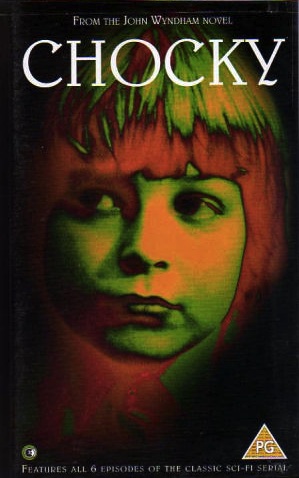
Finally, a couple of months ago, I got the answer. The quote wasn’t from an old SF film, it’s from John Wyndham’s 1968 novel Chocky.
 Assuming it was from the 1984 TV adaptation (which I missed at the time it was first shown, probably because it was on ITV, and I tended to watch BBC), I put it on my LoveFILM rental list. But that turned out only to feature a very shortened version of the “Intelligent Life” speech, and in a totally different voice. (It had good theme music, though. A little reminiscent of Brian Eno’s “Sparrowfall (2)” from Music For Films
 (1978), but excusably so, because I suspect the melody was designed to echo the word “Chocky”, and it’s the melody that makes it sound similar to the Eno track.) There’s also a 1967 BBC radio adaptation (which can be found at Archive.org), but there the “Intelligent Life” speech is equally short.
I’m going to keep searching, but I suspect it must have been recorded by Mr Brock and co. themselves. Either way, here’s some more of the quote from the novel (all the dot-dot-dots are present in the original):
“But intelligent life is rare… very rare indeed… the rarest thing in creation…
“But the most precious…
“For intelligent life is the only thing that gives meaning to the universe. It is a holy thing, to be fostered and treasured.
“Without it nothing begins, nothings ends, there can be nothing through all eternity but the mindless babbling of chaos…
“Therefore, the nurture of all intelligent forms is a sacred duty. Even the merest spark of reason must be fanned in the hope of a flame.”
Which I absolutely agree with.
 It’s a nice little novel, mildly satirical of the comfortable middle-classes it is also so obviously addressed to. Although ostensibly about a little boy who is contacted telepathically by a far advanced alien being, Chocky could equally be taken as a tale about the emergence of a creative talent, and about the way the conventionalities, and even the kindnesses, of a civilised society do their best to stifle, embarrass, disapprove of, and generally shut it up.

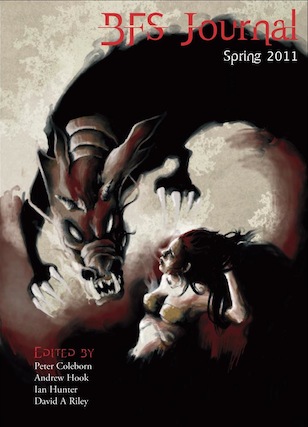 My story “A Night as a Scarecrow” has been published in the latest Dark Horizons, part of the recently-combined BFS Journal, Spring 2011 issue (sent out to all British Fantasy Society members).