Capote, The Libertine, Munich

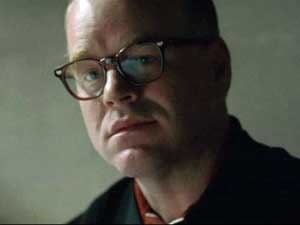
capoteCapote — not a full biopic, but a film covering the events surrounding the writing of Capote’s most famous book, the “non-fiction novel” In Cold Blood — I thought was a bit hypocritical. It’s a well-made film, and Philip Seymour Hoffman does an excellent job of pulling off the role of the diminutive, camp-voiced writer with a lot of self-possession. But the film’s attitude to its main character is to say, “Look at the terrible lengths a man will go to in order to achieve his artistic ends, and think of the human cost” — because he won the trust of the murderers Bill Hickock and Perry Smith, and arranged for new lawyers to get them a second hearing and so on, but as soon as he got what he wanted (their side of the story of the murders they’d committed), he pretty much dropped them and waited for them to be executed so he could have an end to his book. And I’m not saying that this is at all excusable behaviour! But, rather than seeing Capote as a driven man, and thus making his descent into selfishness and isolation a tragedy, the film doesn’t really try to get under his skin at all (except in one scene), and so turns itself into a somewhat censorious morality tale, which is never the most satisfying of approaches. A better one is suggested by that scene where we do get some insight into Capote’s character. He’s talking to the murderer Perry Smith and points out how their childhoods were similar, in that both went through periods of abandonment, and so on, thus pointing out the parallel between the murderers (who mercilessly killed their victims for a small amount of money, then were punished by the death sentence) and Capote (who selfishly used his “victims”, the killers, till he’d got his artistic material, then punished himself with a descent into death by alcoholism.)

Another film about a writer is The Libertine, this time starring Johnny Depp as the notorious seventeenth century writer, the Earl of Rochester. The film starts with an in-your-face monologue from Depp, as Rochester, telling you that soon enough you’ll hate him, which I took to be a film-maker’s gambit that we would, of course, love him as the rogue he is. But as the film went on, I felt increasingly indifferent. Perhaps this was partly because the film wasn’t sure whether it was a tragedy (Rochester’s supposed literary genius, of which I wasn’t convinced, never achieving any sort of fulfilment), romance (with the actress Elizabeth Barry, played by Samantha Morton, who doesn’t really fit the role of ultra-ambitious actress), or straight biopic (Rochester’s horrific decline through syphilis). The real core of the character of Rochester, as presented in the film, is that he was too intelligent not to be cynical about everything, but this wasn’t brought out enough till too near the end (and was too easily conflicted in the scenes where he’s coaching Elizabeth Barry), which is a pity as it would have made much more sense of the earlier parts of the film.

Munich, the third of my recent Amazon DVD rentals, was much more of a success. It’s difficult to discuss such a contentious story — the terroristic revenge-killings that followed the murder of Israeli athletes at the 1972 Olympics — particularly in the current climate, and anyway I don’t want to give the plot away, but the film handles the moral questions in a very human way, bringing out the universal, apolitical side of the situation, and pointing out how responding to violence with violence can only ever result in a spiral into paranoia and yet more violence. A little too long, with the early parts riffing too much on the suspense involved in the Israeli’s determination not to harm anyone but their intended victims, it certainly grew on me by the end.

^TOP

William Gibson’s Burning Chrome

The narrator of William Gibson’s story “The Gernsback Continuum” is a photographer who, commissioned to snap examples of the sort of futuristic architecture America produced in the thirties and forties, finds himself slipping into a reality where that future actually happened, as he sees an enormous propeller-driven, boomerang-shaped aircraft gliding impossibly against a cityscape of “zeppelin docks and mad neon spires” (something similar to the one brought to life in 2004’s Sky Captain and the World of Tomorrow, perhaps).

tron

It’s fitting Gibson should touch on that thirties/forties dream, because it was the only even vaguely optimistic future the 20th Century produced — till Gibson’s came along in the eighties, that is. By that time we’d long since ceased to believe in the sort of technological utopia promised by those hover-cars and jetpacks of the early SF pulps, but Gibson’s future had the advantage of not being limited by the possibilities of the real world. His idea, cyberspace (which he also referred to as the Matrix), was another reality altogether, a world we could jack ourselves directly into, a landscape of computer data turned into geometric shapes in “Bright primaries, impossibly bright in that transparent void”. A world curiously reminiscent of Disney’s wonderful 1982 film Tron, in fact.

It’s now more than twenty years since Gibson’s cyberspace made its first appearance (in “Burning Chrome”, 1982), and we don’t look much closer to achieving it. Excel might be able to produce nice looking pie-charts of your expense accounts, but it comes nowhere near the “electronic consensus hallucination” of Gibson’s computer reality where we’d exist as bodiless intelligences in a world of pure data.

Gibson’s fiction still feels relevant, though. Not because cyberspace is a possible future (I’m sure jacking your brain directly into a computer is as far off today as it was when Neuromancer first came out). Cyberspace wasn’t really a re-imagining of the future, it was a re-imagining of the imagination itself. It is once-upon-a-time land updated in neon colours, with data instead of gold and computer programs instead of magic spells. It’s just as full of angels, demons, ghosts, animal helpers and monsters as the world of the Grimm Brothers’ fairy tales.

bladerunner_darkfuture

One image that has really stuck in my head from my (very) early reading was a double-page spread in The Usborne Book of the Future. It had two views presenting two possible futures. One was all dark skies and people in gas-masks, the other was bright sunshine and people with wristwatch TVs. I remember staring at those two images for hours, hoping with all my might that the future I’d live in would be, if not the wristwatch TV one, at least not the dark skies and gas-masks one. Outside of cyberspace, Gibson’s rundown, citified future is much more reminiscent of the darker of those two alternatives, though in this he’s generally acknowledged to have borrowed from Ridley Scott’s Blade Runner, another powerful exploration of how the future might be, partly inspired by Philip K Dick, but more derived from Scott’s encounters with massive industrial processing plants in contemporary England.

I know this seems to be reducing Gibson’s future to the influence of two films — Blade Runner and Tron — but I love his work too much to leave it at that. His real strength lies not in prediction, but in writing about how people deal with a changing technological culture. In a potentially de-personalising world of mega-corporations (a dystopian nightmare prevalent in late seventies and early-eighties SF films like Rollerball, Alien and Blade Runner), Gibson’s characters use technology to emphasise, not erode, their individuality. He’s often at his best when writing about people whose (usually artistic) talents are only really released by technology, as in, from his story “The Winter Market”: “…you wonder how many thousands, maybe millions, of phenomenal artists have died mute, down the centuries, people who could never have been poets or painters or saxophone players, but who had this stuff inside, these psychic waveforms waiting for the circuitry required to tap in…” His future is a digital bohemia our iPod-equipped world is coming more and more to resemble, even if we don’t get to actually jack into it via cyberspace. (Do white earplugs count?)

^TOP

The Sun

The Sun (or Solntse, 2005) is the third in a series of films by Aleksandr Sokurov, each of which focuses on a 20th century political leader from the darker end of the spectrum: Moloch was about Hitler, Taurus was about Lenin (neither of which I’ve seen), while The Sun is about the Japanese Emperor Hirohito in the days up to and immediately after the country’s capitulation to the US in World War II.

the_sun

In his production notes on the DVD, Sokurov says that Hirohito is a far more human figure than either Hitler or Lenin, thus making The Sun a more optimistic film than his others about the evils of totalitarianism.

I didn’t read the production notes till after I’d watched the film, but turned to them in the hope of finding out what the film was trying to say. If it is just that Hirohito was a far more human figure than the dictators Hitler and Lenin, then Sokurov’s hardly making much of a point. As the film presents him, Hirohito was a much more human figure simply because he wasn’t really in charge or even connected with what was going on in the war at all. (The Wikipedia article on Hirohito has a brief discussion of the Emperor’s actual involvement). In fact, for a large part of the film, I was wondering if The Sun wasn’t meant as a comedy. Hirohito’s peculiar facial tics and his childlike manner as he distracts himself with dictating notes about the Hermit Crab, and loses himself in a dead end of the war-bunker, made me wonder if there was some mental illness I was supposed to know about. When Hirohito sits down to talk to the incredibly-foreheaded General MacArthur, we get ridiculously inconsequential dialogue which only at one point actually touches on the war — and when it does, it shows Hirohito to be perceptive enough to understand what went wrong, thus raising the question of why he didn’t do anything to stop the war. There’s then a sequence in which Hirohito tries to light a cigar, ending in a peculiar shot of the Emperor lighting the cigar from MacArthur’s. At first it’s as if the two men are kissing, then it’s as if MacArthur was prolonging the event simply to humiliate the Emperor by puffing smoke in his face. But neither of these interpretations has any relevance to the two men’s relationship in later scenes. The film is full of such moments that seem to be saying something, but which don’t build on anything that occurred before, leaving me wondering what it was all leading up to. The Emperor finally animates and starts to talk about his one enthusiasm in life — marine biology — but MacArthur immediately interrupts him to say, bizarrely, he has to leave on an important errand. He goes out of the room and watches Hirohito, who, alone, proceeds to perform a little dance before playfully extinguishing all the candles on the table. MacArthur looks on, smiling as at a child’s antics. Earlier on, US war photographers had called the Emperor “Charlie”, likening him to Charlie Chaplin, underlining this air of childlike innocence.

The only dark moment in the film comes right at the end, when Hirohito has recorded a speech renouncing his divine status. He asks what happened to the engineer present at the recording, and is told the man committed hara-kiri. The Emperor pauses, surprised and upset. Then we get an outside view of a city — perhaps Hiroshima — that is totally devastated and still smoking, a place where thousands have died. It seems to indicate, to me, that an Emperor who can feel the loss of one man he met only briefly obviously didn’t understand the reality of what was happening around him during the war, where such tragedies were occurring every second.

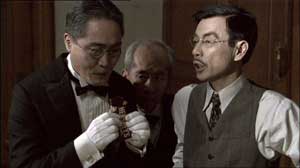
(The film’s best moment is also its funniest, when the Emperor receives a gift from General MacArthur of Hershey bars. Everyone seems slightly awed by the presence of real, cocoa-made chocolate. The Emperor’s butler warns they might be poisoned. The Emperor tells him to try some. The butler nibbles a bit, then says with a shrug, “I prefer rice candy.”)

^TOP