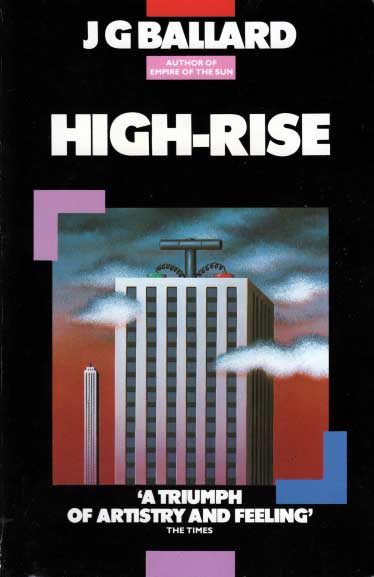
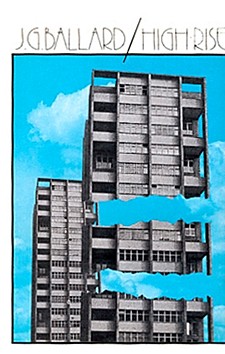
Cover to 1985 release of Ballard’s High-Rise, by James Marsh
As with 1966’s The Crystal World, there’s a feeling that High-Rise (published in 1975) grew from a single image that could have been a surrealist painting — in this case, that of a well-to-do middle-class man crouching on his apartment balcony, roasting a dog over a fire made of telephone directories — and that the rest of the novel is merely a Ballardian extrapolation of that one image.
High-Rise is J G Ballard’s insistence that the utter breakdown of society to be found in Lord of the Flies needs neither an isolated island, nor children without adult supervision to take hold. We can have it here and now, in modern England, in a fully-populated high-rise tower block, tenanted entirely by the most educated, professionally responsible classes. In fact, Ballard seems to be saying, we can not only have it, but we secretly long for it.
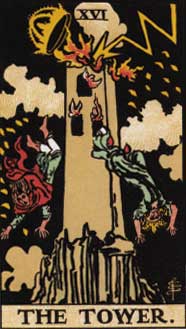 The novel kicks off at the moment the newly-built tower block reaches ‘critical mass’, as the last of its residents move in. From that point, a slow but steady escalation of petty social tensions, technical teething troubles and Ballardian psychopathology takes its grip, as the residents of the building — ‘a virtually homogeneous collection of well-to-do professional people — lawyers, doctors, tax consultants, senior academics and advertising executives, along with a smaller group of airline pilots, film-industry technicians, and trios of air hostesses sharing apartments’ — become increasingly violent, territorial, and tribal. At first maintaining a flawless facade towards the world outside, going to work each day in immaculately pressed suits, the residents return each night to spend more and more time engaging in vandalism and violence, finally forgetting the world outside altogether, to concentrate on their new, almost entirely primitive existence enclosed within the self-contained forty-storey apartment block, whose corridors, garbage chutes, elevator shafts and swimming pools are clogged at first with rubbish sacks, then, towards the end, human bodies.
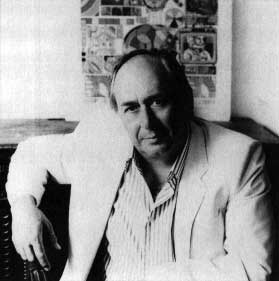 High-Rise follows not one but three protagonists, chosen from the three social tiers into which the forty-storey apartment block divides itself — a division that can’t help seeming arbitrary, homogeneous as the residents are. We start with medical lecturer Robert Laing, who lives on the 25th floor (throughout the book, as well as the usual Ballardian habit of identification-by-profession, minor characters are labelled by their floor of residence — so we get ‘a 28th floor account executive’, ‘a radiologist from the 7th floor’, ‘a newspaper columnist on the 37th floor’ — thus emphasising the social surface, in contrast to the violent or irrational behaviour they’re engaging in). We then switch to Anthony Royal, the high-rise’s architect, living in its penthouse apartment, who, like some sort of Bond villain, wears a white safari jacket while being accompanied by an arctic-coated Alsatian dog. He also has a walking stick, thanks to a recent car crash, which makes him seem, as well as a Bond villain, like an image of the author himself: Ballard, who wears a white suit in his author photograph, had also recently been through a car crash of sorts — the writing and publication of his 1973 novel Crash. Third in this trio of protagonists is Richard Wilder, a pugnacious TV documentary maker from the lower floors. Of the three, Wilder is the only one who has a real story, as such — a determination to climb the high-rise and inveigle himself into the top floors, under pretence of making a documentary. Laing, is, generally, too languorous to do much other than forage for food and join in with the occasional sortie against other floors, while Royal soon loses any sense of being a Bond villain, and retreats into a mix of traumatised detachment and a feeble longing to see the high-rise in terms of some sort of transformation:
‘…the present breakdown of the high-rise might well mark its success rather than its failure. Without realising it, he had given these people a means of escaping into a new life, and a pattern of social organisation that would become the paradigm of all future high-rise blocks.’
But you don’t read Ballard for the story. It’s the ideas, the images and the writing that ensure High-Rise is never static. Throughout Ballard’s works, there’s a longing for the outer world to match the trauma, chaos and perversity of his characters’ inner worlds, as though he were egging us on to become the people he knows we really are beneath the civilised surface — or at least the people he’s seen us becoming, in his prison-camp childhood in Shanghai during the Japanese occupation. But also, there’s a sense of striving for a new sort of freedom, even if it takes violence to reach it.
 But is that what the residents of this high-rise achieve? Towards the end, as tribal divisions break down and the residents retreat individually into their barricaded apartments, there’s a sense of stagnation — ‘sometimes [Laing] found it difficult not to believe that they were living in a future that had already taken place, and was now exhausted’ — or reversion, as the social breakdown, at first presented as a sort of inner fulfilment of what these over-conventionalised professionals really need to live fuller lives — ‘All this brought them together, and ended the frigid isolation of the previous months’ — starts to feel more like a regression, a retreat. Laing reforms his childhood ménage with his sister, and settles into petty power games with her and another bedridden woman he rescues from a nearby apartment; while Wilder, finally reaching the roof, sees children playing in the sculpture garden and doffs his clothes to join them. (Royal’s ending is the most disappointing of all — I was really expecting him, Ballard fashion, to be eaten by his beloved gulls, or perhaps to think he was one of them and attempt to fly off the tower-block roof.)
High-Rise was the first of Ballard’s novels that I read — thanks, of course, to Hawkwind’s song of the same name (whose lyrics paint a more science-fictional and socially rebellious picture of the same theme), released a bare four years later (but recorded in 1977, only two years after the novel came out). It is, I think, the perfect Ballardian novel. The story may at times feel static, but the writing never flags, with Ballard still pulling new images, ideas, and angles out of this situation right up to the final chapters. It also represents something of a change in Ballard’s writing. Before it, despite the careening handbrake-turn from his early disaster novels (The Drowned World, The Drought, The Crystal World) into the transitional, highly experimental work of the late 60s and early 70s (The Atrocity Exhibition, Crash) his writing focused on the individual’s response to a disaster, however worldwide or (in the case of The Crystal World) universe-wide, that disaster was. Here, though, we get to see more of the response of a whole section of society, which is more the style of Ballard’s latter novels (Cocaine Nights, Super Cannes, and I haven’t yet read Kingdom Come, but I’m assuming that’s similar).
Apparently, before starting the novel, Ballard penned a 25,000 word summary, ‘in the form of a social worker’s report on the strange events that had taken place in this apartment block…’ — which I’d love to read, though in the same quote, Ballard says: ‘I wish I’d kept it; I think it was better than the novel.’ !