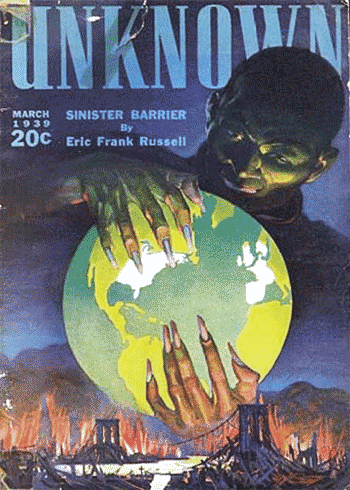
Cover to the first issue of Unknown Magazine (March 1939), art by H W Scott
The fantasy, SF and horror pulps remembered most fondly are those that made a name for publishing a particular type of story — often a specific sub-genre, rather than a broad genre. Weird Tales, for instance, is most remembered for Lovecraftian-style “weird” horror, even though it published a lot more besides, including the more traditional type of ghost story, and sword & sorcery. Unknown, which was for a brief time Weird Tales’ only serious rival in the world of fantasy pulps, was better known for a much lighter type of tale, one so characteristic to the magazine that it became known as the “Unknown school” (though it had had its precedents in the likes of humorous fantasists F Anstey, Thorne Smith, and Richard Garnett). As Weird Tales came first, Unknown defined itself against the older pulp: “No more houses of dripping blood, grinning harridans with butcher knives, bodies dangling from razor-bladed rafters”, as Ray Bradbury wrote in a letter to Unknown. Isaac Asimov characterised WT as “grim” as opposed to Unknown’s “impudent” — “with the accent on the imp”.
There are a few factors which gave Unknown its specific character, but chief among them was its editor, John W Campbell Jr, who supposedly started the magazine as a means to publish stories which had been submitted to Astounding, but which didn’t fit that magazine’s hard-SF style. As a result, a lot of the writers published in Unknown were SF writers with ideas for fantasy stories, and they approached fantasy in a more science-fictional manner. For them, fantasy was something to be confronted with a modern, logical and analytical approach. The most characteristic tales of the “Unknown school” feature an Average Joe confronted by a single instance of the supernatural or magical (rather than being transported to an entire other world, for instance), usually with humorous results.
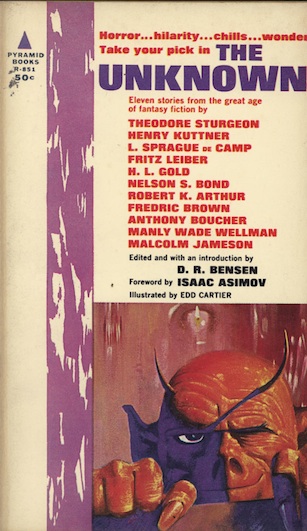
The Unknown, edited by D R Bensen, Pyramid Books 1963
There are a good few examples in The Unknown, a 1963 anthology of stories that appeared in the magazine during its brief life (39 issues in total, from March 1939 to October 1943, when the company’s limited wartime paper allocation was given over entirely to Astounding). Henry Kuttner’s “The Misguided Halo”, for instance, has a young advertising executive mistakenly given a halo by a novice angel, because of a confusion between him (Kenneth Young of Tibbett, North America), and a momentarily-lapsed holy man (Kai Yung of Tibet). Comic shenanigans ensue as Young tries to maintain a normal life despite this holy glow. Similarly, in H L Gold’s “Trouble With Water”, the Average Joe is Herman Greenberg, proprietor of a beachside hotdog & drinks stand, who insults a Water Gnome and is cursed so that “water and those who live in it will keep away from you” — with the result that he cannot wash, or shave, or drink anything but beer, and also (in a momentary boost for his business) cannot be rained upon.
A theme begins to develop, as these average Kenneths and Hermans inevitably go to doctors and psychiatrists for an answer to their problems, only to be dismissed with sedatives, or looked upon as an interesting case for further study, but never actually helped. (The one psychiatrist to star in his own story in The Unknown, in Nelson S Bond’s “Prescience”, actually pursues such an odd case, despite his disinterest, but with disastrous results.) But there is always a solution to be found, and usually it’s by the hero accepting the fantastic situation and working with its own peculiar logic, rather than by trying to attempt any kind of rationalisation. In fact, there are whole subgenres of fantasy which deal with this sort of approach — deal-with-the-devil stories, for instance, one example of which is here, Anthony Boucher’s “Snulbug”, in which the devil dealt with is a very minor imp with limited powers. Boucher’s hero, Bill Hitchens, is notable for not being an Average Joe, but a scientist, who summons the imp Snulbug to try and make some money to fund his research. Bill’s idea — for the devil to bring him a newspaper from tomorrow, so he can make a profit from its information — has, the imp points out, been tried before, and is limited in its usefulness, but Bill pursues his own (logical) approach to the magical situation, and comes through in the end.
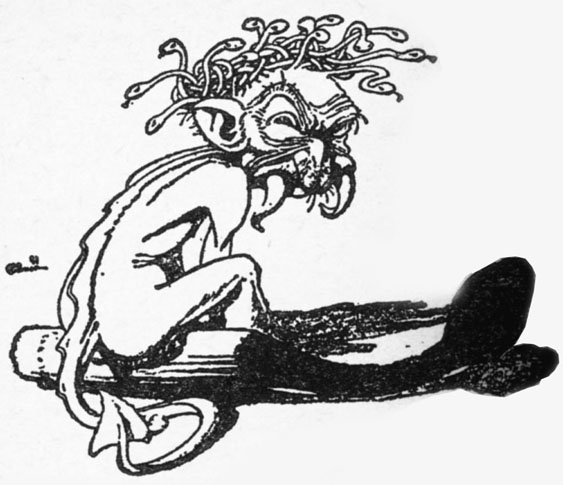
Edd Cartier illustration for Anthony Boucher’s “Snulbug”
Unknown featured other types of story, of course. Some — such straight horror tales as Manly Wade Wellman’s Poe-versues-Vampire tale “When It Was Moonlight” — are no doubt here because Unknown paid better rates than Weird Tales, and so got the chance to accept or reject them first. Another far more WT-style writer, who got his first professional sale in Unknown, was Fritz Leiber. Unknown published the first five Fafhrd & Gray Mouser stories, as well as some of Leiber’s Lovecraftian/M R James-inspired ghost and horror stories, including “Smoke Ghost”, which Ramsey Campbell cites as being important for making its ghost a thoroughly integrated part of a modern urban environment. (It’s his Fafhrd & Gray Mouser tale, “The Bleak Shore”, that gets included in The Unknown.)
Even when Unknown folded, the effect of its take on the fantastic lingered. Poul Anderson’s fantasy novel Three Hearts and Three Lions (first published in 1953, in F&SF), for instance, has its hero (from our world) defeating giants and dragons by working out the scientific rationale behind their fantastic nature, and his contribution to the first Thieves’ World anthology, “The Gate of the Flying Knives” (in 1979) is resolved by the hero’s use of an abstruse snippet of mathematical knowledge, which Anderson can’t quite hold back from naming, entirely anachronistically. A piece of parchment holds a gateway to another dimension, and to prevent its denizens from chasing through to our world after a heroic escape, the hero gives the parchment a “half twist and brought the edges back together”, meaning it now has only one side:
Air rushed in where the gate had been, crack and hiss. Cappen heard that sound as it were an alien word of incantation: “Möbius-s-s.”