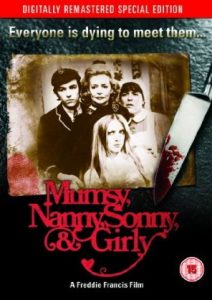
 “Happy families are all alike; every unhappy family is unhappy in its own way.” Yes, but what about mad families? What about psychotic serial killer families? Tolstoy didn’t think of that one, did he? Ever since reading about Mumsy, Nanny, Sonny & Girly
 in Harvey Fenton & David Flint’s Ten Years of Terror
 (an encyclopaedic look at 70s British horror which introduced me to many films I’d never heard of, and some I realised I ought to be glad I hadn’t) in 2001, I’ve been dying to see it, but aside from rumours that Redemption held the rights (there were obviously too many Nazi-nuns-in-bondage films to release first), there was no hint of it coming out on DVD. Then I did one of those wildly hopeful Amazon searches last week and found it had just been released. Watching it last night, I was amazed it’d taken so long, as it’s just the sort of warped filmic fare to appeal to cinephiles, particularly cult cinephiles. I’d go so far as to say that watching it was as bizarre and rewarding an experience as my first viewing of The Wicker Man, where, once I’d got over the shock of people singing, I realised this was one of the most distinctive and subtle of horror films, of precisely the sort that transcends the genre and becomes so much more than merely horrific. MNS&G might not have the awe-inspiring power of that final scene of The Wicker Man, but in a slightly whackier way it is just as distinctive, just as not-quite-horror-though-it-is, and though it couldn’t exactly be described as subtle (it’s as subtle as an eight-year-olds’ jelly-throwing contest), neither is it as over-the-top as you might expect. It’s also as distinctively British a film as they come, in a Mad Dogs and Englishmen kind of way.

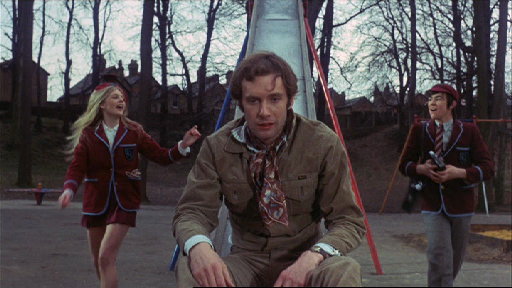
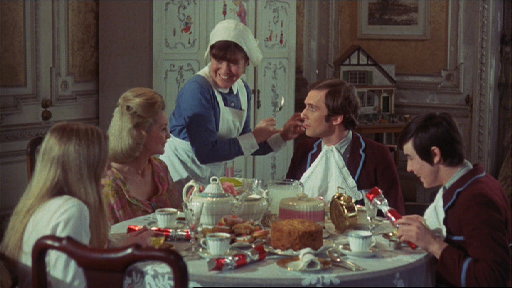
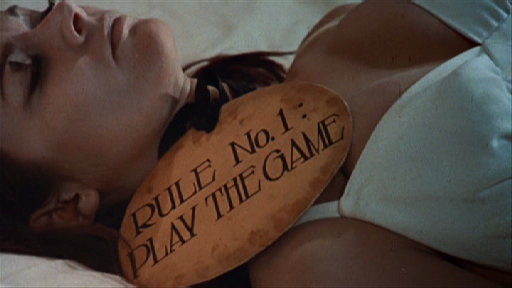
Based on a 1966 play, “Happy Family”, by Maisie Mosco (who is more well-known for her multi-generational family saga about Jewish immigrants living in Manchester, Almonds and Raisins (1979), Scattered Seed (1980) and Children’s Children (1981)), MNS&G‘s action takes place almost exclusively in a rotting, rambling Victwardian pile of a house, inhabited by a family whose members are only ever known as Mumsy, Nanny, Sonny and Girly. Sonny and Girly, obviously in their late teens, dress and act as clichés of the sort of naughty-but-loveable children that only ever existed in nostalgic fiction. But their gleeful gameplaying and chanting of horrid nursery rhymes is a thin mask for a family-wide psychosis. The children go outside the house’s extensive grounds to gather “New Friends” — mostly drunks from the park (though, as the film begins, we’re told Mumsy is fed up with drunks from the park, so the children make a fateful decision to gather a slightly higher class of inebriate) — whom they forcibly involve in their twisted, childish games, where the most important rule is “Play the Game”. New Friends who don’t play the game suffer the consequences, by having the darker side of nursery rhymes literalised — as in the “Humpty Dumpty Game”, which of course ends with someone falling from a great height, and not being able to be put back together again. But their newest New Friend proves to be more up to the mark, and once he’s learned to adjust to the madness of the situation, he begins to play games of his own, manipulating the subtle undercurrent of sexual jealousy that lurks beneath the family’s rule-entrenched power structure. With, as they might say, grisly consequences.

Though, not as grisly as you’d think. For a film slap bang in the middle of a British horror boom (and directed by Freddie Francis, the man responsible for Hammer’s The Evil of Frankenstein, and Amicus’s Tales from the Crypt and Dr Terror’s House of Horrors — though he was also cinematographer on David Lynch’s Elephant Man, Dune, and Straight Story), there’s remarkably little explicit horror. The goriest the film gets is a pricked thumb (hastily kissed better), though there is a corpse in a bed, not to mention the very brief glimpse of a (non-gory) severed hand. So much more is implied than shown, which may be why the film hasn’t dated. MNS&G shows its real power in a scene near the end, in the kitchen, where the viewer will already have realised that the big pot boiling away on the stove contains something that outdoes Fatal Attraction 17 years before Fatal Attraction. You never actually get to see what’s in the pot, but the cutting between its lifted lid and the horror on people’s faces is enough to make you think you have.

The film’s strength really lies in the mix between its characters’ schizoid gameplaying and the darker, messier psychology ready to break through that thin but overbright surface. Mumsy, Nanny, Sonny and Girly are always telling their New Friends that theirs is a happy family — but the fact they insist on this so much, and that “happy families need rules”, immediately gives it the lie.
So what is MNS&G about? It’s possible to enjoy it just for its weird mix of mad glee and nursery-rhyme darkness, but I think it has a power that goes beyond that. It’s of course about family. The thing about the MNS&G ménage is that, although it is sociopathic, psychopathic, not to say outright murderous, it works. It works not because of or in spite of its madness, but because the family have agreed to share a madness. And that may be the thing that transcends Tolstoy’s theory of happy and unhappy families: all families, to work as families, must be a shared form of madness — benign, in the case of happy families, less benign in the case of unhappy ones — but you know they work because the family stays together. That’s, in the end, what makes them a family.
MNS&G was released in the US as Girly, a title which, while it obviously makes the most of the film’s most striking visual asset (ahem):
 …does miss the point a bit about this being, after all, a family film. Though not, obviously, a film for all the family.


 I bought James Cawthorn & Michael Moorcock’s
  — but I’m often referring to it, wondering if this or that title has made the Cawthorn & Moorcock grade, or browsing it for reading suggestions. One thing I have come to learn is that their definition of fantasy is not necessarily mine (Moby Dick, for instance), nor is their definition of best (L Sprague de Camp’s Tritonian Ring, for instance), but that’s the fun of such lists. They’re only annoying if you forget they’re just one (or in this case two) person’s opinion and expect them to be in some way definitive.
 So, what type of story is Witch Wood? It earned its place in Cawthorn & Moorcock’s list because of the new minister’s discovery that, as well as attending kirk every Sabbath, a good portion of his parishioners disappear into the wood (the wonderfully named Melanudrigill, or just “the Wud” to the locals, who fear to name it) to take part in Devil-worshipping rites around an old pagan altar. The new minister learns of this practice when, having got lost one night in an attempt to overcome his fear of a place that a man with God on his side ought not to fear, witnesses his flock, masked as animals, dancing round the altar and, in Buchan’s own delicate phrasing, kissing “some part of the leader’s body, nozzling him like dogs on the roadside”. Yes, we all know where witches are supposed to kiss the Devil, thank you very much.
 — by wielding a huge sword. Sempill uses words alone.)