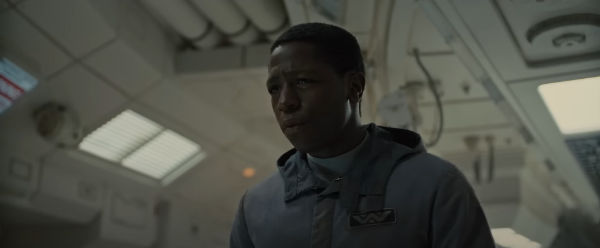
Alien: Romulus

It’s been a while since the last Alien film (Alien: Covenant was 2017), surely long enough for something gestating in this hypersleeping franchise to burst forth and cause merry havoc. And now here it is, Alien: Romulus, which I went to see on a Saturday afternoon at my local cinema. (Two days after its UK premier. I assumed it was best to book in advance, but there were only two other people there. I don’t think this is any measure of the film’s success globally, just a combination of a small town and good weather. Really, I’m glad we have a cinema at all.)

The film opens on a mining colony on the sort of planet where you never see the sun rise, and are equally unlikely to die of old age. The female lead Rain and what I at first thought was her autistic brother Andy, but who turns out to be a slightly malfunctioning android (and I’ve only just got the joke, Andy: Android — but he of course prefers the term “artificial human”, so should have been called Art), are working for the faceless (and hug-less) Weyland-Yutani corporation. Rain, whose parents are both dead (the mother, at least, due to working down the mines), has just clocked up enough hours to be released from her contract and sent off to a proper colony world, only to be told, sorry, due to manpower shortages — mostly, it seems, due to illnesses and fatalities — the company has just extended the minimum contract term and she has to stay for another five or six years. It’s then that her ex-boyfriend Tyler turns up with a proposal. A large chunk of space-debris due to crash into the colony planet’s (spectacularly rendered) Saturn-like ring is an old Weyland-Yutani station, and bound to contain some cryonic stasis chambers. If a small group of them get into it, they can remove the chambers and use them to make their own trip to the colony world of Yvaga, where Rain will be able to see the sun rise at last. Of course, we know from the prologue that this chunk of space-debris is a research station that picked up a certain biomechanical-looking thing from the fragments of the Nostromo… (Which, to pick at a minor point, should in no way have been clumped so closely together. Alien ended with not one but three massive self-destruct explosions.)

I’ve developed my own sketchy thematic outline for the Alien series. The first film is about pregnancy; the second is about motherhood; the third, after struggling through a few rewatches, is, I have to say, about rape (which, despite it being a well-made film, is perhaps why I find it somewhat repugnant); the fourth I haven’t pinned down yet, but might be about hybridisation; Prometheus is about abortion; Alien: Covenant, again, I haven’t pinned down. Alien: Romulus is full of children (twenty-somethings, yes, but still feeling very much like children) who have lost their parents (and most specifically their mothers, as at least two characters mention how they’ve lost theirs — in both cases due to the Company). It might be subtitled, then, “Raised by Wolves”, only the wolf that does the raising isn’t the benevolent she-wolf who nurtured Romulus and Remus, it’s the Weyland-Yutani Corporation, and far from feeding these motherless children from its body’s milk, it sucks the life out of them.

The ultimate aim of the research station is to create a new “perfect” strain of humans, through extracting a certain icky black substance from that biomechanical egg it recovered from the Nostromo wreckage. (And this is this film’s only major connection with the — aptly aborted — Prometheus-direction the franchise had been going in, and I have to say it’s done with the sort of light touch I prefer.) So, you could say, by the end of the film we get to see what a real “Raised by the Weyland-Yutani Wolf” child would look like. And I’m sure it would never call in sick, but I also wouldn’t call it human.

My basic feeling about Alien: Romulus is similar to how I felt about the recent (2022) Hellraiser film. Both are returns to a franchise that had been going awry, if not downhill. Both bring a more 21st-century sensibility — to me, they very much feel like they’re made by the current generation — and both are aware that they’re bearing the responsibility to pay proper respect to their originating films and provide something sufficiently box-office-worthy to enable their franchises to survive. As a result, they’re basically well-made films which provide some nice minor surprises, lots of nods to their originating films (maybe too many, sometimes), and a satisfying watch, but never stray into the truly challenging, truly shocking, truly visceral or mind-blowing, as those originating films did. That might be unfair to ask — great films are rare — but every sequel will be judged against its original. And anyway it’s probably better, in both cases, to have a solid success so the franchise can continue, than the sort of big-idea-loaded messes that Ridley Scott’s last two contributions were (despite being well-directed, shot, plotted, and acted). But, at the same time, you come away missing that essential something from the franchise, and that essential something is, it has to be said, the sort of transgressive, shocking, visceral weirdness that made the originating films so original. The original Alien seemed to exist in a constant state of shock at how weird its alien was; by Alien: Romulus, even the gloopier moments are handled in an almost offhand way, without that element of reverence or awe — that sense of the dark sublime.

(There seemed to be, in Alien: Romulus, a lot of business with doors, multi-layered difficult doors, with obstructive locking systems. I can’t help wonder if that doesn’t reflect, in some way, the creative atmosphere around a film like this, with the weight of so many requirements — commercial and artistic — putting a constant series of checks, blocks, and dead-ends in the way of really free creativity.)

The stand-out in this film, as all the reviews I’ve read so far agree, is David Jonsson as Andy the android, particularly when he gets an upgrade and suddenly becomes a corporation man. The other notable android — sorry, artificial human — is what for a brief second seems like a nice tribute to Ian Holm, as we see another of the same model of android that was Ash in the first film. But then he talks. And the special effects technology is not up to giving us a mock-up of Ian Holm moving his mouth in anywhere near a convincing way. (Film-makers: lay off relying on this until it’s convincing! It’s just creepy, and not in a good way.)

What I’d really like to see, I think, is an Alien mini-series, long enough for a nice, slow build-up and deeper characterisation. Aliens worked so well by tying the SF-horror of the original with another genre — military SF, or the Vietnam War movie — and I’d love to see the series tied to something like a political thriller, full of the sort of commercial shenanigans we only get to glimpse in the films. (Which makes me realise that, in the Alien films, the political and the commercial are one and the same. I’m sure my motherhood/reproduction-based reading of the films can be completely replaced by one saying that the whole series is basically about capitalism. Certainly this film.)

Anyway, basically a good film, and if I expect too much of it, that’s only because the first two instalments in the franchise are so good. I can only hope there will be more — while also hoping there won’t be so much more it becomes like Disney’s over-ploughing of the Star Wars franchise. But then again, Disney owns 20th Century Studios, which makes this, basically, a Disney film, so I can’t be sure that won’t happen…

^TOP

The Hellbound Heart by Clive Barker

Fontana 1991 PB

Re-reading Barker’s fiction, The Hellbound Heart presents itself as something of a quandary. Overshadowed as it is by its adaptation as Hellraiser (1987), the question is, is this novella a standalone piece of fiction, or just a stage in the production of the film? In his biography of Barker, The Dark Fantastic, Douglas E Winter writes: “Clive insists that The Hellbound Heart was not conceived as a template for a film… but as he wrote the short novel, he realized that it was ideal for low-budget film-making.” But an October 1987 interview by David J Howe for Starburst, quotes Barker as saying that he wrote the novella “with the specific intention of filming it. This was the first and only time that I have done that, but it was useful in that I worked through a lot of the visual problems in the novella and the final screenplay didn’t take that long to draft.” The only reason this matters to me, in this re-read, is I thought the first two-thirds of the novella didn’t quite click, and I wondered if this was because the focus was on a film as the finished product — and so, the visuals and outward drama, rather than the inner lives of the characters. But equally, it could just be that sometimes fiction does take a while to click, even in its finished form.

1987 Legend PB

The Hellbound Heart was first published in 1986 in Night Visions 3, an anthology edited by George R R Martin, which gave a third of its space to each of Ramsey Campbell, Lisa Tuttle, and Clive Barker. Barker’s only contribution was the novella.

The story of both novella and film are virtually identical. Julia is in a passionless marriage to Rory (Larry in the film), which was ruined before it even got started thanks to a one-night stand with his far more adventurous but driven-to-extremes brother Frank. When the couple move into Rory’s now-empty parents’ house, it turns out the long-missing Frank is there with them, only in an all-but-disembodied state. He used the house to experiment with an occult ritual involving Lemarchand’s Box (the Lament Configuration in the film), to summon the demonic Cenobites. Thinking this would open up whole new realms of hedonistic indulgence, Frank quickly finds their version of “extreme” is way more extreme than his, and now he just wants to escape back to reality again. Blood from a cut to Rory’s hand starts the process of reforming his sundered body. But to complete the process — and fully escape the Cenobites — he needs more blood and bodies. The besotted Julia agrees to provide them. Unaware of any of this, Rory asks his somewhat pallid friend Kirsty, who’s silently in love with him (but is his daughter in the film, which works better dramatically but less well thematically), to talk with Julia. Kirsty finds herself facing the Cenobites, and does a deal that will either return Frank to their S&M hell, or let them take her in his place…

As I said, for me, the story only really kicks into gear, as a piece of written fiction, in the last third or so, when Kirsty becomes the protagonist. Julia, the main mover of the first part of the story, doesn’t have the presence she does in the film, with the result that when the narrative wanders off to follow Frank or Rory, it feels less like a diversion and more like the story’s still in search of its narrative centre. But when Kirsty takes over, even though she’s presented as a much less passionate woman — she’s “the girl with the pale handshake” who “had long ago decided that life was unfair” — her perspective is the one that makes the full horror, weirdness and threat really click into place.

1991 Harper PB, art by Kirk Reinert

The Hellbound Heart does that thing horror does so well, of both indulging in something and issuing a stern warning against it. Here, that thing is one of Barker’s key themes, the “further reaches of human experience”, and the quest into other realms for its fulfilment. It’s clear, here, that Julia is suffering, as a human being, by living such an unfulfilled life with Rory, having been awakened to something stronger, darker, and more passionate by Frank (even though that relationship probably contains just as little love). But there are no gradations here between dour lovelessness and the Cenobites’ realm of unbounded “pleasure”. Because the Cenobites have taken things so far that they, too, have stagnated, caught at the point where what they provide has long since ceased to be pleasure in any sense of the term. Right from the start, they’re presented as an image of over-repletion, tired, empty and chilly:

“A fitful phosphorescence came with them, like the glow of deep-sea fishes: blue, cold; charmless.”

“…he saw nothing of joy, or humanity, in their maimed faces: only desperation, and an appetite that made his bowels ache to be voided.”

They’re accompanied by a scent of vanilla — a byword for blandness — “the sweetness of which did little to disguise the stench beneath”. The quest for the far reaches of human experience has taken them to a dead end, a one-note world (like the bell that tolls when they appear). Frank, who just wants his sexual fantasies made real, ends up in the position of a jazz enthusiast turning up to hear some legendary saxophonist, only to find their art has advanced to the stage where they honk the same, single note, as loud and long and ugly as they can, on a bent instrument with a split reed.

According to Winter:

“The evil of appetite is a repeated theme in Barker’s work, and in The Hellbound Heart he offers a searing condemnation of lust in the guise of love — and the pursuit of pleasure in fulfilment of a spiritual void. Frank’s sin is not his self-indulgence, but his hollow — and thus hellbound — heart…”

But elsewhere, though very briefly — in the one moment where the character of Julia starts to come to life in the novella — we get a glimpse of how the promise of pleasure, in a world devoid of it, can attain an almost spiritual dimension, capable of transforming everyday reality. Watching the news on TV while she thinks of the promise of the slowly-regenerating Frank, Julia is already in another realm of being:

“What did the world have to tell her? Little enough. Whereas she, she had news for the world that it would reel to hear. About the condition of the damned; about love lost, and then found; about what despair and desire have in common.”

2008 Voyager PB

But, like all of Barker’s fiction that deals with transcendence, transformation, and elevated realms of being, this is still just about the body. The Cenobites — “angels to some, demons to others” — are utterly physical, “their anatomies catalogues of disfigurement”. Their realm, their power, lies entirely in what they do to your body, your nerves. Frank’s return from death means not some magical rebirth, but the disgusting business of remaking a new body out of other, freshly-slaughtered bodies. In bed with Rory, trying to distance herself from her own despair, Julia thinks of herself as nothing but a body with its physical processes, reducing herself to the least she can be as a human being. Next to the Lead Cenobite (better known as Pinhead), the book and film’s crowning image is of the body revealed beneath the skin: Frank as nothing but a pulsing, naked nervous system, “this too vulnerable body”, as Julia thinks of it.

It seems odd, then, that the centre of this tale would turn out to be the supposedly passionless, pallid Kirsty (though even in her, the ever-lubricous Frank sees possibilities), but probably she only seems passionless in comparison to Julia and Frank. Kirsty loves Rory and will do anything for him (he just doesn’t ask much); hers, then, is a very human form of passion. And she can see the horror in Frank and the Cenobites that Julia can’t, because Julia is blinded by her own desperation. (Perhaps the real villain of the novella is Rory, for being so inadequate to the women in his life.)

Perhaps, though, the reason the first part of the book doesn’t have the impact I wanted it to have is simply because I already know the story from having seen the film so many times. (If so, it’s something the film doesn’t suffer from, as that’s still a thrill to watch.) It’s hard — certainly for me, having never got used to watching pre-Hellraiser films till after I’d seen Hellraiser — to really appreciate what a game-changer the world presented by this novella-and-film-combo really was, for the horror of its day. It sits alongside Alien and The Thing as a milestone in the genre.

The puzzle box, for instance, did away with years of the same old cinematic occult rituals (pentagrams and women sacrificed on altars). And it wasn’t just a visual coup; the box captured as never before the difficulty and self-absorbed, driving obsession of such a magical operation (while also no doubt chiming with an audience who’d grown up trying to solve a Rubik’s Cube, and were now glad they hadn’t).

And then the Cenobites themselves: a whole new class of demon, with the suaveness of the vampire, the grossness of the zombie, and that added Barkerian element, a philosophy, and the eloquence to defend it.

Hellraiser is a more finished form of The Hellbound Heart, and one that works all the better for having actors bring it to life. It’s a rare film whose strong emotional drama matched the impressiveness of the day’s cinematic effects (whose new levels of “rubber reality” all too easily dominated 80s genre films, to the point where they were visual spectacles first and human dramas second). I’ve only seen the two immediate sequels (both have nothing on the first film) and the very latest reboot, which neatly franchise-ifies the first film’s elements into something that feels just a little bit too packaged to retain the raw-nerve edge and sense of danger of the original. As for Barker, Hellraiser proved him to have a cinematic sensibility as developed as his literary and artistic ones, thanks to its occasional arthouse touches of surrealism and dark beauty (seen best of all in his short film The Forbidden) — though, I have to say, that’s an element of his work as a director that didn’t survive into his subsequent movies.

And speaking of what’s next (skipping over my favourite Barker novel, Weaveworld, which I’ve reviewed before): another novella-and-film pairing, with Cabal/Nightbreed.

^TOP

The Shadow by E H Visiak

After The Haunted Island (1910) and Medusa (1929), E H Visiak’s only other substantial work of weird fiction was the novella The Shadow, which was published in 1936 as part of a fat, budget volume (560 pages for 2 shillings and 6 pence) called Crimes, Creeps and Thrills (“Forty-Five New Stories of Detection, Horror and Adventure by Eminent Modern Authors”), with no listed editor, but online sources have John Gawsworth in that role. (And he is the co-author of two tales in the book under his own name, and one under his real name Fytton Armstrong, which feels like confirmation.)

The Shadow is a departure from Visiak’s previous two novels, in that it’s contemporary, and not a sea adventure. It’s told in two parts. In the first, the main character Edmund Shear is fourteen years old, and is spending his school holiday at the house of a fellow pupil, Anthony Layton. The two aren’t exactly friends, as Anthony’s main means of relating to people seems to be mockery and contempt, with the occasional retreat into self-pity when things go wrong. Edmund’s father is a painter of seascapes, and Edmund himself is obsessed with the sea (“His mind ran much upon nautical imaginations”), making him possibly a stand-in for Visiak himself.

In the room where Edmund sleeps is a portrait of one of Anthony’s ancestors, Hamond Layton, who was “a sort of pirate—a smuggler, anyway”, and was hanged for it. The portrait affects Edmund profoundly, as though the long-dead Hamond has perhaps, at moments, started to possess him.

One of eight uncredited illustrations to Visiak’s story.

An initially confusing array of other characters is introduced, including an old sailor known as “Jerusalem John” who actually knew Hamond Layton, a ship-owner called Archie Anderson, a Mr Jervons who spends a lot of his time at Anthony’s home (Anthony’s mother is a widow) and is the main male influence — though “an embittering, belittling, restraining influence” — on the young Anthony’s life, a “prophetess” of the New Idealism called Mrs Evans, her granddaughter Margaret Conyers who writes poetry, and finally a painter, Reginald Rudderford Thurston, who is described by one of the other characters as “a monster in human habit, a psychological octopus”, a vivacious but violent, sly and domineering and perhaps supernaturally-possessed man, “thrilling with ravening spite”.

So many of the relationships between these characters are about various forms of domination. Anthony tries to bully those he perceives as within his range (Edmund and Margaret, neither of whom gives in). Anthony in turn is domineered by the sarcastic Mr Jervons, who has clearly installed himself in the Laytons’ home and is living off it. Mrs Evans so believes in the truths of her New Idealism (whose main tenet is that there is no such thing as evil, only ignorance) that she bosses everyone around (“a look of complacent domination in her eyes”), assuming they’ll come round to her way of thinking and thank her for it. But worst of all is the almost Devil-like Thurston, who seems to have a supernatural insight into others’ secrets, and revels in manipulation, bullying, and generally being extremely unpleasant, and whose one redeeming virtue is that he does it so excessively he is clearly the villain of the piece, even if it’s never clear what he’s up to and why.

The second half of The Shadow leaps forward to Edmund as a young man, having just inherited Mr Anderson’s shipping firm. He returns to the scene of the first half of the book (near Lowestoft) and experiences some sort of breakdown. Ever since encountering the portrait of Hamond Layton (which he now owns), he has moments when the old pirate/smuggler seems to take him over, turning him angry and domineering. In the midst of his breakdown, he’s taken in by his old headmaster, Mr Atwell, who speculates on what might be going on with the young man, and so provides the story’s only lucid explanation. It seems that the smuggler Hamond Layton was, at one point, presented with a choice, either to continue his life of crime, or marry a woman who loved him. He made the wrong choice and was hanged for it, but perhaps his lingering essence is seeking redemption through the young Edmund. But to do this, Edmund has to learn to tame the angry, domineering aspect of Hamond-the-pirate, before he can find love (with poetess Margaret). This makes a sort of sense of most of what’s going on in the novella.

But it raises the question of what the villainous Thurston’s role is. At one point, Thurston is said to be “a representation, in some way, of Hamond Layton”, but if so it’s only of his darker nature. However, Edmund is already battling that darker nature within himself, so why have another character represent the same aspect? It seems more that Thurston is a (or even the) Devil, taking it on himself to try and drive Edmund to the same fate as Hamond — a life of crime, followed by hanging. And certainly Thurston takes a Devil-like joy in sowing discord and misery all around him. Anthony Layton has fallen particularly under his spell, and Thurston urges him to seduce Margaret, to take her potentially redeeming influence away from Edmund.

If one of the story’s main themes is the dominance of some people over others — as well as all those domineering types such as Mr Jervons, Thurston and Mrs Evans, there’s the “shadow” of Hamond Layton’s supernatural dominance over Edmund — a secondary theme is how this domineering impulse, in the male characters at least, is tied to sex.

We’re told early on that the boy “Edmund’s absorbing interest in nautical things had kept his thoughts away from sexual aspects.” At one point, after having met Margaret for the first time, he has a particularly troubling dream, which implies that “nautical imaginations” are, for him, a sublimation of his adolescent sexuality:

“…a woman had changed into a ship; and the ship — which was such a fine one! — had to be sunk for it to become a woman again…”

(Which is perhaps also linked to Hamond Layton, who named his ship Barbara, after the woman who loved him.)

Mr Jervons and the adult Anthony Layton are both casually predatory on women. It all seems to tie in with Visiak’s belief that the Eden-like state of childhood comes to an end with adolescence purely because of the introduction of sexuality — though, here, it seems to be redeemable by love. (Mr Anderson, the main adult male character who isn’t domineering, was in love with a woman who died before they could marry. Edmund and Margaret’s love, when it’s admitted, seems to be the redemption both for Edmund and the shadow of Hamond Layton.)

Mrs Evans’ New Idealism, though probably satirising many beliefs both then and now, is perhaps most notable for its idea that there is no such thing as evil. But Visiak is clearly presenting us with evil in the form of the barely-human Thurston. Visiak, I’d say, believes in real evil.

The Shadow is quite a confusing novel. The opening introduces a lot of characters, all of whom seem to be basically unpleasant and domineering in various ways, painting a very dour picture of the world of human relations. Even by the end, things aren’t very clear, and if it wasn’t for that one chapter where Mr Atwell speculates to himself on what might be going on, I’d probably have no clue as to what Visiak had intended. Take out the supernatural influence of the “shadow” of Hamond Layton, and you’d have the story of a young man with troubled moments of dark, almost hallucinatory depression and bouts of anger, perhaps rooted in a sexuality that can no longer safely be sublimated into boyish thoughts about boats. Perhaps another read might make it all clear… But perhaps not.

However, further clues might be gleaned from Edmund’s speculations at one point, which strays into the territory of cosmic horror. Is it being put forward as a valid interpretation of Visiak’s supernatural world, or is it just a throwaway — if frightening — thought?:

“Perhaps superhuman beings used us as we used animals, for food and work — a different sort of food and work.”

Visiak had another tale in the same anthology, a collaboration with John Gawsworth called “The Uncharted Islands”, that is, again, a sea-adventure, but with no supernatural element.

^TOP