
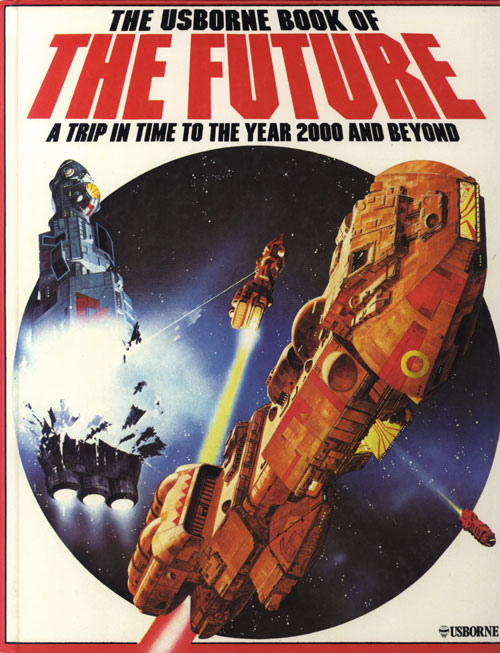
“Now read on… into the fantastic world of the future!” That’s how each of the three sections of The Usborne Book of the Future (on Robots, Future Cities, and Space Travel) begins, after a brief look at these subjects (tool-use, cities, and transport) in history. It was published in 1979. I don’t think I owned it, but must have got it out of the local library — certainly, I pored over it enough for some of its images and ideas to really stick in my mind. I mentioned the key one in a previous Mewsings a while back (writing about William Gibson, whose latest novel I am, by coincidence, reading at the moment), which showed two possible views of how the future might be, one good, one bad. It was titled “Two Trips to the 21st Century”, and I remember really worrying that I might end up living in the nasty, polluted, breathing-apparatus one. I recently gave in to a bout of curiosity/nostalgia and bought it, perhaps mainly so I could have a second look at that image. Here it is (click on it for the full double-page spread, including key to the numbers):
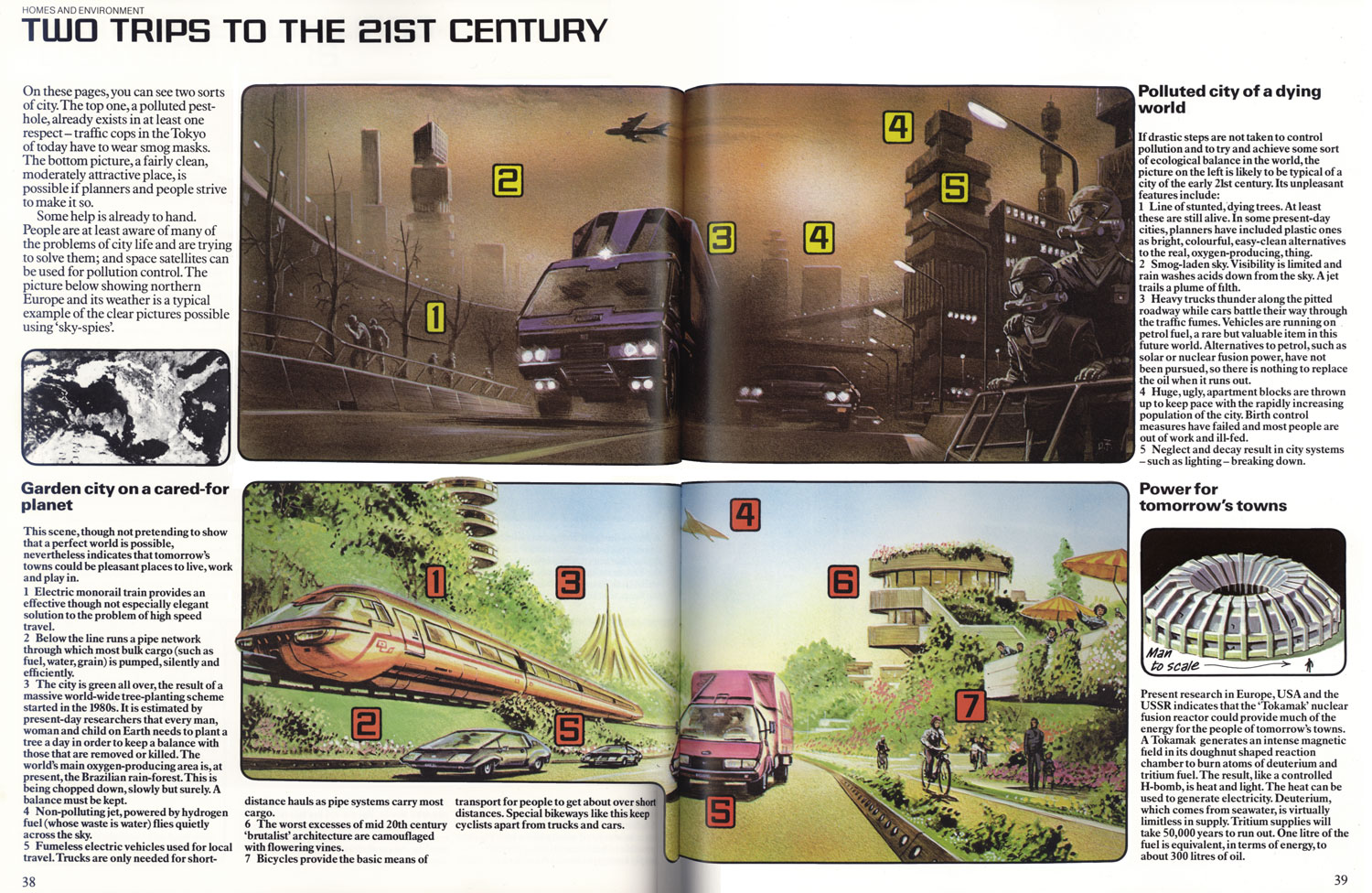
“Two Trips to the 21st Century” from The Usborne Book of the Future (1979)
And then, of course it struck me — here I am, living in the 21st century!
Usually, nothing dates as fast as people’s ideas about how their future is going to be, but having a browse through the Usborne Book from the privileged standpoint of living in the era it was talking about, I was pleased to see how well it stands up. This may be partly thanks to the fact that it wasn’t just based on someone’s speculations having read a few topical SF novels, or on what would look the most visually interesting to Star Wars-hungry kids, but because it was based on the research and speculation of scientists and groups like Bell Aerospace, Boeing, and NASA, which get mentioned in the acknowledgements (alongside Arthur C Clarke and Omni magazine). In fact, the most dated thing about it is, perhaps, a single reference to “housewives” — which also led to my noticing how few women are taking an active part in the jumpsuited future the book depicts.
But generally, the thing that works in The Usborne Book of the Future is that it isn’t talking down to its young audience. It’s not setting out to paint a picture of the sort of future the kids of the day would have wanted, but it really looks at how technical advances might affect day-to-day life, and how the problems of an ever more energy-hungry civilisation might be overcome (gathering solar energy in space and sending it down to Earth in a concentrated microwave beam, for instance — is this still a possibility?). There are far more bicycles (even if occasionally solar-powered) than jetpacks in the book, and the one technological advance that most excited me at the time, I now realise is decades old:

The “risto”, or wristwatch radio-telephone.
Here is how the living room of the 1970s future was going to look:

The living room of a house of the future, from The Usborne Book of the Future (1979)
And, apart from the fashions (futuroid, for the man watching TV, retrograde for the footballer he’s watching), and the drinks-serving robot, it’s all come true. We have video cameras, we have home shopping, we have films on video discs, we have electronic mail, we even have video phones and — gods! — we have flat-screen TVs. I think we all deserve a pat on the back for now, officially, living in the future.
The one thing I wonder, looking at this picture, is why man number 2 is so keenly filming his neighbours. The politics of the future is not discussed in The Usborne Book, and this may prove to have been its one major blind spot. Most of its more optimistic ideas (and it generally takes the optimistic view, though doesn’t ignore the problems) have perhaps not come about because there just isn’t the level of political unity required to change the way we live.
Also, of course, there’s the annoying problem of the way the past doesn’t disappear the moment we hit the future — so much of it is left lying around, clogging up the pathways to futurological advancement. The real reason we don’t have superfast cool-looking monorails is because it’s far more cost-effective to adapt our existing dual rail systems to new advances (if we even bother to do that), and the same goes for all technological advances. They have to be bolted onto the present, upgraded step-by-step. But cost, and the sheer tonnage of existing hardware, are two things it’s easy to ignore when you’re reclining in your semi-spheroid easy chair in your sparkly new jumpsuit, speculating on what the future will bring.
Still, I’m so glad it wasn’t that “polluted city of a dying world”. Not yet, anyway.
(Some credits: The Usborne Book of the Future was written by Kenneth Gatland and David Jefferis, and the artwork was by Gordon Davies, Terry Hadler, Brian Lewis, Michael Roffe and George Thompson.)


 (1978), but excusably so, because I suspect the melody was designed to echo the word “Chocky”, and it’s the melody that makes it sound similar to the Eno track.) There’s also a 1967 BBC radio adaptation (which can be found at
