The Power of Stars by Louise Lawrence

1989 Collins hardback, art by Geoff Cummins

I thought I had read all the Louise Lawrence books that initially grabbed my fancy, but when I happened upon the premise of this, her second novel, I had to read it because it sounded so bizarre: a girl is bitten by a rabbit and gains the destructive “power of the stars”. I was sure, from my recent reading of Lawrence’s Wyndcliffe, Star Lord, and The Earth Witch, it couldn’t be as radioactive-spider ridiculous as it sounded. It turns out to fit very much with the kind of late 1960s/early 1970s YA novel I’ve covered on Mewsings before — things like Alan Garner’s The Owl Service and Penelope Lively’s The Wild Hunt of Hagworthy — so that, in the end, I found The Power of Stars (1972) interesting for its preoccupations, even though I didn’t think it quite worked as a novel.

The setting is the borderland mountain region between England and Wales, and the cast is that old Owl Service/Earth Witch formula, the bickering trio of teens (two boys, one girl) with added class tension (two are working class, one is middle class). The girl is Jane Bates, 15 years old and the poorest of the three, who lives with her Granny as her mother abandoned her before moving abroad and breaking all contact (as with Owen in The Earth Witch). Walking home from school with the local lad she’s known all her life, Jimmy Keir, and an English boy, Alan Grant, whose divorced, soon-to-be-remarried mother has recently moved to the area, all three, separated in the dark of the village countryside, are distracted by a strange, powerful brightness in the stars. They hear a weird scream, but it’s only a rabbit, caught, somewhere in the dark, in a trap. The following evening, the three are again walking home when they find the poor thing, still alive, though out of the trap. (They find the trap, which seems to have been hit by lightning — it’s just a lump of molten metal.) Jane picks up the rabbit, intending to take it to a vet, and it bites her, deep in the wrist. Uncharacteristically for a rabbit, it hangs on, as though to make sure she’s thoroughly bitten. Jimmy flings the rabbit off her, and they take her to Alan’s stepfather-to-be, Dr Nick Mackenzie, who, once Jane has been taken to A&E, seeks out the rabbit, thinking he might find something unusual about it because of its behaviour. He and Alan bump into local oddity Marcia Cotterel, known to the area’s kids as the Batwoman, because she’s a scientist studying bats (also, they think she’s a bit crazy). Her dog, it turns out, was also bitten by a rabbit — perhaps the same one — and she’s also trying to find it, to see if it was infected by some odd new disease.

1st UK HB, art by Antony Maitland

Things tick along for a while, with the trio of kids bickering lightly but constantly, in the way of bored teens, when two odd things start to occur with Jane. First, she seems to have gained a new fear of machines — though only at night, when the stars are out. Second, if Jane is particularly worked up, those machines suddenly fuse, or melt, or even blow up, as though hit by a blast of intense energy. Afterwards, Jane will usually be found alone in the dark, staring up at the stars, drinking in their light.

It turns out Jane has been infected by a sort of alien life-form, an intelligence that exists as tiny, neuron-like protozoa, simple on their own but somehow forming, together, a sort of intelligence. And it’s an intelligence that feeds off starlight and hates machines, perhaps because (Dr Nick suggests) they might have once become too reliant on machines in their own, more advanced, society that self-destructed, and now they’re trying to save us from the same fate, using Jane as a focus. (They also use her to drink up the experience of embodied life, something they’ve evidently been missing since becoming space-bound protozoa. That, and music.)

US HB

This hatred of machines, combined with bouts of the irrational need to destroy them, reminds me of The Changes. The BBC series came out in 1975, but Peter Dickinson’s trilogy of novels the series was adapted from were all out by 1970, and I can’t help wondering if Lawrence wasn’t proposing an alternative explanation for those books’ outbreak of irrational anti-machine violence. (Star-bound protozoa with a beef against the mechanical is a little bit better — though only just — as explanations go, than Dickinson’s Merlin-on-drugs.) But the idea of a rabbit bite infecting Jane with an alien life-form is less about scientific plausibility, I’d say, than a sort of imaginative pressure on the author to bring together the two archetypal forces that come out again in her later novel Star Lord: the science-fictional force from the stars, and the ancient forces of nature, only here they’re united, rather than being inimical as they are in Star Lord.

This is Lawrence’s second novel — her second published novel, anyway — and I thought it perhaps showed in a couple of structural weaknesses. The lengths she goes to in order to ensure her trio of teens are out at night (under starlight) in a machine (Alan’s car), far from home, near the climax of the novel, felt a bit too much like an author over-thinking things (they run out of petrol, then a tyre blows). And the chapter where Dr Nick and Miss Cotterel theorise on the nature of the neuron-like protozoa that have taken up residence in Jane’s brain relies a bit too much on some far-fetched guesses being taken by two scientists as the only likely explanation.

1976 Lions PB

But it’s a short novel, and I enjoyed it for how much it fits in with the other books of the time. The constant tensions between the characters have that post-Kitchen Sink era air of gritty social realism, as do their goodnatured but cranky attempts not to give in to class resentments (Alan always has money, Jimmy never does); the writing style has that poetic terseness writers on the literary side of late 60s/early 70s YA seem to slip into (Garner eventually taking it to the extreme, but it’s also there in John Gordon and William Mayne); and there’s another theme of early 70s YA, broken families and the added emotional burden this places on adolescents who not only have to deal with puberty, but some sort of supernatural/science-fictional menace as well. (And Jane’s “power of the stars” feels very much like that horror trope that became increasingly prevalent in the 70s, of what I might call Teenage Telekinetic Breakout Disorder, or Carrie’s Syndrome.)

It’s perhaps more interesting when read as part of Lawrence’s own body of work and her development as a writer (I now want to read her first novel, the more purely SF Andra), or as one more part of early 70s rural fantasy (folk fantasy, as it might be called), so I wouldn’t recommend The Power of Stars as a first read if you’re interested in Lawrence, but it’s by no means a bad book. I’m still not entirely sure about the rabbit, though…

^TOP

Radicalized by Cory Doctorow

Radicalized, first published in 2019, is a collection of four novellas of a Black Mirror-ish cast, bringing as they do a dystopic twist to areas of modern concern. I hadn’t read any of Doctorow’s fiction before this, aside from I think one short story in a cyberpunk anthology, but have been listening to his podcast, where he reads his non-fiction pieces, mostly on matters concerning the social impact of big tech companies’ business practices. The first of the stories in Radicalized is a fictional take on one of these topics, but if that makes it sound dry, it isn’t.

The protagonist of “Unauthorized Bread” is Salima, a refugee immigrant to the US who, upon finally being allocated housing, finds herself in one of the quota of assisted-housing flats in a large, technologically modern tower block. This means certain aspects of the building’s tech infrastructure quietly but relentlessly discriminate against her, to ensure she can never forget she’s there on sufferance. The lifts, for instance, have two lobbies, one for the full-paying residents, one for the likes of her, and if a full-paying resident is in a lift, it won’t open its doors on Salima’s side, or stop at any of the assisted-housing floors. As Salima lives on the thirty-somethingth floor, she often has to wait forty-five minutes for a lift that will open its doors for her. Mostly, after a hard day’s work, she climbs the stairs.

Her apartment comes equipped with some modern appliances, too, including a Boulangism toaster. (Which I, as a UK reader, thought meant a pop-up toaster, but apparently means a “toaster oven”.) This marvel of modern tech will toast anything to perfection, as long as it’s in the manufacturer’s approved list. So, if you buy just any bread (i.e., cheap bread), the machine won’t even open up. You have to buy approved bread, made by bakers who have paid a subsidy to Boulangism. (In turn, Boulangism pay a cut of the profits to the landlords who install these appliances, which is how they can afford to rent a number of apartments to low-paying tenants: the tenants end up paying more than the difference in rent through having to buy more expensive consumables, the profits from which partly go into the landlords’ pockets.) And it’s not just the toaster that does this, but the dishwasher, the fridge, and so on.

Then Boulangism goes out of business, and the toaster refuses to toast anything. Salima goes online to work out what to do, and discovers a world of advice on how to jailbreak her toaster’s firmware so she can use it again. Once that’s done, she doesn’t see why she shouldn’t jailbreak her dishwasher and fridge, too. And then, perhaps, the lifts?

“Unauthorized Bread” feels like one of those SF stories that could be happening not just tomorrow but right now. The technology for a choosy toaster might not be quite there, but things like this are going on (printers only accepting manufacturer-approved inks, for instance). And, as Doctorow has pointed out in his non-fiction pieces, this isn’t just about high-end consumer appliances, it’s an aspect of tech business practice that covers things like pacemakers (if your pacemaker-maker goes out of business, it’s illegal to have someone concoct a firmware update for it to, for instance, protect it from security flaws) and farm equipment (not being able to sew non-approved seeds, for instance, thus locking farmers into one mega-corporation’s entire product range). This story feels, then, like the moment 80s cyberpunk gets so close to modern life it’s just not SF anymore.

“Radicalized” is another tale of modern tech’s effect on ordinary people’s daily lives (though this time specifically in the US). The protagonist is Joe Gorman, whose wife develops a life-threatening cancer. There’s a treatment available, but it’s experimental, and their medical insurance won’t pay for it. Joe starts checking in on a forum for people in a similar situation, where men, helpless and furious at a system that denies their loved ones the possibility of recovery (and therefore of life), vent their darkest thoughts. Inevitably, some of these are of revenge on the people behind it — the executives at the insurance companies, the politicians who’ve blocked universal healthcare, and so on. Then, perhaps just as inevitably, one of these men, driven to despair when his loved one finally dies, decides to act on these fantasies. He’s going to go into the offices of the insurer who denied payment for an expensive treatment and blow himself up. Because, as he reasons, no one’s going to expect a middle-aged white guy to be carrying a bomb. And when he goes ahead and does it, everyone associated with the forum — even Joe who tried to talk the guy out of it — become, in the eyes of the government, terrorists.

Cory Doctorow, photo by Jonathan Worth (http://jonathanworth.com), Creative Commons Attribution 3.0

The only tale, here, to enter fantasy territory is “Model Minority”, about a superhero called the American Eagle who is, in all but name, Superman. (He has a fellow crime-fighter friend in a billionaire called Bruce, and has — or, rather, his secret identity has — a reporter-girlfriend called Lois.) One day he sees a group of cops relentlessly beating a black man, having stopped him on the flimsiest of pretexts. The American Eagle puts a stop to it, and decides to make sure the victim, Wilbur Robinson, receives the proper medical treatment and a fair trial. Suddenly he finds himself on the wrong side of an America that, previously, had pretty much worshipped him. His crime-fighting billionaire friend Bruce, even the victim Wilbur Robinson, tell the Eagle he’s bitten off more than he can chew, and he’s probably going to cause himself, and everyone else, more trouble than he’s preventing.

I’m not really sure what the take-away from this tale is, aside from flinging a lot of blame at a hero-figure (something the new series of Doctor Who did a lot, I felt), as in, where was the American Eagle at all the other high-points of racial tension in America? The trouble is, this turns the story into, in a way, a criticism of a fictional character (why didn’t the Superman comic take up these issues? — I have no idea if it ever did), rather than addressing the issue of racism. I wondered if the American Eagle wasn’t supposed to be taken as a sort of icon of America’s image of itself, but the story undermines that, by pointing out how this superhero is in fact an alien from another planet, and so, technically, a “minority” himself, and only tolerated as long as he serves the values of the country’s power structures. But the issues here are too complex to be dealt with by such a blunt instrument as a Superman-analogue, so this, for me, is one of the tales in the book that, despite having an excellent premise, ultimately fizzled out. (Perhaps this is just because “Unauthorized Bread”, right before “Model Minority”, was so much about solutions, and I expected this one to present a more optimistic ending than it did. To me, “Model Minority” was basically saying: there’s nothing you can do.)

Radicalized’s final novella, “The Masque of the Red Death”, is about one of America’s super-rich, Martin Mars, who, feeling that “the Event” is coming, has built what he’s called “Fort Doom” as a hideaway for himself and a select bunch of equally wealthy friends. “The Event” isn’t a specific thing, just a vague revolution/societal collapse he feels is bound to happen, an “adjustment period”, in the somewhat understated terminology of economists:

“The fact was the world just didn’t need all those people anymore, and the market had revealed that fact, squeezing them into tinier, more uncomfortable places… the world was heading to a state when the number of betas and gammas the alphas needed to keep the systems running would far exceed the demand…”

“Those people”, here, being the poor. It’s pretty obvious from the novella’s title which direction this tale is headed once Mars makes “the call” and summons his super-rich buddies to Fort Doom to begin sitting out this hiccup of civilisation (after which he, and they, all expect to emerge and resume their place at the top). But this novella didn’t quite have the moral inevitability I thought the reference to Poe’s tale implied. It does have a Poe-esque ending, but not one that quite hit the mark as the satire of super-rich survivalists I was expecting. It’s more about the idea that no one can buy out of the basic fact that plans go wrong.

My favourite novella of the four remains “Unauthorized Bread”, which not only kept its central situation evolving on a constant edge of suspense, but ended with a positive message about taking control of the tech that’s intent on controlling you. The others worked good as ideas more than they did as finished novellas, I felt, but were nevertheless worth reading. I’d certainly go for another collection of similar pieces from Doctorow.

^TOP

The Children of Light by H L Lawrence

I wrote about Hammer’s 1962 film The Damned back in 2014, and ended by saying that the novel it was based on, H L Lawrence’s The Children of Light (from 1960), was “rather difficult to get hold of”. I set up an AbeBooks want anyway, and seven and a half years later a copy popped up for only £10 — a little battered and page-stained, and with no dust-jacket, but at least it meant I could read it.

Having watched The Damned a fair few times since — it’s become one of my favourite films — what of course stood out on reading the novel were the differences between it and the film, so that’s what I’m going to concentrate on here (which means I’ll be going into plot spoilers for both book and film, so be warned). The basic premise of book and film, though, is the same: a man and woman, thrown together and on the run, stumble upon a secret government enclosure where a number of children are being raised in isolation, their only contact with adults being by TV screens. It turns out these children were born after their mothers were accidentally exposed to lethal doses of radiation, and are, as a result, highly resistant to its effects. Unfortunately, it also means they’re radioactive themselves, and anyone who spends time with them will sicken and die.

The novel kicks off with an immediate difference from the film. The protagonist of the The Damned, Simon Wells, is a holidaying American (imported for box office reasons, in much the same way Hammer did with Brian Donlevy in The Quatermass Xperiment); in The Children of Light, he’s an Englishman, Simon Largwell, and has just murdered his wife. Actually, we later learn (once the author has allowed us to sit with that shock for a moment), it’s not murder but manslaughter, as what really happened was she tried to stab him with a pair of scissors when he discovered her with another man, and in the struggle he accidentally stabbed her. Nevertheless, he runs from the scene, leaving her alive long enough to tell the police it was her husband who did this to her. From this moment, Largwell is on the run. And, as he admits, he’s not very good at it. He heads for the coast, “borrows” a friend’s (very identifiable) car, then has the misfortune to run into a gang of criminal youths, who steal the car and his money, and beat him up pretty thoroughly before deciding that, as he’s a wanted man and is going to hang, they might as well have some fun and see what it looks like when a man is hanged. These, then, are no stylishly strutting youths as in the film, but a bunch of utterly psychopathic criminals with no redeeming features. Whereas in the film their leader (Oliver Reed) is called King, in the book his name is Caesar (the gang, unlikely as it sounds, call themselves the Borgias, and have taken names from characters in Shakespeare). Caesar is nothing but an ultra-violent thug. Joan, the gang-member who goes on the run with Simon, is King’s sister in the film, and King’s slightly incestuous possessiveness of her is what makes him pursue her all the way into the children’s domain; in the book, Joan is Caesar’s half-sister, but the only reason he wants her back when she makes off with Simon is she knows enough to see him hang, and he’d rather she were dead than in the hands of the police.

1962 PB edition

Simon and Joan, on the run, happen upon a War Department enclosure and, despite the fact it says it’s a minefield, go in. Unlike the film, it’s not on the coast, though they do end up falling down a cliff — in this case, not to a beach but an artificial pit-like area in the middle of the countryside where the children are kept. Here, just as in the book, the adults are found and taken in by the children. (Simon has broken his arm in the fall. One of the children, already an expert doctor, gives him an advanced healing drug that will bind the bone in days rather than weeks.)

Unlike the children of the film, though, these kids aren’t cold to the touch. But it’s possible that idea came from a scene in the book where they first meet Simon and Joan. One child touches Joan’s arm and says:

“She’s warm!—she’s warm! She’s not cold. I said she’d be warm!”

And another child, Sylvia, says:

“That’s very rude. Besides, I told you they were warm, and just like us.”

So, it’s just that the children, bereft of adult contact (except, perhaps, with men in radiation suits), have simply got into believing adults might be cold. (More, perhaps, from the lack of emotional warmth they’ve experienced than anything else. This is one of the novel’s few insightful moments into what life must be like for these poor children.) Unlike the film, the kids don’t believe they’re in a spaceship bound for another planet. We don’t really know they’ve been told anything. But their education is at once highly practical (there are tractors and other agricultural equipment in their stores), highly scientific (these 10-year-olds can quote the radiation resistance of various micro-organisms from memory), and highly impractical (they’re taught ballet and interior décor) — that is, impractical considering these fourteen children are expected to be the lone survivors of the human race, and painting their future homes in coordinating colours is likely to be one of the last things they’ll need to know.

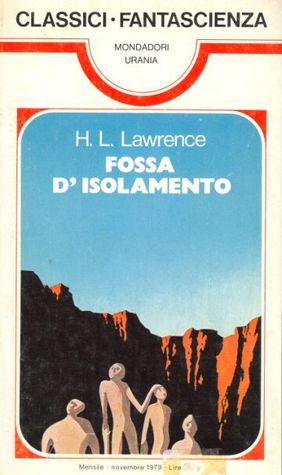
1962 Italian translation. The title means something like The Isolation Pit.

Which leads to another key difference with the film. In The Damned, these children are an insurance policy against the assumed inevitable end of the world through nuclear war. They alone will survive the high levels of post-war radiation. In The Children of Light, Lawrence has his characters dismiss the idea there’s ever going to be a nuclear war, but it turns out the children are needed for a different reason. The amount of radiation released into the atmosphere already, simply through testing bigger and bigger H-bombs, has resulted in the gradual sterilisation of humankind. This has affected people living in mountain areas first of all, but has started to trickle down to lower elevations. It’s only just beginning to be noticed by the press, and is going to result, sometime or other — or so the authorities believe — in a mass panic. And this is the reason they have to keep the children secret: if a foreign power learned of them, it would want a say in the their upbringing. As it is, the British want a monopoly on this hope for the future, and are intent on equipping these children to found an ideal (to their thinking) civilisation after the current one collapses. Johnny Parks, a reporter, comes across an example of what the children are being taught in an essay in one of their exercise books:

“We (he read) will be known as The Race. In our minds and hearts we shall carry all the knowledge and wisdom of the Past. We shall create in an empty world the people of the future, free from racial pride, free from the Babylon of speech confusion, free from the terrifying superstitions of the past so-called religions, free, for the first time in human history, to form a society of healthy, intelligent Beings; we shall have the knowledge of every science, from the beginning; knowledge will be all we shall have; but as we shall increase in numbers, we shall be able to use our knowledge and once again force Nature to provide us with all we need. Mankind, the Old People, are doomed to perish at the dawn of the Space Age. We shall begin, in a few generations, where they finished. But this time we shall begin as One People, The Race, with neither false pride nor false illusions to frustrate us.”

(To which Johnny thinks: “My God—what a hunk of drivel… What the hell is this—a school for scientific political nuts?” … And need I add that, unlike the film, in the book all the children are platinum blond? It’s The Midwich Cuckoos again, only through radioactive disaster rather than alien invasion.)

(…And another point about the children in the book. We’re given all their names, and the first thing you notice is that the boys have surnames, but the girls don’t. Presumably their governmental “parents” decided there was no point giving the girls surnames as they’d only lose them when they grew up and got married. The other thing is that most of the boys have thoroughly normal-for-the-day English-sounding names — James Robinson, Albert Jones, Henry King — but one is called George Orwell!)

1979 Italian PB

Johnny Parks is another difference between the novel and the film. Whereas in the film King follows Joan and Simon into the children’s domain out of a need to get his sister back (and retain control of her), in the book Caesar contacts a local reporter, Johnny, to get him to find out if Joan is alive or dead. Because, some time after Simon and Joan enter the War Department enclosure, an explosion is heard and body parts are found, which are claimed to be the couple, who are then officially declared dead. But Caesar knows different. The remains were supposedly identified thanks to a silver cigarette lighter belonging to Simon Largwell, but Caesar knows Simon didn’t have that lighter on him, because he personally stole all of Simon’s possessions of any value. So, their death is a cover-up. Obviously, Caesar can’t go to the police with this; and anyway he just wants to be sure Joan really is dead, so as not to have to worry about her telling the police about his crimes. Johnny is intrigued by the air of government secrets and gets into the enclosure. There, he meets Simon and Joan and the kids, and arranges an escape. It’s meant to be just the three adults escaping, but one of the kids, Sylvia, tags along, desperate to see something of the outside world. They start to head back to London, where Johnny is going to give the story to a national newspaper. In the film, the characters escape but don’t get far before being captured, and by that point we know they’re dying of radiation poisoning anyway. In the book, about the final quarter is taken up with the characters’ attempts to reach London and get the story out, while the secret government organisation in charge of the kids attempts to silence them.

What’s also interesting is what’s in the film but not the book. One of the things I like about The Damned is that, as well as its Wyndhamesque science fiction elements, it has a lot of character moments extraneous to the plot. The book, being much more of a breathless thriller, has far fewer of these, meaning the film feels more novelistic than the book. The clearest example of this is the character of the sculptress, Freya Neilson, who is completely absent from the book. In The Children of Light, Bernard (who’s in charge of Project Mannekin, as the operation to raise the children is called) is nothing but a government official, driven entirely by the need to protect the children and the single hope for the future they represent. (He refers to himself and his fellows on the project as “custodians of our human heritage”.) In the film, he’s humanised by being in a relationship with the artistic Freya (though ultimately proves to be equally singleminded as the novel’s version).

Overall, I think the film makes improvements on the novel, sometimes in big ways (bringing in the character of Freya), sometimes in small ways (the fact that the children in the film have all selected pictures from books which they pretend are of their parents), all of which add a depth of character that’s mostly absent from the book. Johnny Parks, the reporter, is the one character I miss from the book, but it’s easy to see why he was dropped (to allow more screen-time for Oliver Reed). If nothing else, the book — like all thrillers, I expect — is a good gauge of what your average person in early 1960s Britain might have been worried about: the dangers of nuclear weapons, the scariness of violent youth gangs, and perhaps a growing suspicion the government were up to something secret and had the power to keep it covered up.

The author’s full name was Henry Lionel Lawrence. He was born in 1908 in Lambeth (and baptised Catholic), and died in Colchester in 1990. His parents were music hall artists, meaning young Henry and his siblings spent a lot of time moving about. He was educated in the north of England, and had some short stories published in his early twenties. (I’ve only been able to find one, which was subsequently anthologised, “A Journey by Train”, about an encounter with a man who was dead for four days before being revived, and is now overcome by occasional murderous urges.) Lawrence worked as an advertising copywriter. He moved to Australia for a while, then Ceylon, but was back in Britain in time to join the RAF during World War II (when he served as a photographer with a Bomber Command Pathfinder unit). He was married, and had a daughter by the time of his first novel, at which point he was “a Senior Copywriter in a well-known London Agency” (according to the jacket blurb of Children of Light). His second novel, another thriller, The Spartan Medal, came out in 1961, and he seems to have published no more after that, though a 1979 biographical snippet lists him as being a member of the Crime Writers Association, PEN, and the Television and Screen Writers Guild.

^TOP