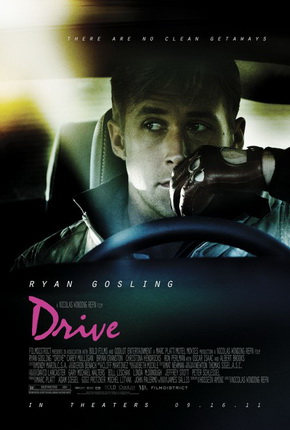
 Drive, released last year, although not at all a fantasy, was really a superhero film. Its main character is a stunt driver who, on the side, hires himself out as a getaway driver for criminals. He has a simple rule — he’ll get you where you need to be, wait a specified time, then leave, with or without you. Added to this super-power of being able to out-race any cop (even a heli-cop) is an additional power of being able to launch into bursts of super-violence so suddenly he always beats his opponents. Even in a world of violent criminals, he wins his fights because, unlike the gangsters who have to psyche themselves up and get angry in order to be violent, the hero of Drive can turn from super-quiet to ultra-violent as though he’s merely flicking on a switch. In this, he’s similar to a long line of cinematic heroes and anti-heroes who do the same thing, the most obvious recent example being Heath Ledger’s Joker in Batman Returns. The key scene here is where the Joker goes to a meeting of criminals and seems to be playing with a pencil, trying to balance it on its blunt end. Suddenly, he uses the pencil to stab a goon’s eye, thus impressing everyone at the table with his power of switch-it-on ultra-violence. In that instant he becomes head of the criminal underworld.
This has become such a commonplace in films, usually thrillers, it’s almost a convention. The hero wins not because (as in King Arthur‘s day) right gives might, but because he can turn on the violence at a snap. And the reason he can do this is because, like the hero of Drive, he’s been scarred into emotional deadness, and so, to him, violence is as unemotional as any other activity. Usually, he’ll be given a dead wife or child to explain this raging void inside him, but this is done so often it’s become a convention, and is more a shorthand to get us to simultaneously sympathise with and hero-worship our hero, while granting him the power of ultra-violence. Drive wasn’t a bad film at all, but I felt it’s main fault was the way it took on this convention too much as a convention, without saying anything new about it.
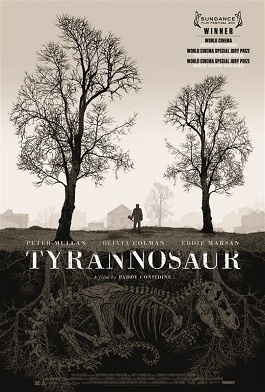 Tyrannosaur is a far more gruelling watch. Which isn’t to say I didn’t laugh a couple of times — though I’m not sure if that wasn’t because I’m so used to seeing Olivia Colman in comedies, and her timing and delivery of lines is so perfectly comic, it can get you even in non-comedic scenes. I wasn’t laughing by the end, though. Unlike Drive, Tyrannosaur is all about that blind sense of objectless, burstingly-repressed rage that compels its characters to violence — and not the heroic, villain-bashing violence of Drive, but the petty, or worse-than-petty, violence to loved ones and neighbours. Its main character, Joseph (Peter Mullan), having started things off by kicking his own dog to death and throwing a brick through a Post Office window, takes refuge in a charity shop run by Hannah (Olivia Colman), who, being forgiving, meek and middle class, seems perfectly designed to annoy the always-annoyed Joseph. She is, however, the one person to show him any sort of emotion other than anger, and he can’t help coming back to see her, even if all he can offer in exchange, at first, is abuse. And it turns out Hannah is no stranger to abuse.

This is by no means a feelgood film — it has more in common with a Jacobean tragedy — though it avoids, to my mind, the sort of ultra-abject miserablism some have accused it of. But by the end of it, I had that peculiar washed-clean feeling you can get after watching a really stark, scouring, take-it-out-of-you drama. This is nothing like the air-punching triumphalism you’re invited to feel by a film such as Drive, whose hero uses his powers of ultra-violence to beat up the baddies (who need beating up because they’ve used their violence to beat up goodies), and walk away feeling he’s done a good deed. Here, you’re left feeling that the violence itself must surely have been exhausted, and perhaps, just perhaps, overcome, by its characters, though only by being taken to such awful extremes. In Drive, the hero’s emotional deadness leaves him heroically lonely by the end of the film, a sort of scapegoat for the violence of the society he lives in; in Tyrannosaur, the characters are far more human because, however emotionally dead they may think themselves, every repetition of violence or verbal abuse surprises them into feeling their own wounds yet again. For them, there is no escape from hurting themselves every time they hurt others, though they continue to do so for far too long. In this, it’s a far more honest, and brutal, depiction of violence.
Cinema is all too much in love with the glamour of violence, and films which rely on it for sheer spectacle all too often make lazy use of conventional signs about how violence affects its characters (the cop who ends every day soaking his sorrows over a photo of his estranged family, for instance) — a quick tip of the hat to the reality of things rather than an attempt to understand — then getting on with the action. Meanwhile, a film like Tyrannosaur comes along to illustrate how violence wounds the perpetrator as much as the victim, and the result is the sort of catharsis talked about as being the function of the great tragedies, be it Oedipus Rex or Hamlet. A sort of exhaustion of rage through being faced too much with its after-effects. Not an easy watch, by any means, but an oddly rewarding one.