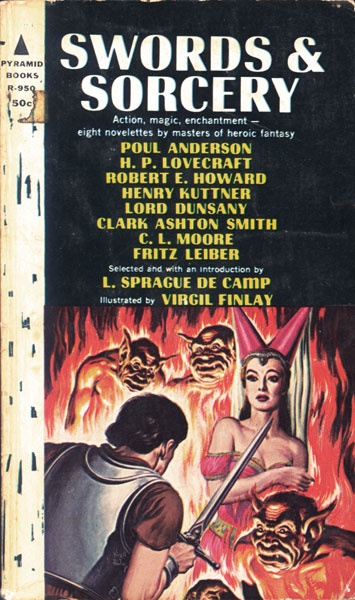
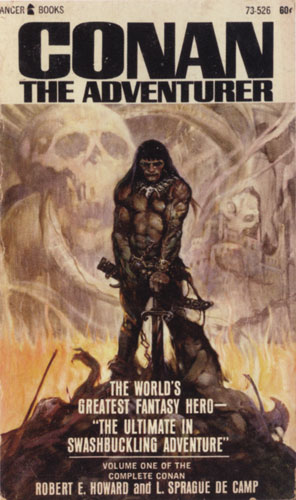
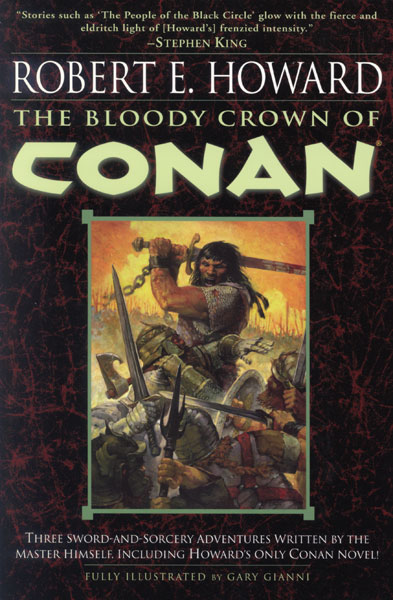
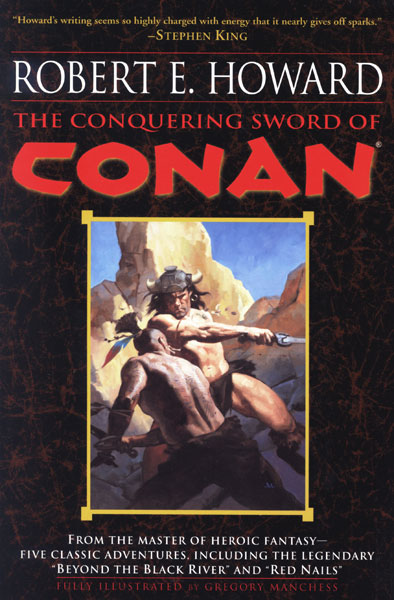
I recently read L Sprague de Camp’s seminal anthology, Swords & Sorcery, published in 1963, which was perhaps the first mass-market book to define the genre. De Camp followed it with a number of similar volumes, but the first contains fiction by Poul Anderson, Robert E Howard, Lord Dunsany, Henry Kuttner, Fritz Leiber, H P Lovecraft, C L Moore and Clark Ashton Smith. I love Fritz Leiber’s tales of Fafhrd & the Gray Mouser, and I love Clark Ashton Smith‘s decadent-fatalistic fantasies too, but the story that struck me as the most purely sword & sorcerous, and which most made it clear why its sword-swinging protagonist deserved to be the hero of his own tale, was Robert E Howard’s “Shadows in the Moonlight”. Whereas Leiber’s tales are carried along as much by their playful wit and comic undermining of the heroism of their twin leads, and Smith’s by an archaic word-magic and a deep sense of the cosmic un-heroicism of all human beings, Howard’s writing leaves you in no doubt that Conan is meant to be read as a hero, not an ironic comment on one. And this, to me, seems very much what sword & sorcery, at its purest, should be about. It is hero-fiction.
Much has been made of Howard’s invention of Conan — though perhaps “discovery” is a better word, because in Howard’s own words:
“I know that for months I had been absolutely barren of ideas, completely unable to work up anything sellable. Then the man Conan seemed suddenly to grow up in my mind without much labor on my part and immediately a stream of stories flowed off my pen — or rather off my typewriter — almost without effort…” [Letter to Clark Ashton Smith, Dec 1933]
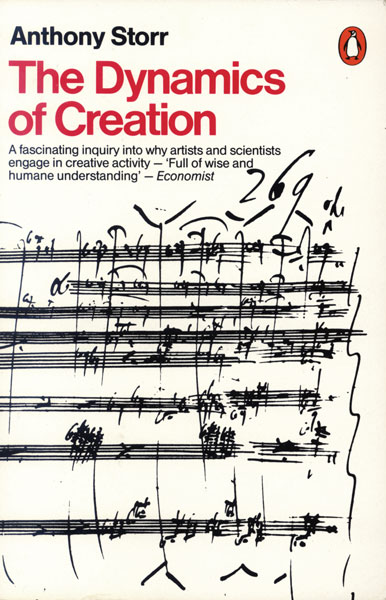
 As Anthony Storr points out, in his book The Dynamics of Creation, a period of apparent creative sterility can be the necessary precursor to a sudden burst of major creation, as a lot of work is being done unconsciously all the while, and although the actual details of Howard’s creation of Conan (his first Conan story was in fact a rewrite of a previously-rejected King Kull story, and many of the subsequent tales went through several drafts, rather than simply “flowing” into being) it certainly seems that the feeling, at least, that Howard is describing was true: in a way, Conan arrived like the solution to a creative problem Howard had been chewing over for some time, and the fact that his first tale was a rewrite of a story initially featuring a different character even seems to back this up. Where King Kull failed, Conan succeeded, and continued to do so. It is as though Conan simply encapsulated that much more of what Howard wanted to say.
So what was the creative problem Conan was designed to solve?
Every author has, in their imagination, an image of the world as it appears to them, and those that create heroic characters can be seen as doing so as a means of finding the perfect person to exist in that world, and to meet its various challenges. (Colin Wilson, in The Craft of the Novel, puts forward the idea that all novels can be seen as thought experiments in how to live, and shows how, for instance, George Bernard Shaw only truly found himself as a writer when he discovered a type of hero who embodied his worldview.) In a way, then, the hero and the world the writer creates can be seen as answering each other.
 Take the first Conan story, “The Sword on the Phoenix”. Howard begins by providing us with a villain who is in many ways similar to his hero. Ascalante is plotting to remove Conan from the throne of Aquilonia, and though this may seem a villainous thing to do, we learn that Conan himself has only recently removed the previous king by violent means, so it can’t be mere intent that separates our hero from his opposite — Conan’s Hyperborea is a savage world, and getting to the top by murder is an entirely valid thing to do. Having learned of Ascalante’s plans, we shift to a scene with Conan, which parallels the scene with Ascalante in several ways. Ascalante, for instance, is introduced in the presence of the closest thing he has to a confidante (an enslaved sorcerer, the Numidian Thoth-amon); Conan, meanwhile, is introduced in the company of his closest friend, Prospero. Another minor parallel is how the talk, in both scenes, touches briefly on poets (one particular poet, Rinaldo, is involved in the plot to kill Conan). Ascalante is dismissive of the breed:
“Poets always hate those in power. To them perfection is always just behind the last corner, or beyond the next. They escape the present in dreams of the past and future.”
Conan has more respect for them:
“A great poet is greater than any king. His songs are mightier than my sceptre; for he has near ripped the heart from my breast when he chose to sing for me. I shall die and be forgotten, but Rinaldo’s songs will live forever.”
There are other similarities. Both Conan and Ascalante have small cadres of bodyguards who abandon them at a key point, and both have to face the same final trial alone. But of course the main point is that both are vying (one to gain, the other to retain) the kingship of Aquilonia — and, in a sense, Howard’s entire story-world.
 There is a key difference between the two, the thing that makes Conan the hero and Ascalante the villain. Conan is a king, but is coming to realise that it’s not really what he wants. He made an excellent liberator, and slayer-of-kings, but now he’s on the throne, he feels hemmed in by responsibility. He’s not interested in exercising power for the sake of it, but wants to follow his own path, be his own man. Being a king seemed a good way of doing that at the time, but now it limits him. Ascalante, on the other hand, longs for power, and we can be sure he’ll enjoy tyrannising his fellow men as much as he can once he gets it. Ascalante is endlessly duplicitous, plotting to betray even his closest cohorts, while Conan is simply as you find him. If Conan doesn’t like you, he may lop off your head, but he won’t plot against you. And the reason for this difference is that Ascalante is civilised — is sick with the decadence of living at a remove from the pure, savage violence of the world in which the barbarian Conan was raised. Conan is a creature of instinct, appetites and action; Ascalante is a man of plots and plans, vengeance and resentment, greed and need.
This is a theme that runs throughout Howard’s tales. Civilisation, which provides comfort and security, separates men from true contact with the reality of life, and so breeds decadence, corruption, treachery, sorcery and perversity. Conan is a barbarian but is not uncouth — he may be brutal, but he is honest. He is intelligent, and cultured enough to enjoy a good poet, and to want to make an accurate map of the world as he knows it (which is what he’s doing at the start of “The Phoenix on the Sword”), but he’s in direct contact with his instincts, and acts on them without doubt or reserve. His over-civilised enemies, on the other hand, brood and stew their instincts, twisting them into treacherous plots and plans, and perverse desires.
 But creating two similar but crucially different characters isn’t enough. In heroic fiction, one character has to prove himself superior, not simply be more admirable. Howard doesn’t do the obvious thing (let them fight it out and have Conan prove himself the better man through sheer physical superiority) but instead has both Conan and Ascalante face a sort of ultimate test of their worth in his world. Hyperborea is a savage place, where often the sword is the decisive factor, but rather like the contemporaneous world of Hard-Boiled Detective fiction, it’s also a world beset by a bleak, Godless view of human life — a grim place of struggle and darkness, where at the ultimate its heroes may have to face the dread, cosmic void of utter meaninglessness. So, both Conan and Ascalante face a being from the “Outside” — a semi-Lovecraftian creature which represents the ultimate awful nature of inhuman reality. (In appearance it’s a giant, mummified baboon-demon, thus combining animal savagery and the supernatural spookiness of un-death.) Before it, the over-civilised Ascalante freezes in horror, but Conan connects with a “frenzied fury akin to madness”, a burst of inner vitality that saves him from his rival’s fate, and proves him to be the true hero of Robert E Howard’s world — a hero fit not just to face savage swords and evil sorcerers, but the bleak truths of the 20th century’s psychological ills, too.
 Howard makes Conan credible through an intense belief in the truths represented by the character. Life to him is savage and brutal at heart, so a savage is the best sort to thrive in it, though the only philosophical stance one can take in the face of such a world is Conan’s grim fatalism. Conan is the hero because he and his world are perfectly matched. His knowledge of his world is gained partly through a hard-earned, wide-travelled experience, and partly through an innate understanding of its savagery — Conan regards himself and the wild beasts of Hyperborea as little different, so can think his way into defeating the dragon in “Red Nails”, for instance, by knowing how it will act, and using that knowledge against it. (For me, the most powerful image in all the Conan stories is the one that strikes the greatest contrast with Hyperborea’s savagery — the ugly alien creature trapped in “The Tower of the Elephant”, a piteous thing longing, above all, for the release of death, because it is so alone. It is, oddly for something so alien, the essence of raw human feeling, totally unsuited to Howard’s violent world, but nevertheless an essential part of it.)
“The Phoenix on the Sword” was published in 1932, only two years after another writer addressed the clash between the individual (the hero) and the repressive nature of modern life — Sigmund Freud, in his Civilisation and Its Discontents. Freud concluded that, in the face of civilisation’s repressive forces, humankind could only lapse into neurosis (which could only be treated by psychoanalysis); Robert E Howard had a different solution — connection with the adventurous savage within, and redemption through sword & sorcery.

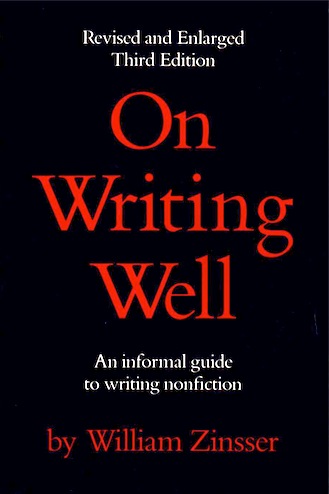 I found William Zinsser’s On Writing Well for 15¢ in a charity shop in Los Angeles, and it was the best 15¢ I’ve ever spent. (Not that I’ve spent many ¢ents. I tend to stick to pence.) It’s about writing non-fiction, not fiction, but what it teaches still works, I think, as a basic grounding in wordcraft. It’s also the best example of a test I apply to every book on writing I’ve come across since: if a book is about writing, it ought to be well written, to prove the author knows what they’re talking about.