 The latest Doctor Who DVD release, The Sensorites
 , has got me thinking about my eccentric Doctor Who buying habits. I get all the Tom Baker and Patrick Troughton DVDs on principle, but pick and choose from the William Hartnell and Jon Pertwee stories, perhaps because I like the comic Doctors better than the cranky ones. I’ve only just realised, though, that the First Doctor stories I buy are always the science fiction ones, never the historicals. To me, those early stories are usually too slow-paced to succeed as dramas, so my enjoyment of them has to come from their atmosphere. And when it comes to atmosphere, the old TV shows couldn’t help doing minimalist sci-fi better than they did history.
I love the aesthetic of old sci-fi (the sort of thing that begs to be called sci-fi, rather than SF). Despite Coleridge’s most famous remark on the subject, I think there are two ways to make fantasy work. One is, indeed, through the suspension of disbelief, but the other is what I might call suspension by disbelief — by which I mean the sort of thing that kicks in when you’re presented with something so strange it doesn’t matter whether it’s convincing or not, it conquers by aesthetics alone. Limited by budget and technology as they were, the old Doctor Whos, to be successful, had to rely on artistry as much as craftsmanship. A single fault (a sticking-out zip or a wobbly mask) will puncture the “convince them it’s real” suspension-of-disbelief approach, but the alternative, “convince them it’s alien“, works top-down, not by the evidence of the senses, but through the sense of wonder. Doctor Who’s early aliens work by being so weird you don’t so much believe in them, as bask in their strangeness.
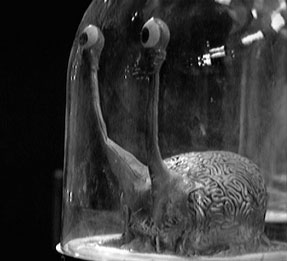
“Does he mean me?”
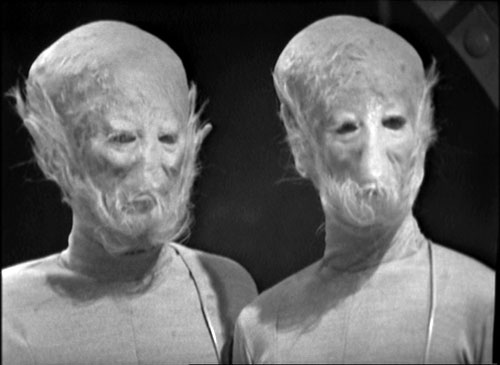
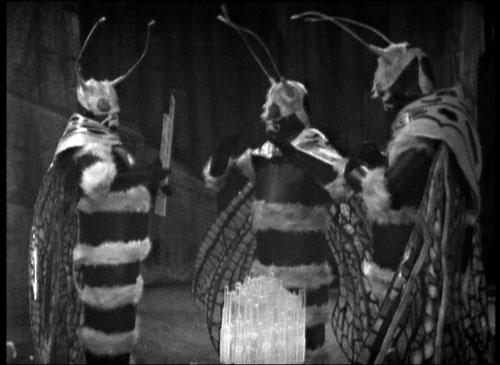
It’s impossible to see the Daleks in this way nowadays, due to overfamiliarity, but their extremely unconventional, not-a-man-in-a-suit design goes to the heart of it. The Dalek design looks like a very alien solution to the problem of how to survive in an overly radioactive environment (encase yourself in a life-support machine and stay indoors, after which you’re bound to get a bit cabin feverish and want to conquer the universe). A more obvious example is the Alice in Wonderland sensibility of The Web Planet, with its stagey, almost balletic make-believe world of man-sized moths and giant ants, as well as those crawling things that were a cross between The Magic Roundabout‘s Dougal and a hairbrush. It would take a billion dollar budget to convince you the Web Planet was real, and perhaps another billion to make sure you didn’t laugh, so why not just convince you it’s so strange it’s worth doing away with your disbelief altogether? With this approach, it’s the surprising details that convince, not the realistic ones, so the Sensorites’ circular feet — the first detail of theirs you see, after that spooky scene where one peeks into the spaceship from the outside — as much as their long, wispy-bearded, old-man faces, that goes towards making you believe in these alien creatures.

Most of all, I love the original Cybermen, from William Hartnell’s final story, The Tenth Planet. I would probably have first seen them on the wonderfully Art Nouveau-ish cover (by Chris Achilleos) to the Target novelisation, where their peculiarly feminine looks make them all the more spooky, like futuristic mummies in white bandages.  Watching them in action (via YouTube, though I long for them on DVD), the awkwardness of their design only makes them all the more alien. Those huge chest units they lumber around with are exactly the sort of thing a Cyberman would design — all function, no ergonomics — as are the chillingly minimal childlike doodles of their faces. In fact, watching them waddle about with all that front-loaded weight, and their head-mounted guns, I can’t help feeling they look like robotised pregnant women in beehive hairdos, which makes their ultra-modernist emotionlessness all the more scary. And a world apart from the tramping little-boy militarism of their latest incarnation. In this way, it’s the rough edges, the feeling of those early Cybermen’s make-do approach to self-design, that convinces.

Perhaps this is why William Hartnell’s alien stories were always set away from contemporary Earth. Except for the Daleks (who had already invaded everyday life by the time they hit the Earth on TV), the First Doctor’s encounters with alien life took place on other planets, or on spaceships, or in the future, and I’m sure it was only this happening-in-another-place feel that made the aliens work. Were a Menoptera or a Sensorite to appear in contemporary London — except for Carnaby Street, where it might get invited to a Love-in — it would undoubtedly wither before the glare of reality. But out in space, where no-one can hear you say “It’s got a zip up the back!”, they’re in their own weird, modernist, minimalist, unnatural environment, where it’s not belief, but sheer strangeness, that wins the day.





 , Oxford World’s Classics, ed. Helen Cooper.)