
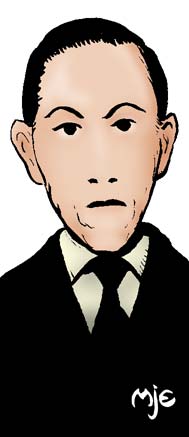
 I like the way there’s always one fact you know about an author, even if you know nothing else about them. If you know only one thing about Jane Austen, for instance, it’s that she, the great writer on marriage & marriageability, was herself unmarried. If you know only one thing about Charles Dickens, the great writer on (and righter of) social wrongs, it’s that his father was imprisoned for debt and young Charles had to work in a blacking factory, an experience he loathed & feared for the rest of his life. If you know only one thing about H P Lovecraft, it’s that he was a racist. The main difference with the Lovecraft fact is that, while you can read the entire works of Dickens or Austen and never guess their particular fact, if you read enough Lovecraft, you’re sure to stub your toe against his enough times to grow more than wary. And if you do enjoy his fiction for its unique take on the weird, it always does feel like stubbing your toe — both painful & angry-making.
For anyone who likes to read old fantasy, horror, and weird fiction, it’s a constant hazard. Sometimes it seems that no sooner do you find an author you like, you discover some objectionable opinion they held. (Why is this such a hazard for fantasy, horror & weird fiction enthusiasts? Perhaps because we’re more likely to read the not-so-great writers in our genre’s past.) I remember the sinking feeling I experienced when I first read David Lindsay’s Devil’s Tor (1932) and encountered its passages — from an author who had previously written that “nationalities, and the patriotism that attends nationalities, are inconsistent with true mental freedom and progress” — having one of his characters explain how “Christ was blue-eyed, belonging by descent to the North”. (I also remember the sense of relief I felt when I read Tolkien’s letter to his would-be publishers in pre-WWII Germany who had asked if he had any Jewish blood; he replied that he was sorry he hadn’t, but would be proud to admit it if he had.) There’s a watershed at World War II, before which racism, and (in Britain) Imperialism and classism, were strewn quite freely through the works of so many writers. (Casual racism, of the “it’s the word we always used, we never meant anything by it” type was still the norm amongst my grandparents’ generation.)
But should we bowdlerize Lovecraft? No. Lovecraft’s racism is part of the man we encounter whenever we read his fiction, and as it’s often the most noticeable of his objectionable characteristics, perhaps that’s one reason for keeping it — it alerts us to the fact that these stories are not the products of an entirely healthy mind. The very thing that draws me to reading Lovecraft — his portrayal of a very bleak and inhuman, even anti-human, universe — is centred on his own intently-held fears and beliefs. Lovecraft had a deep terror of life (which I’m not saying was groundless), and particularly of the body, and in a sense it was only because his racism was, at the time, the most socially acceptable part of his profound world-rejection, life-rejection, and body-rejection, that it comes out so explicitly in his fiction.
Lovecraft’s horror of otherness — most crassly expressed in his fear of the foreign faces and cultures he found himself surrounded by in New York — is ultimately the horror of his own body, and the shadow part of his mind. There is in his fiction a mixed loathing for and longing for union with that “other” — as there always must be, the psyche seeking to heal its self-division — and so we get that moment at the end of “The Outsider” where the protagonist sees his own horrific form in a mirror (which is not simply the end of a cheap twist tale, but a depiction of how far a man can go to deny what he knows is most horrific about himself), but also all those fantasies of having one’s mind transplanted into other, alien bodies, which Lovecraft strained to imbue with horror whilst quite plainly longing to experience.
Should we not read Lovecraft, then? My interest in Lovecraft’s fiction is as much with the man who wrote it as the stories he produces, but I don’t at all mean that I admire him through and through. Lovecraft is the picture of a man struggling at the edge of life, caught between the desire to live and the impulse to reject it all. An intelligent, sensitive, self-limited man, he strove all his life to try and solve the very alien equation at the core of his own psychology. He certainly didn’t achieve perfection at any point, but I believe it’s possible to find in his fiction evidence for the very difficult self-healing, or self-unifying (“I am it and it is I”), process we all undergo, and which is all the more explicit in the works of artists and writers who address the darker realms of the mind. Which is also the reason we go to those works, to try and illuminate our own self-healing, self-unification, and the struggle that goes with it. All authors are fallible human beings, and it’s in none of our interests to pretend they aren’t, to make a cult of them, to revere them unreservedly. Far better that they teach us to be always wary of what we read, and work out our own values for ourselves.
As for whether we should admire such authors, quite often it’s not a question of admiration — it’s fascination, that combination of repugnance and attraction, as much as anything, that brings us back to the work of the most powerful artists. It’s seeing ourselves, in however warped, exaggerated, and difficult-to-take a form, that brings us to their work — just like Lovecraft’s ghoul seeing itself in a mirror. Certainly, that’s what brings me back to Lovecraft.

 back in 1993, but it can be found
 was about marathon running, with a few tentative links to writing), and he seems to have taken the telling of this tale as he might a marathon, beginning with an easy, steady pace, and continuing at the same, determined trot, gradually picking up momentum till you feel there’s a real story going on. That’s how I felt till about halfway through the second volume, anyway, whereupon either I or Murakami hit the Wall and began to falter.
 and
and  . But 1Q84 has received a lot of positive reviews, and a great deal of success in Japan. There really were some quite moving passages. Perhaps all I really want to say is, it may be good, but he’s done better.


