
Alice at R’lyeh for your ears

Alice at R’lyeh” moves into another dimension with the addition of an audio version, courtesy of MorganScorpion!

I was thrilled when MorganScorpion, who has produced a number of readings of H P Lovecraft’s stories and novels (which you can hear, for free, over at the Internet Archive), contacted me at the weekend offering to do a reading. I was even more thrilled when the finished reading turned up first thing Monday morning!

It’s now up and listenable. You can hear it via the “Alice” audio page, or download/listen to it at the Internet Archive.

^TOP

The Transformation of E F Benson

The Horror Horn by E F Benson (Panther 1974)My lunchtime reading of late has been The Horror Horn, a collection of ghost stories by E F Benson, published in 1974 by Panther, with a typically excellent cover by Bruce Pennington. In the 70s, Panther seemed to be engaged in a project to bring back into print, or package into new collections, every writer mentioned even in passing by Lovecraft in his essay, “Supernatural Horror in Literature”. A worthy pursuit.

Lovecraft called Benson “versatile”, and “an important contributor” to the weird short story. But approaching E F Benson (the initials are essential in differentiating E F from his brothers A C and R H, both of whom dabbled in weird fiction) by way of Lovecraft can lead to a certain disappointment. Much of the supernatural element in E F Benson’s short fiction, as typified by the thirteen stories in this book, is conventional. All too often we have the ghosts of murderers, or suicides, or generally evil people, returning to menace the protagonist out of revenge, or mere wickedness. When Benson departs from the ghostly for the more demonic, he has a tendency to want to explain his (usually slug-like) entities away using the spiritualist terminology of his day, taking pains to identify them as “Elementals”, as if that goes, in any way, towards explaining them. (In fact, to me, it only deflates their mystery and menace. The whole point of supernatural horrors is that they are beyond understanding, not easily classifiable or quantifiable.) Most important of all, once the “Elementals” in question are defeated (in one case by the use of a shotgun), or have had their specific revenge, they depart, and all is once again right with the world. This is in stark contrast to the Lovecraftian approach, where the demon entity is only ever a signifier of far worse — a glimpse of a dark, alien order to the universe quite at odds with mankind’s self-satisfied, self-regarding unquestioned beliefs (as Lovecraft would have it). In E F Benson’s fiction, the fact that his ghosts and Elementals exist comes with no frisson of itself, no wider cosmic significance. As a result, his supernatural horrors, though horrifying to the individuals facing them while they are facing them, leave no residue of deeper, background horror in the reader’s mind, which is an essential part of the “poetry” of weird fiction.

To enjoy E F Benson’s ghost stories, then, you have to look for some other quality than inventiveness in his use of the supernatural.

Because of this, the first few stories in The Horror Horn, aside from their interest as part of the wider tapestry of the history of weird fiction, didn’t really interest me as fiction. But something happened about halfway through the book, with the start of one of Benson’s more well-known weird shorts, “Negotium Perambulans”:

The casual tourist in West Cornwall may just possibly have noticed, as he bowled along over the bare high plateau between Penzance and the Land’s End, a dilapidated signpost pointing down a steep lane and bearing on its battered finger the faded inscription ‘Polearn 2 miles’, but probably very few have had the curiosity to traverse those two miles in order to see a place to which their guide-books award so cursory a notice.

Contrast this to the start of “The House with the Brick-Kiln”, which appears earlier in The Horror Horn. The comparison is illuminating because both stories start by painting a picture of a location:

The hamlet of Trevor Major lies very lonely and sequestered in a hollow below the north side of the south downs that stretch westward from Lewes, and run parallel with the coast. It is a hamlet of some three or four dozen inconsiderable houses and cottages much girt about with trees, but the big Norman church and the manor house which stands a little outside the village are evidence of a more conspicuous past. This latter, except for a tenancy of rather less than three weeks, now four years ago, has stood unoccupied since the summer of 1896, and though it could be taken at a rent almost comically small, it is highly improbable that either of its last tenants, even if times were very bad, would think of passing a night in it again.

Although the above passage ends with a fittingly ghostly hook, it’s the start of “Negotium Perambulans” that’s by far the more intriguing. Both passages are trying to create an air of mystery around the locations they’re describing, but the “Perambulans” one succeeds while the “Brick-Kiln” one doesn’t. Why?

First I should say that this change isn’t just present in “Negotium Perambulans”, but, to a lesser or greater extent, is in most of the stories following it. A quick check on the copyright page provides an explanation. “The House with the Brick-Kiln” and the rest of the first five stories in The Horror Horn were published in Benson’s early collection, The Room in the Tower, in 1912. (Issued by Mills & Boon, in their pre-specialisation days.) “Negotium Perambulans”, however, comes from Visible and Invisible, a collection from 1923. It seems that something happened to E F Benson, as a writer, between those two dates.

The “Brick-Kiln” opening suggests an attempt to create a spooky atmosphere about the hamlet of Trevor Major — it is “very lonely and sequestered”, and the particular house in question has, since the events to be related, “stood unoccupied” — but these are a classic case of the writer telling rather than showing. That “very” in “very lonely and sequestered” in particular seems like a writer begging his readers to appreciate the effect he’s trying to create.

Polearn, in “Negotium Perambulans”, is a similarly fitting location for a ghostly (or in this case Elemental) encounter, but we’re introduced to it in quite a different way. Benson turns what was mere description in “The House with the Brick-Kiln” into mystery and story. Instead of just describing his location, he starts by saying, effectively, “Imagine you’re a traveller in West Cornwall, and you see this broken-down, half-unreadable sign pointing to some nowhere village on the coast. You might easily miss it — most do…” Nowhere does he use the words “lonely” or “sequestered”, but you know instantly that’s exactly what it is. In addition, you want to know why, whereas you don’t with “Brick-Kiln”‘s Trevor Major.

Again, why? Because Trevor Major seems a cliché, a stock setting for a gothic story, straining for an effect. Polearn is much more like a real village, if an odd one — its oddity, in fact, makes it seem more real, as well as serving the needs of the story. Benson goes on to describe Polearn, always emphasising its lonely oddity, without stating explicitly that this is what it has. We learn, for instance, of the peculiar arrangements the Post Office has to deliver mail to this remote village, and how the village’s remoteness has produced an isolation in its individual inhabitants as well — and all this before there’s even a hint of the supernatural the story is building up to. Yet I kept reading — and enjoyed doing so — because the setting seemed so very much alive. It had a definite character, yet seemed so oddly individual that it had to be real. It has, in fact, remained in my imagination, where Trevor Major hasn’t.

It seems that, between The Room in the Tower in 1912 and Visible and Invisible in 1923, Benson learned to relax into his writer’s role, and to work realities, rather than conventionalities, into his stories. He learned to stop straining to tell ghost stories, and instead to tell what were simply stories — interesting stories, some of which simply happened to be ghostly.

^TOP

Stephen Fry and Alan Moore: They Got Rhythm

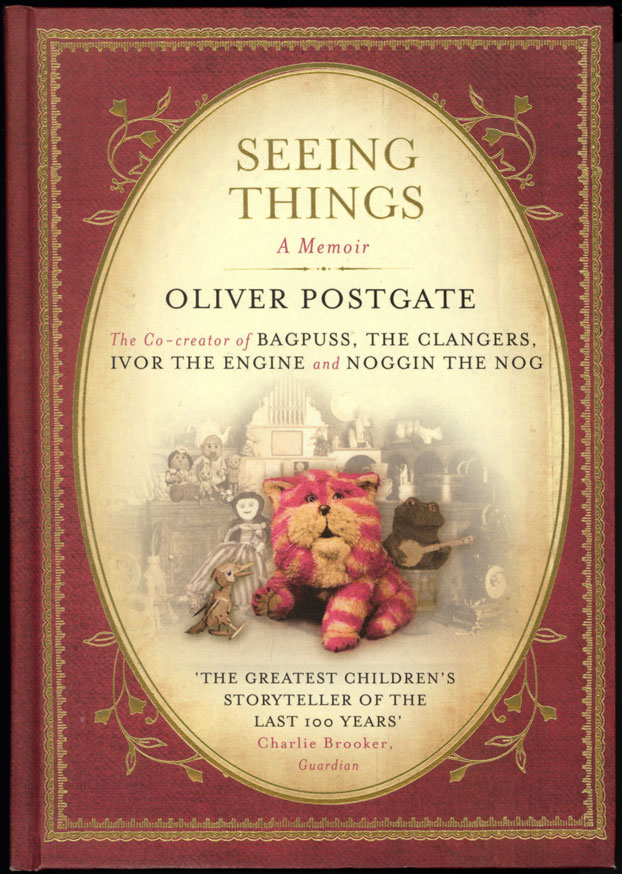
Recently re-reading Stephen Fry’s autobiography, Moab is My Washpot, (I’m in a memoir mood following Oliver Postgate’s Seeing Things — I’m now reading Thomas de Quincey’s Confessions of an English Opium Eater), I found myself thinking that, at its most florid, Stephen Fry’s prose style has certain similarities to Alan Moore’s.

Moab is My Washpot by Stephen Fry

They come from opposite ends of the social spectrum, of course. Moore was born and raised in Northampton’s poorest area; Fry went (mostly) through the public school system. But this sort of contrast only makes the similarities between the two all the more interesting. Apart from a few superficials (both are tall men, both have been described as “National Treasures”), the main similarity, to me, is in the character of their writing and their all-welcoming generosity of spirit. Both have a gourmet’s love of language, gleefully discarding traditional ideas of writerly propriety, such as brevity or concision, for the uninhibited joys of wordplay. Both use the full resources of their (large) vocabularies, swooping effortlessly from the literary to the archaic, the scientific, and the crudest Anglo Saxon, with perfect poise. Both use long, complex sentences but are never unreadable. In fact, these things add to the life, the vigour, and therefore the readability, of their prose. As writers, both have that Chaucerian/Shakespearean ability to include all aspects and levels of life in their writing, from the low physical to the high spiritual, from art as Art to art as entertainment, and from life as poor comedy to life as high tragedy.

So, having formed my theory, I tried to find some corroborative evidence. Here, for instance is Alan Moore, from the start of what I think of as one of his best pieces of non-fiction prose, a review of the works of occultist Kenneth Grant, published as “Beyond Our Ken” in Kaos magazine issue 14 (which can be downloaded here):

As fascinating and ultimately mystifying as a giant squid in a cocktail dress, what shall we make of Kenneth Grant? I know few occultists without at least a passing interest in his work, and I know fewer still who would profess to have the first idea what he is on about. What he is on. To open any Grant text following his relatively lucid Magical Revival is to plunge into an information soup, an overwhelming and hallucinatory bouillon of arcane fact, mystic speculation and apparent outright fantasy, as appetising (and as structured) as a dish of Gumbo. The delicious esoteric fragments tumble past in an incessant boil of prose, each morsel having the authentic taste of magic…

I know the sound of both Moore’s and Fry’s speaking voices (which is certainly something that helps them come alive in my mind as I read them), so I tried reading a few of the more characteristic passages of Stephen Fry in the voice of Alan Moore. This, for instance, is Fry in full flight:

For the English the words healthy and hale, at their best, used to carry the full-belief weight of florid good cheer, cakes and ale, halidom and festive Falstaffian winter wassail. By the end of the seventeenth century, the hale health of pagan holiday was expelled from the feasting-hall along with Falstaff and Sir Toby Belch by the sombre holy day piety and po-faced puritanism of Malvolio, Milton and Prynne. “Health!” became no longer a bumping boozer’s toast but a quality of the immortal soul. Health no longer went with heartiness, but with purity. (From Moab is My Washpot, by Stephen Fry, p. 156)

Read as Alan Moore, it’s completely wrong. And the vice is as true of the versa. Moore’s prose (after that “As fascinating and ultimately mystifying as a giant squid in a cocktail dress”, which I can imagine Stephen Fry saying) just doesn’t fit even Fry’s gorgeously eloquent audiobook-friendly voice.

What’s going on? What is this magic of words that the best, most characteristic writers have, which brand them indelibly as their own and no-one else’s? What is “style”, which is at once so uniquely characteristic yet so infinitely variable? How can a writer write so many sentences, each different, but each sounding undoubtedly like them?

Whenever I read people trying to analyse “voice”, or style (and I love reading the attempts), it usually breaks down with resort to a word like “rhythm” — the “rhythm” of a particular writer’s prose — which always annoys me as an answer, because it seems to be cheating by shifting gears from literary to musical terms of reference. And besides, it implies it’s just about the pattern of syllables in a writer’s sentences, when it’s obviously so much more.

But when I try to come up with my own answer, I can’t help but do the same shift in gear. “Music” is the best I can come up with — the music of the way a writer uses his or her words. Not just the rhythm, but the melody and the harmony and the counterpoint, the characteristic key changes, the riffs and runs, and everything else. It’s the particular brand of humour, the breadth of curiosity and interest, the way a writer relates to his or her readers, their ability to link disparate ideas, the way they say one thing while meaning another…

Writing contains so much. It’s amazing to think how a single stream of words, read one at a time, can create such rich, multi-layered music, such magic, and how every writer who takes up the task of putting a sentence together does so in a way that is characteristically branded as theirs and no-one else’s. And when a writer surrounds you with their world, their way of thinking and looking, of laughing and feeling, it really is magic. It’s the magic of looking at the same world you always knew, but through another person’s eyes, and seeing just how different — different yet the same — it looks.
^TOP
