The Invisibles

“Every paranoid fantasy, every conspiracy theory, every alleged coverup and government deception, every tabloid crank story you’ve ever heard… Imagine if it all were true?”
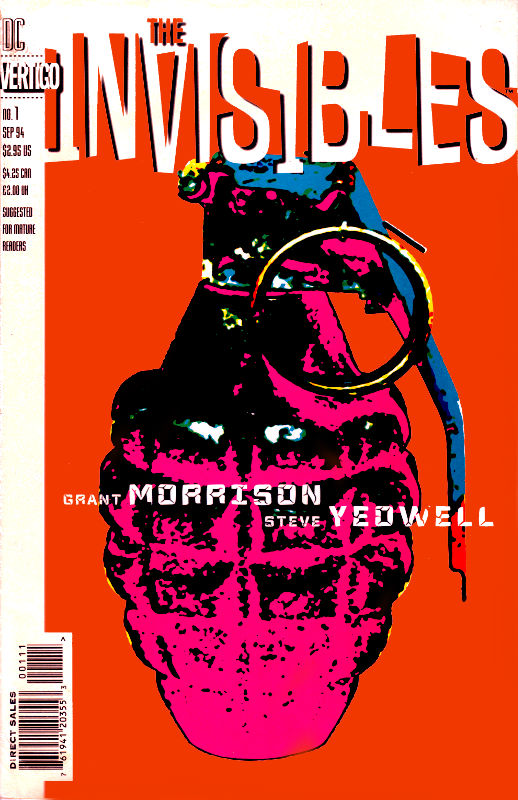
Cover to issue 1

This is how Grant Morrison’s Vertigo series The Invisibles explained itself in the first issue of its second volume reboot. (It eventually went through two reboots, three series, and 54 issues in total.) Running from September 1994 to June 2000 (the last issue was meant to coincide with the millennium, but was delayed), it tells the story of a countercultural cell of postmodern revolutionaries attempting to thwart the establishment’s plan to install the “Archon of the Aeon” as King of the World — after which we’ll have “cameras in the head, children with microchips, spin doctors rewriting reality as it happens”, “the infinite deathcamp of tomorrow” — by materialising the Archon into the body of the 200-year-old extradimensional offspring of the British Royal Line and Lovecraftian Things From Beyond, in a battle for “Timeless Freedom or Eternal Control”.
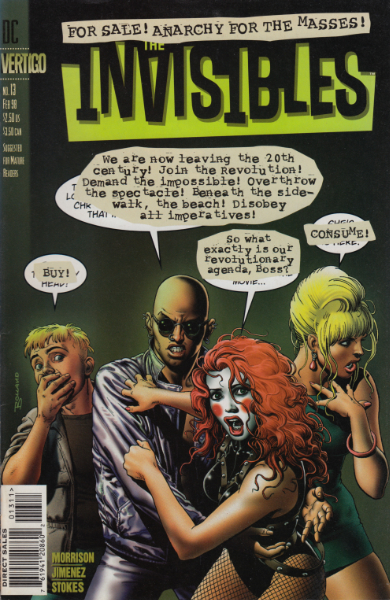
Series 2 first issue, cover by Brian Bolland

In The Invisibles’ world, not only is every conspiracy theory true, but every sort of magic — voodoo, shamanistic, ritual, chaos — works, and overlaps with the most advanced forms of technology. It’s a world of Gnostic engineers, four-dimensional liquid armour and remote-viewing time travel. It’s a world where an alien really was recovered from the Roswell crash, but as well as being a living entity it was also a form of liquid information. It’s a world that revels in all forms of 1990s counterculture — just look at the Day-Glo acid-orange cover to issue 1 — from multicoloured iMacs to Brit-Pop (“They’ve just cloned a sheep!” Morrison declares on one letters page), but also traditional mythology, with typical early stories consisting of interweaving strands, where one character may be relating an Egyptian or Aztec myth, another is undergoing a visionary experience in a separate dimension, while a third is having a bloody fist-fight/gun battle with soldiers, Ciphermen (human beings modified into hive-mind drones, engaging in psychic time-work from deep isolation tanks) or the Gigeresque King-of-All-Pain.

It’s difficult to tell how much its exuberant, sometimes self-referential storytelling style, with so many leaps in time, point of view, and style (some of the final issues are drawn by several different artists with widely different styles, from the cartoonish to the grimly realistic), is just buying into the whole postmodern style of post-80s comics, or is doing the same thing that, say, T S Eliot was doing in The Waste Land — mixing widely disparate fragments into a seemingly indigestible whole because that’s what the world feels like to its creator.

panel from The Invisibles #1, art by Steve Yeowell

I’d say there’s a lot about The Invisibles to link it to what I’ve called ‘crisis literature’ — as in The Waste Land, Ballard’s Atrocity Exhibition, Hesse’s Steppenwolf, or Garner’s Red Shift — but where I said that those works often present themselves as intellectual puzzles whilst attempting to present deep emotional trauma, The Invisibles feels like it’s already on the other side of the trauma. Its fractured style is not a case of a creator trying to piece together irreconcilable fragments, but to present a very weird vision in the only way it can be presented. It doesn’t feel like it’s fighting against its own conclusions or presenting them as evidence of despair or horror; The Invisibles is wholly, and joyfully, accepting of its weirdly destabilised world.

In the final issue, Morrison says he was using The Invisibles:

“…to recreate the complete and unabridged sensation of an ‘alien abduction,’ thrill-ride style. I’ve attempted to simulate an initiation into some of the secrets of time and ‘high-magic’ (where ‘simulation’ and ‘reality’ are synonymous, as in the formula Fake It Till You Make It) and create something which not only pays my rent but deprograms the nervous system and unravels the wallpaper.”
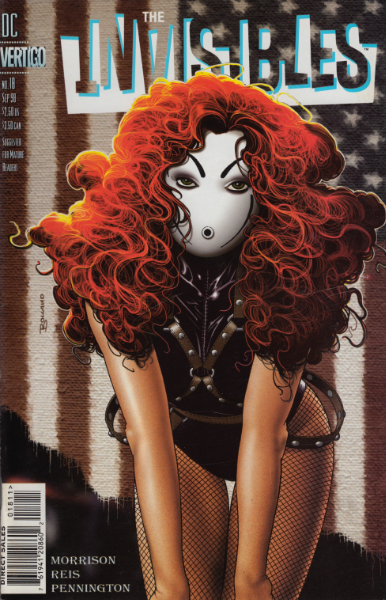
Series 2, issue 18, cover by Brian Bolland

That “alien abduction”, relates to an actual experience Morrison had, and which he has related in several places (such as this interview on YouTube (10 minutes)). He only jokingly refers to it as an alien abduction, because, he says, there wasn’t any other context to put it in. A religious mystic would have the vocabulary, but Morrison, raised on pop culture and comics, had to make his own version of the experience, with his own tools.

The last few issues of The Invisibles are so full of about-turns, reinterpretations and jumps in narrative, that it’s quite exhausting, like a deliberate attempt to break the reader’s sense of meaning and reality altogether, and there’s a feeling that what made the series fresh, fast-paced and full of ideas in its early issues has reached a point of exhaustion. Or perhaps that was just the result of my re-reading it all in so short a time.
^TOP

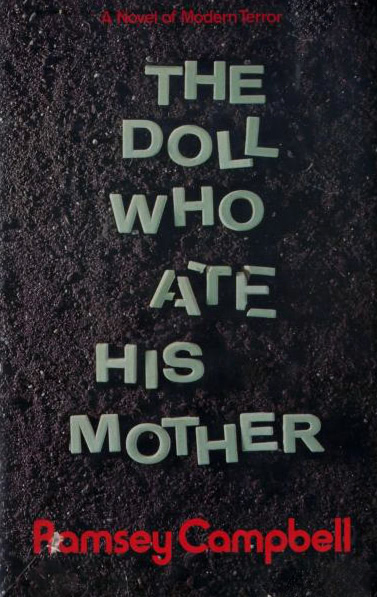
The Doll Who Ate His Mother by Ramsey Campbell

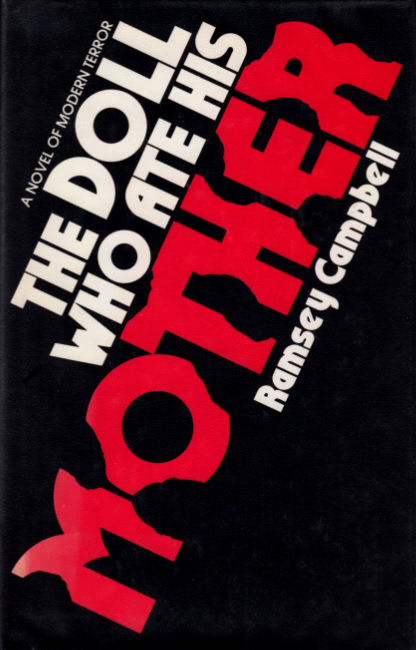
The Doll Who Ate His Mother, Millington Books HB, 1977

Driving her brother Rob home one night, Clare Frayn is forced to swerve into a lamppost when a man suddenly appears in the road in front of her. The accident severs Rob’s arm, killing him, but when the emergency services arrive, they can’t find either the man who caused the accident or Rob’s arm… A few months later, Clare is contacted by Edmund Hall, author of such non-fiction crime books as Secrets of the Psychopaths, The Homicidal Heart, Love Has Many Weapons and Sinister Sirens. He believes the man who caused the accident and made off with Rob’s arm is a local boy he knew from school, Christopher Kelly, whom he once saw bite into a bully’s arm and refuse to let go, and whom he believes responsible for another local crime, in which a man entered an old woman’s house and ate her dog, causing her to die from a heart-attack. Hall recruits Clare and two other people who’ve suffered from Kelly’s crimes to hunt down this monster and bring him to justice.

I think the deliberately lurid title of Ramsey Campbell’s first novel (published in 1976 in the US, 1977 in the UK), is a sort of goad, a backhanded hint that you should look beyond the obviously sensationalistic aspects of the story. This being Campbell, the characters are drawn with too much subtlety to fit neatly into the usual horror categories of victims, heroes, and, even, monsters. And although Kelly does some undeniably monstrous things, this is not, ultimately, a book about how a human being can be a monster. It’s about the very human means by which monsters are not only made, but kept monstrous.

The ultimate source for the evil that’s in Christopher Kelly is the influence of John Strong, a man who believed that:

‘Sometimes, in its evolution, the Universe bears a mind that will grasp and wield its unity; such a mind is mine.’

Bobbs-Merrill, US HB, 1976

Strong had the ability to exert his will over others, and used it to control and degrade anyone who came under his influence. When Kelly’s mother, Cissy, went to him thinking his ‘black magic’ could terminate her unwanted pregnancy, he instead forced her to keep the child and dedicate it to him. Strong, though, is not a character we get to know in Doll except through a pamphlet he wrote (called Glimpses of Absolute Power) and the devastating effect he’s left in his wake. We cannot know the how or the why of him. (‘Of my birth I shall say nothing,’ he writes in his pamphlet.) He represents a perhaps necessary blank wall as far as tracing the ultimate origins of Christopher Kelly’s evil are concerned. All we know about him is that he is the cause of life-ruining degradation and powerlessness in others.

What matters more is how that degradation and powerlessness are sustained by less supernaturally-endowed hands. Mrs Kelly — Cissy’s mother, and the one who raises the boy Christopher — doesn’t have any special powers, but she’s just as controlling, repressive and degrading as John Strong, only she does it in the name of God. Justifying the control she exerted over her daughter, she says:

‘All we asked was that she was home by nine every night, and told us everything she’d done during the day. And what she was going to do the next day.’

And this is when her daughter was a young woman, going out daily to work. Her rejection of the pregnant Cissy is what drives this young woman into John Strong’s hands, and even before Christopher is born, Mrs Kelly has decided what he is:

‘The Devil had made him clever — pretending to be a little boy, waiting for the chance to be a monster.’

John Strong made dolls by which he magically controlled human beings; the likes of Mrs Kelly, by prejudging and repressing at every stage, do their best to make people into less-than-human dolls.

1978 cover, image from Too Much Horror Fiction

The family of George Pugh (whose mother was the old lady who died when she found Kelly gnawing at her dog), though by no means perfect, is the opposite of Mrs Kelly’s approach. The Pugh household allows for both religion (mother Alice Pugh saying grace before dinner) and scepticism (‘George bowed his head, but Clare could see it was a token gesture’) without any conflict, and is obviously nurturing of both its two children, and their pets. George, it turns out, was raised on Shakespeare (‘Everything is in Shakespeare. He makes you feel things as if you’ve never felt them before’), and his parents’ sacrifices were not made in the name of an Old Testament deity, but for the running of a chain of local cinemas. It’s Alice Pugh who, at the end, offers Kelly his chance to rejoin the human race, by convincing him to accept responsibility for what he’s done and hand himself in to the police. But then Edmund Hall, who has consistently made crude, instant judgements about everyone he meets, and who has already made up his mind that Kelly is a monster and must meet a monster’s end, comes blundering along and ruins things.

Bracketing the central horror/tragedy is the subtler and more human tale of Clare, whose self-judgements (having once been told she has ‘stumpy legs’, she’s self-conscious about her every movement) show us a normal human being making herself a little bit monstrous, a little bit unacceptable, in the way so many normal human beings do, while herself being completely understanding of others. She wasn’t raised by anyone as toxic at Mrs Kelly, but we learn that her brother Rob thought their ‘Father and Mother put down everything I was…’, and that this may have made him a little monstrous, too, in the way he makes himself into something he’s not (he fronted an outspoken ‘Working Class Hero Show’ on Radio Merseyside, despite not really being working class, and Clare thinks this made him ‘aggressive, dogmatic, secretly unsure’). We never learn what effect her upbringing might have had on Clare, only that, at the end of all the horror, she finds herself weeping.

‘What is it, Clare?’ Dorothy said.
‘Oh, everything,’ she said indistinctly. ‘It goes back so far.’

And her ‘everything’ can be no way near as horrifying or lurid as Christopher Kelly’s ‘everything’, but it’s still her ‘everything’, which she has to deal with, something that requires, in a humanity-starved, sensation-hungry world, a little extra understanding, a breaking down of judgement and self-judgement, so she can, in her own small way, start to heal.

It’s only, I think, by allowing itself to look beyond its own sensational elements that horror can go full circle into catharsis or healing like this, and its rare to find books in the genre that really try. Particularly rare to find one with a title like The Doll Who Ate His Mother.

^TOP

The House on the Brink by John Gordon

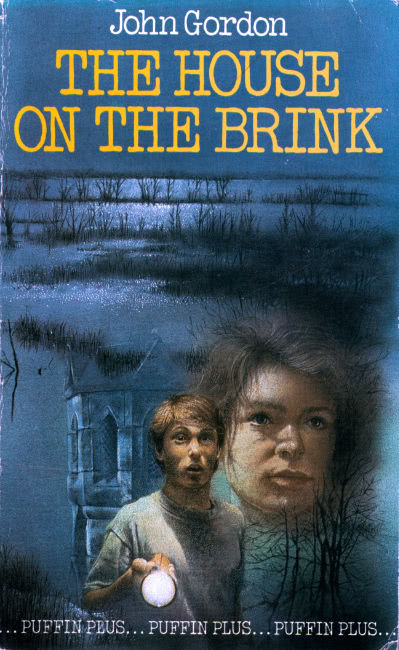
Cover to 1982 Penguin Plus edition, art by Neil Reed

Walking home after his literature evening class’s end-of-term party, sixteen-year-old Dick Dodds gives in to an impulse to nab a boat and let it drift him down the river. But the dare turns dangerous when he loses the row-boat’s only oar and finds himself being drawn helplessly out to sea. Saving himself, he has to plod through the fens back to dry land, and as he does, he passes a track in the mud that sends a chill up his spine:

‘I stepped into that trail and it seemed to put the moon out. Everything darkened. I went cold and stiff and then I fell. I must have done. I was on my hands and knees just a short distance away from the trail and I could feel the moon on my back.’

He discovers, the next day, that he can still feel the trail as it crosses dry land. Following it, he meets Helen Johnson, who on the night of Dick’s escapade saw something passing her father’s farmlands:

‘It was like a man all tied up, no legs and no arms. But it kept moving. Sort of gliding…’

The two begin an off-and-on investigation of the trail, driven by bursts of impulsive determination from Dick, but hampered by the ups and downs of the pair’s incipient romance. Visiting a local water-diviner, Mrs Shepherd, they learn that they share her ability to detect water running underground, and think at first this explains the chilling effect of the trail, until they follow it a bit more and encounter the thing — ‘A black, smooth, round, bald-headed old post’ — Helen saw that night, which is not a post, but may in fact be the mummified body of one of King John’s men, said to have been charged with guarding the treasure the king lost in the fens hundreds of years ago. And, dead though it clearly is, it moves.

The mystery begins to centre on a young widow, Mrs Knowles, whom Dick knows from his literature class. She believes:

‘My house… has a good side and a bad. The river is on the dark side. Everything it contains is contaminated… And out the back of my house… somewhere in the distance, there is something that when it appears always gives me hope… I call it the Silver Fields.’

Mrs Knowles tells Dick of how she was out walking by the river one day with a friend, local solicitor Mr Miller, when she saw ‘a piece of wood’ that ‘the river had made… evil’, and Dick realises it’s probably the same thing whose trail he and Helen have been investigating. Mr Miller, it turns out, is interested in the legend of King John’s treasure — he tried to talk Mrs Shepherd into using her water-divining powers to locate it — and now Dick begins to suspect Miller of having some sort of unpleasant plan for Mrs Knowles.

What’s notable about The House on the Brink is that it’s not a straightforward kids-investigate-the-supernatural type of story. It’s as much about the moment-by-moment feeling of being a teen on the verge of adulthood, experiencing the world in new ways, entering into a first relationship, getting glimpses of the dark world of adult secrets. Dick is impulsive, at times touchy, at times shy, given to the need to prove himself in sometimes dangerous ways. The book’s terse, poetic style emphasises this feeling of teenage life being a series of intense but fragmented moments of pure experience:

He dropped the bicycle on the verge and turned in the road with his arms outstretched. ‘I am the key in the lock of the world,’ he said. He let himself believe it for a moment. Then he picked up his bike. ‘And I’m also mad.’

As so often happens in YA books, the teens are central to the story because, being caught between the two worlds of childhood and adulthood, they’re free to move between, and look into, other worlds, too.

There’s the worlds of social position, for instance, that the children move between, or are caught by. Mrs Shepherd, the water-diviner, is working class, while Mrs Knowles is obviously very well-off, but both accept the teens into their lives without the class prejudices they might apply to adults. When it’s revealed that Mrs Knowles’s man-friend, whom Dick has already started to suspect of being up to no good, is a solicitor, he feels that ‘He might have known it would be somebody like that’, and I certainly read ‘somebody like that’ to be a judgement in terms of social standing. (Miller is later described as having ‘a long face with a golf-course tan.’) Dick feels that his smaller house puts him in a lower class than Helen (‘Dick’s shame began at the backyard gate. With two bicycles in it the yard was crowded. At her house there was space…’), while Helen feels that, when she goes round to Dick’s for dinner, the Dodds being ‘Town, not country’ puts her subtly in a lower class (as Dick’s father wears a suit, ‘not a farmer’s shirt-sleeves.’). Later, she says Dick can’t ‘know anything about fen people. Real fen people’, because he lives in the town.

Far more explicit are the two worlds of belief in the supernatural and dismissal of it. Helen tells her mother about the thing she saw passing their farm that night, ‘But that sort of thing doesn’t sink in.’ Dick alone of his literature class understands what Mrs Knowles means when she talks of the river being ‘bad’ and the Silver Fields being ‘good’, to the extent that he cycles out one morning to find those ‘Silver Fields’.

Belief in the supernatural is tied to an ability to understand the less intellectual aspects of poetry (Mrs Knowles asserts ‘You have to feel a poem. You can’t analyse it.’), but also being open to emotional instability and madness. Mrs Knowles, standing daily on the balcony of her ‘House on the Brink’, is herself on the brink of insanity, of being lost in the instability of her unbalanced feelings, and Dick at one point puts his and Helen’s involvement in the trail and the spooky old ‘log’ down to:

‘How people’s feelings seem to cross and get tangled. That’s what’s been happening, isn’t it?’

Mr Miller, being a solicitor — a shrewd thinker used to dealing with down-to-earth issues — is Mrs Knowles’s opposite in terms of rationality and intuition, and it’s perhaps because of this that he ultimately can’t save her from her own mental instability, but the kids — who can understand both worlds — can.

In an interview published on the Ghosts & Scholars site, John Gordon says that, in The House on the Brink, he was:

‘…writing about the time in everyone’s life when you suddenly realise that the real world is more mysterious and magnificent than the static wonders of fairy tales.’

Ultimately, it’s a book that shrugs off easy divisions. Its world is not one of ‘good’ and ‘bad’, nor is it one where it’s easy to tell the supernatural from madness, and the implication is that part of growing up is learning to realise this.

^TOP