Last Men in London by Olaf Stapledon

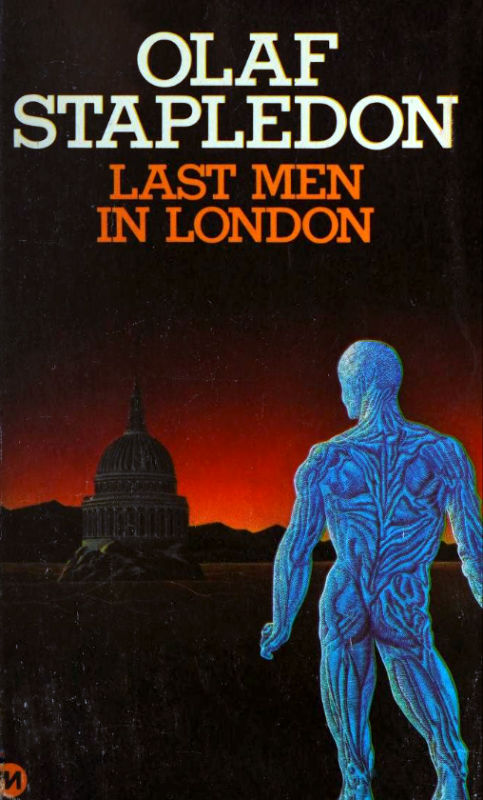
1978 paperback, art by Peter Goodfellow

Olaf Stapledon’s second novel, published in 1932, is not so much a sequel to Last and First Men (1930) as a sort of pendant to it (as his next novel, Odd John, started out as an appendix to this one). Like that first book, it’s dictated by a Neptunian from the far-future final race of humankind, who have developed the ability to project their consciousnesses into minds of the distant past, and not just witness events, but influence them to a certain extent, too. (Stapledon gets over the difficulty of the future being able to influence the past with a little handwaving: “Thus when I am observing your mental processes, my activity of observing is, in one sense, located in the past.” Or, for a little more detail: “though future events have indeed no temporal being until their predecessors have ceased to exist with temporal being, all events have also eternal being. This does not mean that time is unreal, but that evanescence is not the whole truth about the passing of events.”)

Instead of the vast, thousands-of-millions-of-years sweep of Last and First Men, Last Men in London concentrates on one comparatively tiny sliver of time, but one that is nevertheless “a crucial incident in the long-drawn-out spiritual drama of your species”: the First World War and its immediate aftermath. And the Neptunian chooses to approach this period through the consciousness of one individual, a relatively ordinary man called Paul. His intent is to present a deeper understanding of the causes of what was then known as the Great War, but also, by introducing Paul to glimpses of the more cosmic worldview of the Eighteenth Race of humankind, to see how this affects a man of our age. “It is my task,” he says, “to tell you of your own race as it appears through the eyes of the far future…”
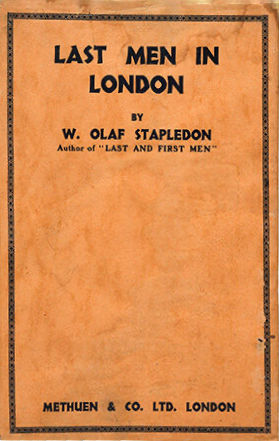
Methuen hardback, 1932

After the immensely compressed tale of multiple human species in his first novel, focusing on a single individual might make it sound as though Last Men in London would read like a more straightforward narrative. In fact, it’s even less of a traditional novel (in terms of character, plot, and so on) than Last and First Men. After an initial chapter which details life on far future Neptune, we get a brief glimpse of Paul as he hesitates before an army recruitment centre in London, wavering between social pressure to join up and his more deeply held belief in pacifism. But this is one of the few conventional scenes in a book that has only about three or four named characters, and almost no scenes with dialogue, action, and so on. Following the introduction of Paul, the narrator digresses for two long chapters on the causes of the Great War (whose roots are not in the messiness of Imperial European politics as you might think, but in the very nature of our simian ancestry), before returning to Paul and his personal experiences in the war, and then onto his life in the years that followed.

This is only partly a criticism—you come to Stapledon for ideas, not realism—but I have to say I still find Stapledon at his most readable when he’s following a narrative, whether it be of the human race as a whole as in Last and First Men, or the life of an intelligent dog in Sirius. (To be fair, Stapledon declares early on: “Though this is a work of fiction, it does not pretend to be a novel. It has no hero but Man.”) Here, he has his exposition dials turned up to eleven—which isn’t a criticism as such, but I have to say I did find these sections, though interesting, a bit of a slog.
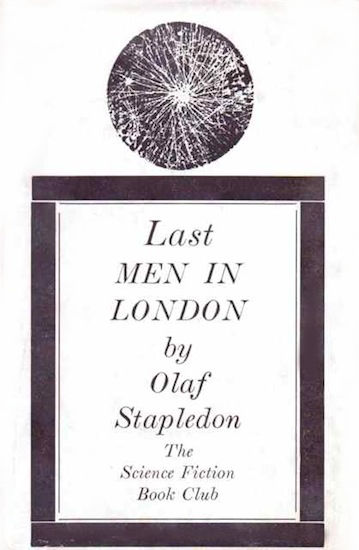
1963 SF Book Club editionBut Last Men in London could also be a kind of autobiographical novel. Like Paul, Stapledon refused the call-up into the army, but elected to serve in the Friends Ambulance Unit as an expression of his pacifism—and, like Paul, he won the Croix de Guerre, and was intensely aware of the irony of a pacifist winning a war medal. Also like Paul he spent time as a teacher. All this leads me to suspect you can probably read Paul’s education in a wider worldview as Stapledon’s own philosophical awakening, with the Neptunian narrator/educator a sort of fictional stand-in for Stapledon’s inner, guiding, slightly alienated deepest self. (It might even be better to read this novel as Stapledon’s attempt to write about the causes of the First World War being derailed by an inner need to tell the story of his own philosophical development.)

As to the causes of the Great War, from the Neptunian perspective it comes down to humankind’s “practical intelligence” getting ahead of its deeper self-understanding, plus a tendency in the First Men (as the Neptunians call us) towards “the importance of personal triumph over others in the great game of life”—the tendency to value heroic individuals over humankind itself, with a corresponding belief in nations as a sort of communal hero-self, with one nation necessarily triumphing over others being the accepted state of things. From the Neptunian point of view, the Great War was on the cards from the moment we came down from the trees (we have “a will that is still in essence simian, though equipped with dangerous powers”), but awaited the technological breakthroughs of the nineteenth century for its fruition:

“…your ‘modern’ world came too soon. In the century before the war it developed with increasing acceleration. You had neither the intelligence nor the moral integrity to cope with your brave new world.”
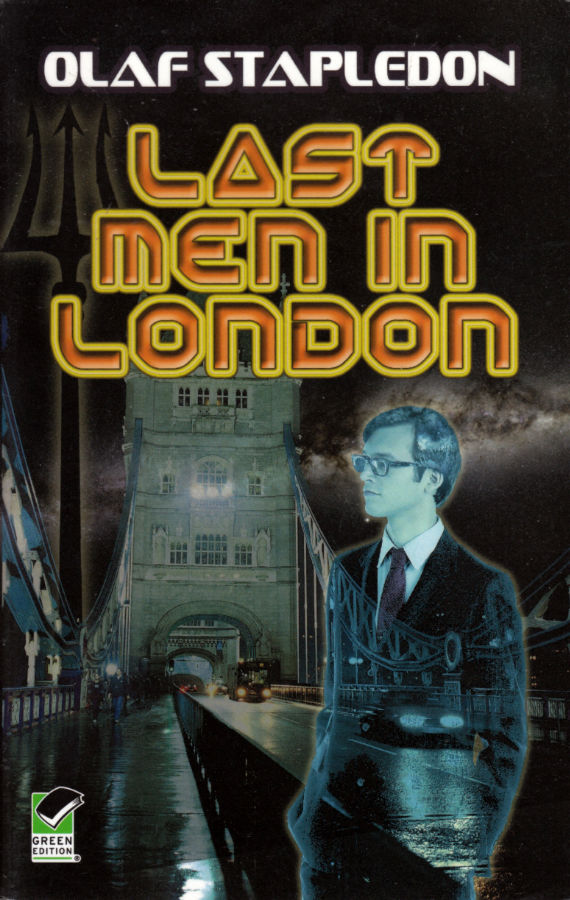
Dover Books edition

More interesting from a present day perspective, perhaps, is Stapledon’s insight into the mood during and after the Great War. There was, he says, a “suspicion in all the combatants that human nature had failed”, its ultimate effect being to “undermine man’s confidence in his own nature”. He goes on, in perhaps his most passionate and forthrightly critical section of the book, to detail how various sectors of society—politicians, religious leaders, teachers, artists and writers, common people—contributed to the war by turning a blind eye or justifying it to themselves. Perhaps the most useful passage to read today, as it still has such relevance, is this:

“Many people seemed to Paul to unearth a new self to cope with [the war], a simpler, less doubting, more emotional self, a self that concealed under righteous indignation a terrible glee in the breakdown of old taboos.”

Post-war, Stapledon describes the mood as one of:

“…a deep and deadly self-disgust, a numbing and unacknowledged shame, a sense of huge opportunities missed, of a unique trust betrayed, and therewith a vast resentment against earlier generations, against human nature, against fate, against the universe.”

Though Paul, in moments of particularly Stapledonian insight, still finds himself thinking:

“How can things be so wrong, so meaningless, so filthy; and yet also so right, so overwhelmingly significant, so exquisite?”

Which is perhaps one of the things that led John Kinniard to write, in Starmont Reader’s Guide 21: Olaf Stapledon, that “Stapledon’s philosophy is best approached as a challenge and a corrective to the disillusionment that became the dominant attitude of the Nineteen-twenties.”

So, what is Stapledon’s answer to all of this? It can be summed up in ideas that were already present in Last and First Men: “loyalty to man and worship of fate”. Or, as the Neptunian narrator puts it in a way that perfectly sums up Stapledon’s mix of the acceptance of cosmic doom with a defiantly joyous optimism:

“The story of your species is indeed a tragic story, for it closes with desolation. Your part in that story is both to strive and to fail in a unique opportunity, and so to set the current of history toward disaster. But think not therefore that your species has occurred in vain, or that your own individual lives are futile. Whatever any of you has achieved of good is an excellence in itself and a bright thread woven into the texture of the cosmos. In spite of your failure it shall be said of you, had they not striven as they did, the Whole would have been less fair.”

Does this help us at all, though, in the prevention of future wars? Stapledon’s notion of “loyalty to man and worship of fate” is a little too vague to be practically useful (unless one were to be faced with a catastrophe that really did threaten the species as a whole like, say, an increasingly unstable climate). Who is to say what best serves “man” or what should be regarded as “fate”? Elsewhere, Stapledon criticises the pursuit of happiness for this very reason:

“For if happiness alone is the goal, one man’s happiness is as good as another’s, and no one will feel obligation to make the supreme sacrifice. But if the true goal is of another order, those who recognise it may gladly die for it.”

Reviews at the time, though fewer than for Stapledon’s first novel, were mostly positive: “one of the most impressive things I have read” (The Birmingham Weekly Mercury), “engrossing and equally stimulating to the imagination and the reflective capacity” (The Aberdeen Press and Journal), “approached seriously, it will be found a rich, stimulating book” (The Daily News). Hugh I’Anson Fausset, in the Yorkshire Post and Leeds Intelligencer, though, offered up a criticism of the Neptunian narrator:

“He may personify ‘the mature individual who has wholly escaped the snares of private egoism,’ and whose will is for the racial good, but only by ceasing to be a person with a real unity of being and a spiritual centre.”

Around the same time, Fausset reviewed (positively) David Lindsay’s Devil’s Tor, a novel which has a few similarities with Last Men in London: both are books in which events and characters are manipulated by science-fictional beings (one from the future, one from space); both touch on the early evolution of humanity and talk of a coming, better race; both make use of sometimes quite intense examination of characters’ inner motives; and both ultimately move towards the metaphor of music made up of many individual instruments as a way of apprehending the cosmic story (and Stapledon’s declaration that “There is no music without the torture of the strings” might have interested Lindsay).
John Wyndham’s Chocky (1963) is a much more readable take on the theme of the alien/futuristic visitor inside one’s own head. I’m sure Wyndham must have read at least some of Stapledon’s works, and wouldn’t be surprised if he’d read them all. Whether he remembered it while writing Chocky is debatable, but there’s a hint of Stapledon’s cosmic vision in Chocky’s parting statement about intelligent life being “the rarest thing in creation, but the most precious. It is the only thing that gives meaning to the universe. Without it, nothing begins, nothing ends…”

Last Men in London is not one of Stapledon’s essential works, but it does make interesting reading as a historical document (its insights into the postwar mood), and as a transition point in Stapledon’s own creative direction: here, he’s working out how to take the themes of Last and First Men and apply them to his evident interest in the philosophical development of an individual. His treatment of Paul’s life is rather distant and unengaging, but he ends the novel with a short episode in which Paul, as a teacher, encounters a weird-looking child prodigy who proves to be, like the next novel’s “Odd John”, a throw-forward to the next step in human evolution. Writing Last Men in London, then, perhaps showed Stapledon the way he should be going, and which he’d do more successfully in both Odd John and Sirius.

^TOP

After Engulfment by Ellen Greenham

I’ve looked at cosmic horror before on this blog in the case of individual works—is Stephen King’s Revival cosmic horror? or Lem’s Solaris?—and certainly some of my all-time favourites, from Alien to HP Lovecraft, are, but I’ve never been sure I could properly define “cosmicism”, or say why the horror in cosmic horror is “cosmic”. Ellen Greenham, in this 2022 book from Hippocampus Press (full title: After Engulfment: Cosmicism and Neocosmicism in H. P. Lovecraft, Philip K. Dick, Robert A. Heinlein, and Frank Herbert), on the other hand, can:

“The principal tenets of cosmicism are that the universe operates as an indifferent mechanism, without purpose or direction, and the human creature is not only insignificant but exists as a biological mutation or accident of elemental and chemical stellar processes.”

I’d add—or at least, this is an aspect I’ve latched onto in my look at, say, Roadside Picnic—that cosmicism presents the universe as being vast, and far weirder than we could ever expect, to the point of being overwhelmingly incomprehensible. (Though this could be seen as a bleaker variant on the sense-of-wonder of science fiction.)

In my Mewsings on Stapledon’s Last and First Men I called cosmicism the religious aspect of atheism, but I might instead say it’s a worldview not just with no God, but with an oppressive God-shaped absence, to the point where the universe seems not merely indifferent but actively hostile. As Greenham says:

“The hallmark of cosmicism embodied within Lovecraft’s corpus is the apparent lack of anything even remotely like human emotion and morality being employed in the process of human eradication. Lovecraft’s others simply swat the human creature as that creature in turn swats flies.”

Why “cosmic”, then? To the Ancient Greeks, cosmos was opposed to chaos; it was order and certainty. The idea of the “cosmos”, then, relies on having a cosmological model—an ordered mental model of how the universe works. But, as Greenham points out, such models, however accurate they may seem, inevitably fail, for “a cosmological model, like a map, is only one particular view and not the territory itself”. For her, there is always an ineradicable degree of chaos that makes the universe ultimately resist any attempt to turn it into a tame and knowable cosmos.

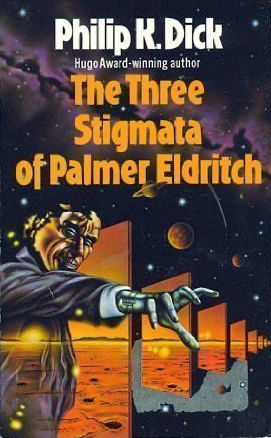
Philip K Dick’s Three Stigmata of Palmer Eldritch, cover art by Peter Gudynas

The horror of cosmic horror is all about incursions from the “outside”—the depths of space, other dimensions, other orders of being—but this “outside”, as Greenham says, “is simply the territory beyond the parameters of the cosmos”. “Outside” means outside one’s cosmological model. The thing that turns this into horror (as opposed to the sense-of-wonder of discovering something new), is that the outsideness is so extreme it doesn’t merely reveal flaws in the cosmological model, it shatters it so thoroughly that it destroys the protagonists’ very notion of themselves.

In cosmic horror there are usually two outcomes: madness or death. In this book, Greenham maps out an expansion of the ideas of cosmic horror into what she calls neocosmicism, and adds a third response, engulfment, a term that still captures something of the sense of fear and loss of self (as experienced by many a Lovecraft protagonist), but points to a way “the human creature” (as she refers to you and me) can move beyond a merely negative outcome:

“By choosing to be engulfed by the universe, rather than simply observe it from a distance, the human creature in neocosmicism can move beyond what stops and destroys it, to enter a vitalised engagement with the universe and with others.”

Being engulfed, one may drown, or one may (like the protagonist of Lovecraft’s “Shadow Over Innsmouth”) be transformed and take to the alien environment as one’s new home. But the transformation must be profound.

Heinlein, The Unpleasant Profession of Jonathan Hoag, cover art by Peter Gudynas

The primary Western cosmological model for centuries has been what Greenham calls “the Genesis model”, where humanity, God’s favoured creation, is “significant in its world”, and where there is a “moral code bestowed upon it by that God”. When this was assailed by the key ideas of the 19th and 20th centuries (the revolutions started by Darwin, Freud, Einstein, and others), it was replaced by “the Machine Universe”, one “without emotion or human morality”, ruled by “the cold equations” of the laws of physics. Caught between these two worldviews, you’re in what Greenham calls “the Schizophrenic Universe”, which is “no longer one stable thing or another”, “an alien and schizophrenic landscape that has become strangely separate from the human creature within it”. The way forward to a new understanding—or to a new way of relating to the universe without a full understanding—one must face the “gaping black hole between cosmos and universe” which Greenham calls the void. For, “the light,” she says, “can never be truly understood without knowledge of the darkness also”.

The void, of course, seems empty, meaningless, a frightening vacuum. But it has a useful purpose in this neocosmological process. Like Nietzsche’s abyss, its job is not so much to be stared into as to stare back: “The void is thus named because its function is to make void, to empty the full; to turn the human creature into a tabula rasa.” To accept a new notion of what the universe is, you must—painfully, if necessary—get rid of the old notions first, even if it means throwing everything out.

Dune by Frank Herbert, cover art by Bruce Pennington

At this point, the universe becomes “a proving ground”, where “the human creature enters a relationship of ‘lethal proximity’ with the universe”. A prime example is the planet Arrakis in Herbert’s Dune, whose harsh conditions have resulted in the super-tough Fremen, a people who’ve learned to live with the “cold equations” of their particular environment. The apparent hostility of the universe, then, becomes a spur: the successful entrant into the proving ground is “facing imminent threat so that… [it] might also engage its vitality”. Ultimately, though, the idea is not to just become a machine for survival, but a human being that survives, one that seeks to find “whether it is possible to survive in the cold equations with emotion and empathy intact”.

All this points to a new relationship with the vast, sometimes hostile-seeming universe. Against the apparent insignificance of humanity that’s a given in cosmic horror, Greenham’s neocosmicism points to how the very hostility of the “proving ground” can lead to a new sense of significance: the proving ground may weed out those who can’t survive its ultra-harsh conditions, but “Gardeners do not remove weeds for the sake of the removal”. There is, then, an ultimate aim: to turn oneself into a creature that fits this universe, perhaps even adds something to it. This can, Greenham says, even be a liberating view, for:

“…in remaining indifferent to whether the human creature succeeds or fails, the universe nullifies any sense that creature might have of striving for a final result, thereby releasing that creature from the requirement—real or illusory—to be bound by a sense of finitude.”

In the end, the idea is to no longer see the individual human being as a thing contained in, and oppressed by, a vast universe, like a pea rattling around in an enormous box, but as a part of it, and perhaps even (in John Wyndham’s phrase) “the crown of creation”—the human that triumphs against incredible odds, and retains their humanity, and not because a god deemed that it was always going to be so, but through their own efforts.

Olaf Stapledon

Reading Greenham’s book, I kept thinking of one author she doesn’t mention, Olaf Stapledon, in particular his Last and First Men. Stapledon has some of his future races of humankind actively engage with the sort of ideas Greenham writes about. They see their role as surviving in the universe as it is, not as they wish it to be, and being prepared to accept that the end must ultimately be a tragedy—the universe’s “cold equations” (literally cold: they face the dying of the sun) will win out, but in the meantime, their role is to seek the fulfilment of their particular nature within this universe: “man is a fair spirit, whom a star conceived and a star kills”. And Stapledon adds something I think Greenham doesn’t mention, as far as I recall, a willed returned to that science-fictional sense of wonder. Stapledon’s future humans “render the universe that intelligent worship which, they felt, it demanded”, and learn to “admire the Real as it is revealed to us, and salute its dark-bright form with joy”.

It’s an excellent study of an idea that could really be applied to so much I’ve previously written about on this blog. (Reading it didn’t require an extensive knowledge of the writers she covers—I’m certainly not very familiar with Heinlein, or with Herbert beyond the first Dune book. I’m tempted now to read some more in the Dune series; not so much with Heinlein.)

You can hear Greenham interviewed on episode 152 of the Udda Ting Podcast (don’t worry about the Swedish intro, the interview itself is in English), on most podcast apps or here at Soundcloud.

^TOP

Sirius by Olaf Stapledon

1972 Penguin PB, art by David Pelham

First published in 1944, Sirius shares a lot, in its themes, with the previous decade’s Odd John — Stapledon even referred to it as “my ‘Odd Dog’ novel’” — but with the crucial difference that, whereas John is a human who far exceeds normal human levels of intelligence, Sirius is a dog raised to (high, but normal) human-level intelligence. So, he isn’t going to be creating any super-scientific technologies or casually getting rich through ultra-shrewd investments. And the limitations placed upon him by his body (his lack of hands), and the equally debilitating limits that come from living in a society where he, as an animal, has no rights, and where he’s even more likely than Odd John to be regarded as freakish and unnatural, are brought that much more to the fore.

(At a number of points, the tone of the book reminded me of William Horwood’s novel Skallagrigg, whose two main characters have cerebral palsy, and have to deal with both their own less-able bodies and being treated as inferior to other human beings. Stapledon’s novel could easily be read, metaphorically, as being about physical disability.)

1979 Penguin PB, art by Adrian Chesterman

Before he’s born, the puppy Sirius is injected with hormones to promote the growth of his brain. He’s not the only dog to be treated, but the others either only develop remarkable-for-dogs but less-than-human intelligence (they can’t talk, for instance), or die young. A crucial part of Sirius’s story, though, is that his creator, the physiologist Thomas Trelone, decides to raise this dog within his own family, as much like one more human child as possible. Trelone’s wife, Elizabeth, has just given birth to a daughter, Plaxy, so the two are raised as, in effect, siblings, and develop an almost twin-like intimacy, with little wordless calls they use as their own private language, and so on.

It’s not long, though, before Sirius becomes aware of his limitations. Having no hands, he’s stymied in what he can do — and, thus, is also limited in how he can use his intelligence to explore the world as his foster-sister does. His eyesight is poor, too (he’s also completely colourblind), though his far superior sense of smell gives him access to an entirely new perspective on the world than his human family possess.

1944 HB from Secker and Warburg

Trelone has plans for his canine prodigy. After as much of a human-level education as he can get (Sirius can’t go to school, and Plaxy soon tires of passing on the lessons she’s learned every time she gets home), he’ll be sent to a nearby farm to gain some experience as a sheepdog. After this, he’s to come to Cambridge and be more thoroughly tested in the lab, while working to devote himself to the field Trelone thinks will be most suited to him, animal psychology.

Sirius suffers the first two stages as much as he can — working on the farm, he has to pretend to be just one more smarter-than-average dog who can’t speak — but after a while at Cambridge he begins to develop his own ideas. One such impulse comes from moments in which he has felt a wider, and bleaker, sense of his place in a vast, indifferent universe:

“Sometimes when Sirius was out on the hills alone in the winter dawn, examining the condition of the snow and looking for sheep in distress, the desolation of the scene would strike him with a shivering dread of existence. The universal carpet of snow, the mist of drifting flakes, the miserable dark sheep, pawing for food, the frozen breath on his own jaws, combined to make him feel that after all this was what the world was really like; that the warm fireside and friendly talk at Garth were just a rare accident…”

Stapledon cites McCulloch’s book as a source for Sirius

This prompts him to want more than Trelone’s purely scientific education, and he starts to ask about religion. He’s sent to spend some time with a cousin of Trelone’s wife, a priest who works among the poor around London’s docks. Sirius soon realises he needs to find his own mix of these two approaches to life, the religious and the scientific, and settles on that very Stapledonian word “spirit”, which crops up in the future histories Last and First Men and Star Maker, meaning that sense of a thing that transcends the merely physical circumstances of life, yet, unlike religious ideas of a soul, comes with no guarantees or guidelines. Whatever it is, it’s still evolving, and needs work. Like those future races Stapledon wrote about in his first novel, Sirius finds “in fate’s very indifference… a certain exhilaration” — a challenge to create his own meaning, rather than the despair of meaninglessness. By the end of the novel, the dog has come to embody Stapledon’s ideal of how to live as an intelligent being in the modern world:

[Plaxy] saw that Sirius, in spite of his uniqueness, epitomized in his whole life and in his death something universal, something that is common to all awakening spirits on earth, and in the farthest galaxies. For the music’s darkness was lit up by a brilliance which Sirius had called ‘colour,’ the glory that he himself, he said, had never seen. But this, surely, was the glory that no spirits, canine or human, had ever clearly seen, the light that never was on land or sea, and yet is glimpsed by the quickened mind everywhere.”

As the novel enters its final quarter, it returns to a theme from Sirius’s early life, the close relationship with his human foster-sister Plaxy. The two have grown apart, tortured by the differences between them, yet always drawn back to the unity they call “Sirius-Plaxy”. It’s here the novel presents its most challenging aspect, as Stapledon takes their relationship into a physical intimacy which, although strongly implied in the published text, was apparently more forthright still in the draft he first submitted.

2011 Orion PB, art by Cliff Nielsen

I have to admit it’s this part that comes close to breaking the book’s spell, for me. Stapledon heads into this sexual territory as though it were the natural, even only, next stage in the couple’s relationship, when it should surely be possible that the two would feel absolutely no sexual pull towards one another, being of different species. And if that weren’t enough, there would surely be the incest taboo of their having been raised as siblings. It feels, though, that this is an area Stapledon is intent on exploring — not for its salacious aspects, which aren’t dwelled upon, but as it allows him to philosophise on love, and how it can thrive on difference:

[Plaxy:] “We are bound to hurt one another so much, again and again. We are so terribly different.”

[Sirius:] “Yes… But the more different, the more lovely the loving.”

For Stapledon, the key point is “the fundamental identity-in-diversity of all spirits”. And this is needed to combat Sirius’s alienation:

“There is no place for me in man’s world, and there is no other world for me. There is no place for me anywhere in the universe.”

To which Plaxy counters:

“I’m your home, your footing in the world.”

(There is, apparently, another thing that could have driven Stapledon to have this novel contain a forbidden love-relationship. In his biography of Stapledon, Robert Crossley says that parts of the book were inspired by an affair Stapledon had around this time.)

Cartoon of Stapledon from The Daily Herald

The book received a good amount of attention on its release. The Times Literary Supplement named it their “Novel of the Week”. The Western Mail’s H M Dowling brought in comparisons with Swift, Shelley (Percy Bysshe, though those with Mary are there, too), and Robert Louis Stevenson. Robert Lynd of The Daily News was less impressed:

“The book, repellant as the exhibitions of freak sideshows in old fair grounds, is written in the semi-scientific language of a work of popular psychology and in this, perhaps, Mr. Stapledon sins against more than the dignity of science.”

While L P Hartley, in The Sketch, was mixed. For him, “As an allegory of the spirit, tormented in the search for a fulfilment it cannot find, and of the individual persecuted by the mob, there is much to be said for this book.” Yet, “The physical aspects and embarrassments of Sirius’s peculiar make-up are ruthlessly insisted upon, with a complete—indeed, with a positive and challenging—lack of humour.” Ultimately, for him, Stapledon “fails because he cannot effect a unity between fantasy and realism.”

I think Sirius is the most accessible of Stalpedon’s novels yet. It contains the same themes — of the spirit in a constant struggle against an indifferent fate, and exalting in the challenge of life even though it knows it must fail — as his earlier novels, but couched in, oddly enough, far more humanly-relatable characters. Stapledon’s long-distance view and challenging moral stance is still here, to some extent, but so are thoughts about love, loyalty, family, and the business of making a living, which didn’t feature in the future histories. Its ultimate message — “the most valuable social relationships were those between minds as different from one another as possible yet capable of mutual sympathy” — might have been brought out by the war that was raging as the book was written, but it remains a valid idea to this day, just as Sirius remains a readable book.

^TOP