
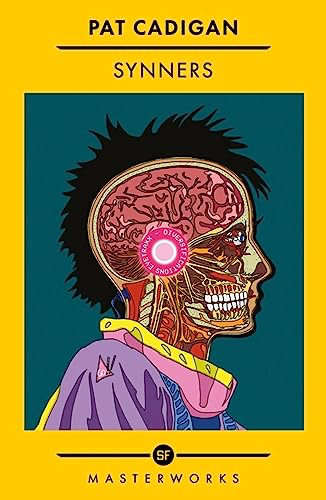
Gollancz 2024 edition, art by Autun Purser
Instead of the gloomy, neon-lit Tokyo-esque setting of William Gibson’s Neuromancer, Pat Cadigan’s 1991 cyberpunk Synners is set in sunny LA, and overall feels less noir-ish than Gibson’s novel. Both use a hard-boiled style, though: dense, slangy, throwing you into the midst of the action and leaving you to work out what sort of world this is, who these people are, and what’s going on, as the action unfolds. (I sometimes wonder if SF’s aversion to info-dumps goes a little too far. It was a while before the characters were anything but names… and too many of them short ones beginning with ‘G’! I’m not asking for a full, formal introduction, just something to hook onto.)
The focus of Synners is the world of commercial video production in the near future, where talented individuals don “hotsuits” and electronic headgear to create something that’s halfway between a film and a lived experience, whether as a music video, advertising or immersive game-movies where you take part in the action. Small video-production company EyeTraxx has just been taken over by the mega-corporation Diversifications—not for its talent, but for a patent it quietly took out on a new way of producing and interfacing with video: sockets grown directly into the brain. Creators with sockets can effortlessly create much more vivid experiences, and those who plug directly into these new videos get a much more vivid a kick. One such creator, known to the world as Visual Mark, something of a drug burnout as well as being a highly talented artist, finds that using sockets is a medium he’s been waiting for all his life (which reminds me of a quote from one of Gibson’s early stories, about “how many thousands, maybe millions, of phenomenal artists have died mute, down the centuries, people who could never have been poets or painters or saxophone players, but who had this stuff inside, these psychic waveforms waiting for the circuitry required to tap in”).
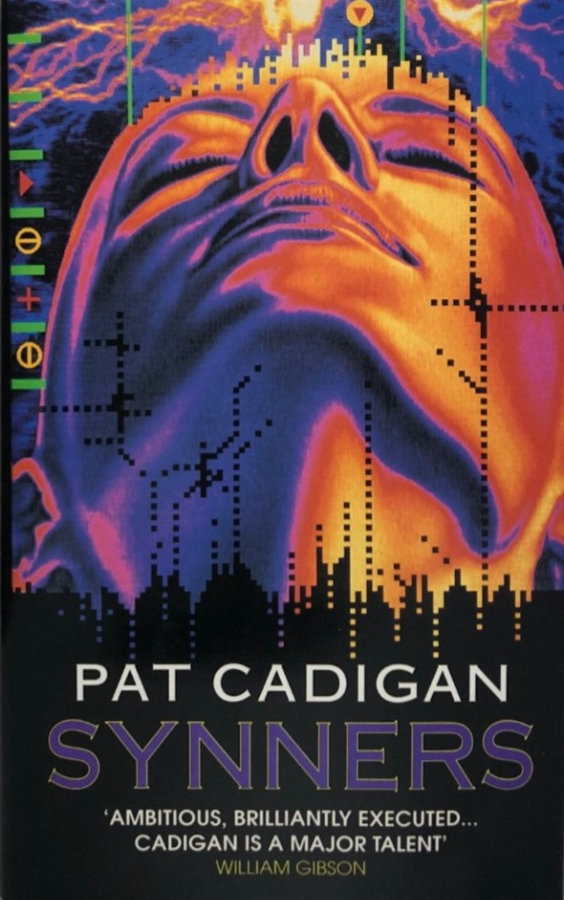
1991 edition, art by Peter Gudynas
Visual Mark gets his sockets just in time. Suddenly aware that direct neural access to the net (or the dataline as it’s most often called in this novel) makes it as much a part of his brainspace as his former limited grey matter, he expands into the digital world, just as his much-abused, over-toxed body gives out with a stroke: which itself enters the net as a separate, malicious and virus-like entity with an intent of its own.
For a novel published 35 years ago, there’s a lot that still feels like valid science fiction here. (Perhaps only the same things that Gibson and other early cyberpunk writers missed out on, such as a lack of mobile phones or wi-fi, date it.) Cadigan herself admitted, in a 2016 interview in Locus, that “there’s actually not as much science fiction in it as there used to be”, but there certainly is still relevance. Direct “neural interface equipment” is (I assume) a good way off, as is the use of brain implants as “an accepted treatment for certain depressives”. But such a phrase as “Better business through chemistry”—i.e., drug use—and a belief in what sounds like the much-touted singularity are, certainly, live ideas now, at least among the sort of tech elites who take cyberpunk novels not as warnings but how-to manuals:
“Pretty soon it would all be happening at the speed of thought, before it could actually happen, so that nothing would ever have to happen again. You’d only think things had happened, and if anything ever did happen, you wouldn’t know the difference.”
The dark side of that—the neglect of the real world at the expense of the much-hyped digital one—gets acknowledgement here (it’s post-quake LA, but this could well be taken as a general statement):
“Whole portions of the physical world had yet to be reclaimed from the unusable, unliveable state that negligence and malevolence had consigned them to…”
Faced with the question of whether socket tech should be unleashed on the world, a senator from Michigan comments:
“Funny idea, isn’t it, putting something aside until you’re moral enough to use it.”
Which makes a valid point, I suppose—you’ll only develop the necessary moral maturity if you actually use the technology in question, by which point you’ll already be causing damage. (Apart from the obvious other answer: read more SF.)
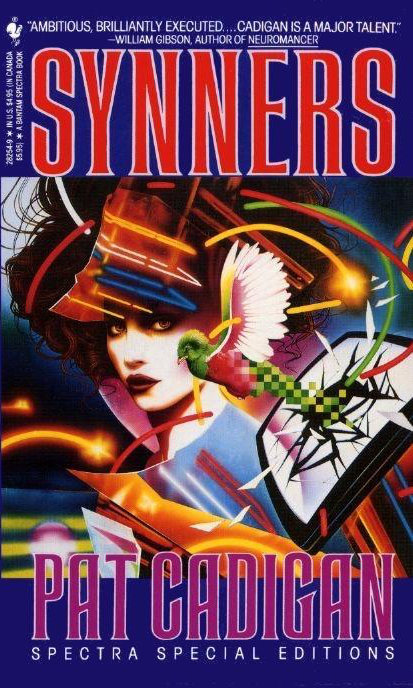
1991 edition, art by Francisco Maruca
Synners doesn’t feel, to me, as much on the raw edge of the cyberpunk aesthetic as Gibson’s earlier novel—though its future is closer to a realistic prediction than his (vat-grown ninjas are still a long way off). But the story has less of Gibson’s noir-ish feel and comes across more as a techno-thriller, with a clearer division between the good (the creatives, the hackers) and the bad (the controlling corporate types). All have that hard-boiled, life-worn, cynical edge to them, but the good guys don’t have as much of that deep-down compromised feel you get in the deeper shades of noir.
One thing the cyberpunks got right: as one of the characters here says, “We’ve become denizens of the net. Homo datum.” To which another adds, “Synners” (a foreshortening of “synthesisers”). Later, someone comments that “Every technology has its original sin”, implying we’re all original-synners now, fallen from the Eden of the real world into a mash-up of the digital and the real. Especially now, even early cyberpunk feels like something to revisit, just to check if there are any other prescient warnings we might do well to be reminded of.
