Synners by Pat Cadigan

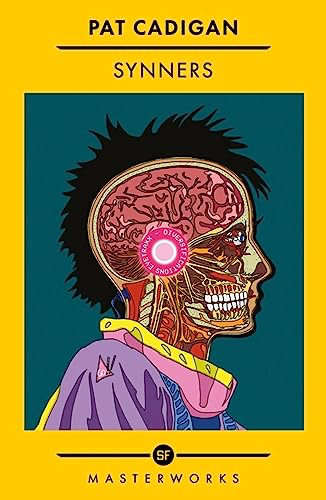
Gollancz 2024 edition, art by Autun Purser

Instead of the gloomy, neon-lit Tokyo-esque setting of William Gibson’s Neuromancer, Pat Cadigan’s 1991 cyberpunk Synners is set in sunny LA, and overall feels less noir-ish than Gibson’s novel. Both use a hard-boiled style, though: dense, slangy, throwing you into the midst of the action and leaving you to work out what sort of world this is, who these people are, and what’s going on, as the action unfolds. (I sometimes wonder if SF’s aversion to info-dumps goes a little too far. It was a while before the characters were anything but names… and too many of them short ones beginning with ‘G’! I’m not asking for a full, formal introduction, just something to hook onto.)

The focus of Synners is the world of commercial video production in the near future, where talented individuals don “hotsuits” and electronic headgear to create something that’s halfway between a film and a lived experience, whether as a music video, advertising or immersive game-movies where you take part in the action. Small video-production company EyeTraxx has just been taken over by the mega-corporation Diversifications—not for its talent, but for a patent it quietly took out on a new way of producing and interfacing with video: sockets grown directly into the brain. Creators with sockets can effortlessly create much more vivid experiences, and those who plug directly into these new videos get a much more vivid a kick. One such creator, known to the world as Visual Mark, something of a drug burnout as well as being a highly talented artist, finds that using sockets is a medium he’s been waiting for all his life (which reminds me of a quote from one of Gibson’s early stories, about “how many thousands, maybe millions, of phenomenal artists have died mute, down the centuries, people who could never have been poets or painters or saxophone players, but who had this stuff inside, these psychic waveforms waiting for the circuitry required to tap in”).
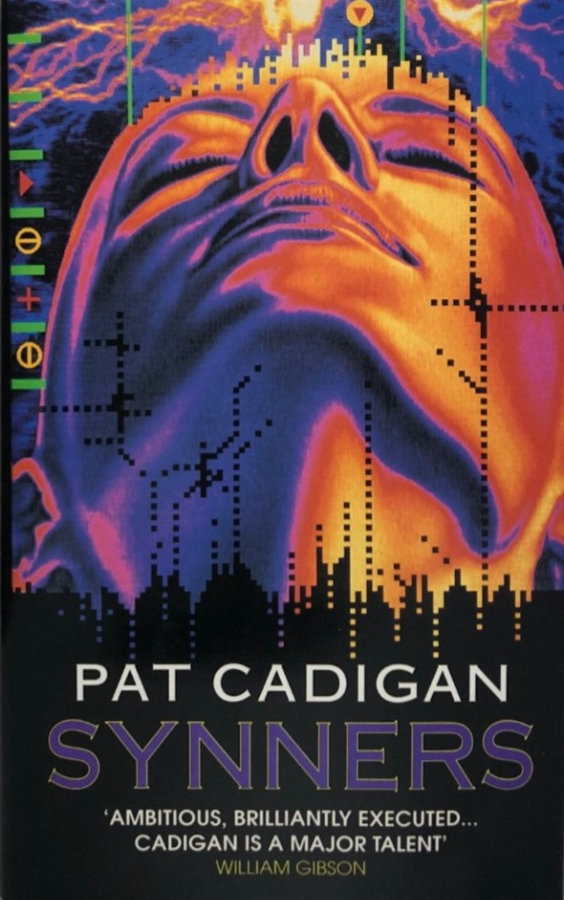
1991 edition, art by Peter Gudynas

Visual Mark gets his sockets just in time. Suddenly aware that direct neural access to the net (or the dataline as it’s most often called in this novel) makes it as much a part of his brainspace as his former limited grey matter, he expands into the digital world, just as his much-abused, over-toxed body gives out with a stroke: which itself enters the net as a separate, malicious and virus-like entity with an intent of its own.

For a novel published 35 years ago, there’s a lot that still feels like valid science fiction here. (Perhaps only the same things that Gibson and other early cyberpunk writers missed out on, such as a lack of mobile phones or wi-fi, date it.) Cadigan herself admitted, in a 2016 interview in Locus, that “there’s actually not as much science fiction in it as there used to be”, but there certainly is still relevance. Direct “neural interface equipment” is (I assume) a good way off, as is the use of brain implants as “an accepted treatment for certain depressives”. But such a phrase as “Better business through chemistry”—i.e., drug use—and a belief in what sounds like the much-touted singularity are, certainly, live ideas now, at least among the sort of tech elites who take cyberpunk novels not as warnings but how-to manuals:

“Pretty soon it would all be happening at the speed of thought, before it could actually happen, so that nothing would ever have to happen again. You’d only think things had happened, and if anything ever did happen, you wouldn’t know the difference.”

The dark side of that—the neglect of the real world at the expense of the much-hyped digital one—gets acknowledgement here (it’s post-quake LA, but this could well be taken as a general statement):

“Whole portions of the physical world had yet to be reclaimed from the unusable, unliveable state that negligence and malevolence had consigned them to…”

Faced with the question of whether socket tech should be unleashed on the world, a senator from Michigan comments:

“Funny idea, isn’t it, putting something aside until you’re moral enough to use it.”

Which makes a valid point, I suppose—you’ll only develop the necessary moral maturity if you actually use the technology in question, by which point you’ll already be causing damage. (Apart from the obvious other answer: read more SF.)
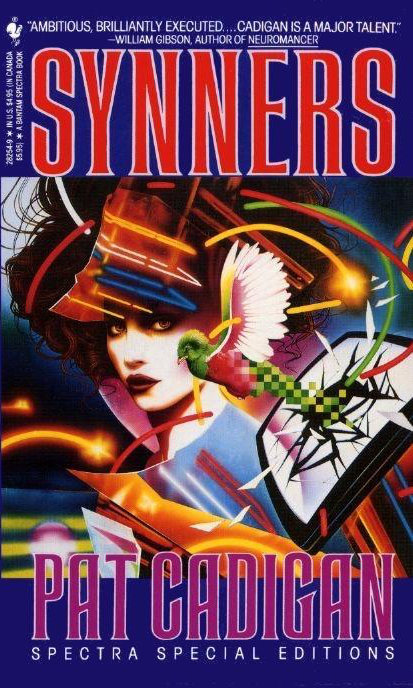
1991 edition, art by Francisco Maruca

Synners doesn’t feel, to me, as much on the raw edge of the cyberpunk aesthetic as Gibson’s earlier novel—though its future is closer to a realistic prediction than his (vat-grown ninjas are still a long way off). But the story has less of Gibson’s noir-ish feel and comes across more as a techno-thriller, with a clearer division between the good (the creatives, the hackers) and the bad (the controlling corporate types). All have that hard-boiled, life-worn, cynical edge to them, but the good guys don’t have as much of that deep-down compromised feel you get in the deeper shades of noir.

One thing the cyberpunks got right: as one of the characters here says, “We’ve become denizens of the net. Homo datum.” To which another adds, “Synners” (a foreshortening of “synthesisers”). Later, someone comments that “Every technology has its original sin”, implying we’re all original-synners now, fallen from the Eden of the real world into a mash-up of the digital and the real. Especially now, even early cyberpunk feels like something to revisit, just to check if there are any other prescient warnings we might do well to be reminded of.

^TOP

The Possessors by John Christopher

SYLE Press edition

If the “cosy catastrophe” is the archetypal post-WWII English SF story, surely the quiet invasion comes a close second (The Midwich Cuckoos or Quatermass II being prime examples). They’re quiet because they either occur in an isolated location (a cut off village in Cuckoos) or by hiding in plain sight (an industrial processing plant in Quatermass II). John Christopher’s The Possessors (first published in 1965) is of the former type, being set in a ski-chalet high in the Swiss Alps, which is further isolated from its nearest village when an avalanche blocks the one mountain road leading to it.

At first, the holidaymakers (all Brits, having chosen this chalet for the English-American couple who run it) continue as normal, expecting the pass to be cleared in a couple of days. They’re a hung-up bunch, many of them recovering (or not recovering) from a variety of losses: Jane Winchmore is a widow in her thirties, Douglas Poole is on the rebound from an abruptly ended affair, while hostess Mandy Hamilton left the three children from her first marriage behind in America. Others have clear compromises or unbalances in their relationships: plastic surgeon Selby Grainger is the eternal dallier-with-women, while his wife, the cooly beautiful Elizabeth, puts up with it, confident he won’t actually leave her, and Ruth Deeping clearly favours her younger son Andy over ten-year-old Stephen, whom she constantly nags. Perhaps the only fully happy one of the bunch, in fact, is eight-year-old Andy, so beloved by his mother, which is perhaps why he’s the first victim of the alien invasion. Thinking he’s found a glowing blue ball in the snow, he touches it and instantly drops to the ground. Selby declares him dead, and he’s put in a makeshift coffin in the cellar—only for him to get up and leave the chalet sometime in the night. Everyone joins in the search, though only his mother, Ruth, has any faith that a boy in so few clothes and no shoes can survive for any length of time in the snow. But he does return—only, not quite himself. Significantly colder to the touch and slightly less human, he has (as we, the readers, know from the book’s opening section) been taken over by an alien spore, flung out from its dying home planet millions of years ago, which landed by chance on the Earth and was uncovered by the recent avalanche.

US edition from 1964, cover by Paul Bacon

The alien—symbiotic or parasitic, depending on whether you take its point of view or ours—needs to isolate the humans, one by one, so as to infect them. And of course the humans take a long time working out what’s happening, speculating first of all that it’s some new kind of illness, or an infectious mass hysteria, or even demonic possession. And all the time, the survivors are becoming increasingly besieged in the chalet, boarding themselves up against the possessors trying to get in, get them alone, and take them over.

For most of the book the story is driven by suspense and the increasing tensions between the already flawed characters. In this, there’s an obvious contrast to be drawn between the aliens (who work effortlessly together, and tempt in at least one character with the promise of an end to human struggles) and the humans, whose only working relationships are those founded on long-held compromises. Chalet owner George Hamilton, for instance, is a good husband to his wife Mandy because he ignores the bottles of gin she’s got stashed about the place, and is pretty much an alcoholic himself. (There’s a lot of drinking in the book. Interviewed in a special issue of Interzone, Sam Youd—the real name of John Christopher, and meant to rhyme with “cloud”, apparently—admitted: “It’s the way I live, yes, I do drink alcohol, and quite a bit of alcohol, though only wine…” Though it seems to have been pretty much part of the times anyway.)

1965 edition

It’s hard not to compare Christopher with his contemporary John Wyndham, both of whom were the face of general-readership SF in Britain at the time. Christopher’s characters are much more evidently flawed, and come with a greater dose of cynicism about human relationships, a sense that there can never be anything more than a “total failure of comprehension” between people. Offered the slightest sign of sympathy for her widowhood, young Jane just wants to escape, and instantly regrets it the one time she shares her feelings of despair with someone else. The sense is that isolation and compromise are built-in to the human condition, whereas the characters in, say, Day of the Triffids, though they have to overcome external difficulties and the occasional dangerous human, will eventually find some sense of community, even family, in the end. For Wyndham, decency is a struggle but a worthwhile one; for Christopher it feels, at times, like a lost cause.

But there are resonances with other SF-horror, too. The most obvious to me was The Thing, for its icy setting and its alien that takes on human form, but also for its sense that if the invasion isn’t stopped here, the whole of the human race is at risk: “there can be no question of toleration between it and us. We have to wipe it out, if we are not going to be assimilated by it.” Invasion of the Body Snatchers is another, as is one of my favourite Doctor Who serials, The Horror of Fang Rock (where, as here, the isolation is prolonged by a lingering thick fog).

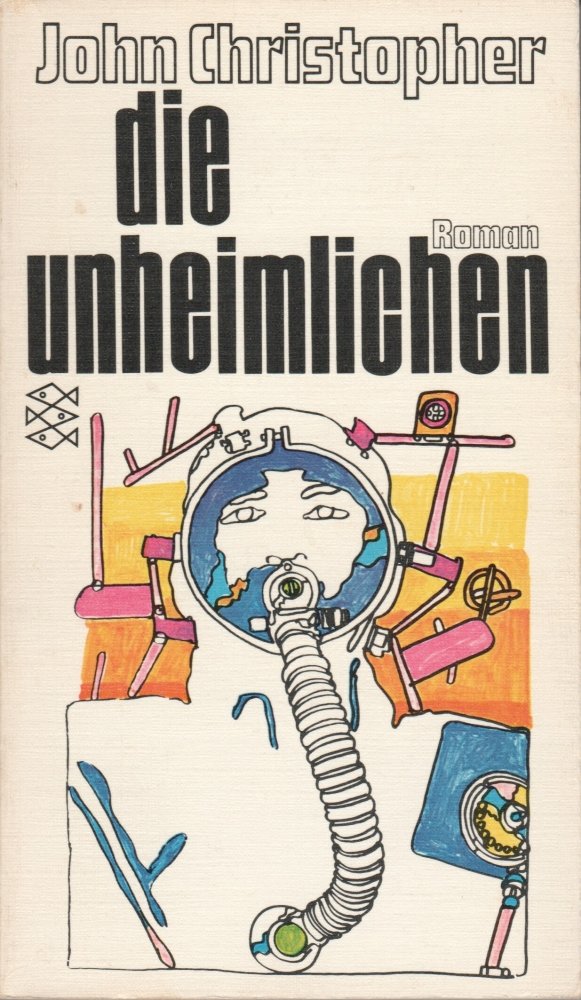
1970 German edition, art by Hans Mainer

It’s certainly a suspenseful read, and I’m surprised it hasn’t been filmed (it was optioned, apparently), because it could surely be made on a reasonable budget. (Special effects: one glowing blue sphere.) It perhaps has less of the weird feeling I might have liked—I’d have preferred more of what seems to be promised by the German translation of the book, titled Die Unheimlichen (“The Uncanny Ones”). This is far more of an adventure/disaster tale (and the cast of flawed characters, each with their cross to bear, recalls the set-up to so many 70s disaster movies), and a successful one, at that. I’d definitely like to read more by Christopher. I’ve been meaning to read The Tripods since around the end of the 1970s…

^TOP