Back in the days of HG Wells’ War of the Worlds, aliens, with their “intellects vast and cool and unsympathetic” could be seen as a warning against one of the great threats of the looming 20th century: letting pure intellect dominate, and lead us into our own technologically-flavoured destruction. Midway through the century, an alien of a different type (Klaatu by name) turned up to issue a more direct warning against blowing ourselves up, as though to say, “You just don’t get it, do you?” Later still, in the post-Morning of the Magicians/Chariots of the Gods? 70s and 80s, when aliens came not to invade us, they were still often remote (2001), weird (Close Encounters of the Third Kind) or at least impressed by our capacity to feel emotions (Starman).
But here we are in the 21st century, and it’s a sorry state of affairs when aliens come along to remind us how to be human.

I went to see Disclosure Day the day after the current president of the United States hosted an Ultimate Fighting Championship night in the White House, so the opening scene of Steven Spielberg’s latest dip into alien lore—a wrestling match in which one contestant breaks a chair on his opponent’s head while the crowd eggs him on to further showy violence—couldn’t help but feel like a political statement. Is this, Spielberg seems to be asking, America today: a baying crowd driven to distraction by a trumped-up fight while the world teeters on the brink of environmental instability and World War III, and meanwhile a shady organisation that somehow blurs the distinction between a tech company and a government agency is responsible for incarcerating and mistreating immigrants (of the interstellar variety, but immigrants all the same)…?
If it needs to be made any more explicit, we’re told at one point (slight spoiler) that Disclosure Day’s aliens regard empathy as an important evolutionary advance—a direct riposte, I assume, to a certain [update: ex-]trillionaire’s assertion that the same quality is “the fundamental weakness of Western civilisation”. (Elsewhere, footage of dead or injured Close Encounters-style aliens, with their emaciated bodies and overlarge heads, surrounded by various flavours of the uniformed military, can’t help recall images of the victims of Nazi concentration camps…)
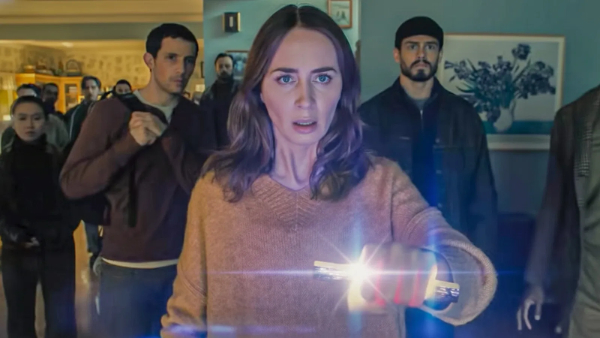
It’s a pity, then, that Disclosure Day is such a mess. The story (though not the script) is by Spielberg himself, and I can’t help feeling the “story” in question was more a wish-list of scenes and ideas, which had to be knocked up into some sort of a narrative. Can we have crop circles, please? Just the one. It doesn’t have to mean anything in the narrative, but just be there for a brief attempt at a sense of wonder (though it comes off more as a tired joke)…? It is, in this way, the film of a true believer, who feels he has to include everything, rather than pick only what serves a well-honed story.
On the way, Spielberg gets to fake some archival UFO/alien footage, which I’m sure is already, in some sectors of the internet, being claimed to be actual alien footage, snuck into a Hollywood film against the government’s wishes (the government, of course, never watching Hollywood films) while also being a government-sanctioned plot to prepare us for the real disclosure day (the government, of course, being in secret control of Hollywood films) which will happen any day now. (No, now. No… now. Alright, but soon.)

(Despite apparently valuing empathy, the aliens are not above terrifying small children.)
Ever since Klaatu assumed the name of Carpenter in The Day the Earth Stood Still, the line between aliens and angels/saviours/gods (or, as von Däniken would have it, Gods?) has been somewhat blurred, but here the blurring is more slapdash than subtle. On the one hand, Spielberg spends a rather contrived scene assuring his viewers that a belief in aliens isn’t incompatible with traditional faiths, then he undermines it by having people treat our touched-by-the-aliens protagonists with religious awe. (Why should technologically more advanced beings be thought of as spiritually superior? If my neighbour has a better iPhone than me, is he holier? Does being guided by AI make a war any more spiritual? Or make the Buddah, not having a digital watch, any less?) There’s too much demand on the aliens in this film to be everything Spielberg wants them to be.
But I don’t think it’s the point of Disclosure Day to make sense. Its point it to thrust a lot of stuff at us—Steven Spielberg sense-of-wonder stuff (though it’s nowhere near as sense-of-wonder-ish as Close Encounters)—while making a broad point about empathy at a time when the world could really do with a reminder that such a thing exists.
There’s a push to see Disclosure Day at the cinema, but I have to say, it doesn’t really do much in the big-screen wow-ing visuals department. Worth watching on your home TV (if for no other reason than you can pause it to take a loo break, because it’s over two hours long), but not, I’d say, if you’re up for a wholly satisfying story—more if you’re happy with a dip into the realms of conspiracy culture (or are a believer, in which case it’s probably a delight), plus an occasionally moving reminder of what it means for people to perhaps, maybe, sometimes, be nice to each other, have hope in the future, and get together to turn things around generally.