
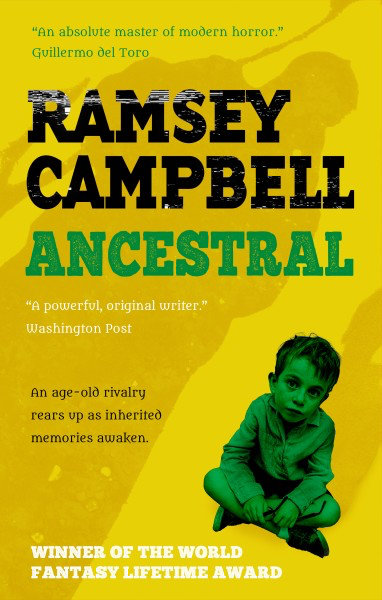
 In Ramsey Campbell’s latest novel, eight year old Tim Bystone is the scion of two families with deep roots in the Wirral Peninsula, where both still live. (His mother works with her parents at Stanton’s Stationers, his father with his parents at Bystone’s Pharmacy across the road.) Only a couple of generations back, the two families wouldn’t have spoken, let alone married and produced a child, as they were under the shadow of a rivalry so old no-one recalled its origins—though hints come through in the memory of certain significant locations even the current generations somehow find familiar: the gloomy cave of Boggart’s Grot, the foggy mountains at Stalking Edge, the viscid waters of Umbrage Cove, and the overcrowding trees of Fay Woods.
Told, at school, to write a true story, Tim is upbraided for producing one about a battle between two wizards whose rivalry was so intense they summoned elementals from the landscape to fight one another, which obviously can’t, the teacher insists, be true. (What’s more, it offends his classmate Sophia, the daughter of strictly religious parents, meaning he has to apologise to her in front of the class.)
But perhaps there’s more truth to Tim’s story than anyone could suspect, and he’s feeling the stirring of a magical power feeding into him from both of his ancestral lines. When his parents ask him to pick locations for a series of weekend trips, he chooses Boggart’s Grot, Stalking Edge, Umbrage Cove and Fay Woods, and at each feels he’s encountering something that wakes to his presence, and follows him back home…
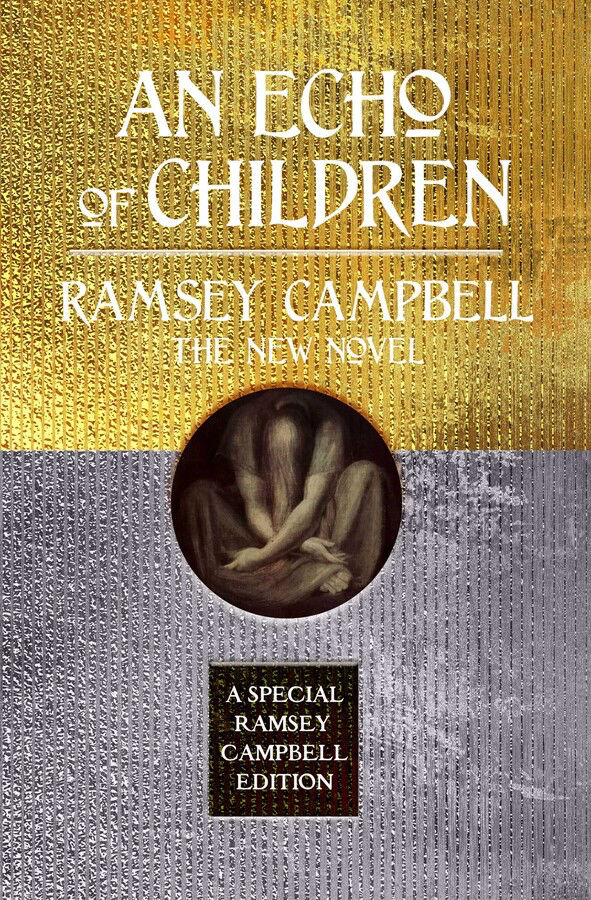
There are Lovecraftian touches here (in the influence of an ancestral wizard being visited on a modern descendent), and even the hint of a dark Harry Potter (in a child’s awakening to magical powers, though with no Hogwarts to guide him), but most of all this feels like a companion piece to Campbell’s 2025 novel An Echo of Children. There, a young boy apparently comes under the influence of the supernatural, only for his newly (and strictly) religious parents to begin a programme of, essentially, persecuting their own child so as to “save” him. Here, there’s no doubt Tim really is in touch with the supernatural, but aside from Sophia’s parents demanding front-of-class apologies whenever Tim even mentions something like the occult, at least in this novel the boy’s parents are on his side. They may not believe what Tim suspects to be true, but they are willing to listen to the boy.
(Is there a hint, though, about the dangers of families, if they’re too insular? There Sophia’s unquestioning parroting of her parents’ extreme views, but there’s also Tim’s parents, who still work for their parents, and whose union has resulted in a combination of two ancestral lines of dark magic and a dangerous supernatural re-awakening—something like an occult version of the intermarriage of cousins, perhaps.)
There are other echoes of previous Campbell works, here, too. Both The Kind Folk (2012) and The Wise Friend (2020) used the idea of a tour of supernaturally-charged locations to reawaken the dark forces found there, in what might be termed (after MR James) a “Black Pilgrimage”, or perhaps (playing to Campbell’s Catholic upbringing) the “Stations of the (Inverted) Cross”. Such a scheme plays to Campbell’s strengths, as the exploration of a spooky environment, fraught with darkly suggestive hints of something unnatural emerging in uneasy ways, is one of his most characteristic tropes.
 Here, the “Black Pilgrimage” takes up the first half of the novel, but it was after this that I felt the suspense falter a bit, and mainly, I think, because of the publisher’s tagline: “An age-old rivalry rears up as inherited memories awaken.” This, to me, suggested the ancestral rivalry between the two now-wedded families was going to be revived, perhaps because it made me think of Gordon Honeycombe’s Oedipally-charged 1972 novel Dragon Under the Hill, in which a similar clash of ancestral rivalries (in this case between the descendent of a Viking raider-king and the his first English victims) comes dangerously (and supernaturally) alive in the child of the two lines. There, it results in the young son throwing an ancient spear-head (mounted on a modern mop-handle) at this father. But that’s not the line Ancestral follows at all. That tagline, I can’t help feeling, is misleading.
Rather, having awoken those elemental forces once summoned to life by his wizardly ancestors, Tim finds himself with a supernatural servitor all too ready to take his slightest childish resentment or whim as a potentially lethal command. And it’s not either of his parents, nor his grandparents, that he has a problem with, but those difficult buggers in his class at school. (It could be said Tim is on the road to becoming what the parents of An Echo of Children feared their child would become.)
Ancestral is a fine supernatural novel, full of classic Campbell linguistic spookery. (It contains what may be the boiled-down essence of all of his negative suggestiveness, in the line: “No, not a face; the swelling mass had none.” Is that the denial of a face, or the refusal to see one? Either way, the reader’s left with the image of some sort of face/not-face… swelling…)
He has some fun with language too, as with a visit to the Pizza Piper (one of a series of punningly-named eateries that pepper his work):
“The pizzas proved palatable, though Tim perceived politeness had prompted his parents to purchase them despite their presentiments.”
Or, at the Fish You Wish café:
“He used his fork to separate a crunchy chunk of fish and captured a chip before raising the culinary combination to his mouth.”
Which, aside from making my mouth water, makes me think there’s a (no doubt darkly-comic) food-related horror novel to come from Campbell (if I haven’t missed one he’s done already—I’m still catching up on his prodigious output, in between re-reads of his older novels.)
