Strange Evil by Jane Gaskell

Strange Evil was written in 1955, by the fourteen year old Jane Gaskell, and published in 1957. It belongs to that small class of genuinely unique sports of imaginative fiction from the time before fantasy was a commercial genre. In a sense, it was published in another age. As the publisher’s preface states (after basically apologising for the fact that the book was written by a “prodigy”), the manuscript was submitted in “eight little blue exercise books”, something which wouldn’t even get a cursory glance nowadays. But they published it “not because it is remarkable to have written a novel at all at fourteen, but because we think Strange Evil is, in itself, a strange, arresting and beautiful book.”

The question is, is it still worth reading today? In the preface, the publishers go on to say: “That it has faults and immaturities we know; revision has deliberately been kept to a minimum and has been carried out by the author herself, for we felt that the youthful sparkle of her writing should at all costs be preserved.” One of the things that makes the book still worth reading is its style. And the point about Strange Evil‘s style isn’t its maturity, or lack of it (though I don’t see much of the lack of it myself), but its originality.

As an example:

“Flowers thanked the blue sky with perfume. Perfume was wafted down to her — not only from the great beds on the sunlit terraces, but from those bright assemblages of flowers far away on the mountainside. At the top of the slope trees were massed in shades of jewel-green. White blossoms peered and peeped among them, blurry pearls in the midst of the hard vividity of the rest of the colours of the day. A blue sky rose above them and arched its back as though it, too, were alive and vital. It was certainly sun-soaked. It was blue as though it depended on its living for it.”

“It was certainly sun-soaked” might be immature, but you’d have to have no poetry in your soul not to immediately forgive it for the sentence that follows it, which is just one of the many little sparks of surprise dotted throughout the book. Here’s another:

“A red butterfly perched on her shoulder, and, frightened by the texture of her blouse, darted off again. She followed it until she lost it in its gay philanderage among the flowers.”

Has a butterfly’s flight ever been better described than as a “gay philanderage”? (Taking both words in the 1950s sense, of course!) But the poetry of Gaskell’s style isn’t only reserved for the beauties of her world — though it is far more colourful than most writers’ worlds — as this example from a long and bloody battle at the end shows:

“Once, as she fled and slipped again, it was upon five separate fingers in the pool — they were like five little sticks which clutched at her feet.”

The thing about these examples is they’re so vivid and unique. I’ve read enough fantasy novels by full-fledged adults to know that you don’t find images as arresting as those “five separate fingers” often, however violent things get. One thing you can say about Gaskell’s writing that sets it apart from the “immature” is that it is unclichéd. Most fourteen-year-old writers would simply be rehashing what they’d read before, and in a similar style. It takes a certain maturity to break free of other writers, and Gaskell certainly has that.

The basic plot of the book isn’t so original, as fantasies go, but is so full of weird invention that you either won’t notice it, or won’t care. Judith, our heroine, receives a last minute note telling her that a cousin she has never met is coming to stay. It turns out this cousin, Dorinda, and her fiancé Zameis, aren’t human, but are what could best be called fairies, as Judith realises when their golden antenna become visible in a particularly sunny London restaurant. For some reason, knowing their true nature means Judith can’t be left in our world, but must go with them to theirs, though this is something she seems happy enough to do. They travel to Paris, to jump off the roof of Notre Dames, which happens to be one of the places where our world touches theirs. Judith and her two companions find themselves on a moving silver road, which takes them across the many disparate regions of fairyland.

They are making for a mountain, which Dorinda, Zameis, and other “Internals” live inside. But before they can reach it, they’re kidnapped by “Externals” — a mix of exiled Internals and conscripted satyrs, who grow food for the Internals in exchange for brief returns to the inside of the mountain (which the Externals need to do regularly in order to survive). But it turns out that the Internals have finally denied the Externals any entry to the life-giving interior of the mountain, and the Externals, driven to desperation, are ready for war.

Judith, neither an Internal nor an External, at first finds herself free to move about, but soon comes to the attention of one of the Internal nobles, who thinks she is an agent of Death come to kill him. War breaks out. Judith, finding the decadence and pleasure-loving perversity of the Internals not to her taste, sides with the Externals, and finally confronts the Baby — a monstrous giant god in the shape of a vastly overgrown human baby who represents the selfish, sybaritic nature of the Internals’ religion, “just sheer, puffed-up, spoilt, colossal selfishness”. (This, I suppose, is what China Mieville was referring to when he said Strange Evil had “the most extraordinary baddy in fiction”.)

The book is sprinkled with weird moments that go way beyond the imaginations of most generic fantasists. At one point, heading for the final battle, Judith witnesses the passing of a “colossal black woman”, so big that:

“She stepped over the mountain as though it were flat grass on a plain, and Judith knew her to be one who cared nothing for the little ways of men. Truly there were dreadful things in this world.”

It’s a brief pause that adds nothing to the plot, but does everything to open up the sense of being in another, totally alien world, where potentially vast forces might at any moment come into play. (It may have been inspired by Goya’s “The Colossus“. The back flap of Strange Evil says Gaskell “derives the inspiration for some of her descriptive passages from studying paintings”.)

So, I think Strange Evil is still worth reading, not for the fact it was written by a fourteen-year-old, but because it is the product of a unique imagination. I’d even say there’s an air of David Lindsay’s A Voyage to Arcturus in the home-grown, one-offness of its fantastic invention, and the authenticity of its intent. This is something that’s still rare today, when it’s so easy to fall into the wheel ruts of genre fiction and follow them through the usual standard plots, standard styles, and standard fantastic images, for the standard reasons.

Jane Gaskell went on to write the Atlan fantasy series, which I haven’t read, but I will certainly be on the look out for.

^TOP

The Big Sleep

I can’t believe I haven’t read any Raymond Chandler before this. I think I was put off because that hard-boiled style is so widely imitated — or attempted, anyway — that there seemed no point. But a few sentences into The Big Sleep, I was laughing out loud for the sheer wit of the writing, the comic conciseness of it, the way it revels in its own ultra-cynical view of a dark, dark world:

I sat down on the edge of a deep soft chair and looked at Mrs Regan. She was worth a stare. She was trouble…

She said negligently: ‘He didn’t know the right people. That’s all a police record means in this rotten crime-ridden country.’ …

At times, you’d be hard pressed to tell Chandler from the Marx Brothers, or S J Perelman:

‘Mr Cobb was my escort,’ she said. ‘Such a nice escort, Mr Cobb. So attentive. You should see him sober. I should see him sober. Somebody should see him sober. I mean, just for the record.’

…you have to hold your teeth clamped around Hollywood to keep from chewing on stray blondes…

‘Two coffees,’ I said. ‘Black, strong and made this year…’

She had long thighs and she walked with a certain something I hadn’t often seen in bookstores…

He sounded like a man who had slept well and didn’t owe too much money…

But at others he achieves a perfect sort of scintillant, shadowy beauty — only ever in brief snatches — that works because of the sheer surprise of finding any beauty at all amongst so much shade and squalor:

It got dark and the rain-clouded lights of the stores were soaked up by the black street…

Dead men are heavier than broken hearts…

She was smoking and a glass of amber fluid was tall and pale at her elbow…

And — rare for a literary style — it works just as well with brisk action:

A tall hatless figure in a leather jerkin was running diagonally across the street between the parked cars. The figure turned and flame spurted from it. Two heavy hammers hit the stucco wall beside me. The figure ran on, dodged between two cars, vanished.

The Big Sleep has been filmed twice, the first (the 1946 version directed by Howard Hawks, starring Humphrey Bogart and Lauren Bacall) being so perfect as to doom the second (from 1978), even if it hadn’t been directed by Michael Winner.

The screenplay for the 1946 version was co-authored by William Faulkner, Jules Furthman and Leigh Brackett (a hard-boiled writer herself, not to mention the author of Michael Moorcock’s favourite planetary romance, and a helping hand on the screenplay to The Empire Strikes Back), but its greatest asset has to be Bogart. I put off watching either film version till I’d finished the book, but still found it impossible not to hear Philip Marlowe’s narration in Bogart’s voice. His is the perfect hard-boiled detective tone — a lazy, drawly, world-weary whine, its every word bit back by a deeply ingrained sarcasm. Once you hear him delivering hard-boiled prose, it’s like a meme you can’t get rid of, and to which every other actor cannot help but fall short. If Raymond Chandler himself didn’t sound like Humphrey Bogart, I don’t want to hear him.

This is a point amply proven by Robert Mitchum in Michael Winner’s version. Faithful to so many details of the book in terms of dialogue and incident — to a degree the Bogart classic isn’t — Winner’s film nevertheless manages to miss almost every point in terms of the spirit of Chandler’s world. Mitchum simply can’t deliver a line with the bite and world-weariness of a truly hard-boiled PI. It sounds (fatally) like he means what he says, whereas a hard-boiled PI’s meaning is never in the words he speaks, only in their bitter aftertaste. And, gods, Winner has changed the setting to seventies England! Seventies England just isn’t, and can’t ever be, thirties LA. If nothing else, the sleazy photo-trade aspect of The Big Sleep‘s plot becomes rather quaint and old-fashioned in full-colour post-sixties England. And, although it may be too weird to say it, there’s just too much sun and fine weather in Winner’s UK. Chandler’s novel takes place mostly at night, or in those oppressively dark and super-heavy downpours LA can have. It’s almost black and white before the fact, never mind the year it was filmed in. (Which isn’t to say noir can’t be done in colour — Ridley Scott’s Blade Runner and David Lynch’s Lost Highway are modern noir. Plenty of black, still, but they bring in the sharp, dark reds of lipstick and blood, too.)

The 1946 version’s main departure from Chandler’s novel is to increase the interaction between Marlowe and the older of the two Sternwood girls, as played by Lauren Bacall, this apparently because an early showing didn’t go down so well, and seeing as Bogart and Bacall had recently had a screen-chemistry-fuelled hit with To Have and Have Not, additional scenes were inserted allowing the two to indulge in some playfully suggestive banter — including a weird scene that attaches such suggestiveness to an exchange about betting on horses, it sounds even more explicit than any upfront conversation ever could. Although this makes the film more acceptable and commercial in Hollywood terms, it does end up sacrificing one of the high-points of the novel. In the book, when Marlowe finally tracks down crime boss Eddie Mars’s wife, he finds something like an angel, a total contrast to the eternally cynical, selfish and calculating grifters who make up the rest of the book’s cast. Writing of her, Chandler’s prose switches to a level of sentiment you wouldn’t be able to take were it not so hemmed in by cynicism (“Her breath was as delicate as the eyes of a fawn.”), and it works, it really works, you feel you’re in the presence of something rare and delicate, something that all too soon leaves Marlowe’s shadowy, ever-disappointed world. But this is something not possible in the 1946 film, because Bacall’s character has to be the focus for Marlowe’s (and our) admiration, and Eddie Mars’s wife becomes just a bit part, yet another blonde. (As for the 1978 film, it can’t hope to approach anything like sentiment, let alone real feeling.)

A brunette, a blonde and Bogey

The fact that I’ve recently read the novel and watched two film versions of The Big Sleep yet still fail to remember whodunnit each time points to how little plot matters in this type of fiction. What matters is that, for the duration of the book or film, you’re dwelling in Hard Boiled Land, in Noirville — which is, really, more of an atmosphere (or, better, a shade) than a place, an effect caused by donning a pair of most definitely not rose-tinted glasses. But, as with the bleakest tragedies, there’s something about it that works — like a cold, hard slap works. Fitting, perhaps, as one of the iconic images of the hard-boiled world is of the detective slapping the hysterical blonde. This is a world, after all, where the only emotion ever expressed is one that bursts loose, out of control, something that’s closer to insanity than real feeling (at one point, near the end, Marlowe starts to laugh “like a loon”, making me wonder how much Chandler’s fiction was an attempt to address the same concerns as H P Lovecraft’s). Every other emotion has to be bitten back, or let loose in terse slugs of hard-boiled dialogue. It’s a world in which everything of any value has to be reduced, sullied, disenchanted. Women aren’t women; they’re blondes or brunettes. Men aren’t men; they’re cops or heavies. And everyone’s a grifter, and life is nothing but a series of no-hope games played for too-high stakes. The only surprises in this world are gunshots, corpses and the occasional troubled blonde. Till then, there’s always another drink, or a blackjack to the back of the head, or a sock to the jaw. Above all, there’s a feeling of a world steeped in a profound sense of injustice, something so fundamentally rotten the law cannot touch it — hence the need for the hard-boiled hero to be a freelance, a PI, half outside the law so he can stray across that grey line between right and wrong, and deliver his own sort of (leaden) retribution — something personal, before it gets to the (inevitably corrupt) impersonal courts.

Film noir – a guy, a girl, and a gun

The more I think about it, the more the hard-boiled world sounds like Lovecraft’s fictional world. I know hard-boiled Lovecraft has been done several times (Cast a Deadly Spell, and Kim Newman’s “The Big Fish”, to name a couple), but really, however fun, these are kind of superfluous. Chandler’s world was not quite as bleak as Lovecraft’s at its bleakest — I can’t imagine there’s a hard-boiled equivalent of “The Colour Out of Space” — and Lovecraft doesn’t really have an equivalent of the briefly-glimpsed angel of Eddie Mars’s wife — but they were certainly touching the same territory, each in their own oft-imitated but really inimitable way.

^TOP

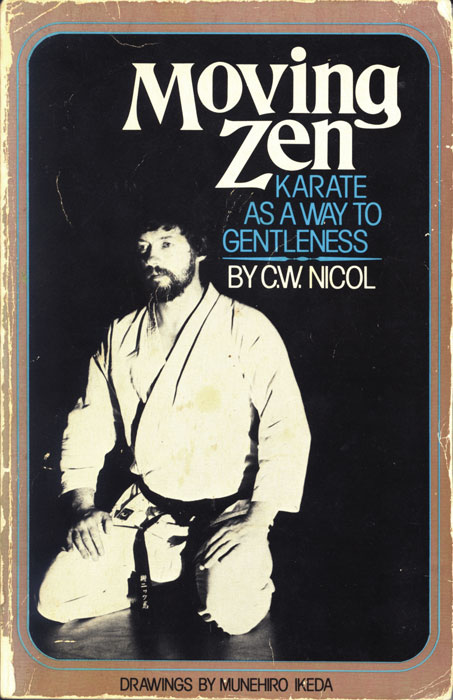
Moving Zen by C W Nicol

Writing about Robert K Elder’s The Film That Changed My Life recently made me think about books that have changed mine (in that wordlessly changing way I wrote about), and the one that came most immediately to mind was Moving Zen by C W Nicol. Because I’ve never had much in the way of storage space, my personal library has seen a lot of books come and go, but Moving Zen (given to me as a Christmas present by my brother Garen back in about 1985) is one of the few that have stayed with me. Of course, I first read it because I was heavily into Karate at the time, but it’s the one Karate book I’ve kept, in part because it tells a story that isn’t just about Karate, but something far more universal.

First published in 1975, Moving Zen is C W Nicol’s memoir of the time he went to Japan (in the early sixties) to learn Karate. “I wanted it to be the simple story of a journey from white to black belt”, he says (in an excellent two-part interview which can be found online here (part 1, part 2), and which makes a wonderful afterword to reading Moving Zen), but really it’s about a young man finding a place (both inwardly and outwardly) where he truly feels at home.

The start of his first Karate lesson at the Japan Karate Association’s dojo in Yotsuya is the perfect illustration of this. A Westerner with only a smattering of Japanese, he at first finds the very atmosphere makes an outsider of him:

“Silence. I tried to draw myself into it, but it excluded me, and I held my breath lest I should make a noise, and hovered, uncertain, on the edge of it, for I did not know, and would not know for some time, exactly what we were doing.” — p. 9

And outside the dojo:

“Crowded Tokyo magnified my loneliness. In language and life-style, I lived apart from the people. I had not yet truly found a place to belong. Coming off an Arctic expedition, with its close and isolated companionship, did not equip me emotionally for dealing with huge, alien crowds, or for the many people I had to know, greet, and be friendly with.” — p. 18

As well as learning a martial art, and coming to understand a new culture, Moving Zen‘s subtitle, “Karate as a Way to Gentleness”, points to another conflict Nicol faces, this time with something alien inside himself, a raging temper he was prey to, which had led to him being involved in street-fights as a youngster, and he deals with the paradox of using a martial art as a means of learning to control these urges to violence, eloquently.

In fact, one of the joys of this book is just how well-written it is. Always clear and simple in style, it evokes the Japan that Nicol comes to know in a very Japanese way, using brief, accurate but expressive strokes to describe small incidents, sights and experiences:

“Outside, in the yard of a nearby farmhouse, a little grey-haired old lady bent over a broom, busily sweeping the fallen leaves of a gnarled and ancient persimmon tree. Dark clouds scudded by, over the curves of the eaves. And then came a gust of wind, and a thousand leaves clung to the wet roof, and tears came to my eyes, and my scalp tightened, and the wet leaves and the roof suddenly brought an understanding to me of something that was pure Zen, and therefore wordless, and Sonako and I went home for supper.” — p. 90

It’s these passages that provide some of the most moving episodes in the book, particularly in the final chapters where Nicol looks back on the many experiences he’s had in this once-alien country and realises how far he’s come, not just in terms of learning Karate (and earning his black belt), but in terms of ridding himself of his “foreign-bachelor isolation” and finding a way to truly belong:

“I was part of a family now… Each day was an object lesson in living, and I had so much to learn.” — p. 68

“It was as if the surface were calmer now, and I could begin to see beneath it, coming face to face with the warrior philosophies of Japan… I knew now that I had not come to Japan on a wild goose chase. It was all here.” — p. 100

Is a knowledge of Karate necessary to enjoy the book? I don’t think so, as Nicol was writing at a time when few Westerners would have known much about the subject, and he takes time to introduce the various concepts as he comes across them — mostly those relating to the spirit of Karate, the paradoxical heart of Bushido that turns a fighting method into a discipline, an art, a means of “perfecting one’s character”, rather than becoming some sort of killing machine. But this is certainly not an instructional manual, and the passages that explain aspects of the people and culture of Japan are as frequent as those about the martial arts. For me, there’s something about the very way this book is written, a calmness and clarity in its language, a simplicity in its insight into the many paradoxes of Japanese culture, and Karate in particular, that reveals how deeply Nicol was changed by the experiences he describes.

Doing a web-search, I was surprised to learn that C W Nicol is quite a celebrity in Japan, and has written more than a hundred books, not to mention plays and scripts for TV. He continues to practise Karate, and to follow his other passion, for the environment. His official website’s here, but alas (for me), it’s in Japanese. Amazon lists a couple of other English language books by him, though, so I may well be checking those out in the near future.

^TOP