What books do best

I love films. I love music. I love games, comics, paintings, the lot. But most of all I love books, stories told in words. I’m not going to argue that my chosen favourite form of art/entertainment (if only there was one word that meant both and didn’t sound either pretentious or disparaging) is better than the others, because it’s not. They’re all means of telling stories, or saying interesting things, and they all work in different ways. The ones that work best are the ones that use the strengths of their form to the best advantage. In Watchmen, for instance, Dave Gibbons and Alan Moore deliberately used one of the advantages of comics to do something which can’t be translated into film — the fact that you can pack a lot of detail into each panel, and the reader can linger, and flip back and forth, to really absorb that detail. That’s why, when watching the recent film of Watchmen, I kept thinking, “But they’ve missed out… And what about… And where’s..?” All the way through.

But what do books do best? What are their strengths and weaknesses?

The weaknesses are obvious. Unlike all the other art-forms I listed above, they can only say one thing at a time — worse, they can only build up what they want to say one word at a time, which means you have to put a lot of work in just to get to the first thing they want to say. Music can be instantly impressive; the first shot of a film can just grab you; a splash page opening a comic takes you right into its story; but even “Call me Ishmael” has to be read one word at a time.

What are books’ strengths? I’ll take my answer not from a book, but a song:

Book after book
I get hooked
Every time the writer
Talks to me like a friend

— “Spaceball Ricochet“, Marc Bolan

Books talk to you, just like people do. Alright, you don’t see them waving their hands and pulling faces while they’re talking (books are more like telephone conversations, in that way), and they don’t allow you to talk back (or they don’t listen if you do), but although books are the least like our sensory experience of the world (mostly pictures and sounds), they are, I think, the most like our experience of people.

Some books (like some people) talk at you, and expect you to believe what they say because it’s they who say it. Such books are written by Authors, and their Authorship comes from them regarding themselves as Authorities — and that’s a little too close to regarding themselves as what Philip Pullman called The Authority in His Dark Materials, i.e., God. (Books written by Adults for children all too easily fall into this trap. Don’t they, my dearie wittle ones?)

The best books, though, are written by human beings, not Authors. They talk to you as an equal, as another human being, and don’t try to be clever or sophisticated or loud, or to put on airs:

My name is Mary Katherine Blackwood. I am eighteen years old, and I live with my sister Constance. I have often thought that with any luck at all I could have been born a werewolf, because the two middle fingers on both my hands are the same length, but I have had to be content with what I had.

We Have Always Lived in the Castle, Shirley Jackson.

Idle reader: without my swearing to it, you can believe that I would like this book, the child of my understanding, to be the most beautiful, the most brilliant, and the most discreet that anyone could imagine. But I have not been able to contravene the natural order; in it, like begets like.

Don Quixote, Cervantes, translated by Edith Grossman

When the phone rang I was in the kitchen, boiling a potful of spaghetti and whistling along to an FM broadcast of the overture to Rossini’s The Thieving Magpie, which has to be the perfect music for cooking pasta.

The Wind-Up Bird Chronicle, Haruki Murakami

Ever since people started reading books silently (Saint Ambrose is recorded as the first to engage in this peculiar practice), when books speak, they do so inside your head. In this way, they can seem not so much to be speaking to you, as to be the result of your eavesdropping on someone else’s thoughts, their own interior monologue raised to the clarity of complete and artistically ordered sentences.

What goes on in other people’s heads is, of course, one of the great mysteries of life. We can be reasonably sure that if I see a red penguin and you see a red penguin then the sensory impression received by our eyes is roughly the same thing, but the thoughts that go through our separate heads (“A red penguin? Am I insane?!” and “Ah, the Red Penguin returns…”) can be as different as, well, two books on a shelf.

But it’s in books that we have the solution to this mystery. Books allow the most intimate contact with the inside of another person’s head, because the writer doesn’t have to talk to us like a friend, they can go one better, and talk to us as they would to themselves, either about themselves, or (if they’re pure narrator) about the story, situation or picture they see:

The Piano Teacher, Erika Kohut, bursts like a whirlwind into the apartment she shares with her mother. Mama likes calling Erika her little whirlwind, for the child can be an absolute speed demon. She is trying to escape her mother. Erika is in her late thirties. Her mother is old enough to be her grandmother.

The Piano Teacher, Elfriede Jelinek, translated by Joachim Neugroschel

Gormenghast, that is, the main massing of the original stone, taken by itself would have displayed a certain ponderous architectural quality were it possible to have ignored the circumfusion of those mean dwellings that swarmed like an epidemic around its outer walls.

Titus Groan, Mervyn Peake

A-hind of hill, ways off to sun-set-down, is sky come like as fire, and walk I up in way of this, all hard of breath, where is grass colding on I’s feet and wetting they.

Voice of the Fire, Alan Moore.

A good book opens up a world and surrounds you in it. Because it starts inside your head, if read right, it replaces your senses and becomes your world, while you read it. One word at a time you go into all the strangeness, wonder, fear and peculiarity of being another human being. Which, you of course find, is just like being yourself. Only, with the furniture moved about a bit.
^TOP

A Plague of Scanspellos

They’re not typos, they’s scanspellos — errors that come not from someone mistyping something and failing to check it, but from someone scanning something in, running a quick OCR and spellcheck, then thinking that’s enough work on that one and publishing the damn thing. And I’m not talking about people putting stuff up on the web, I’m talking about supposedly professionally produced books available through Amazon. And this plague of scanspellos is set to get a lot worse as ebooks gain in popularity.

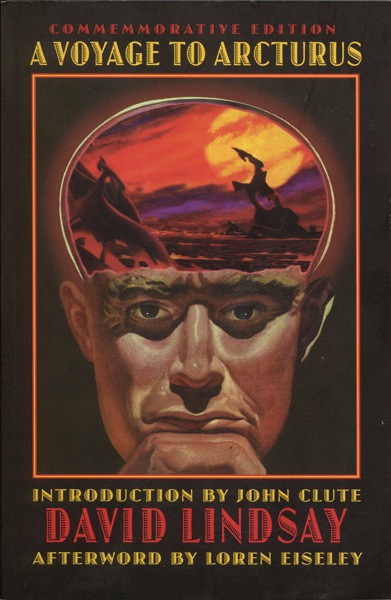
It’s not an issue limited to ebooks. The old Ballantine Adult Fantasy paperbacks had their fair share of typos, for instance — enough to make me want to replace them with a higher quality edition if I ever wanted to re-read them, but never so many that it made me give up reading them to start with. I first read A Voyage to Arcturus in its Ballantine edition, and although the typos were mildly annoying, they never got in the way of my understanding — and in fact being bowled over by — the book. It was always obvious they were typos. The trouble with scanspellos (a horrible word for a horrible phenomenon) is, because they involve a careless run through a spellchecker, they’re that much less obvious. The first book that really got my readerly goat as far as scanspellos are concerned was, in fact, another edition of A Voyage to Arcturus, in this case one produced by a university press — Bison Press, who are associated with the University of Nebraska. In a supposedly “commemmorative” edition (that’s one “m” too many, they even managed to introduce an error on the cover), the text was so garbled I actually fired an email off to the publisher (and never got a reply of course). Although it was full of silly little obvious errors, including number 1’s for letter l’s (hardly an important error, but irritating enough to act as a constant distraction from pure reading), some of the words, and therefore the meaning, had actually been changed. At one point, for instance, the text said, “The short stranger turned and comforted the party”. Any reader new to Arcturus would read that and take it at face value, but I, having read the novel a fair few times and knowing that the very essence of the “short stranger”, Krag, is discomfort — he is a supernatural being who has another name in our world, and it is Pain — checked that sentence in another edition and found it was supposed to read “The short stranger turned and confronted the party” — an entirely different meaning.

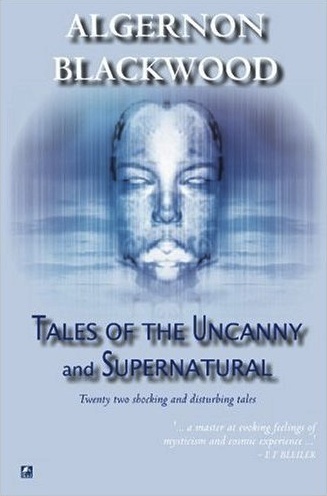
I’ve recently been reading Tales of the Uncanny and Supernatural, a bumper volume of Algernon Blackwood stories. This is from House of Stratus, a publisher who has issued a lot of Blackwood in affordable paperback form. A while ago I bought their edition of his novel, The Human Chord, and it was a well-produced paperback. I thought Tales would be up to the same standard. In fact it was scanspelloed to the hilt. “Her” constantly replaced “for”, “ox” replaced “or”, “axe” replaced “are”, “lie” replaced “he”, among many, many others. Worst of all was its constant replacement of long dashes with hyphens. This might sound like a minor annoyance on a par with number 1’s for letter l’s, but it was actually the thing that most interrupted my reading. There’s a constantly disruptive effect in reading a sentence like:

“The Club-it crossed his tortured mind for a second-was impossible.”

The worst thing was, once I’d been reading the book for a while, I found myself looking at hyphenated words I came across elsewhere, wondering if they were supposed to have a dash or a hyphen between them, and tentatively re-reading them each way before continuing.

Neither of these examples are of ebooks. I recently read Treasure Island on my Kindle, in the free edition offered by Amazon. That actually had very few scanspellos, but had plenty of examples of the other fault that irritates me about ebooks — poor design. I hate books that use html-style paragraphing (a double line-space between paragraphs rather than a single line break and an indent). The free edition of Treasure Island didn’t do that, fortunately, but quite frequently had line breaks within paragraphs, though aside from that — and the poor formatting of chapter headings — it was generally readable. But bad enough to persuade me to pay for a book I want to read in future.

None of this is because of the rise of ebooks, or of print-on-demand technology (the House of Stratus book was POD, the Bison Press wasn’t), but it is an effect of the ease with which old, often out-of-print, books can be brought into production nowadays. On the one hand, I applaud publishers for bringing hard-to-find works back into print once more — particularly the Algernon Blackwood novels and stories. But the very thing that makes it viable for them to do so is that they can put so little effort into it — just scan them, OCR & spellcheck them, and release them to the public without a proper (human) proofread. And the trouble is that once these cheap editions are out there, it makes it so much less likely that a proper publisher — one who will actually check what they publish — will bring out a better edition to replace it, one which will necessarily be more expensive, and so sell less.

In the meantime, I’ve discovered a better way of reading out-of-print books. I download them as PDFs from archive.org. Kindles are generally pretty bad for reading PDFs because they either shrink them too small to read in order to fit on the screen, or you have to constantly pan right and left to read them; but books of a certain age are just the right size to fit on a Kindle screen and remain readable. And they’ve got a good selection of Algernon Blackwoods at archive.org.

^TOP

“Zathotha” in Cyäegha issue 4

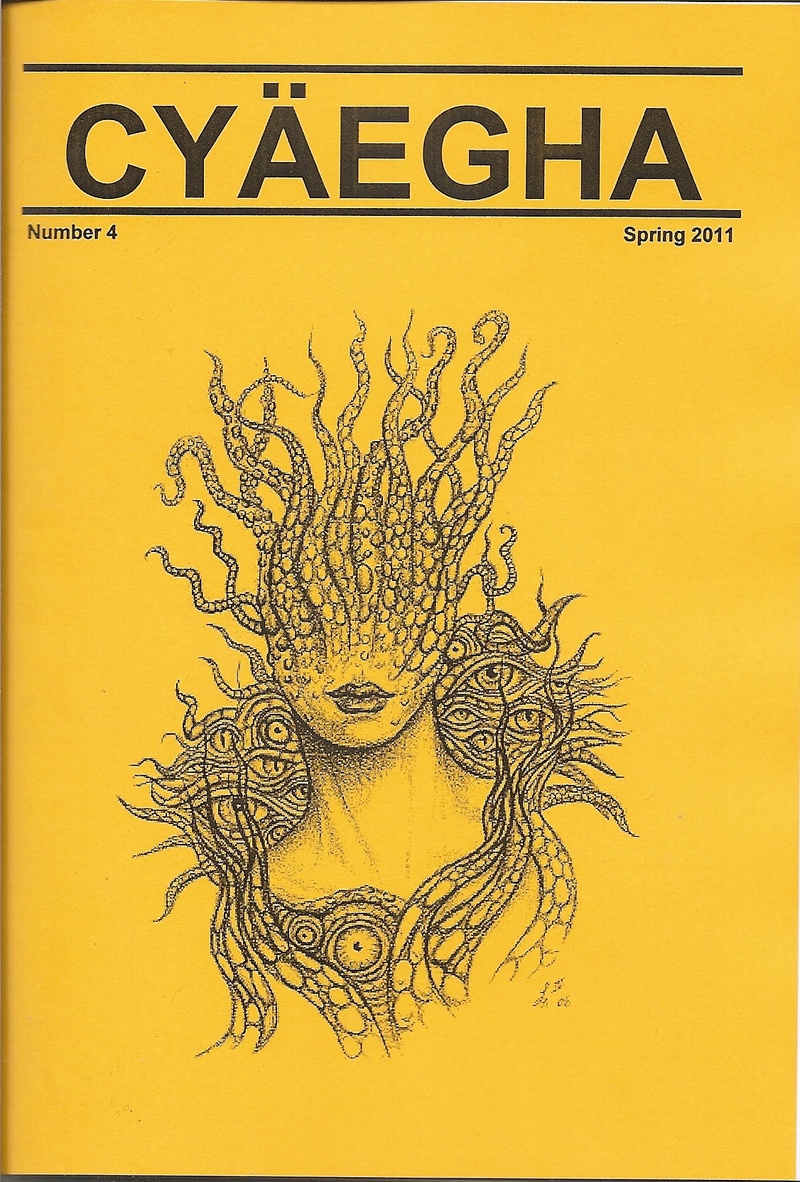
My Lovecraftian story, “Zathotha” has been published in Graeme Phillips’ Cyäegha issue four, out now. (For ordering details, see this page, on Stranger Aeons.) Cyäegha is produced in a limited run of 75 copies per issue, and has in the past reproduced some intriguing, rare Lovecraftiana, both fiction and art. Issue 3, for instance, was devoted to the Australian pulp writer Vol Molesworth. Issue 4 mixes old and new, including fiction, poetry, reviews and an interview with artist Paul Carrick. Anyway, I’m thrilled to be in its pages.

^TOP