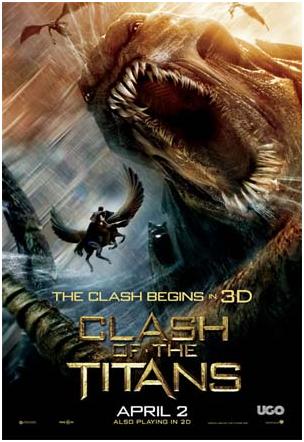
It’s difficult for me to compare the 2010 version of Clash of the Titans with the 1981 Harryhausen version because I love the 1981 film so much. I watched it at the cinema when it first came out, watched it again when it came out on video, watched it some more whenever it was shown on TV, and bought it on DVD as soon as it came out. I’ve watched that a few times, too. So, when I heard they were remaking it, I couldn’t quite stifle a groan that summed up a whole set of grumpy-old-man-type feelings, including my weariness with the idea that digital effects are necessarily better than other (older) types of effects, or that a modern take on a story will necessarily be a better one. All the same, I knew had to watch it, if only to get in 106 minutes of tutting and eye-rolling.
In the end, I didn’t hate it. I didn’t actually feel sufficiently moved to feel much about it all. There was a certain amount of puzzlement at the changes they’d made to the story — incomprehensible, to me, in the main, but then again, so was remaking the film in the first place. It’s quite likely that a new audience coming to the film without having seen the Harryhausen original will love the 2010 Clash, and that any criticisms I have may be all down to my being so familiar with the old one. If so, I can’t get sufficient perspective to see it. I think there are a few points to be made.

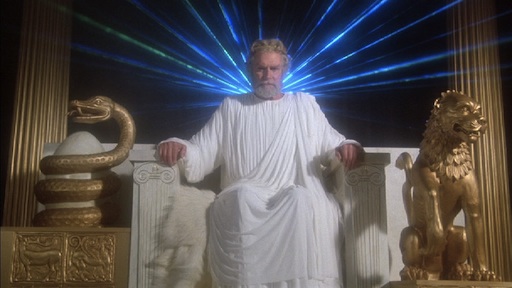
In the 1981 Clash, the gods (in particular Laurence Olivier’s Zeus) were vain, petty, scheming, cheating, irascible, vindictive and self-interested — basically, larger-than-life humans who happened to have divine powers. The film’s story grows out of the tensions between them, and the way the mortals are caught up in their game. In the 2010 version, suddenly we have Hades (not present at all in the 1981 version), who seems to have been introduced simply so as to have one god to blame all the evil on. So, Hades creates the Kraken, Hades kills Perseus’s family, Hades wants to destroy all the other gods, and so on. This might seem like a minor change, but it annoyed me because one of the attractions of Greek mythology — which I first encountered, I suspect, through this and Harryhausen’s Jason and the Argonauts — is that the Olympian gods encapsulate a quite different view of the world to the reductive, good-versus-evil, God-versus-Satan, version in which there is a definite right (as represented by the goodies) and a definite wrong (the baddies). The Greek gods were both remotely divine and all-too-human; they were mercurial, prone to vanity and vindictiveness, squabbling amongst themselves, using humans as pawns in their game (a point made literal, in the Harryhausen film, by the clay figures the gods use to control mortals). Zeus, noble father of the Gods, is in fact a dirty old man, always on the look out for another nubile young maiden to seduce, usually with the aid of a bit of divine showing off, such as appearing as a transplendent shower of gold or (for some reason) a swan. Thetis is vain and petty, revenging herself when her beauty is compared to that of the mortal Andromeda and found wanting. Basically, the Ancient Greek gods represented life as it was perceived by the Ancient Greeks: loaded with fatality, tragedy, and the sheer incomprehensibility of the wilfulness of these inscrutable divine powers who were at once both remote and (nicking Ambrose Bierce’s definition of the police) a “force for protection and participation”. The story of the 1981 film was a web of different strands caused by the gods’ competing aims and loyalties, with the mortals helplessly caught up in it all. By the mere introduction of a single evil character, the 2010 version loses all that richness, and just becomes another good-versus-evil smash-em-up. That, I think is the greatest loss in the remake.
 The other main point is the effects. I’m not biased against digital effects at all. It’s just that I’ve seen rather too many fantasy films of late which, perhaps because digital effects have opened up the possibilities for what can be realised on-screen, seem to feel they have to realise every idea they can possibly have. The effects expand to occupy all the space that previously (perhaps due to limited effects budgets, but also perhaps due to the taste of the filmmakers) was left for the storylines to simmer a bit and develop. It used to be that an effects-centred fantasy film might be, say, 15% effects scenes at most; but now, with effects so seemingly cheap, it’s 85% effects, if not more — just because it can be done. Ray Harryhausen’s monster scenes in the 1981 film were few, but were handled with taste, and had the benefit of a build-up, and some breathing space in between. When they appeared, the monsters weren’t just monsters, they were acted. They were lit, they were half-hidden in shadows, they were directed — they seemed to think. They had mood, they had imaginative weight. The 2010 Clash has wall-to-wall monster scenes, so visually overwhelming with in-your-face detail that I ended up just not caring. And all the monsters do is fight.
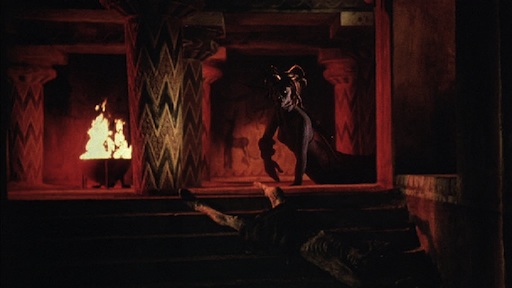
Is this just me? Could be. But I long for the days when — yes, perhaps because of limitations in the budget and technology — effects were (not always, but sometimes) treated with that magic that made them come alive. Even though I can look at the 1981 film and know Harryhausen’s Medusa is a model made of foam rubber and a wire skeleton, there’s a magic to it all the same. The super-detailed, brightly-lit Medusa of the 2010 film just seems to have no character, by comparison. Perhaps because the visual wow of what she can be made to do so far outweighs the work required to make her truly come alive on-screen.


The worst thing is, the 2010 film seems to have a sort of contempt for its predecessor. In one scene, when they’re preparing to set forth on their quest, someone finds the mechanical owl from the 1981 film. They make some condescending remark and toss it aside. Now, I’m not going to say that Bubo the mechanical owl is a vital part of the 1981 film, or that he’s a brilliant comic invention.  Thinking about it, he’s a mini-C3PO/R2D2 combo, and just as annoying. But I don’t hate him. For a fantasy film, which relies on its audience having absolute belief in it in order to work, bringing in humour can be quite a risk. If it’s done wrong, the audience can just end up laughing at the whole film. The 1981 Clash carries off its minor moments of humour without a dent; the 2010 film, supposedly showing its superiority to the 1981 original by making fun of its mechanical owl, is in fact showing how defensive it has to be towards a predecessor that, with more primitive technology and a lower budget, could nevertheless carry off that little bit of humour and still work as a fantasy film.