Marianne Dreams and Paperhouse

Marianne Dreams, from Faber & FaberCatherine Storr’s 1958 novel Marianne Dreams contains a perfect example of what Humphrey Carpenter calls the “Secret Garden”, found in so many classic kids’ books from Alice in Wonderland onwards — those Arcadian pocket-worlds that encapsulate an idealised childhood, part fantastic imagination, part golden-tinged nostalgia. In Storr’s book, the “Secret Garden” is a dream world 10-year-old Marianne creates through drawings made in her waking life. Bed-bound for weeks after an unspecified illness, she finds a special pencil (“one of those pencils that are simply asking to be written or drawn with”), thereafter referred to as The Pencil, in her grandmother’s button box. With it, she draws a standard child-style house, and when she sleeps, dreams of walking up to this very house, but being unable to get in. When she wakes, she adds a knocker to the door, and, for someone to answer it, a face at an upper window. Both details have been added to the house when she next dreams, but the boy at the window can’t answer her knock because the house has no stairs inside and (something he doesn’t admit immediately) he can’t walk. So Marianne starts working on interior drawings, too. In her waking life, because she can’t attend school till she’s well again, she’s being taught by a governess, who mentions another home-visit pupil, a boy called Mark whose illness has left him too weak to walk. When Marianne learns the boy in the dream-house is also called Mark, she realises her dream world isn’t entirely her own.
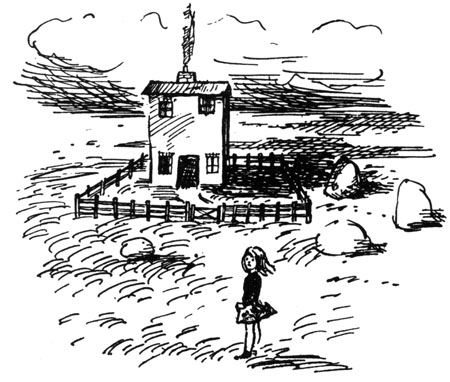
Marianne in the dream-world. Illustration by Marjorie-Ann Watts

Marianne in the dream world. Illustration by Marjorie-Ann Watts

In the dream world, though, the two children don’t exactly hit it off. Both are tetchy from being bed-bound for so long, and Mark is resentful of the idea he might be living in a world Marianne has created. After a particularly heated spat, she punishes the dream-Mark by scribbling him out (though this only puts bars over his window) and, worse, by adding a single, watching eye to each of the boulders she drew outside the house. When she next dreams, she finds Mark terrified of “THEM”, the watching rock-creatures crowding the house. Regretting her anger, but unable to undo it (what she draws with The Pencil can’t be erased), the story comes to be about Marianne encouraging Mark to regain the physical strength and will to walk so they can escape the house and the watching, threatening presences.
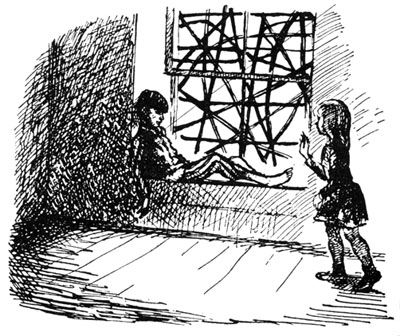
Marianne and Mark. Illustration by Marjorie-Ann Watts

Marianne and Mark. Illustration by Marjorie-Ann Watts

Aside from its dream world fitting neatly into Humphrey Carpenter’s idea of the “Secret Garden”, Marianne Dreams has other similarities to Frances Hodgson Burnett’s 1911 novel from which Carpenter got the name. In Burnett’s book, the slightly spoiled 10-year-old Mary Lennox, orphaned and sent to live with a reclusive uncle, discovers an abandoned, walled rose garden and in it comes to not only befriend her withdrawn and seemingly crippled cousin Colin (who, like Mark, can’t, or won’t, walk), but to engage in a wholesale healing of the family: Colin of belief in his physical frailty, herself of her spoiled nature, and her uncle of both his extreme grief over the death of his wife and his estrangement from his son. The main difference between the two novels is that, while Mary Lennox of The Secret Garden is basically working at healing the adult world (where Uncle Archibald’s mourning for his wife is the cause of all the other problems) in Marianne Dreams the focus is entirely on the children, not just in recovering from their illnesses, but in their working together to overcome the self-centredness which their long periods of convalescence have led to. There’s a feeling that they’re taking a step away from the dependence of childhood towards taking a fuller responsibility for their own lives.
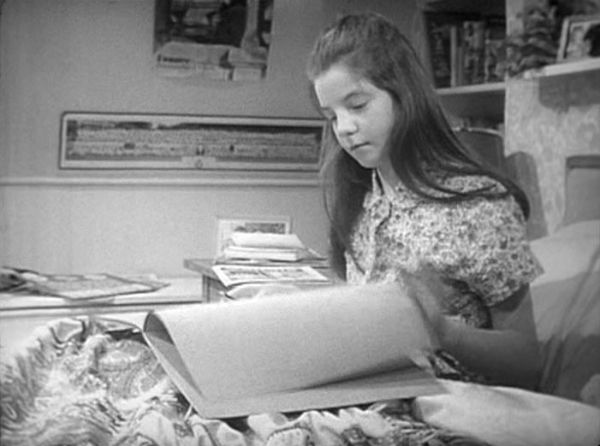
Vikki Chambers as Marianne in Escape into Night

Storr’s book has been adapted a few times. The author turned it into an opera libretto in 1999. In 1972 it was adapted for television as Escape into Night (made in colour, but only surviving in black & white). This six-part series stuck faithfully to the book — perhaps too faithfully, as the story of Marianne’s coming to understand the relationship between her drawings and the dream world inevitably leads to a lot of similar-seeming scenes, though perhaps I only feel this because I watched them back-to-back — but it also comes across as slightly darker, as, somehow, showing the bizarre one-eyed stones surrounding the house makes them that much creepier. My first encounter with the story, though, was in a very different form, the 1988 film Paperhouse.
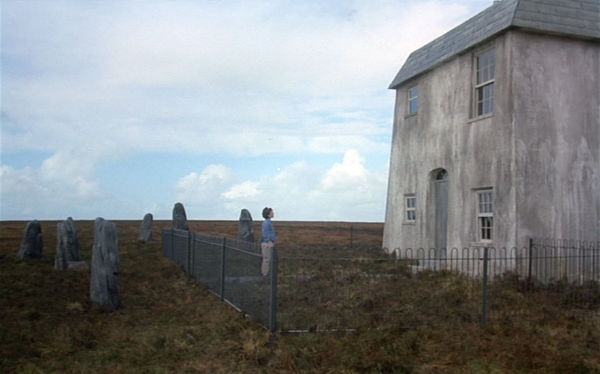
Charlotte Burke as Anna in Paperhouse

I can’t think of many children’s books which, when adapted, turn into films for adults — and I wonder if that was always the intent for Paperhouse (rated 15 in the UK), because, though it ups the scares of Catherine Storr’s novel, it doesn’t do the usual horror cliché of turning childhood itself into a scary world — there’s no tinkly toy piano music, or ghostly nursery rhymes echoing down empty corridors — so it’s still a story that’s for children rather than being about them. In fact, apart from the level of scares (always a difficult thing to judge), I think it would actually be a good film for young adolescents, as it’s very much about their experience — about the first tentative moves towards forging deeper emotional attachments away from mum & dad, and about the tug-of-war between growing up and remaining a child. (Now I come to think of it, the two main characters’ lingering in bed after their illnesses could well be a metaphor for lingering in a state of dependent childhood, putting off the first steps into independence and adulthood.)
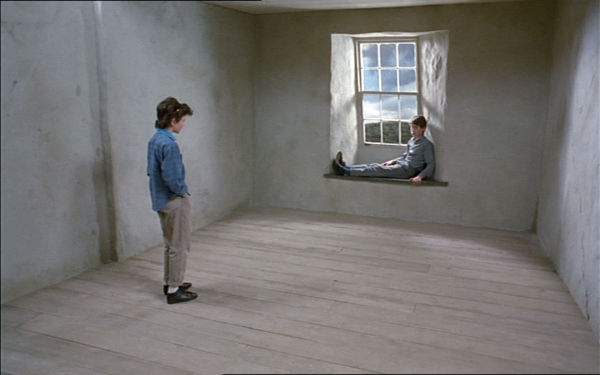
Anna and Marc (Elliott Spiers)

Marianne from Storr’s novel is now Anna, a girl very much on the verge of adolescence. One moment she’s bunking off school to try on makeup and ask her friend about snogging (“Like kissing a vacuum cleaner”), the next she’s playing hide-and-seek. In contrast to the book (where the mother is pretty much a cipher), in the film, Anna’s relationship with her mother is strained by some very teenage tantrums. The real transformation from novel to film, though, is the father. In the novel, though he’s living at home, the father is all but absent — he pops into the story only briefly, to do those things a standard father of the 1950s was expected to do, i.e., authorise a few key decisions and knock in a nail. In Escape into Night, his irrelevance to the plot is smoothed over by having him working abroad. In Paperhouse, not only is he working abroad, but Anna is torn between feeling abandoned by him and being grateful he’s not there because of how he scares her sometimes when he drinks. In the film’s dream world, the stones-with-eyes (“THEM”) central to the novel’s sense of threat are replaced by a blinded father figure wielding a hammer. (This, more than anything, must be what makes it a 15 certificate, the way it turns the threat into a very real, domestic one, rather than a generalised, fantasy version of anxiety.)
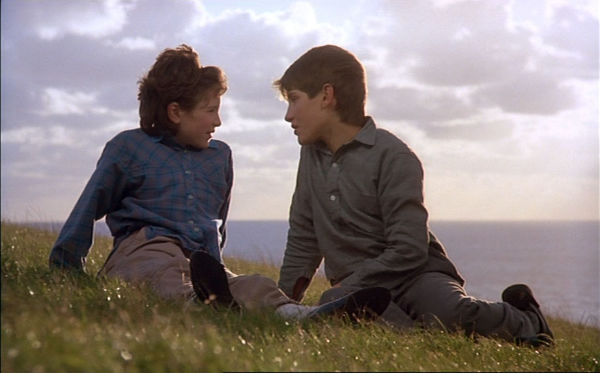
All this brings a muted aspect of the novel to the fore. Anna’s ambivalence about her father is an ambivalence about males in general. Sitting up in bed after a checkup from the doctor (here, a woman — Anna’s world, including teachers and friends, is almost entirely female), she says, “I don’t like boys,” then immediately adds one at the window of the house she’s drawing, as though her unconscious has other things to say on the matter. Far more powerful than the horror element of the film is the sense that Anna is learning to transfer the complex feelings she has for her father to a more fitting male figure of her own age. Paperhouse’s scares and dream world shocks can seem a bit over the top — as can Anna’s teenage histrionics, though “OTT” may well be the definition of teenage histrionics — but the film ends with a real sense of combined loss and gain, all because of how Anna has matured from a self-centred child to someone who can start to have fuller, more mature relationships.

Catherine Storr was, at the time she wrote Marianne Dreams, married to Anthony Storr, author of some of my favourite books about psychology — his The Dynamics of Creation (1972) and Solitude (1988) are both very readable and interesting delves into the complexities of two subjects Marianne Dreams also touches on: creativity (Marianne, in the novel, is not great at drawing, and her frustrations at how her lack of skill has a real effect on the dream world make up one of the novel’s strands), and the pleasures and pains of being alone.

^TOP

The Damned

There was more than radiation in the fallout from the first atomic bomb — there was an awful lot of science fiction, too, peaking in certain eras (the 1960s and 1980s) as though that cloud of glittery dust, lingering off the cultural coast, had been blown in again by adverse, probably cold, winds. I’d never heard of The Damned — a fittingly black & white little masterpiece from Hammer, released in 1963, though filmed two years earlier — till I happened upon it late, late one night when I couldn’t sleep (one of the best times to happen upon a film, particularly a black & white one), and I couldn’t believe I hadn’t heard of it before.

The sculptures in the film were created by Elisabeth Frink

Its approach to the science fictional core of its story is oblique — it’s a good half hour before there’s a hint of anything strange going on. Before that, it could be a slice-of-life seaside drama. It starts with a retired US insurance man, Simon Wells (played by Macdonald Carey, who I’ve only just realised played the good-guy cop in one of my favourite films, Hitchcock’s Shadow of a Doubt, two decades earlier), thinking he’s getting the come-on from local girl Joan (Shirley Anne Field), but in fact is being lured off the sea-front to get mugged by her gang-leader brother, King (Oliver Reed). The motorcycle gang, fingersnapping in black leathers, seem halfway between the danciness of West Side Story and the smartly-dressed nastiness of A Clockwork Orange: Reed’s character carries a brolly; it’s got a knife blade in the handle.

Meanwhile, further up the coast, freethinking Freya (Viveca Lindfors) has a remote, clifftop cottage where she makes some fractured-looking sculptures (glimpsed in the movie’s opening shots, they look uncomfortably like the victims of an atomic bomb blast), unsuspecting that the “public servant” Bernard who lives next-door (and who is, I think we’re supposed to infer from the way he leans familiarly on her bed, her lover, though they’re an odd match) is running a dangerously top-secret operation in a bunker beneath the cliff. The first glimpse we get of this operation is when Bernard turns on a TV link and starts talking to nine very British schoolchildren living in total isolation. When Joan and Simon, on the run from the possessive King, fall from the cliff to the sea below, they’re rescued by the children — who aren’t supposed to be able to get out, but have found a way. Starved of any interaction with other people (one of the boys believes their bunker is actually a spaceship, transporting them to another world), the kids are as excited by the hope this couple they’ve fished from the sea might be their parents, as they are to find they’re warm to the touch — the children themselves are ice-cold. When King arrives and touches one of the boys he backs off, scared, saying the children must be dead. In fact, the children are, in a way, the key to a new life — born out of a freak accident involving a strange kind of radiation, they may be able to survive in a post-bomb-drop future. The only thing is, they can’t live with us normal humans. Or, we can’t live with them. Not for long, anyway.

I love this slow-start approach, where the fantastic only begins to intrude once a real-seeming, recognisable world, and real-seeming characters, have had a chance to establish themselves. If only films like The Damned had been a success (neither Hammer, nor its distributor Columbia seemed to know what to do with it), we might have had more of them. Its bleakness is made all the more tragic by the way that, before the characters enter such a hopeless situation, they’ve been grappling with their own, more normal-worldly, versions of hopelessness already.

It’s a little odd that 1963 saw the release of another UK film featuring apocalyptic kids that had the word “damned” in the title: Children of the Damned, a sequel to the 1960 John Wyndham adaptation, Village of the Damned. (The Damned is also an adaptation, but the 1960 novel it was based on, Children of the Light by H L Lawrence, seems rather difficult to get hold of.) In the US, the film was retitled These are the Damned, but I think The Damned is a better title, as it leaves room for the question: who are the damned? Is it the kids isolated in their underground bunker, or is it us, aboveground, exposed to the constant nuclear threat?

^TOP

The Thing

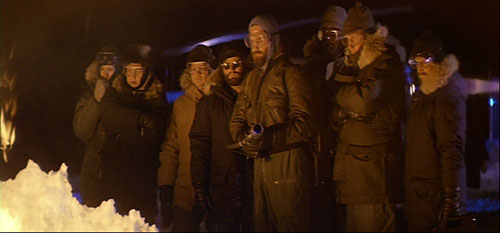
Who goes there? The Thing! Four of them, in fact.

Who Goes There by John W Campbell JrThe original novella that inspired the three film versions (1951, 1982 and 2011) was “Who Goes There?” by John W. Campbell Jr (published as by Don A. Stuart, in Astounding Science-Fiction, August 1938). It has one of the best origin stories of any piece of fiction. Campbell’s mother was one of a pair of identical twins, and apparently his aunt resented the fact that her sister had married first, and that she had a child. To make things worse, Campbell’s mother would deliberately goad her sister when she visited by doting on John Jr — and the aunt would be correspondingly cold. As Sam Moskowitz writes in Seekers of Tomorrow:

“This created a bizarre situation. The boy would come running into the house to impart something breathlessly to a woman he thought was his mother. He would be jarred by a curt rebuff from her twin. Each time his aunt visited the home, this situation posed itself until it became a continuing and insoluble nightmare. Was the woman standing in front of him friend or “foe”?”

Perhaps it all sounds a little too plausible — could young John Jr really not tell his aunt from his mother, if nothing else by their clothes or hair style? But other details about his home life perhaps add to an explanation for the atmosphere of claustrophobic mistrust found in “Who Goes There?” and its adaptations. John Jr’s father, apparently:

“…carried impersonality and theoretical objectivity in family matters to the brink of fetish. He almost never used the pronoun “I”. All statements were in the third person: “It is necessary,” “One must,” “It appears that,” “One should.” Not only was he an authoritarian in his own home but a self-righteous disciplinarian as well, who put obedience high on the list of filial duties. Affection was not in his make-up, and if he felt any for the boy he managed to repress it.”

And, even when the aunt wasn’t present:

“The mother’s changeability baffled and frustrated the youngster. Self-centred, flighty, moody, she was unpredictable from moment to moment. While she was not deliberately cruel, her gestures of warmth appeared to him so transitory and contrived as to be quickly discounted.”

The essence of “Who Goes There?” is an intellectual problem: caught in a remote Antarctic base with a hostile, shape-changing alien, how do you tell who’s an alien and who isn’t? But around this science-fictional core is a deeper question that comes more to the fore in the film versions: who can you trust?

Kinner shuddered violently. “Hey. Hey, Mac. Mac, would I know if I was a monster? Would I know if the monster had already got me? Oh, Lord, I may be a monster already.”

“You’d know,” McReady answered.

“But we wouldn’t.” Norris laughed shortly, half hysterically.

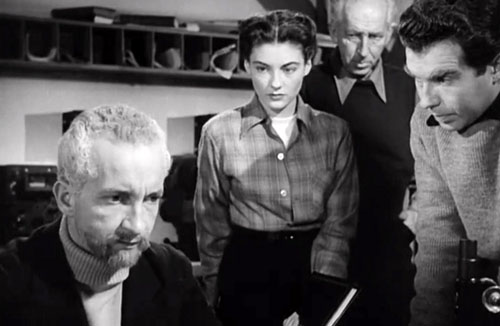
The Thing (1951) Dr Carrington

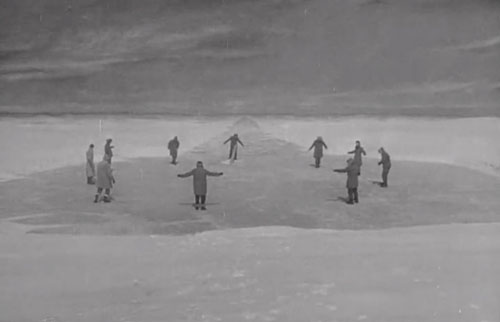
The first adaptation, The Thing From Another World, came out in 1951, and, despite being widely praised as a classic SF film of its era, is a world apart from the original novella. (Quite literally — it takes place at the North Pole rather than the South.) Here, the core of the story isn’t how-do-you-tell-who’s-an-alien, because this version’s creature isn’t a shape-changer. The Thing From Another World uses its alien to be what most 1950s Hollywood aliens were — something strange, something not-human, something plainly other, with not much need to go into why or to what degree. (1951 also saw the release of The Day The Earth Stood Still, so not all Hollywood aliens were evil.) This Thing is a Thing because it’s not an animal but a vegetable, a “super-carrot”, though one that scientist Dr Carrington claims will be so much more intelligent and (oddly) “wiser” than the humans. The real enemy in the film is Carrington himself, the obsessed scientist for whom “knowledge is more important than life.” This film’s answer to the question, “Who can you trust?” then, is: not the scientists, they invented the atom bomb. No, in Howard Hawks’ film the people you can trust are war-toughened men (and a woman who has proved she can drink harder than the toughest of the men). This was, after all, close enough to the end of WWII that the world was full of people who had proven themselves in the recent conflict, a world where even the reporter who comes to the North Pole base in search of a story can’t be entirely dismissed as a pencil-squeezing wuss, because he’s seen action, too (though he does faint at one point). The final message of the film is entirely outward-directed: “Watch the skies!” The enemy is out there, not in here. (Invasion of the Body Snatchers was a mere, but perhaps significant, five years away.) The film’s best moment — and its most cinematic — is when the party that’s gone out to examine a magnetic anomaly (which has only just appeared, rather than, as in the other versions, having been there for hundreds of thousands of years) spread out to determine the shape of what they find buried in the ice. Forming a circle, there’s no need to say anything other than: “We finally got one!” Flying saucers were enough part of the culture, they didn’t need to be named.

The Thing (1951) UFO

The best version of Campbell’s story, for me, is John Carpenter’s, from 1982. Its main innovation is to have the story occur as a sequel to the action that drove the initial novella: other people, in a nearby Norwegian camp, discovered, dug up, and defrosted the alien; our heroes just get caught up in the aftermath. Here we have no over-obsessed scientist types, only ordinary Joes trying to get by in a harsh world. In many of his films, Carpenter presents us with both a nihilistic, hostile world and a hard-bitten loner hero who’s the perfect answer to that world. The people in this Antarctic base are the most human of all four versions of The Thing — before the alien action even starts, they’re getting on each other’s nerves. McReady (the Kurt Russell character) is, for some reason, living in his own hut disconnected from the main base, but despite being a cynical loner, he’s the one everyone turns to when things get in a fix. (Even the base’s captain, Garry, whom nobody trusts with a weapon, feels the need to justify himself to McReady, showing that he, too, defers to the loner-hero.) This, then, is John Carpenter’s answer to “Who can you trust?”: hard-bitten loner-types. They’re the only sort that can deal with a world in which, any moment, one of your fellows might suddenly turn into a thing, all mouth and tentacles, that wants to digest and replace you. They’re hardened against such a nihilistic world, because they don’t believe in anything anymore.

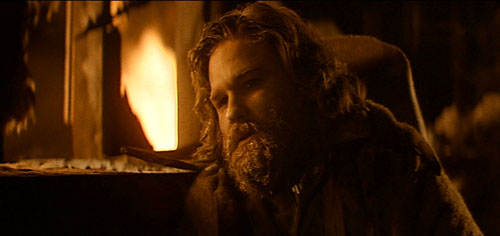
The Thing (1982) - McReady

The other key character — here, and in Campbell’s novella — is Blair. He’s the one who grasps the implications of the situation before anyone else. Realising an alien monster that can take human form will not only be impossible to find, but will, if it reaches human society, rapidly wipe out the human race, his response is twofold: one, he destroys the radios and means of escape, and two, he goes insane.

The Thing (1982) Blair

This, surprisingly, is straight from “Who Goes There?” One of the remarkable things about Campbell’s novella is just how modern it feels, especially compared to the sharply divided heroes and villains of the 1951 film. Campbell’s characters are — though glimpsed through very cut-back prose that focuses on speech and action, not feelings — edgy, nervous, and some of them go insane from the pressure. “Who Goes There?” contains the most shocking moment in all of four versions of The Thing, as far as I’m concerned: when Kenner, the cook, learns that the cows he milked only an hour ago were probably alien duplicates, he goes hysterical. Locked up in the kitchen, he bothers the others with his screaming and prayers so much that someone slips out and murders him. Not because they think he’s an alien, but because he’s getting on their nerves. That, as far as I’m concerned, is the most extreme picture of human beings under pressure in any of the four versions, but Campbell doesn’t dwell too much on the morality of this action — particularly as it turns out Kenner had been taken over anyway, so it wasn’t, technically, murder. (Campbell’s novella has a few jarring moments when the action is skipped over — to emphasise its suddenness — and we get nothing but the aftermath. It’s a hard-boiled style, one that leaves you to work out a lot of implications for yourself, and sometimes, either because of its style or the period it was written in, I found myself unsure of exactly what had happened and what was being implied.)

The Thing (2011)

The Thing from 2011 is presented as a prequel to the 1982 film, ending where Carpenter’s began, with two Norwegians in a helicopter chasing a dog through the snow. But in terms of the human situation, we take a bit of a step backwards to the 1951 film — before the alien lets loose, everyone on the base is being polite to each other, apart from one, the arrogant scientist. (And maybe one other — the lukewarm boyfriend-type who too quickly gives way to the arrogant scientist, his boss, rather than backing up the heroine.) Dr Halvorson says, “As scientists, we are obliged to study,” but he’s just impatient to get past everyone’s fine sensibilities about the fact that one of them has just been eaten by the Thing, so he can dissect it. When they open it up and find their colleague’s remains, he says, “It’s fascinating.” Then, defiantly: “It is fascinating.” It’s a good remake, but it lacks the deep-down, rough-edged tetchiness, claustrophobia and nihilism of Carpenter’s.

The Thing (1982)

The Thing, in its various incarnations, works as a story through the reaction the alien evokes in the humans faced with it — will they group together, or split apart? All four are most different in their endings. Campbell’s original novella has the scientists frustrated that, in ridding themselves of the alien, they’ve lost out on learning about its technology (it had just managed to build itself an anti-gravity flying device and a small, nuclear-powered generator), while thanking God it had crashed so far from human civilisation; the 1951 film ends with a reminder of who the real enemy is (“Watch the skies!”) with an implied, “And let’s keep tabs on those scientific-types, too”; the 1982 film is the most nihilistic, but also the most heroic, its two survivors, unsure if either of them is an alien, prepared to drink away their last living moments in a hostile, very much God-less world; the 2011 film, having added the least to the idea, has the least characteristic ending.

The Thing (1982) titles

Alien owes a lot to “Who Goes There?” (not least because Campbell’s story inspired A E Van Vogt to write SF, and his Voyage of the Space Beagle is sometimes cited as an influence on Alien), but also, more specifically, to The Thing From Another World: not only is Dr Carrington very much like the Company android Ash, in that he wants to save this creature that he admires far more than his human compatriots, but also in the way that a Geiger counter is used to detect the alien’s presence, just like the motion detectors in Alien and (far more) Aliens. Carpenter’s The Thing probably owes its existence to Alien’s success, though oddly it wasn’t a huge success itself. Still, to me, it’s the best of the “Who Goes There?” bunch, with John Campbell Jr’s novella a close second.

(And, as an alternative take on the story, there’s Escape Pod’s reading of Peter Watts’ “The Things” — the events of the 1982 film, from the alien’s point of view.)

^TOP