Something More Than Night by Kim Newman

The premise behind Kim Newman’s latest novel is that Raymond Chandler (RT to his friends) and William Pratt (better known as Boris Karloff, but Billy to his friends) not only knew one another — both came from English public schools, and lived near to one another for a while in Dulwich — but teamed up to fight often macabre, even supernatural, crime. And it’s narrated by Chandler, so it’s all done in that classic hardboiled style:

“In a mystery, Joh would be the hero. In life, as it now turned out, he was the corpse.”

The above-mentioned Joh Devlin is — or was — the third of their crime-fighting trio, an ex-cop-turned-private-eye whom Newman based loosely on Leslie T White, a real person the real Chandler used as the partial inspiration for his fictional private eye Philip Marlowe.

At the start of the novel, RT, Billy and Joh have already got a few cases behind them, including “the Mystery and Imagination Murders” and “the Ape Ricotte Abductions”, referred to, and occasionally hinted at, in the best “Giant Rat of Sumatra” style. Then things get serious when Joh Devlin turns up dead — shot in the head, seemingly by himself, while behind the wheel of a car that simultaneously drove off the end of a pier. Everyone immediately recognises it as straight from Chandler’s own fiction, it being an echo of a notoriously untied loose end (who killed the chauffeur?) from Chandler’s first novel, The Big Sleep. (Which, at the time of Newman’s novel, Chandler has only just had published. For most of the book, which largely takes place before Joh’s death, Chandler is only known to the world — if he’s known at all — as a writer for the pulps. Billy, meanwhile, though a star thanks to playing the monster in Frankenstein, is in something of a career dip, as horror movies have temporarily gone out of fashion.)

We then take a step back in time to the bizarre case which led to Joh being ousted from the police force, and his becoming a private eye. Junior Home, the son of an ultra-wealthy Hollywood magnate, has been found nearly dead after being fried alive by some sort of electrified metal cage-suit. Turning up at his mansion immediately afterwards, Joh finds a basement straight out of James Whale’s Frankenstein, complete with crackling generators and knife switches — with the added macabre detail of four bodies hanging from the wall, each encased in a similar cage-suit as Junior Home was fried in. Only, one of these bodies isn’t dead.

Joh gets thrown off the case — and the force — because this is the kind of investigation the corrupt LAPD wants in the hands of officers happy to take bribes. So Joh tells his pals RT and Billy, who decide to do some investigating of their own. Their first stop is the mysterious Lamia Munro Clinic where Junior Home is recovering. Or, it turns out, more than recovering. Because when they find him, he’s far from the frazzled little man he was when Joh last saw him. He is now, somehow, a giant with incredible strength, a super-fast healing ability and perhaps even telekinetic powers. His explanation:

“I decided I didn’t want to die. Not now, not ever; never.”

RT calls him “The world’s first self-made Übermensch”, and:

“As for moral constraints—he was third generation Hollywood money… qualm was bred out of him.”

There’s an excellent interview with Newman about this book at the Talking Scared podcast, where the interviewer points out how redolent the character of Junior Home is of a certain ex-president: a rich man-baby using the wealth he inherited to buy himself power he doesn’t deserve and will only misuse. Newman says it wasn’t a parallel he’d intended (he partly based the character on the Hollywood moguls of Chandler’s and Karloff’s day), and that he’s used such characters since he started writing — which is depressing as it means it’s a type that will no doubt recur, in real life, again and again.

But this isn’t a book about the takedown of a monstrous, over-powered tycoon, so much as it is an exploration of ideas about what drives creativity, and how it too often produces monsters.

“Monsters”, in this book, is an ambiguous term. Sometimes Newman uses it as a straightforward indicator of what is monstrous in humankind — the need for power, and its inevitable misuse — but in a more nuanced way, he sets the term “monster” against “villain”. The monsters of monster movies, though undeniably monstrous, are also often flawed creatures we can feel sympathy for, Frankenstein’s creature being a clear example. These monsters are monstrous because they’re different, and often have a sort of innocence about them. Monsters, RT writes, are often monsters because they’re afraid; villains, on the other hand, are villains because they don’t feel fear. Monsters are the misunderstood; villains are plain bad.

(We get a bizarre example of such villains in the second half of the book, as Junior Home sends out his peculiar bunch of henchmen to deal with the investigators. These henchmen double as the stars, stand-ins, and stuntmen of Home’s rip-off series of Marx Brothers-style comedies, the Sparx Brothers, and they like to do their killing in the style of slapstick jokes and silent comedy gags. Like dropping a safe on you.)

Raymond Chandler

Then there’s where creativity comes from. Newman has RT and Billy both driven by a sort of muse character, a woman or supernatural entity called Ariadne. She has turned up, as a real person, in their past adventures, and both know she’s fascinating and dangerous in equal measure. They glimpse her again during this case, and we never learn fully who or what she is, only that she’s a driving force behind some of the more daring, deep, and dangerous creative acts in history, both those of novelists like Chandler, and of mad scientists like the Dr Vaudois who runs the Lamia Munro Clinic. In this world, creativity is driven by something monstrous like Ariadne, and often produces monsters of the likes of the now-super-powered Junior Home, but only comes about because of the actions of human beings — human beings who are weak, and so can’t help being driven by the likes of Ariadne, and whose weaknesses can’t help being transformed into unbalanced, Frankenstein-like monstrosities in a seemingly endless cycle. As RT says:

They’d shot I don’t know how many Frankenstein pictures and still nobody learned the lesson of the story.

Don’t make Monsters. Just don’t.

It’s a densely-packed novel, both in terms of ideas and language — certainly, one of its joys is the way Newman pulls off the hardboiled Chandleresque tone. (“He contemplated the ingredients of a friend’s head. The puzzle had too many pieces missing ever to make a picture you’d want to look at.”) In his afterword, Newman says it’s a standalone novel, though some of the characters (including Ariadne) have apparently appeared in his other fiction — but I wonder if there won’t be more adventures featuring RT and Billy from Newman’s pen in the future.

^TOP

The Children of Light by H L Lawrence

I wrote about Hammer’s 1962 film The Damned back in 2014, and ended by saying that the novel it was based on, H L Lawrence’s The Children of Light (from 1960), was “rather difficult to get hold of”. I set up an AbeBooks want anyway, and seven and a half years later a copy popped up for only £10 — a little battered and page-stained, and with no dust-jacket, but at least it meant I could read it.

Having watched The Damned a fair few times since — it’s become one of my favourite films — what of course stood out on reading the novel were the differences between it and the film, so that’s what I’m going to concentrate on here (which means I’ll be going into plot spoilers for both book and film, so be warned). The basic premise of book and film, though, is the same: a man and woman, thrown together and on the run, stumble upon a secret government enclosure where a number of children are being raised in isolation, their only contact with adults being by TV screens. It turns out these children were born after their mothers were accidentally exposed to lethal doses of radiation, and are, as a result, highly resistant to its effects. Unfortunately, it also means they’re radioactive themselves, and anyone who spends time with them will sicken and die.

The novel kicks off with an immediate difference from the film. The protagonist of the The Damned, Simon Wells, is a holidaying American (imported for box office reasons, in much the same way Hammer did with Brian Donlevy in The Quatermass Xperiment); in The Children of Light, he’s an Englishman, Simon Largwell, and has just murdered his wife. Actually, we later learn (once the author has allowed us to sit with that shock for a moment), it’s not murder but manslaughter, as what really happened was she tried to stab him with a pair of scissors when he discovered her with another man, and in the struggle he accidentally stabbed her. Nevertheless, he runs from the scene, leaving her alive long enough to tell the police it was her husband who did this to her. From this moment, Largwell is on the run. And, as he admits, he’s not very good at it. He heads for the coast, “borrows” a friend’s (very identifiable) car, then has the misfortune to run into a gang of criminal youths, who steal the car and his money, and beat him up pretty thoroughly before deciding that, as he’s a wanted man and is going to hang, they might as well have some fun and see what it looks like when a man is hanged. These, then, are no stylishly strutting youths as in the film, but a bunch of utterly psychopathic criminals with no redeeming features. Whereas in the film their leader (Oliver Reed) is called King, in the book his name is Caesar (the gang, unlikely as it sounds, call themselves the Borgias, and have taken names from characters in Shakespeare). Caesar is nothing but an ultra-violent thug. Joan, the gang-member who goes on the run with Simon, is King’s sister in the film, and King’s slightly incestuous possessiveness of her is what makes him pursue her all the way into the children’s domain; in the book, Joan is Caesar’s half-sister, but the only reason he wants her back when she makes off with Simon is she knows enough to see him hang, and he’d rather she were dead than in the hands of the police.

1962 PB edition

Simon and Joan, on the run, happen upon a War Department enclosure and, despite the fact it says it’s a minefield, go in. Unlike the film, it’s not on the coast, though they do end up falling down a cliff — in this case, not to a beach but an artificial pit-like area in the middle of the countryside where the children are kept. Here, just as in the book, the adults are found and taken in by the children. (Simon has broken his arm in the fall. One of the children, already an expert doctor, gives him an advanced healing drug that will bind the bone in days rather than weeks.)

Unlike the children of the film, though, these kids aren’t cold to the touch. But it’s possible that idea came from a scene in the book where they first meet Simon and Joan. One child touches Joan’s arm and says:

“She’s warm!—she’s warm! She’s not cold. I said she’d be warm!”

And another child, Sylvia, says:

“That’s very rude. Besides, I told you they were warm, and just like us.”

So, it’s just that the children, bereft of adult contact (except, perhaps, with men in radiation suits), have simply got into believing adults might be cold. (More, perhaps, from the lack of emotional warmth they’ve experienced than anything else. This is one of the novel’s few insightful moments into what life must be like for these poor children.) Unlike the film, the kids don’t believe they’re in a spaceship bound for another planet. We don’t really know they’ve been told anything. But their education is at once highly practical (there are tractors and other agricultural equipment in their stores), highly scientific (these 10-year-olds can quote the radiation resistance of various micro-organisms from memory), and highly impractical (they’re taught ballet and interior décor) — that is, impractical considering these fourteen children are expected to be the lone survivors of the human race, and painting their future homes in coordinating colours is likely to be one of the last things they’ll need to know.

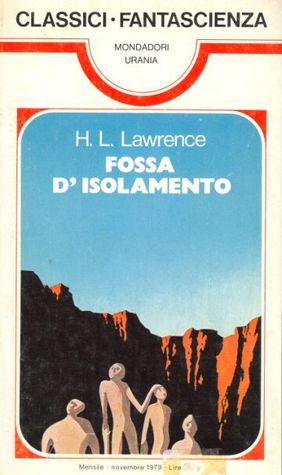
1962 Italian translation. The title means something like The Isolation Pit.

Which leads to another key difference with the film. In The Damned, these children are an insurance policy against the assumed inevitable end of the world through nuclear war. They alone will survive the high levels of post-war radiation. In The Children of Light, Lawrence has his characters dismiss the idea there’s ever going to be a nuclear war, but it turns out the children are needed for a different reason. The amount of radiation released into the atmosphere already, simply through testing bigger and bigger H-bombs, has resulted in the gradual sterilisation of humankind. This has affected people living in mountain areas first of all, but has started to trickle down to lower elevations. It’s only just beginning to be noticed by the press, and is going to result, sometime or other — or so the authorities believe — in a mass panic. And this is the reason they have to keep the children secret: if a foreign power learned of them, it would want a say in the their upbringing. As it is, the British want a monopoly on this hope for the future, and are intent on equipping these children to found an ideal (to their thinking) civilisation after the current one collapses. Johnny Parks, a reporter, comes across an example of what the children are being taught in an essay in one of their exercise books:

“We (he read) will be known as The Race. In our minds and hearts we shall carry all the knowledge and wisdom of the Past. We shall create in an empty world the people of the future, free from racial pride, free from the Babylon of speech confusion, free from the terrifying superstitions of the past so-called religions, free, for the first time in human history, to form a society of healthy, intelligent Beings; we shall have the knowledge of every science, from the beginning; knowledge will be all we shall have; but as we shall increase in numbers, we shall be able to use our knowledge and once again force Nature to provide us with all we need. Mankind, the Old People, are doomed to perish at the dawn of the Space Age. We shall begin, in a few generations, where they finished. But this time we shall begin as One People, The Race, with neither false pride nor false illusions to frustrate us.”

(To which Johnny thinks: “My God—what a hunk of drivel… What the hell is this—a school for scientific political nuts?” … And need I add that, unlike the film, in the book all the children are platinum blond? It’s The Midwich Cuckoos again, only through radioactive disaster rather than alien invasion.)

(…And another point about the children in the book. We’re given all their names, and the first thing you notice is that the boys have surnames, but the girls don’t. Presumably their governmental “parents” decided there was no point giving the girls surnames as they’d only lose them when they grew up and got married. The other thing is that most of the boys have thoroughly normal-for-the-day English-sounding names — James Robinson, Albert Jones, Henry King — but one is called George Orwell!)

1979 Italian PB

Johnny Parks is another difference between the novel and the film. Whereas in the film King follows Joan and Simon into the children’s domain out of a need to get his sister back (and retain control of her), in the book Caesar contacts a local reporter, Johnny, to get him to find out if Joan is alive or dead. Because, some time after Simon and Joan enter the War Department enclosure, an explosion is heard and body parts are found, which are claimed to be the couple, who are then officially declared dead. But Caesar knows different. The remains were supposedly identified thanks to a silver cigarette lighter belonging to Simon Largwell, but Caesar knows Simon didn’t have that lighter on him, because he personally stole all of Simon’s possessions of any value. So, their death is a cover-up. Obviously, Caesar can’t go to the police with this; and anyway he just wants to be sure Joan really is dead, so as not to have to worry about her telling the police about his crimes. Johnny is intrigued by the air of government secrets and gets into the enclosure. There, he meets Simon and Joan and the kids, and arranges an escape. It’s meant to be just the three adults escaping, but one of the kids, Sylvia, tags along, desperate to see something of the outside world. They start to head back to London, where Johnny is going to give the story to a national newspaper. In the film, the characters escape but don’t get far before being captured, and by that point we know they’re dying of radiation poisoning anyway. In the book, about the final quarter is taken up with the characters’ attempts to reach London and get the story out, while the secret government organisation in charge of the kids attempts to silence them.

What’s also interesting is what’s in the film but not the book. One of the things I like about The Damned is that, as well as its Wyndhamesque science fiction elements, it has a lot of character moments extraneous to the plot. The book, being much more of a breathless thriller, has far fewer of these, meaning the film feels more novelistic than the book. The clearest example of this is the character of the sculptress, Freya Neilson, who is completely absent from the book. In The Children of Light, Bernard (who’s in charge of Project Mannekin, as the operation to raise the children is called) is nothing but a government official, driven entirely by the need to protect the children and the single hope for the future they represent. (He refers to himself and his fellows on the project as “custodians of our human heritage”.) In the film, he’s humanised by being in a relationship with the artistic Freya (though ultimately proves to be equally singleminded as the novel’s version).

Overall, I think the film makes improvements on the novel, sometimes in big ways (bringing in the character of Freya), sometimes in small ways (the fact that the children in the film have all selected pictures from books which they pretend are of their parents), all of which add a depth of character that’s mostly absent from the book. Johnny Parks, the reporter, is the one character I miss from the book, but it’s easy to see why he was dropped (to allow more screen-time for Oliver Reed). If nothing else, the book — like all thrillers, I expect — is a good gauge of what your average person in early 1960s Britain might have been worried about: the dangers of nuclear weapons, the scariness of violent youth gangs, and perhaps a growing suspicion the government were up to something secret and had the power to keep it covered up.

The author’s full name was Henry Lionel Lawrence. He was born in 1908 in Lambeth (and baptised Catholic), and died in Colchester in 1990. His parents were music hall artists, meaning young Henry and his siblings spent a lot of time moving about. He was educated in the north of England, and had some short stories published in his early twenties. (I’ve only been able to find one, which was subsequently anthologised, “A Journey by Train”, about an encounter with a man who was dead for four days before being revived, and is now overcome by occasional murderous urges.) Lawrence worked as an advertising copywriter. He moved to Australia for a while, then Ceylon, but was back in Britain in time to join the RAF during World War II (when he served as a photographer with a Bomber Command Pathfinder unit). He was married, and had a daughter by the time of his first novel, at which point he was “a Senior Copywriter in a well-known London Agency” (according to the jacket blurb of Children of Light). His second novel, another thriller, The Spartan Medal, came out in 1961, and he seems to have published no more after that, though a 1979 biographical snippet lists him as being a member of the Crime Writers Association, PEN, and the Television and Screen Writers Guild.

^TOP

The Wyndcliffe by Louise Lawrence

cover art by Anthony Maitland

I came across this book while looking for art by Anthony Maitland (having seen his cover for John Gordon’s Giant Under the Snow and wanting more). Louise Lawrence was the pen-name of Elizabeth Holden (1943–2013), and this was her third novel, published in the UK in 1974. (It came out in the US in hardback in 1975, but doesn’t seem to have got a paperback edition in either country.)

It opens with the Hennessey family buying a house in a remote spot near the village of Oakers Mesne. Hollies Place, as the house is known, stands atop the Wyndcliffe, an escarpment overlooking the River Wye. As well as Mr and Mrs Hennessey, the family comprises Simon, 22, who’s studying at the Royal Academy of Music; Ruth, 17, who at first thinks moving to so remote a part of the country will leave her cut off from the world, but soon finds that being from London makes her somewhat glamorous and interesting at her new school and it’s not long before she’s set up with a boyfriend with a motorbike; and Anna, 15, who is lonely at the beginning, and remains lonely as she fails to click with her new classmates.

The contrast between Ruth and Anna is set up from the start:

“Only eighteen months divided Ruth and Anna in time, but Anna seemed so much younger, still a little girl who showed no sign of growing up. Anna at fifteen was very different from Ruth at fifteen, and Ruth at seventeen had left Anna far behind.”

Ruth is destined to fit in, while Anna seems bound for the opposite:

“Ruth had always said she [Anna] wasn’t normal and now Anna knew what she meant. Anna didn’t care about pop singers, and Georgie Best, and eyeshadow, and what her hair ought to look like, and what she ought to wear. But worst of all Anna had never had a boyfriend. There was something wrong with her and they all knew.”

But Anna soon finds a friend. John Hollis is a poet and lover of the natural landscape that surrounds the Wyndcliffe, and he’s 22 years old — but he’s been 22 for nearly a century and a half, as he died in 1823. (Lawrence dedicates the novel to Keats, who is presumably the inspiration for Hollis.) Though both dead and insubstantial, Hollis can be seen and heard by Anna; what’s more, Anna can feel his sensations and emotions, and comes to see the natural world around her in an entirely new way thanks to his presence:

“Perfect. Everything was so perfect. Each feathered grass, slender, delicate, separate and perfect. She was afraid to touch them for fear they’d break. Every frond of bracken, intricate, tinted, perfect. Spiders’ webs, filigree strands, complex, woven, perfect. Everything sprang at her, alive, vibrant with colour. It was as if she became part of the sunlight, insubstantial, intangible, slipping through pink flower petals that brushed her face, smooth, china-smooth, strong and cold…”

If this novel is a kind of supernatural teen romance, it’s clear from the language it’s not a romance between Anna and John Hollis so much as it is between Anna and the landscape, which takes her up and caresses her with its poetry:

“She was helpless in the booming wind. It clutched her with hollow hands as it beat on the percussion sky. It touched her with gentle fingers that played the harpstring trees. She was drowning in the sky full of sounds. Sinking and there was nothing to hold. She reached out for the moving wings, the drifting leaves, the propeller parachutes of white whirling seeds but everything eluded her. She was left to sink. But her falling brought no fear, only a thrill for she was buoyant and the wind always held her.”

Where Anna was lonely before, she comes to learn to appreciate solitude — that is, the solitude of being with John and the countryside that surrounds the Wyndcliffe:

“Solitude and loneliness, John had told her they were different. Once she’d been lonely, she’d had no one and she’d found it terrible to be alone. But now she chose it and was glad.”

back cover detail from the UK HB, art by Anthony Maitland

The Wyndcliffe started by reminding me of other YA novels in which the (often lonely or troubled) protagonist’s coming of age is achieved through contact with a supernatural entity, as in John Wyndham’s Chocky, or William Rayner’s Stag Boy. But whereas Chocky is being told through the sceptical father’s eyes, and he can never be sure, till the final chapter, that Chocky’s not just an imaginary friend, so for most it the whole thing’s treated with a sort of parental indulgence, the second half of Wyndcliffe is all about the very serious struggle to wrest Anna from her relationship with Hollis.

US HB. Art by Stephen Bommell (if I’m reading the signature correctly)

But it’s not her parents who do the wresting. Mr and Mrs Hennessey don’t stay around long enough to establish themselves as characters. Mr H has to go on a month-long-plus business trip to the States, and Mrs H goes with him, leaving Anna and Ruth alone in a new house. Ruth starts to suspect Anna has a boyfriend and follows her to find out who it is, but only sees her sister wandering the countryside talking to herself. When she hears Anna calling out John Hollis’s name, she asks around and though what she hears is clearly folklore, it’s evident this John Hollis is dead. There’s tales of “Mad Edie” who also walked about talking to him, and a story that, because he took the stone to build Hollies Place from the Wyndcliffe, he’s been cursed to haunt that location till he’s driven enough suicides over the cliff’s edge to repay each pound of stone with a pound of flesh. Ruth at first doesn’t believe it, but she can see it’s driving Anna to spend too long in the foul weather, making her ill. She calls Simon back home, and suddenly the pair are like stand-in parents — though far from ideal ones. Simon is condescending, still treating Anna like a little sister half her age and threatening to smack her if she doesn’t simply obey him; Ruth is indifferent and at times doesn’t seem to care if Anna is determined to self-destruct.

But both come to accept, to some degree, that Hollis is real. Both even talk to him, despite not seeing or hearing him: Simon to castigate him for preying on someone who’s still just a girl, Ruth to tell him to face up to reality — the reality being that he’s dead, and ought to act that way.

from the spine of the UK HB, art by Anthony Maitland

There are moments when the book teeters on the edge of Owl Service territory, with Ruth unintentionally taking on the appearance and manner of Sorrel Lancet, the girl who Hollis originally fell in love with, and who his attempts to please led to his early death. Is there to be a replaying of past tragedies? But ultimately, John Hollis is not the implacable force that haunts Garner’s Welsh valley, and Anna, by the end, achieves a new depth and maturity, though on her own terms. She doesn’t give in to Simon and Ruth’s demands she behave and fit in, but neither does she become wholly unworldly like Mad Edie. She hardens, but only to the extent of accepting that life for someone as sensitive and imaginative as she is will likely be tough, and not to the extent of giving up on being who she truly is.

Lawrence wrote a sequel, Sing and Scatter Daisies, published in 1977, but it’s pretty hard to find at a reasonable price, so it might be a while before I read it (if I ever get to). Instead, I think I’ll try some of her other books. She clearly has a way with language — she’s brave enough to give us a full poem from Hollis at one point, and it doesn’t fail to convince — plus a sensitivity for the solitudinous, imaginative type of soul that used to so populate 1970s YA.

^TOP