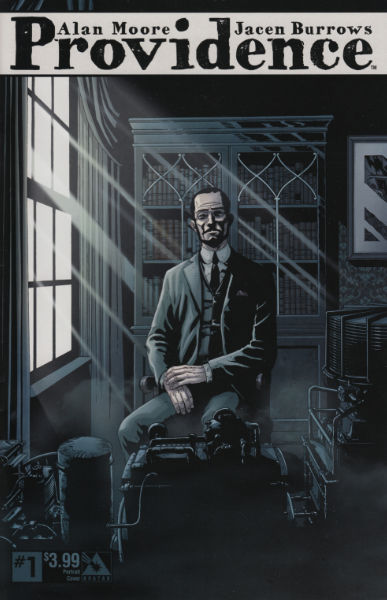
Providence by Alan Moore

Providence issue 1, art by Jacen Burrows

Halfway through the run of Alan Moore and Jacen Burrows’s 12-issue comic, Providence, I re-read all of Lovecraft’s stories (as well as S T Joshi’s monumental Lovecraft biography, I Am Providence), and suddenly the comic made a lot more sense. It’s not that Moore makes a lot of references to Lovecraft’s work — being pretty familiar with Lovecraft, I’m confident I’ll get most broad-brush references to his stories — it’s that the interplay between Providence and Lovecraft’s work (and life) can be quite subtle, and the deeper you can go into those subtleties, the more connections you can spot, and the more you’ll get out of the series. (The annotations at Facts in the Case of Alan Moore’s Providence helped a lot, too.)

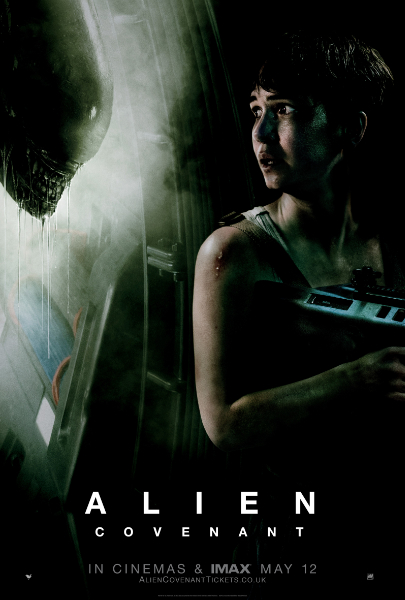
Now I’m going to completely eat my own words about something I went into only a few Mewsings ago. Talking about Alien: Covenant, I said how prequels, particularly those that delve into a series’ background mythology, are pretty much doomed to failure, unless, like Star Wars: Rogue One, they do their best to keep their entanglements with the further reaches of the mythology as minimal as possible. Well, Providence is a prequel to Moore’s two other Lovecraftian comics — The Courtyard and Neonomicon — and it wallows in mythology (mostly Lovecraft’s, but at the end you need to know Moore’s, too). Not only that, but it attempts to make all of Lovecraft’s ramshackle mythology tie up, and — ye Eldritch Gods! — it even tries to explain it all.
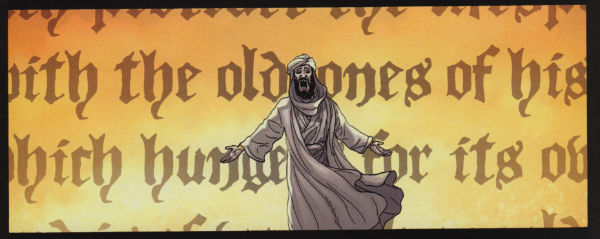
art by Jacen Burrows

But, it works.

Perhaps it works because this twelve-issue series isn’t also trying to be a cinema-audience-pleasing ninety minute thrill-ride at the same time, but can take its time to tell the story as it needs to be told. Considering this is a horror comic, very little happens in the first few issues — unless, that is, you’re busy making Lovecraftian connections, in which case the implications will be building. But also, of course, this is Alan Moore, and Moore is particularly good at not only sorting out other people’s narrative tangles, but at adding his own — often awe-inspiring — sense for them to make.

In fact, I’d say Moore is energised by a creative challenge, and the bigger and more impossible-seeming, the better. He stated his aim for Providence in a 2015 article on Previews World:

“…Providence is an attempt to marry Lovecraft’s history with a mosaic of his fictions, setting the man and his monsters in a persuasively real America during the pivotal year of 1919: before Prohibition and Weird Tales, before Votes for Women or the marriage to Sonia, before the Boston Police Strike and Cthulhu. This is a story of the birth of modern America, and the birth of modern American terror.”

The comic follows Robert Black, a reporter from New York who, upon the suicide of his lover (in a suicide booth — this is a slightly different world to ours, in this case owing a little to Chambers’ King in Yellow), leaves his job to pursue his dream (“some day, if Providence allows”) of writing a novel. Scholarly, nervous, and by no means an action hero, Black is the typical Lovecraft protagonist — in all but being both Jewish and gay. Intrigued by the mention of a translated Arab alchemical text that made its way to the US, Black begins tracking down the various individuals and occult groups who have made use of it in their beliefs.
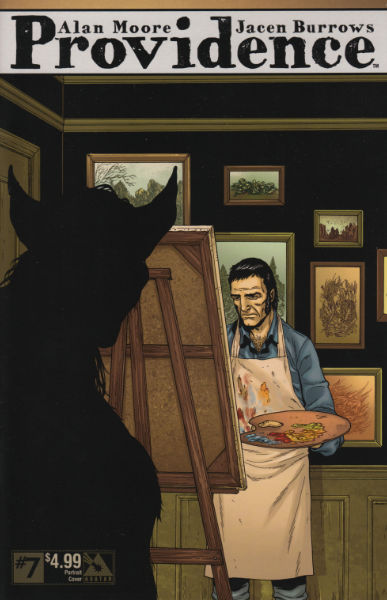
Providence 7, art by Jacen Burrows

These individuals and groups are Moore’s renamed versions of Lovecraft characters, and the main fun of the first half of Providence is in tying up Moore’s characters with Lovecraft’s, and seeing what twist Moore has put on them. Usually, the effect is to emphasise the historical and social context in which their stories are being told, and to — at first at least — make us feel that perhaps Lovecraft’s presentation of them as figures of horror is a misunderstanding because of their status as social, racial, religious, or sexual outsiders. Because of this, Black doesn’t even start to glimpse the implications of what they’re saying (Moore’s dialogue has a wonderful way of playing with double meanings), and I, as a reader, started to feel that perhaps the whole point of Providence was to redeem Lovecraft’s secretive, evil-intentioned cultists from any horrific interpretation at all.

The first character Black meets, for instance, is a Doctor Alvarez, Moore’s version of Lovecraft’s Dr. Muñoz, from “Cool Air”. Like Lovecraft’s Muñoz, Alvarez is seeking to preserve his life beyond the natural point of death, which requires him to live in a controlled, artificially cold environment. He doesn’t hide that he’s doing this, but neither does he state it outright:

“For myself, I must not complain. Here, for a time, I can be comfortable… Life does not trouble me.”

It’s as though Alvarez might be quite willing to admit the truth about what he’s doing, if only Black were to ask the right question. But Black never does, because — who would? Who would suspect that the quiet-voiced, well-mannered Alvarez is actually a walking corpse, preserved by ammonia and low temperatures? Also unlike Lovecraft’s character, Alvarez is fully human, even compassionate, as revealed in a very un-Lovecraftian line:

“…to not love is to waste the existence. Even life is a small matter beside it.”

But there is a real horror, and Black’s journey takes him right to the heart of it. The Arab alchemical text, the Kitab Al Hikmah Al Najmiyya, includes a prophecy of two figures, a Herald and a Redeemer, who are to bring about the end of our world — or its transformation. Moore’s refusal to provide a Lovecraftian moral judgement of his characters extends to a refusal to judge the coming transformation.

So, you start by thinking this Dr Alvarez is, in fact, a pretty nice chap; then that those Innsmouth folk are maybe odd-looking but they’re just folk from a different culture; then that Garland Wheatley (Moore’s version of Wizard Whateley from “The Dunwich Horror”) is, well, dangerously backward, perhaps best left alone, but not a world-shattering evil… Then you find yourself at issue 6, the halfway point, where it is, finally, made clear to Black that he is in the midst of something really bad, and in deep, and it’s way too late to do anything about it.
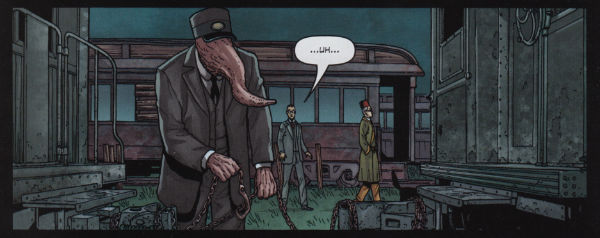
art by Jacen Burrows
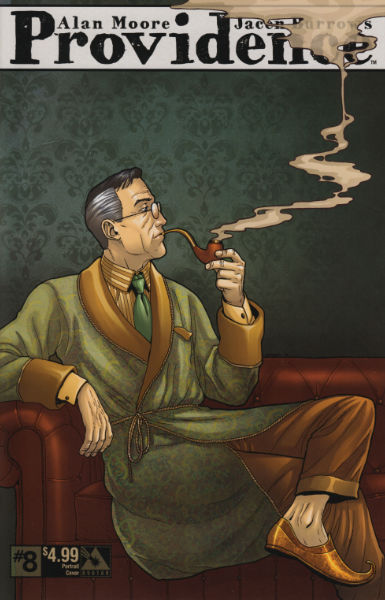
Randall Carver, art by Jacen Burrows

The ideas Moore presents undergo a similar shift. At first, it seems as though he’s presenting Lovecraft’s horrors and his dream-world stories as evidence of a real but separate dream-reality, which brushes up against our world and which can even be accessed by dreamers such as Randall Carver (Moore’s version of Lovecraft’s Randolph Carter, which confusingly is also Lovecraft’s fictional version of Lovecraft himself, which makes it triply strange when Moore presents us with his versions of Carver and Lovecraft living in the same town). Black has a few such brushes, but initially dismisses them as hallucinations. His issue 6 experience, though, is too deeply traumatic to be dismissed even if it can be thought of as a hallucination, and it sets the tone for an increasing bleakness throughout the second half of the series, which on a first read left me with as much a feeling of nihilism as Ridley Scott’s Prometheus did on a first viewing. There’s a real sense, in the closing issues of Providence, just how little human life and our illusions of free will matter in the face of the coming transformation:

“We are words on papyrus, a thousand years ago.”

In its final issues, Providence is at times quite moving — issue 11, for instance with its rapid skim through the history of Lovecraft, his circle, and his growing impact on culture — but, at the end, it’s also terribly bleak. Robert Black turns out to be yet another Moore version of a Lovecraft character, so you know he can’t come to a good end, but in its final issue, Providence brings in characters from The Courtyard and Neonomicon (which I also found horrendously bleak, after its protagonist underwent a similarly horrific and traumatic experience as Robert Black does) and resolves the whole three-title series.
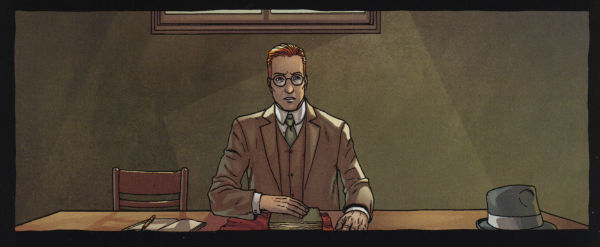
Robert Black, art by Jacen Burrows

Most of the issues of Providence included a lengthy text extract from Black’s diary, and I have to admit that, on my re-read of the series, I skipped these. In part because, although they provided Black’s innocent interpretation of the events in the comic part of the story, they didn’t really add much, as it was pretty easy to guess what Black thought was going on anyway. But also I skipped them because they were pages and pages of single-column, long-paragraph, small-size handwritten text and were just plain difficult to read. Aside from the wonderfully punnish extracts from an Innsmouth parish newsletter in issue 3, I really don’t think I missed much by skipping them.

It’s an excellent series, if bleak, though one I think you really need to know your Lovecraft to get the most out of. As such, it might not have wide appeal, but I’d certainly rank it with the best of Moore’s work, and Jacen Burrows is to be applauded for the amount of work he’s put into realising so many historically accurate locations and Lovecraftian characters, as well as providing some neat visualisations of sometimes transdimensional concepts.
^TOP

Alien: Covenant

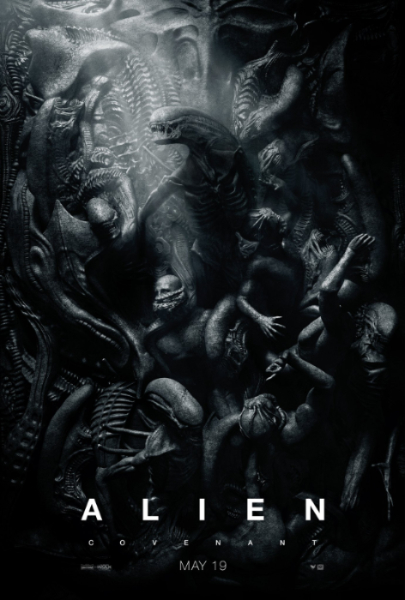
Alien: Covenant posterOne of the things that makes the original Alien so effective is how lean and sleek it is, plot-wise — what you might call its structural perfection. You can’t help but admire its purity. It’s a survivor, unclouded by conscience, remorse, or delusions of morality…

The original film’s one allusion to a backstory or mythology, the Space Jockey scene, is so brief yet mind-blowing that all it does is hint at what a vast, scary, and utterly unknowable Lovecraftian universe there is behind the xenomorph’s existence. It’s as if, with the Space Jockey scene, the film is saying, “All this stuff with one killer alien is merely scratching the surface of the horrors that are out there.”

Aliens knew what it was doing when it left any question of mythology alone. Like a need-to-know-only military briefing, it stuck to the xenomorph, and the xenomorph only. Anything beyond that was unnecessary to its story. Prometheus changed all that, but Prometheus was trying to be a different sort of film altogether, only tangentially related to the Alien franchise. That wasn’t what audiences wanted, though, so now, instead of a Prometheus sequel, we have Alien: Covenant, a DNA-fused hybrid that promises a return to the Alien franchise proper, but that also wants to keep things going on the Prometheus front. We know the xenomorph is endlessly adaptable, but I can’t help thinking of that pathetic human/xenomorph thing at the end of Alien: Resurrection, that seemed, to me, more unintentionally comic than evolutionarily impressive.

(And why ‘Covenant’? Aside from it being the name of the ship carrying human colonists to the distant planet Origae-6, there doesn’t seem to be any actual covenant involved.)

Alien: Covenant posterI enjoyed Alien: Covenant, but only in a so-so way. I think the trouble with it is that, by this time, the series has picked up so many story elements it feels the need to give the nod to, none of them can get the attention they deserve. There’s the xenomorphs; there’s the Engineers; there’s the synthetics; there’s David (from Prometheus) in particular; there’s the Weyland-Yutani Corporation; there’s its ageing founder… And somewhere amongst all that, there’s the new characters who must be introduced in each film, if only to give them some sort of story before they’re infected, impregnated, punctured, dissolved, burned, torn apart, experimented on, or whatever other gruesome fate awaits them. In a need to be both a prequel to Alien and a sequel to Prometheus, Alien: Covenant spends all its narrative energy running around ticking boxes, doing its best to add its own particular twists (yet more variations on the xenomorph and its ever-mutating gestation cycle, yet more new ways for characters to die), trying to at least hint it’s going to connect with the original film in a meaningful way, while all the time trying to provide some justification for its existence as a film in its own right.

All the scenes that made Alien and Aliens so great get stuffed into Alien: Covenant and hastily run through, but with none of the necessary build-up in character and tension that made them work in the first place. Who is that getting torn apart by the latest variety of xenomorph (a pale, fleshy creature more than a little resembling Pan’s Labyrinth’s eyeless Pale Man)? I don’t know. Which means I don’t care.

Michael Fassbender as David in PrometheusWhere Alien: Covenant does get to create some sort of unique identity as a film, it actually starts to work. The one thing it’s got going for it is the fact that it has two superficially identical synthetics, David and Walter, both played by Michael Fassbender (who is, I suppose, the prequel series’s Ripley, though an anti-Ripley). This is a new situation for the Alien films, and Alien: Covenant manages to do something with it. The trouble is, it only gets round to doing it in the last few minutes, once the film has finished dealing with all the other Alien/Aliens/Prometheus stuff it feels so contracted to deal with. (Perhaps that’s the covenant in Alien: Covenant? A contract between Ridley Scott and his audience who, he seems to feel, need, not a sleek, tense, killer of a film, but a series of ticks against an ever-increasing list of must-have scenes, twists, and backstory updates, however shoehorned-in.)

Prometheus left me reeling at how nihilistic it was. Alien: Covenant never gets round to making any sort of equivalent statement. And I think this is the curse of backstory, or mythology, or whatever you call it, generally. Backstory works as backstory, not as the main plot of a movie. That’s why the Star Wars prequels could never be as good as the originals. It’s great to have, in the original Star Wars trilogy, references to what went on before — the Clone Wars, the Old Republic, and so on — because those throwaway references gave the story-world a bit more dimension, and uncovering hidden past events and family secrets added some counterpoint to the main action of the plot. When Darth Vader said he was Luke’s father, it was a great, though crude, shock moment. But it certainly wasn’t the justification for three new films. (The Harry Potter books/films did it better, in terms of interweaving discovery of past events with present-time plot advancement.)

Star Wars Rogue One posterI really enjoyed Star Wars: Rogue One, and a good deal of that came from its being so free of the tangles of established backstory — certainly, of the ponderous, melodramatic, Gothic weight of the ‘Saga’ of the (let’s face it, majorly dysfunctional) Skywalker clan. Granted, Rogue One took as its kick-off point a detail from the original story — Rebel spies stealing the Death Star plans — but that, and its being set in the recognisable Star Wars universe, was all it took. And all it needed.

Alien: Covenant doesn’t actually add much to the Prometheus mythology, which makes it all the more annoying how weighed down it is by including so much of it. I don’t think it’s going to happen, but what I think the Alien series needs is to jettison this dead weight of trying to build a mythology, and get back to being the sleek, simple but mind-blowing killer beast it used to be, with only the occasional between-the-fingers glimpse of a wider, even more terrifying, cosmic reality behind it all.

^TOP

English Gothic by Jonathan Rigby

At the end of this exhaustive (and occasionally exhausting) film-by-film history of English horror cinema, Jonathan Rigby quotes Anne Billson on the special place Gothic has for the English:

‘Horror thrives best when emotions are bottled up, and no one bottles them up quite like us.’

I’m not sure this is true of all horror. I’d say the US horror films, like Night of the Living Dead, The Texas Chainsaw Massacre, Rosemary’s Baby and The Exorcist, which put an end to the 20th century’s main British horror boom, are more about political than emotional repression — when they’re not simply about pure, primal terror, that is. Certainly, they don’t work in that stiff-upper lip way Hammer’s fairy-tale Gothics do. Perhaps that’s why the term ‘Gothic’ seems so much more appropriate to English horror cinema. (Though Rigby has also written books on European Gothic and American Gothic.)

Although Rigby mentions a welter of early horror films in his first chapter (covering 1897 to 1953), things (as well as Things) really kick off in 1954, with Hammer’s The Quatermass Xperiment, which made a marketing virtue of its ‘X’ certificate (brought in by the BBFC in 1951, to exclude under-16s). That film’s success led to the ‘First Flood’ of British horror (as Rigby titles the chapter), most of which were science fiction horrors, or the sort of costume-drama Gothics that Hammer were to make so much their own.

Right from the start, British critics and censors did their best to act as the repressing super-ego to these horror films’ blasts of unleashed id, complaining of a surging tide of boundaries-testing ‘sex and sadism’ (that nowadays seems merely quaint), which led to a slow choking-off of this initial horror boom in the first half of the 1960s, when horror filmmaking in Britain seems to have been dominated by costume Gothics (not just Hammer, but Roger Corman’s Poe films, too), alongside some respectable one-offs like The Innocents, The Haunting, and Repulsion. (Michael Powell, with his 1960 film Peeping Tom, became the sacrificial lamb to the repressive critics’ slaughter.) With the social changes of the 1960s, that critical repression flipped into outright prurience by the early 1970s, when a glut of US investment led to the films Rigby covers in a chapter called ‘Market Saturation’. After Hammer finally went to the Devil (literally — their last film being 1975’s To the Devil a Daughter), Rigby lumps the rest of the 20th century into a single chapter titled ‘British Horror in Retreat’.

Jonathan Rigby

That’s where the first edition of English Gothic ended. In this new (2015) edition, there’s a new chapter, ‘Risen from the Grave: 2000–2015’, covering the period which contains, among other things, Hammer’s own resurrection, its most characteristic film being (again) in period costume (The Lady in Black).

Perhaps it’s notable that Hammer had their success at the same time as the Carry On films. Both relied for their character on British prudishness, and both failed to adapt to the changing mores of the latter half of the 1960s (trying and failing in, for instance, Carry on Loving on the one hand and Dracula 1972 A.D. on the other), finally giving way to pulpier home-grown product which was far less repressed, and less finessed (Prey, Frightmare) — which themselves failed in the face of the fully explicit, overseas-made films of the video-driven 1980s.

I wonder if perhaps the horror genre will always have two opposing strands to it: the shocking, gory, explicitly violent side and the more dreamy, surreal, Gothic side. As people get tired of the excesses — or used to the shocks — of one (too much blood, or too little), the other has a breakout success. Hence, for instance, the boom of ghostly and surreal Asian horror films at the turn of the millennium, which then gave way to the excessively physical terrors of the Saw franchise five years later.

Some of my favourite British horror films have their feet in both camps — Clive Barker’s Hellraiser, or Ken Russell’s Lair of the White Worm, for instance — but I much prefer the dreamy, supernatural, Gothic side: chills rather than shocks, and spooks rather than psychopaths.

^TOP