Jacob’s Ladder

Jacobs Ladder posterIn a perfect world, I’d never listen to, or read, film reviews. One of the best cinema-going experiences I ever had came as a result of an impulse decision to go and see a film I knew nothing about. It was, I think, 1991, I had a Wednesday afternoon off, and I just happened to overhear one person saying to another “…this film called Jacob’s Ladder…” Right, I thought, I’ll go and see this film called Jacob’s Ladder. Somehow, I even managed to walk into the cinema without seeing the poster, so I really had no idea what sort of film it was going to be.

Jacobs Ladder 01

I sat down (in a mostly empty theatre — a circumstance which added a certain efficacy to some of the film’s early scenes) and at first thought, “Oh dear, it’s about Vietnam.” I’m not a great one for war films, generally. But then it changed from being about Vietnam to Tim Robbins waking up on a subway train thinking he’s missed his stop, getting up and going into the next carriage to ask a starey-eyed woman if he’s missed it (and she just stares at him), and then noticing a drunk lying on a seat by the door. As he gets off the train at the next stop, Tim Robbins notices that the drunk seems to have a tail. I thought, “What the hell’s going on?” But, in a good way. And, partly because Tim Robbins’ character was also obviously thinking, “What the hell’s going on?” (though, for him, in more of a bad way), it soon became obvious that this film, Jacob’s Ladder, was the perfect film for me to go and see without knowing anything about it, because it was a film all about finding out what the film itself was about. And, as it was full of weird, unsettling, spooky, or even horrific moments (faceless men leering from a car that’s almost run you over, a heaving party at which Tim Robbins’ girlfriend seems to be dancing — or more than dancing — with a demon, a nightmare gurney-journey into the nether bowels of a rather unhealthy hospital, Macauley Culkin), it was, as luck would have it, just the sort of thing I liked anyway. Jacob’s Ladder has since become a favourite film, one that works just as well now I know what it’s about, but I always remember, whenever I watch it, how much I enjoyed that initial viewing for never having seen a trailer, or heard a review.
Jacobs Ladder 02

Ever since, although I do listen to and read film reviews (Mark Kermode & Simon Mayo’s podcast is a Saturday afternoon after-work fixture), I initially only pay attention as far as finding out the bare basics of what a new film is about, then, if I decide it’s the sort of thing I’d like to see, I add it to my LoveFilm list and don’t concentrate much on the details, unless it sounds like a real stinker. (And Mark Kermode tends to let you know if it’s a real stinker. Vociferously.)

Pan's Labyrinth posterA case in point is Pan’s Labyrinth. I remember seeing the mere mention of the title of this film in Empire magazine about a year before it came out, and instantly knew I was going to have to see it. After that, I avoided, as much as possible, any mention of what it was going to be about, and was deeply rewarded. Pan’s Labyrinth was, amazingly, so much more than I could have ever hoped it would be.

But with Jacob’s Ladder and Pan’s Labyrinth I was lucky. Because I also thought, from a brief summary, that Sucker Punch might be a film I’d like. After all, it seemed to mix the escape-into-fantasy-worlds and psychodrama strands of Jacob’s Ladder and Pan’s Labyrinth, so how could it fail? Well, by being a loose anthology of sub-adolescent pop video fight-outs with no plot, sensibility, emotion or meaning, is how. I should have listened to Dr Kermode. He hated it from the start. I didn’t watch this film, I endured it.

In a perfect world, some benevolent, perhaps web-based, vendor of books, films and music would somehow, perhaps through analysing my copious purchase history, get to know exactly what books, films and music I like, and issue increasingly spot-on recommendations, so I could repeat that Jacob’s Ladder/Pan’s Labyrinth experience on a daily basis. But though I’ve been dutifully rating my purchases from Amazon, and plugging my reading habits into Goodreads for some time now, still, whenever I look at the sort of thing they recommend I find myself thinking, “On what planet is this what I might like..?” I mean, they haven’t even worked out the basics, yet. (For instance, that though I buy Doctor Who DVDs, I don’t buy the new series. Guh! And my buying a Woody Allen box-set may mean I’m interested in the man’s films, but that doesn’t mean I like them so much I’d want to buy them again individually. And why, oh why, can’t LoveFilm let me forget last year’s foray into Carry On films? It’s practically all they’ve been recommending since!)

Perhaps it’s that, if even I can’t define the thing I’m looking for in films, books, and music, in each of my many moods & wants — the best way I can think of describing it is “humanity, and magic” — how can I expect a computer (devoid of humanity and magic as it is) to understand?

Or perhaps it’s that adjective, benevolent, I got wrong?

^TOP

Edward Gorey

I first came across mention of Edward Gorey in The Penguin Encyclopaedia of Horror and the Supernatural, and instantly knew I had to read him:

“His characters perform or endure unspeakable indecencies set against Victorian and Edwardian backdrops. His preoccupations are those of a man obsessed by the terrifying randomness of daily life: rocks and urns plummet from the sky without warning; everyday objects suddenly turn menacing.”

There’s something instantly recognisable about his world of Edwardian Grimm. His strain of nonsense — bringing to the forefront the often too-casual-to-see violence & horror depicted in the works of Edward Lear and Lewis Carroll — veers at times towards the purely surreal, but also borrows from that Roald Dahl-like reaction to moralising children’s literature that’s been going on at least since Struwwelpeter (1845, whose “Dreadful Story of Harriet and the Matches” might be an episode in a Gorey book), if not before. Part of the fun of his pseudo-pastiche style is that his books feel like they might have actually existed in the past, and might now be considered curios or classics of a bygone age, unconsciously horrific beneath their air of gentility. Gorey’s is both a ready-made archetypal world, and a world entirely his own, an abandoned nursery room of the imagination, where yesteryear’s toys, ill-used and left to collect spiderwebs, have attained both life and malignancy.

Gorey worked as an illustrator (also producing a lot of book covers) for some time before beginning to write and illustrate the short books he’s perhaps best known for, many of which were self-published by his Fantod Press, (some appearing under anagrammatic or punning pseudonyms), and which have subsequently been collected in a series of bumper volumes Amphigorey, Amphigorey Too, and Amphigorey Also. My two favourites are The Unstrung Harp (1953) and The Doubtful Guest (1957) (both found in Amphigorey).

The Unstrung Harp relates the cyclical life of author Clavius Frederick Earbrass, showing how the writing of a novel (whose title is selected at random from “a list of them he keeps in a little green note-book”) progresses from boredom to self-doubt to gloom to despair to desperation and, post-completion, a sort of blank bemusement as to what it was all for, all wrapped up in the semi-superstitious rituals of a deeply-ingrained creative process.

In The Doubtful Guest, a peculiar, penguin-esque creature invites itself into the house of a Victwardian upper class family, mostly to get in the way, damage things, cause difficulties, and be generally exasperating in a world too reserved to express exasperation. Existing somewhere between Paddington Bear and the staring ghost monkey of Sheridan Le Fanu’s “Green Tea”, it shares Mr Earbrass’s elongated profile and staring eyeball — the characteristic Gorey look that seems to combine angst, anger, despair, exasperation, resignation and a sense of cosmic dread all in one.

All at once it leapt down and ran into the hall/Where it chose to remain with its nose to the wall

The Doubtful Guest is a perfect example of how nonsense becomes sense each time it’s read. The “Guest” could be interpreted as much as a gloomy mood as an actual person, but the first time I read it, it immediately made me think of my stepfather, who appeared in our house almost as abruptly as the “Guest” and came with just as irrational, peculiar, and incomprehensible a set of habits, such as endlessly searching through legions of plastic bags while the rest of us tried to watch TV. I can imagine The Doubtful Guest as an excellent book to leave in a psychiatrist’s waiting room, or as the perfect way for a (perhaps cruel) parent to introduce a child to the concept of a new sibling on the way.

In fact, any one of Gorey’s books might usefully furnish a psychiatrist’s waiting room, if the psychiatrist were sufficiently enlightened or just plain provocative, including his alphabets that describe the various grisly ends of a series of unfortunate children (The Gashlycrumb Tinies being the most well-known), or The Curious Sofa, “a pornographic work” so abstract and discreet, it’s almost entirely chaste:

Still later Gerald did a terrible thing to Elsie with a saucepan

But beware. Just as with the Grimmest of fairy tales, Gorey’s atmosphere of gentility & nonsense can lull you into letting your guard down. Of his fictionalisation of the Moors Murderers’ relationship, The Loathsome Couple, he says: “I showed it to my editor at the time, and he didn’t think it was very funny, and I thought, ‘Oh really, dear, I don’t think it’s very funny either; what made you think that I thought it was funny?'” (quoted in Ascending Peculiarity, a collection of interviews with Gorey).

It’s partly because his work seems to borrow that hand-holding air you get from some children’s literature, that you don’t fully notice, till it’s too late, that the hand in question is leading you towards a pretty dangerous-looking precipice. And, perhaps, a Gorey end?

^TOP

Two Faerie Novels

coverIn Graham Joyce’s Some Kind of Fairy Tale (published earlier this year), a teenage girl disappears into the woods only to return, two decades later, having aged a mere six months. In that time her parents have become OAPs, her brother has married and had children, and her ex-boyfriend, a once-promising musician (who was at one point accused of her murder) has seriously failed to live up to his promise. Joyce’s novel explores the impact of her return, and the sudden perspective it puts upon the passage of twenty years in each character’s life.

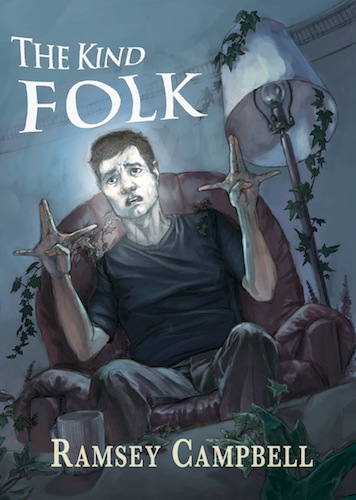
coverRamsey Campbell’s The Kind Folk (published last month) opens with one of those “real people’s problems” tabloid-style talk shows, where the host, Jack Brittain, is poised to reveal the results of a DNA test that will prove if, as Maurice Arnold suspects, his grown-up son Luke isn’t really his son at all. Maurice suspects his brother, Terence, who has always been overly proud of the boy, taking him on trips to remote parts of the country and telling him odd little fairy tales. But despite a family resemblance, it turns out Luke isn’t related to either. Nor, even, to the woman he calls his mother. A stand-up comedian with an uncanny knack for imitation, Luke comes to suspect the truth about his origins by retracing, through his uncle’s tersely-worded journal, the odd places they visited, where they always seemed to meet with “kind folk”. Nice people? By no means.

Joyce’s novel uses a multiple viewpoint approach to work at two questions. One, the rational, is just what happened — is the returned Tara really Tara? And can she really still be a teenager, twenty years on? Or is it all self-delusion and an extreme case of arrested development? The other (and far more interesting) question, is how her disappearance and reappearance have affected the people who knew her (among which the most compelling stories are those of her ex-boyfriend Richie, to whom she was a sort of muse, and who, as a result, was left like the traditional fairy-thralled knight, bereft of his inspiration and life-drive; and of course Tara’s own, having lost twenty years’ worth of family life, and finding herself in a world with which she’s now two decades out of step). My one criticism of the book is that I didn’t think the two questions quite gelled. It’s interesting to compare it to Alan Garner’s Boneland, another Faerie-tinged book published this year which also dealt with the devastating, lifelong impact of loss, though in an even more intense way (perhaps because entirely focused on one character). Garner combines the psychoanalytic and fantastic threads of his novel into one meaningful narrative, whereas Joyce spends a chapter psychoanalysing Tara only to disprove it later, which left me feeling a bit cheated. But in Boneland, psychoanalysis, even if it has a dangerous air, is ultimately seen as an aid to self-understanding and self-healing, while Some Kind of Fairy Tale‘s take is more about the abuse suffered at the hands of the profession by people whose experiences have taken them beyond the norm.

For most of The Kind Folk, Ramsey Campbell takes a more traditional horrific approach to the presence of a race of half-seen non-human beings at loose in the world. As usual with Campbell, his novel is mostly about the isolating, destabilising effect of the supernatural on one man’s family relationships, identity, and sanity. But the end managed to step clear of the simply horrific to a glimpse of something a little more magical. A far more claustrophobic but focused novel, Campbell’s worked that little bit better, of the two, for me.

Both The Kind Folk and Some Kind of Fairy Tale are well-written, interesting modern takes on the traditional matter of fairyland. Cornered as it is by hordes of zombies, vampires and teen wizards, I’m wondering if Faerie isn’t becoming one of the last refuges of the fantasy novelist who wants to do something genuinely different. There’s something about these outward blasts of the irrational & incomprehensible, and how they impact on real-seeming human characters, that smacks of those areas of life that fantasy, perhaps, is the best way to write about. The loss of a loved one may have a rational explanation, but that goes no way to explaining or expressing the impact it has on the people who feel the loss. The fantastic can. Besides, there’s something about the Perilous Realm and its inhabitants that, however much they may be commercialised into butterfly-winged, tutu-wearing Tinkerbells, there’s always a dark underside that resists commodification, a marshy creature lurking in the weeds, a too-wild dance echoing from over the next mist-wrapped hill. All too often, vampires and zombies are more and more restricted by rules and behaviours as their literature grows, but Faerie only seems to increase in its ability, the more it’s written about, to be what you don’t expect it to be. (Which may be its defining feature.) Besides, I don’t believe in vampires or zombies, but can’t help being a little bit afraid that if I say I don’t believe in fairies, they’ll get me.

^TOP