IT was one of the major reading events of my teens. As well as being the first Stephen King book I read as it came out (in paperback, anyway) right when I was in the grip of my first enthusiasm for horror, sheer page count meant IT couldn’t help being an event rather than a mere read. Plus, there was something about the basic idea that seemed so right: a bunch of loser kids face horror in small-town USA, then have to come back and face it again as adults. Nostalgia for the small-town life of 1950s USA seemed to pervade the 1980s, mostly thanks to George Lucas and Stephen Spielberg (Lucas’s American Graffiti sparked it off in 1973, 1978’s film of Grease made it more widespread, but the whole thing found its apotheosis in 1985’s Spielberg-produced Back to the Future), and as I was neither born in the 1950s nor in the USA, it formed for me a sort of fairy-tale fantasyland where stories of innocence and coming of age could be told, no more nor less real than the Germanic never-never land of the Grimms, or Clark Ashton Smith’s far-future Zothique. To read a horror story set in that fabled land of innocence and bobby-sox polka-dot lollypop rock’n’roll seemed just what I wanted — no, needed — as I hit the second half of my teens.
It’s become an occasional (though unplanned) theme in this blog to revisit things I was frightened of as a kid (the most recent one being another King effort, the TV mini-series of Salem’s Lot), and one of the things that made me put off re-reading IT was how certain scary scenes had lingered in my memory — particularly the one where Beverley Marsh hears the voices of dead kids coming up through the plug-hole of the bathroom sink. Back when I first read IT, that made me very nervous of our rather claustrophobic, spider-prone bathroom, and I wasn’t sure I wanted to reawaken the fear. (Pardon the pun, but fear of the bathroom is such an inconvenient fear.) The other thing that put me off re-reading IT was how disappointing I’d found the ending the first time around (combined with how disappointed I’d been by the endings of the last two King novels I read: Duma Key and — a while back — Bag of Bones). But then I read James Smythe’s article on IT, part of his comprehensive re-read of all Stephen King’s novels and story collections, and when he said IT was “a summer novel”, and I realised it was starting to be summer, I decided to dive in.
In the end, a sort of reversal occurred. I was no way near as scared of the horror scenes as when I’d first read the book — in fact, I was rather disappointed by them — but I found the ending a little less disappointing (only a little, mind, and perhaps because I was prepared for it). Nevertheless I still enjoyed IT immensely. So, why?
 The horror scenes, first. One I’d been particularly chilled by the first time I read IT was where grown-up Beverley returns to her former home, finds it occupied by what appears to be a sweet old foreign lady, and is invited in for tea. Once inside, the sweet old lady transforms into something undead and disgusting. (Her line, “My madder was my fadder”, was one of the novel’s many catchphrases that stuck in my mind as surreally horrific. Although, I discovered on this re-read, it’s not as much of a catchphrase as I recalled, only being repeated once, unlike “We all float down here”, or “Beep-beep, Richie.”) This time reading that scene, as the transformation began, I was at first a little creeped, but as King ladled on grisly detail after grisly detail, I started to find the whole thing overdone, and then too OTT to be scary. It was as though King was so over-sugaring his horror with whatever the horror equivalent of sugar is, that he’d numbed my readerly taste-buds. And I think every horror scene — or, I should say, every supernatural horror scene — in IT suffers the same way. What struck me as sensational and grisly when I first read the book, on this re-read seemed merely sensational.
It could be argued that this is the point. King himself spells it out:
It was like some comic-book villain. Because they saw it that way? Thought of it that way? Yes, perhaps so. It was kid’s stuff, but it seemed that was what this thing thrived on — kid’s stuff.
The creature in IT assumes the form of whatever frightens its victims the most, and kids being frightened by gloopy, gory, grisly details, that’s the approach it uses. The trouble is, this is also the fault I found with Bag of Bones and Duma Key — that the supernatural horror scenes were so un-disciplined, so full of detail after detail straining after effect at the expense of meaning, that the overall result was to detract from rather than strengthen the horror and the story. Because the creature in IT has no limits but King’s prodigious vocabulary of gloop, it loses its effectiveness as horror. Pennywise the Clown has the power to assume any form, to read its victim’s innermost thoughts, and to make its victims see whatever it wants them to see, and to even feel it as dangerously real — so why doesn’t Pennywise win hands down? Why hasn’t it wiped out the world? Why doesn’t it assail the kids with so much horror they go insane? Why doesn’t it simply jump out of the nearest drain and tear them to pieces? The truly frightening scenes, for me as an adult reader, were where Pennywise uses human beings to do its work. And although these humans are much less powerful than Pennywise, they’re more scary because I know they can’t be warded off with a childhood talisman (a book about birds, an asthma inhaler), and that they can do actual physical damage. Their lack of over-the-top-ness makes them more real, and so more scary.
 IT has every potential of being a Lovecraftian horror — a horror story of ideas as much as grisly details — but it’s here where, for me as an adult reader, King really falls short. Pennywise is at once set up as a force of pure evil, pre-existing the universe itself, to the extent that we can only assume it to be King’s version of Satan (with the useless Turtle as demiurge, and the “Final Other” a sort of removed, indifferent, Gnostic True God); but at the same time, Pennywise is so limited — geographically, if nothing else (in all of the universe, it is bound to Derry, Maine) — and rather useless. It can only frighten kids. It’s as likely to kill the “bad” kids, that serve its purposes, as the good. It runs away from bird books and asthma inhalers. Unlike Lovecraft’s monsters, the meaning of the evil Pennywise represents is nowhere looked into any deeper than that it is evil. But what would a universe where such a creature as this exists, with the powers it has (telepathy, creation of solid hallucinations, a hunger for fear) mean for human beings? That is what Lovecraft’s fiction is all about — the meaning behind the horror, the implications for mankind if they’re taken as a universal laws. Of course, IT is far more about human than cosmic things — it’s basically a summation of the purest of childhood terrors (King called IT his “final exam on horror”) — and with that God-like “Final Other” providing an ultimate escape clause in any attempt to understand what stops the balance between good and evil from tipping over, there doesn’t seem to be any meaning to Pennywise’s horror, other than to represent pure, irrational horror itself. IT is a nightmare — as scary as that is, and as ultimately insubstantial.
This comes to a head in the ending. The thing about the ending of IT is that because Pennywise has no “rules” — no established weaknesses or limits — I had no idea how it could be defeated. The Ritual of Chüd — a folklorish tongue-wrestling match the kids read about in a library book — sounds like it might work, and might also be genuinely risky to attempt, but the actual ending doesn’t use it (though makes a fudging attempt at pretending it has), making me wonder why King bothered setting it up in the first place. The actual ending involves a lot of kids holding hands, shouting “You killed my brother!” and somehow driving back the creature through sheer force of — what? will? feeling? belief? solidarity? Then physically tearing it apart. In which case, the question is, why didn’t any of Pennywise’s other victims defeat it if it’s so easy to defeat? If the creature in IT had been set up with just one weakness, just one stated limitation, its demise, I can’t help feeling, would suddenly become much more meaningful, and the challenge to the kids much more interesting and real.
And then, with regards to the ending… there’s what Beverley does. I don’t want to break into a spoiler here, but if you’ve read IT, surely you know what I mean when I say I’m talking about what Beverley does after Pennywise is defeated for the first time, and the kids find themselves lost in the sewers. How she “brings them all back together”. I mean… why? It seems just weird. Weird in a wrong way. Demeaning and without meaning. Nothing in the novel prepares for it, and nothing in the novel calls for it. On this re-read, it seemed even more out of place than on my first read.
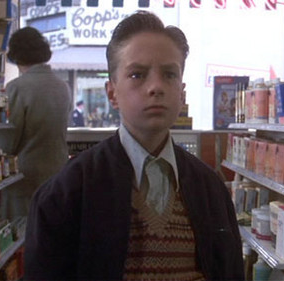
Adam Faraizl as Eddie Kaspbrak from the 1990 mini-series of IT
But despite all this, IT is such a readable book. And IT is readable because King is such a strong storyteller. He kept me going through this very long novel (and as I’ve said before, I don’t like overlong novels) through sheer storytelling power. King inhabits his story like no other writer, and you can just feel him, at times, hunkering down into the scene and simply wallowing in it (for some reason, the image that comes to mind is of a hog in mud, but this isn’t meant as a criticism!). For me, the essence of IT‘s good points all come out in chapter 16, “Eddie’s Bad Break”, which could almost be a short story on its own. Eddie, an over-cosseted kid whose mother controls him through fears about his health, learns first of all that the asthma medicine he relies on is a placebo, then experiences real life-threatening danger for the first time when bully Henry Bowers breaks his arm. King’s supernatural horrors are spooky, mostly superficial, and are all about the effect of grisly details — usually layered on so thickly they start to seem ridiculous rather than horrific — but his moments of character horror, of everyday horror, are subtle and much more effective. The scene where the druggist, Mr Keene, takes Eddie into the back room and explains what “placebo” means is far more tense than any of King’s supernatural horror scenes, because it is so intimately tied up with Eddie’s character, his personal fears, his relationship with his mother, his own identity. It threatens Eddie’s world in a way that the existence of a super-powered mega-clown from outer space somehow doesn’t. The scene where Eddie is cornered by Henry Bowers and his gang, and not helped by a previously-reliable adult is far more chilling, and far more meaningful, than any of the scenes where Pennywise the Clown appears. Pennywise’s most effective appearance in the entire novel is in this chapter, when, in a dream/semi-dream, Eddie imagines the clown’s face imposed on his own mother’s when she’s at her most protective/controlling. The idea that all adults have a little bit of IT in them would be a great idea for a novel… But it’s not in this novel.
I can’t help wondering, considering my reaction to this re-read of IT, whether King’s prodigious storytelling ability almost works against him. Because he can weave such a strong spell with writerly skill alone, he perhaps lets himself get lax in terms of the basic bones of his story. Thinking about it, and despite the fact that I much prefer fantastical elements in the stories I read, the more satisfying King stories and novels I’ve read have all been non-supernatural ones — “Rita Hayworth and the Shawshank Redemption”, “Apt Pupil”, Misery — where King has been forced to take on more disciplined bounds to his boundless skill in storytelling. I want to read more King, but am put off by the suspicion that while the reading experience itself will be enjoyable, the ultimate aftertaste that comes from the end of the story will be that of a little too much of something a little too (horrifically) sweet.
But, having said this, King is of course immensely successful, so what do I know?

 Like other fantasy films of the era (King Kong springs to mind, with its “And lo, the beast looked upon the face of beauty…”), 1942’s Cat People opens with a made-up quote, this time from a fictional psychiatrist instead of a made-up prophet: “Even as fog continues to lie in the valleys, so does ancient sin cling to the low places, the depressions in the world consciousness.” Almost immediately, this is followed by another, and far more appropriate, quote, this time a sign above a zoo litter bin: “Let no one say, and it to your shame, That all was beauty here, until you came.” Because, in a way, this is Irena’s fate: that she, with her dark, Serbian-witch-village ways of difficult passions and were-cattery, comes to this placid, modern, American paradise and ruins the lives of Ollie and Alice, a rather lukewarm not-yet couple wholly unprepared to deal with the psychological complexities of foreigners with hereditary supernatural curses. Kitten-faced Irena’s first action in the film is to mar the “beauty” of the zoo’s fake-tree-stump bin (like the rest of the zoo, a highly sanitised version of the true wilds of nature) by tossing a torn-up sketch at it and missing; her last act is to die in pretty much the same spot, littering the place with her mangled pantherine corpse.


 , this is actually a “shortened version” of what Gibson produced.) Gibson’s Alien3 is far more the sort of thing you’d expect as a followup to those first two films than what we actually got. It’s also far more a product of the 80s, when it was presumably written, than the overpoweringly dark 90s film David Fincher ultimately produced.