
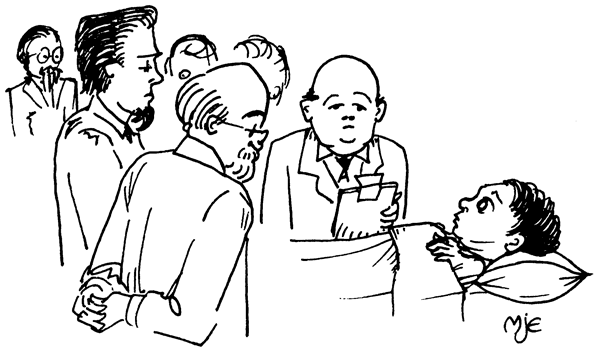
Toby – a Halloween rhyme

They wondered why Toby was always so cold
He was only, they calculated, five years old
Yet his skin was the colour of moonlight on ice
And crystals of water had formed in his eyes
 
“I don’t feel cold,” he said, looking up
As they gathered around him and gave him a cup
Of cocoa as hot as they could possibly make it
And told him to drink it as fast as he could take it
 
“The problem,” one said, “is not the coldness of the skin,
“But the coldness of the child, as it were, within.”
They nodded, and asked, “Do you think cold thoughts?”
“I don’t know,” said Toby. “Do you think that I ought?”
 
They murmured, considered, and angled their heads
Then told him to lie on an unyielding bed
“Bend your knee” — “Cough hard” — “Open wide” — “Wag your ears”
They ordered, all at once, till he was in tears
 
But the tears didn’t fall, they just iced up his eyes
And a nurse had to come with a dropper and pliers
Then they gave him more cocoa, and conferred in a corner
On the best proven method to make Toby warmer
 
An operation, of course, was out of the question
A scalpel wouldn’t make the slightest incision
A pill might have worked, if they could be sure
That a pill could be found not to burn but to thaw
 
“And what of his brain?” one learned man asked
And ventured that he to this end might be tasked
For the psychotherapeutic, transcendental
Cure was his thing (though still experimental)
 
A second said that physiotherapy might
Given time make his joints less frozenly tight
A third disagreed. “A month of rest at least!”
While a fourth proposed a diet of malt extract and yeast
 
And Toby, in the corner, sipped his cocoa and wondered
Against which of the Commandments he had so blundered
To be stuck on a bed in a room with these men
And when he might be let out again
 
After hours of conferring, an elected man came
And smiled at young Toby, and addressed him by name
“We’ve decided at length,” this studious man said,
“That you cannot be helped, and must be declared dead.”
 
The man raised his eyebrows in question and waited
While Toby, mouth open, eyes wide, contemplated
Then asked, “Will I be allowed outside to play?”
“You’ll be expected to stay out all night and all day.”
 
“And will I be sent to some special school?”
“No school.” “Or a prison?” “That would simply be cruel.”
Then Toby, with a shrug, agreed to be dead
So they signed off his case, and then sawed off his head
 

(Previous Halloween ditties can be found here (2010) and here (2007).)

^TOP

Full Fathom Forty

The British Fantasy Society’s 40th anniversary anthology, Full Fathom Forty, edited by David J Howe, is out! I got my copy yesterday. And it’s a heavy tome. The picture on the right attempts to show just what a hefty book it is, at 496 pages. And I thought I’d mention it here because (ahem), I have a story in it, “Elven Brides”, which I’m thrilled about. There are forty authors represented in the book, in all, so if you have any liking for fantasy or horror fiction or poetry, you’re bound to find something to like here. I won’t mention them all, but I’m very, very happy to be in the same book as Ramsey Campbell, Kim Newman & Jonathan Carroll. I am looking forward to reading this book!

It can be bought direct from The British Fantasy Society, but also from Amazon.co.uk, Amazon.com and The Book Despository!

^TOP

Lovecraftian Doctor Who

It struck me recently how Lovecraftian my favourite period of Doctor Who (the first half of Tom Baker’s reign) was. I don’t know if there was ever an explicit influence, but the fact it was a science fiction show being made during a British horror boom (the early seventies), probably led to a certain amount of natural crossover.

Script editor Robert Holmes certainly brought in (or encouraged) all sorts of horror and sci-fi influences, mostly filmic ones — King Kong  in “Robot”, The Thing from Another World in “The Seeds of Doom”, The Beast With Five Fingers in “The Hand of Fear”, Frankenstein in “The Brain of Morbius”, for instance. He wanted to “darken things up a little”, saying “I don’t think it would be unfair to accuse us of aiming towards a slightly ‘gothic’ area. Tom always called it ‘Who-noir’.” (quoted in Classic Who: The Hinchcliffe Years by Adrian Rigelsford)

Another thing that led to a Lovecraftian feel could have been Holmes’s attempt to shrug off good/evil dichotomies. According to producer Philip Hinchcliffe, Holmes “had a theory that there’s no such thing as good or evil in the universe; it’s all just part of a process, and the side you fall into simply depends on how you’re made. He was fascinated by the notion of an organic life-form which lands on earth and causes havoc because it’s neither intentionally bad or good, it’s just that its ‘process’ conflicts with ours and appears evil by comparison.” (from Classic Who, again.) This is pretty much spelled out by Sutekh: “Your evil is my good, Doctor. I am Sutekh the Destroyer. Where I tread I leave nothing but dust and darkness. That, I find good.”

Of course, Doctor Who could never have addressed the underlying cosmic horror outlook of Lovecraft. The Doctor is a heroic figure, and it’s one of the tenets of Lovecraftian horror that people can never be heroic — cannot, in fact, ever be anything other than gnats and flies before the terrible forces that rule our universe. (“In my presence, you are an ant, a termite — abase yourself, you grovelling insect!” — the ever-quotable Sutekh.) Doctor Who, on the other hand, had a fundamentally optimistic nature (necessarily so, perhaps, being a kid’s show). When the Doctor defeats Sutekh, it’s with the feeling of things being returned to their rightful balance, rather than a brief avoidance of an eventually inevitable human defeat (which is how “The Call of Cthulhu” ends). And just consider how Lovecraft would have viewed the story of one of the Doctor’s human companions — more as the sort of alien abduction perpetrated in “The Whisperer in Darkness” or “The Shadow Out of Time” than a romp through space & time, with the Doctor, perhaps, as a sort of charlatan Nyarlathotep figure.

But it’s surprising how much of a similar feel the alien creatures had during these few seasons to Lovecraft’s creations:

insect-like creatures who can fly through the vacuum of space — the Mi-Go (Lovecraft), and the Wirrn (Doctor Who)…

a man transformed into a giant, lumbering, tentacled monster intent on wiping out all human life — the creature at the end of “The Dunwich Horror” (Lovecraft), and Keller transformed into a Krynoid at the end of “The Seeds of Doom” (Doctor Who)…

an alien entity who wants nothing more than to destroy all life in the universe, but who has been imprisoned in a tomb on Earth — Cthulhu (Lovecraft) and Sutekh (“The Pyramids of Mars”)…

a created lifeform, intended as a servant/soldier, destroys the race that created it — Shoggoths (At the Mountains of Madness) and the nascent Daleks (“Genesis of the Daleks”) who, in their naked form, are rather Lovecraftian sea-slug-like slimy blobs…

an ancient alien lifeform, buried for millions of years, is uncovered and comes to life again — At the Mountains of Madness, “The Hand of Fear”.

To me, the most Lovecraftian creatures are the Fendahleen — perhaps just because they spring from the same impulse to try and create a monster that doesn’t simply look like a man in a suit (in the case of Doctor Who) or which isn’t just a slight alteration of the human form, but is designed to be totally alien to everything we ever think of as human (in the case of Lovecraft’s monsters).

Of course, a more direct source of influence on “The Image of the Fendahl”, with its ancient, alien powers being released by scientists examining a 12 million year old skull, is Nigel Kneale’s Quatermass and the Pit. But the Lovecraftianism of Nigel Kneale’s output is a whole nother subject (the meteorites of Quatermass II — nicked virtually wholesale by Doctor Who in “Spearhead from Space” (another Robert Holmes story) — to me recalls Lovecraft’s “The Colour Out Of Space”, for instance.)

So, to recap: Sutekh is Nyarlathotep, Zygons are Deep Ones, and the Doctor ought to faint more often.

^TOP
