
Videodrome

I love the first half of Videodrome (if love is the right word for something so weird & sleazy). Max Renn’s (James Woods) descent into a hallucinatory world of video nasty violence and getting-swallowed-by-a-TV weirdness is handled with enough of a dangerous edge that you really feel this isn’t just an excuse for some shocking/surreal horror-fantasy moments, but may actually be a film with what Renn himself doesn’t have — “a philosophy” — i.e., an actual coherence to its weirdness, something quite rare in this sort of hallucinogenic horror movie.

But then there’s the second half, and I never fail to be disappointed by it. It’s at this point the film sloughs off its weirdness for action; it leaves its ideas behind and settles for a shoot-out and a suicide. It has the effect of someone breaking off an interesting and well-reasoned debate to sock his opponent in the jaw, and represents a similar failure of ideas, or perhaps a lack of courage in its convictions.

After all, the potential was there, particularly once Renn has encountered the Ballardian video prophet Brian O’Blivion, whose Cathode Ray Mission aims to bring TV to the homeless, and who only communicates with the world via video tapes. O’Blivion (a gloriously silly name that surely points to this very much not being intended as a standard action thriller) sees the TV as an extension of the mind, and believes the sort of sleaze peddled by Max Renn’s Channel 83 to be a necessary outing for the murky, nightmarish depths of the unconscious. His is the sort of “philosophy” Videodrome ought to be about — and it’s the philosophy the first half most definitely is about. O’Blivion seeks to liberate mankind from the strictures of reality with the (then-new) power of video, even if it is a savage, uncivilised liberation. At least it will be an honest one.

But it turns out O’Blivion isn’t the man behind the brain-tumour inducing video signal known as Videodrome. That is Spectacular Opticals, an arch-reactionary mega-corporation, who aside from selling cheap glasses and missile guidance systems, seek to skim the scum from the human race using video-brainwashed killers (programmed by pulsating Betamax tapes). And the trouble is, theirs is a boring philosophy compared to the zany O’Blivion’s.

With O’Blivion’s enlightenment-through-video-sleaze we’d have the ending that, apparently, Cronenberg initially planned — a vision of Max Renn, Nicki Brand (Debbie Harry) and Bianca O’Blivion melded together in one “new flesh”, in some video version of heaven. But for some reason he swapped it for what we instead have — people getting shot at a corporate sales conference — the logical consequence of Spectacular Opticals’ realistic philosophy, yes, but so dull to watch after the visual richness of the first half of the film.

Perhaps the trouble is Cronenberg is a good director of the subtleties — and of actors — while having a strong love of the pulpier types of horror. Torn between the two, his films perhaps promise too much of both, but can only fulfil one side of the bargain. (I certainly felt the same about A History of Violence, which I thought, from the beginning, was going to be all about the is-he-or-isn’t-he-a-gangster of Viggo Mortensen’s character, only to be disappointed when it turned into yet another shoot out in the second half.)

My favourite Cronenberg film remains The Dead Zone, which keeps its use of the fantastic very cut back, and tells its tale of emotional reserve and quiet disappointment just as effectively as Videodrome delivers its first-half shocks and disorientations, but sticks with them to the end.

^TOP

Alice at R’lyeh on YouTube

MorganScorpion has put her reading of Alice at R’lyeh up on her YouTube channel. I’ve embedded the reading here, but her channel’s well worth a visit for her readings of Lovecraft, William Hope Hodgson, Oscar Wilde, M R James, and other weird writers’ stories & poems.

^TOP

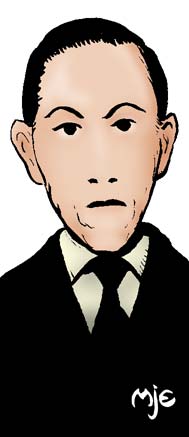
Should we bowdlerize Lovecraft?

I like the way there’s always one fact you know about an author, even if you know nothing else about them. If you know only one thing about Jane Austen, for instance, it’s that she, the great writer on marriage & marriageability, was herself unmarried. If you know only one thing about Charles Dickens, the great writer on (and righter of) social wrongs, it’s that his father was imprisoned for debt and young Charles had to work in a blacking factory, an experience he loathed & feared for the rest of his life. If you know only one thing about H P Lovecraft, it’s that he was a racist. The main difference with the Lovecraft fact is that, while you can read the entire works of Dickens or Austen and never guess their particular fact, if you read enough Lovecraft, you’re sure to stub your toe against his enough times to grow more than wary. And if you do enjoy his fiction for its unique take on the weird, it always does feel like stubbing your toe — both painful & angry-making.

For anyone who likes to read old fantasy, horror, and weird fiction, it’s a constant hazard. Sometimes it seems that no sooner do you find an author you like, you discover some objectionable opinion they held. (Why is this such a hazard for fantasy, horror & weird fiction enthusiasts? Perhaps because we’re more likely to read the not-so-great writers in our genre’s past.) I remember the sinking feeling I experienced when I first read David Lindsay’s Devil’s Tor (1932) and encountered its passages — from an author who had previously written that “nationalities, and the patriotism that attends nationalities, are inconsistent with true mental freedom and progress” — having one of his characters explain how “Christ was blue-eyed, belonging by descent to the North”. (I also remember the sense of relief I felt when I read Tolkien’s letter to his would-be publishers in pre-WWII Germany who had asked if he had any Jewish blood; he replied that he was sorry he hadn’t, but would be proud to admit it if he had.) There’s a watershed at World War II, before which racism, and (in Britain) Imperialism and classism, were strewn quite freely through the works of so many writers. (Casual racism, of the “it’s the word we always used, we never meant anything by it” type was still the norm amongst my grandparents’ generation.)

But should we bowdlerize Lovecraft? No. Lovecraft’s racism is part of the man we encounter whenever we read his fiction, and as it’s often the most noticeable of his objectionable characteristics, perhaps that’s one reason for keeping it — it alerts us to the fact that these stories are not the products of an entirely healthy mind. The very thing that draws me to reading Lovecraft — his portrayal of a very bleak and inhuman, even anti-human, universe — is centred on his own intently-held fears and beliefs. Lovecraft had a deep terror of life (which I’m not saying was groundless), and particularly of the body, and in a sense it was only because his racism was, at the time, the most socially acceptable part of his profound world-rejection, life-rejection, and body-rejection, that it comes out so explicitly in his fiction.

Lovecraft’s horror of otherness — most crassly expressed in his fear of the foreign faces and cultures he found himself surrounded by in New York — is ultimately the horror of his own body, and the shadow part of his mind. There is in his fiction a mixed loathing for and longing for union with that “other” — as there always must be, the psyche seeking to heal its self-division — and so we get that moment at the end of “The Outsider” where the protagonist sees his own horrific form in a mirror (which is not simply the end of a cheap twist tale, but a depiction of how far a man can go to deny what he knows is most horrific about himself), but also all those fantasies of having one’s mind transplanted into other, alien bodies, which Lovecraft strained to imbue with horror whilst quite plainly longing to experience.

Should we not read Lovecraft, then? My interest in Lovecraft’s fiction is as much with the man who wrote it as the stories he produces, but I don’t at all mean that I admire him through and through. Lovecraft is the picture of a man struggling at the edge of life, caught between the desire to live and the impulse to reject it all. An intelligent, sensitive, self-limited man, he strove all his life to try and solve the very alien equation at the core of his own psychology. He certainly didn’t achieve perfection at any point, but I believe it’s possible to find in his fiction evidence for the very difficult self-healing, or self-unifying (“I am it and it is I”), process we all undergo, and which is all the more explicit in the works of artists and writers who address the darker realms of the mind. Which is also the reason we go to those works, to try and illuminate our own self-healing, self-unification, and the struggle that goes with it. All authors are fallible human beings, and it’s in none of our interests to pretend they aren’t, to make a cult of them, to revere them unreservedly. Far better that they teach us to be always wary of what we read, and work out our own values for ourselves.

As for whether we should admire such authors, quite often it’s not a question of admiration — it’s fascination, that combination of repugnance and attraction, as much as anything, that brings us back to the work of the most powerful artists. It’s seeing ourselves, in however warped, exaggerated, and difficult-to-take a form, that brings us to their work — just like Lovecraft’s ghoul seeing itself in a mirror. Certainly, that’s what brings me back to Lovecraft.

^TOP