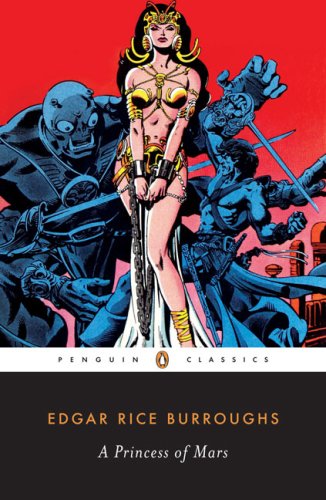
 It’s always been a problem, what to do with young men, bundles of sex and violence that they are. Each age has to come up with new ways of channelling their youthful energies, or face the consequences. The Middle Ages, all too aware of the dangers of having a bunch of steel-plated, lusty young knights roaming the countryside, developed a pair of social codes: chivalry, which said that only a fight between equals was truly honourable (so, no bashing peasants just for the hell of it), and courtly love, which said that the purest expression of a knight’s devotion was to dedicate himself to the service of a (preferably married, certainly chaste) woman, whom he could worship from afar, obey her every command, and pine for. The fiction of the times is full of honourable knights and sighingly tragic longing. Lancelot was the ideal, and though nowadays he’s most known for his massive failure to merely worship from afar, Malory, at least, was convinced of his virtue, saying that anyone who didn’t believe in it was corrupted by the cynicism of the times:
“…nowadays men cannot love seven nights but they must have all their desires… But the old love was not so; for men and women could love together seven years, and no lecherous lusts were betwixt them, and then was love truth and faithfulness. And so in like wise was used such love in King Arthur’s days.”
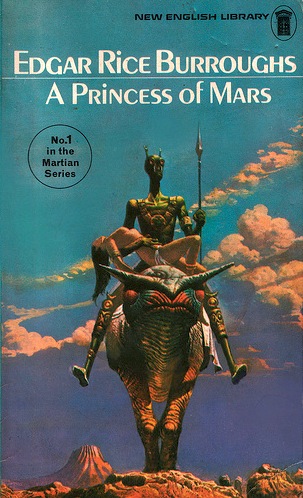
A Princess of Mars – Bruce Penngington cover
Edgar Rice Burroughs’ A Princess of Mars is a direct descendent of the same school of fiction. I first read it when I was 19 or 20, and perhaps because it was so short and so very readable, quickly moved on to its sequels, which proved just as moreish. (I think I got as far as The Master Mind of Mars (6th in the series), or perhaps even Synthetic Men of Mars (9th) — things get a bit blurry after the first three. It’s the uber-cliffhanging ending of the second, Gods of Mars, which has stuck with me.) Even while caught up in them — and they really did have that read-it-in-a-single-sitting compulsion — I knew they were basically an endless series of riffs on a single formula. The thing was, the formula was so primal, it worked even though I was aware of it.
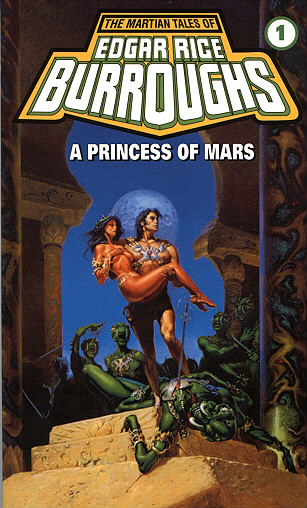
A Princess of Mars – Michael Whelan cover
It’s the romantic male daydream of rescuing a beautiful princess, either from death or a fate-worse-than, again and again and again, raised by the power of its exotic setting (one of Dejah Thoris’s would-be ravishers, Tal Hajus, is “the most hideous beast I had ever set eyes upon… like some huge devil-fish”), and delivered at such a breathless pace, the narrative barely gives you time to recover from one iteration before it lands you in the lap of the next. The hero, John Carter, goes from death-defying extreme to death-defying extreme, at one point having his flying machine shot down to crash in the middle of warring hordes of savage Tharks (six-limbed, twelve-foot-tall green Martians who think the death agonies of their enemies the funniest thing going), only to find himself fighting next to (and saving the life of) the one Thark on all the planet who knows him. The plot has enough holes to sink a heavier vessel (why does Carter, having just freed Kandos Kan in Zodanga, instead of going on to free his beloved Dejah Thoris in the same city, elect to fly all the way to the distant city of Helium, a place he’s never been to before and in which he will not be recognised, in order to get help?), and I felt, on this re-read, some of Carter’s actions were more barbaric than heroic (to rescue Dejah Thoris from being wed to the warlike Zodangan prince, Carter assembles a horde of Green Martians to massacre and imprison the whole city, many of whose inhabitants, it has been pointed out, are against the actions of their leader) but the whole thing stays buoyant through sheer narrative pace as it zings from one romantic peril to the next. Like a shark, it survives only because it keeps moving. But this shark moves fast.

A Princess of Mars – Frank Frazetta cover
It’s not just physical peril, though, that stands between John Carter and the beautiful Martian princess Dejah Thoris (she lays eggs, don’t you know). The exotic setting allows Burroughs to put problematic cultural barriers between the two of them, from Dejah Thoris taking insult at the culturally-ignorant Carter’s unintentional faux pas at the beginning, to her later telling him that, having promised her hand in marriage to the hated Sab Than because she thought Carter dead, honour dictates not only that she cannot go back on her word, but that, should Carter kill Sab Than, she and Carter will never be able to marry.
It’s courtly love all over again.
(Apparently there’s a film out, or something.)
 The latest Doctor Who DVD release,
  , has got me thinking about my eccentric Doctor Who buying habits. I get all the Tom Baker and Patrick Troughton DVDs on principle, but pick and choose from the William Hartnell and Jon Pertwee stories, perhaps because I like the comic Doctors better than the cranky ones. I’ve only just realised, though, that the First Doctor stories I buy are always the science fiction ones, never the historicals. To me, those early stories are usually too slow-paced to succeed as dramas, so my enjoyment of them has to come from their atmosphere. And when it comes to atmosphere, the old TV shows couldn’t help doing minimalist sci-fi better than they did history.