
When the coldness of electronic music combines with futuristic imagery it can create something bleak, ominous, forbidding, but also beautiful, if some sort of human feeling manages to come through all those buzzes, twoops and bleeps. For a while I’ve been collecting soundtracks to science fiction films that use electronics in their score, but it’s turned out to be a surprisingly limited subgenre, no doubt thanks to the example of Star Wars, where, rather than spacey electronics, John Williams used an orchestra in full Romantic mode to humanise the film’s technological imagery. Star Wars is certainly a great score, and perfectly fits the type of film it was made for, but here I’m more interested in the music of dehumanising dystopias and isolating voyages into deep space, perhaps because finding the human element amidst so much visual and aural coldness is all the more rewarding.
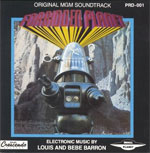 Mother of all sf soundtracks is Bebe and Louis Barron’s score to Forbidden Planet (1956). It’s perhaps the most extreme, experimental soundtrack for a film of any era that’s meant for popular entertainment. Remade today, Forbidden Planet would certainly get the orchestral treatment. Its having an electronic score seems to be more down to the innocence of the times, and the idea that electronics would simply sound more spacey. In an era before even the most primitive of synths, the Barrons built their electronics from scratch, each track being played by a series of custom circuits. The result is something it’s difficult to sit down and listen to in one go — there’s no conventional music, but a soundscape of thuds, whines, swoops and alien growls — but when seen with the film, it provides a perfect destabilising influence on the 50s conventionalities of an otherwise rather mainstream horror-sf plot, making the final revelations about the dead Krel race and their technology that allows Morbius’s subconscious urges to come through all the more authentic and menacing.
 If you have one electronic sf score in your collection, it’s most likely to be the one that started me off — Vangelis’ peerless Blade Runner (1982) soundtrack. Vangelis doesn’t use the harsh electronic sounds of the Barrons, but, while his score is often as lush and romantic as John Williams’, it doesn’t attempt to hide from the strangeness, and darkness, of the imagery it accompanies. Vangelis’ synths add an ethereal, fairy-tale magic to those spine-tingling opening sequences of a futuristic Los Angeles that would otherwise seem like nothing but Hell on Earth. His use of melody is exquisite. At times his music seems to be the lingering ghost of all that is essentially human but which Ridley Scott’s future-noir world has almost strangled from its characters. And who would ever have thought Demis Roussos could sound so lovely?
 There are two soundtracks that mix a traditional orchestra with electronic instruments to an equal degree. When recording the soundtrack to Tron (1982), Wendy Carlos (back then not Wendy but Walter) had the orchestra perform its part of the score on its own, not letting them know that an electronic part using some early synths would be added. Like the film, the Tron soundtrack is more about the action of the chase and the wonder of the weird digital otherworld it takes us through than the feelings of its characters, though there is of course that underlying quest for individual freedom that’s to be found in all dystopias, giving a triumphant note to its brassy synth fanfares. Jerry Goldsmith’s Logan’s Run (1976) score, on the other hand, uses its orchestral and electronic elements in somewhat the same way that black & white and colour film was used in The Wizard of Oz. Within the futuristic city where Logan is a Sandman gleefully despatching those poor Runners who try to live beyond the age of 30, Goldsmith uses unapologetically harsh electronics, particularly in the pulsing rhythm you hear when Logan is in the presence of the all-controlling city computer. As soon as we get out of the city, the music changes to orchestral, emphasising the difference between the two worlds.
 Goldsmith is a prolific composer, and of course provided the score to many other sf films, though none as electronic as Logan’s Run. Alien (1979), wholly orchestral, nevertheless evokes a creepy weirdness with the skittering strings of its opening titles. (His score to Legend (1985) is one of my favourite film soundtracks, but it’s fantasy, not bleak sf.) He also provided the score for Outland (1981), that grimly futuristic remake of High Noon, which was again predominantly orchestral, apart from one notable musical cue. This piece, called “The Rec Room” on the CD, is a good way of introducing an obscure sub-subgenre within the already obscure subgenre of electronic science fiction soundtracks — the leisure zone sequence. Don’t ask me why, but there’s a scene in almost every sf film where the characters go into some sort of recreation room or centre — and the more dystopian the film, the more self-indulgent and sensual the recreation is likely to be. Quite often this provides the composer with an excuse to do something a bit more weird and futuristic, as with Jerry Goldsmith’s attempt at what future dance music might sound like in Outland‘s “The Rec Room”, or the distinctly Forbidden Planet-sounding whoops and tickles of his piece to accompany the “Love Shop” sequence in Logan’s Run. Of course, in Star Wars, John Williams takes this the other way, going completely retro with his aliens playing Big Time Swing Jazz, but mention also has to be made of the descent into funky sleaze in Soylent Green (1973) where Charlton Heston enters an apartment to find it full of lounging women. It seems to be a rule of late 60s/early 70s sf that, where there’s women, there’s wah wah. (Soylent Green‘s score is mostly orchestral, but gets some nasty electronics in for the sequence where Heston enters the Soylent Green factory and learns just what that foodstuff is really made of). Funky kitsch — sleazy or not — is another subgenre of sf soundtracks, mostly for films emerging from the groovy sixties, starting with Barbarella (1968), and including the soundtrack to La Planète Sauvage (1973), a film I reviewed in an earlier blog entry.
 Solaris (1972 & 2002) has managed to garner a weird soundtrack both times it was filmed, the first being electronic (composed by Eduard Artemiev, to be found on the CD Tarkovski par Artemiev), the second being orchestral but with enough glassy-sounding percussion to give it a haunting oddness. Rollerball (1975) uses Bach’s Toccata in D minor in such a way that the church organ it’s played on sounds like a futuristic instrument of oppression. By the time Toto did the soundtrack to David Lynch’s Dune (1984), synths were getting better, producing fuller, more lush sounds rather more like orchestral strings than the harsh early versions, but the Dune soundtrack is electronic enough to still sound weird in that spacey, futuristic way. (Some of the best examples of science fictional electronica, of course, aren’t to be found in the movies at all, but in the lower-budget world of TV, such as the BBCs Radiophonic Workshop’s music for such shows as The Tomorrow People and Doctor Who.)
Electronic music in sf films is sometimes used to simply accentuate the weirdness of the science fictional imagery — all those theremins in 50s alien invasion films trying to convince us that the wobbling plate on a string is, in fact, a menacing flying saucer (though the theremin was used to excellent effect to impart an unearthly grandeur to The Day The Earth Stood Still). But sf electronics are at their best, for me, when they evoke a sense of the numinous, the ethereal, the unearthly. I find myself wanting to include some non-electronic music which has the same effect. I’ve already mentioned a few (Cliff Martinez’s Solaris, Jerry Goldsmith’s Alien title sequence), but the ultimate example has to be György Ligeti’s Lux Aeterna at the end of 2001. This is nothing but human voices, undulating in disturbing microtones, perhaps illustrating that, when it comes down to it, nothing sounds as strange or unearthly as the human voice doing what it isn’t normally heard to be doing. (See also the theme music for the BBC’s 1981 adaptation of Day of the Triffids.)


 I can’t remember how I first came across this album now. Mojo listed it as number one in their “Top 50 Eccentric Albums” feature a couple of years back, and its opening track was sampled to eerie effect on Alan Moore & Tim Perkins’ The Highbury Working, in the Ignis: No. 1 With A Bullet segment, repeatedly playing the line “What’s in store for me” after Moore recounts how Joe Meek shot his landlady then ended his own life with a single-barrelled shotgun. But I think it was while doing a Google search for weird science fiction soundtracks (something I’m into — see my