Swastika Night by Murray Constantine

SF Masterworks cover, art by Eamon O’Donogue

Swastika Night is described by the Encyclopedia of SF as “the first Hitler Wins tale of any significance”, and the interesting thing about this (and the thing that made me want to read it) is that it was published in 1937 — i.e., before World War II. At least one contemporary review notes that “Murray Constantine” is a pseudonym, but it was not generally known that the author was in fact Katharine Burdekin (1896–1963) until the 1980s.

The novel is set in the Year of Our Lord Hitler 720 — presumably measured since the end of the “Twenty Years War”, or what we would call World War II. The globe is, at this time, divided between two empires, the German and the Japanese, which have been in a static truce for centuries. There are no uprisings (the Germans “ruling with such realistic and sensible severity that rebellion became as hopeful as a fight between a child of three and an armed man”), and Nazi rule is ensured via a religion in which Hitler is a god, not born of woman but exploded into existence, who took the form of a seven foot tall, blond, bearded giant. The catechism of this religion enforces a rigid hierarchy, beginning “As a woman is above a worm // So is man above woman”, and goes on to place Nazis above all foreign men, and the elite Knights (hereditary descendants of the Teutonic Knights created by Hitler) above everyone else. (As well as worms, women do get to be above one other thing: Christians.)

Women are kept separate from men, in huts in caged compounds, and are allowed only once each month into the swastika-shaped temples to worship Hitler. Their hair is kept shorn. They have no right to refuse any man, and if they give birth to a male child, it is taken from them after eighteen months.

Gollancz HB, 1937

Not unsurprisingly, their numbers are declining, though this is not something anyone but a few Knights have noticed, at this point. In fact, the German Empire as a whole is in a state of deep stagnation, and the only thing that prevents it being attacked and defeated by the Japanese is that their empire, equally hierarchical and militaristic in nature, is in a similar state.

The story follows a middle-aged English mechanic, Alfred, on a once-in-a-lifetime pilgrimage to the Holy Land (i.e., Germany). He seeks out a German friend, Hermann, who spent some time in England, and who is clearly in love with Alfred. A rather happy-go-lucky man unafraid to speak his mind, Alfred tells Hermann that he knows how to defeat the German Empire: not through violence, but ideas. It only rules, after all, thanks to the ideals and values it forces on its subjects. Key among these is the notion of “the Blood”, the hereditary nature of the Nazi that makes him essentially superior to all others. Alfred has decided that such a belief is in fact a weakness, and that “acceptance on my part of fundamental inferiority is a sin not only against my manhood but against life itself.” The Nazi ideals of “pride, courage, violence, brutality, ruthlessness” are, he points out, “characteristics of a male animal in heat”, and “A man must be something more, surely?”

Feminist Press PB from 1985, cover by Odilon Redon

Hermann, loving Alfred too much to do the patriotic thing and turn him into the authorities, merely groans helplessly. Later, the two meet a German Knight, Friedrich von Hess who, sensing something in Alfred, takes him into his confidence and shows him (and, at Alfred’s insistence, Hermann), two things that will give a new focus to his airy talk of bringing down the German Empire. The first is a book containing an account of the true history of the world before the founding of the German Empire (which has taught its subjects they were savages before it civilised them); the second is a photograph of the real Hitler, proving him to be not a blond giant but a shortish, dark-haired man with a silly moustache. But Hitler’s true physical nature isn’t the real revelation of that photograph. Perhaps the best moment in the book is when it’s revealed to Hermann and Alfred that the youthful, vigorous and attractive long-haired blond creature standing next to Hitler is not a boy, as they immediately assume, but a girl…

The bulk of the book is devoted to conversations between von Hess and Alfred, about how the German Empire set about consolidating its power — by destroying all knowledge of the before-times, and eradicating all culture except music. The result is that the Empire has come to a dead end:

“We can create nothing, we can invent nothing—we have no use for creation, we do not need to invent. We are Germans. We are holy. We are perfect, and we are dead.”

The moment when the “boy” in the photograph with Hitler is revealed to be a girl is an illustration of what this book does so well: capturing how deeply people justify their irrational beliefs, all the better to cling to them. As someone in this book says of women with their shorn heads:

“Why, if they were meant to have hair on their heads they would have it on their faces. Have you ever seen a woman with a beard like mine?”

2017 French edition, art by Jean Bastide

As with Orwell’s Nineteen Eighty-Four, which this novel is often compared to (there’s no evidence, apparently, Orwell read Constantine’s book), Swastika Night has encapsulated some essential ideas about how power warps reality in order to entrench its rule, and how difficult it can be to make one’s way out of the dead end this creates, once all alternatives, and even the possibility they once existed, have been eradicated.

Contemporary reviewers seem generally united in finding the book “as entertaining as it is frightening” (from The News Chronicle, 23 June 1937), but some reveal surprising caveats about the focus of the book’s attack — surprising, anyway, from the position of looking back with a knowledge of subsequent events.

Phyllis Bentley, for instance, in The Yorkshire Post, felt it was unfair of the author to project such a horrible future and blame it on a real people:

“That it is fair, right, and civilised, even in a work of fiction, to throw the onus of creating such a nightmare of a future on any specific nation, whether German or Japanese or other, I have strong doubts; but if we will take the satire ourselves, and regard it as the results of those human tendencies towards fear, greed, and stupidity which must be conquered if they are not to prove fatal, the lesson is striking enough.”

H S Woodham, in The Daily Independent (in Sheffield), makes a statement I still can’t quite fathom, unless it’s a comment on how so many intellectuals between the wars sought to condemn nationalism of any type — both the war-like and the prideful — as a means of preventing future conflicts:

“Murray Constantine is the nom-de-plume of a very able individual who seems to dislike the Nazi system without also disliking his own country—which borders on the unusual.”

He goes on to conclude:

“I do not imagine that the author believes this fantastic picture for one moment; he has exaggerated and caricatured with deliberate intent. Even so the story is fascinating, whether we agree with its trend or not.”

That “with deliberate intent” sounds oddly like the accusation of a crime, and is surely nonsensical, as the alternative is that Constantine wrote the book without intent, i.e., by accident.

Katharine Burdekin

Perhaps the fact that Swastika Night is about Nazis specifically (rather than, as with Orwell, an invented and therefore multiply-applicable ideology) might obscure its insights into the workings of power generally, seeming to relegate its problems to history (though it was certainly prescient in its time) and not the ongoing need to prevent the rise of any such form of totalitarianism. But its core lesson, that you must look to the most ill-treated members of society to understand how the forces in power achieve their ends, remains valuable. (As Perry Farrell of Jane’s Addition puts it: “How you treat the weak is your true nature calling.”) I have to admit I found the conversations in the book a little too long, particularly when they weren’t dealing with the book’s themes but its plot (which is slight), but Swastika Night remains a classic for its key ideas, as well as its boldness in stating them before a world that was, at the time, perhaps not quite ready to listen.

^TOP

Odd John by Olaf Stapledon

1935 HB from Methuen

Stapledon’s third novel, Odd John, began life as an appendix to his second, Last Men in London (1932), a short piece that was called “John’s Story”, which was never published. (In a neat chain effect, Stapledon’s next novel, Star Maker, which he began working on before Odd John was finished, can be linked to this one, as one thing the titular John leaves behind at the end is “an amazing document… purporting to give an account of the whole story of the Cosmos” — a pretty accurate description of Star Maker.)

Odd John (published in 1935) tells the story of the (short) life of John Wainwright. Born to a British GP and his Scandinavian wife after an eleven month gestation (Stapledon makes no mention of how difficult the birth must have been, particularly considering the baby’s outsized head), John proves to be mentally quick but physically slow to develop, in part because his increased brain-power means he has much greater control over his bodily processes. So, we’re told, he “actually had to learn to breathe”, while his walking, when it finally begins, “was probably seriously delayed by [his discovery of] mathematics”. Nicknamed Odd John, he’s obviously physically different, with particularly large eyes and a large head (the cover for the first edition is closely based on Stapledon’s own painting of his protagonist, so, however cartoony it seems, it gives a good idea of how odd Odd John is supposed to look). He is, in fact, an example of Homo Superior, the next stage in human evolution.

1965 Berkley PB, art by Richard Powers

The novel recounts, first of all, John’s self-education and his attempts to understand those peculiar things called human beings he finds himself living among; then, when he realises the differences are too great — when he announces “I’m through with your bloody awful species” — his contacting the few other examples of his own kind, and their attempt to set up a colony on a remote island where they can study, develop, and seek to fulfil their potential away from the judgements, incomprehension, and inevitable conflict with the “sapients” — the rest of humanity.

It’s a very Wyndhamesque novel, though with a colder, more satirical tone. With its tale of strange (bleach-blond, in both cases) children whose evolutionary advancement (or, with Wyndham, alien origin) puts them at odds with the rest of humanity, leading to isolation and eventual conflict, there’s an obvious parallel with The Midwich Cuckoos. But there’s also a touch of The Chrysalids in John’s telepathic reaching out to others of his kind, and with Chocky, too, in the way John’s parents, like Matthew’s in the latter novel, decide not to bring their prodigy of a child to the attention of the authorities, for fear he’ll be taken away and experimented on (and there was me thinking suspicion of governments was a Cold War thing).

E P Dutton HB, 1936

But Odd John is very much a between-the-wars novel. For one thing, there’s its attitude, prevalent among the intellectual circles of the 1930s, that it was nationalism that was to blame for the coming conflict (here, John says: “A nation, after all, is just a society for hating foreigners…”). Its protagonist is also a distinctly pre-Nazi superman, in that Stapledon presents him quite coolly making ethical choices that, a decade later, it would be unthinkable to present without explicit condemnation. In fact, it’s John’s ethics that, to me, stand out as the most evident point Stapledon is making about his “next step” in human evolution. Stapledon’s narrator — in his own words “a rather half-hearted free-lance journalist” and “a very incompetent biographer” — has a tendency to downplay, if not entirely excuse, what are in fact acts of cold-blooded murder, incest, the rape and vivisection of women, and even genocide by either John or his small community of “supernormals”, in a blink-and-you’ll-miss-it kind of way.

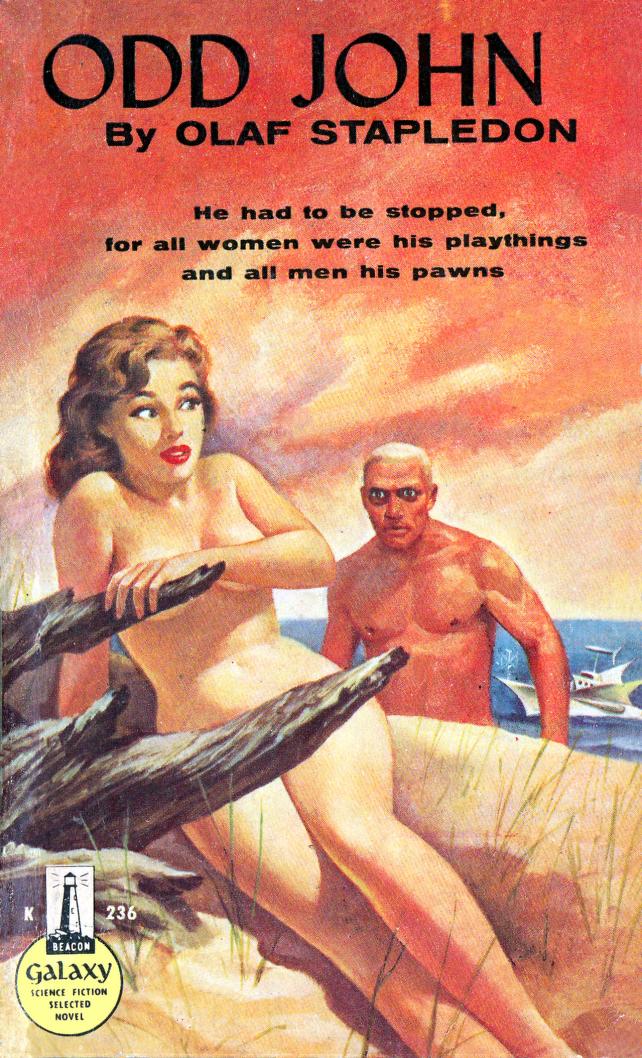
Ed Emshwiller cover to Galaxy Publishing edition, 1951

So, what’s going on here, in a book Stapledon subtitled “A Story between Jest and Earnest”? Are we supposed to take John’s occasional and self-justified acts of inhumanity — or, as he sees it, of his true humanity applied to a race (us) that cannot be called fully human — as part of a rollicking adventure, a light jest about a big-brained superman who in earlier chapters dismisses all our science, religion, psychiatry and poetry as the products of a race that’s “not really grown up”? I think, if anything, Stapledon’s calling his novel a “Jest” is defensive — a brush-off in case we really are offended. But what he wants to do is shock us. Stapledon wants us to realise how alien, how inhuman (in our terms), the next stage in evolution might be, and the best way to do that is to present it treating us as though we’re so much less than it, less than its own definition of human.

(Another take is that the narrator — whom Odd John nicknames “Fido” as though to underline how we’re all below his degree of human — may in fact be under some sort of psychic-hypnotic influence. We learn, later in the novel, that John and his fellow supernormals can bamboozle normal humans with the power of their minds, and John wants “Fido” to write his biography — not so we norms can better understand him, but so the next wave of supernormals knows a little more what to expect — so it’s in his interest to downplay the more negative aspects of John’s career. At the same time, John is presented as engaged, curious, open, personable, and even kind, so it’s sometimes hard to equate the persona with the occasional atrocities.)

1978 NEL PB, art by Joe Petagno

What is this next stage of human evolution anyway? Right from the start, John has an ambivalence about not only the life and sufferings of we human beings, but his own, too. He laughs at his own pains and misfortunes, seeing them from a cosmic perspective, even while in the throes of suffering them. This is an attitude found in the more advanced beings in the other two Stapledon novels I’ve covered, Last and First Men and Star Maker, in both of which our more evolved descendants learn to see their tragedies, even their own coming extinction, as necessary events that “deepened and quickened the universe” itself.

Living among the community of supernormals, the narrator is given a glimpse of what Homo Superior (and, presumably, Stapledon) regards as the true measure of an evolved outlook:

“The true purpose of the awakened spirit… is twofold, namely to help in the practical task of world-building, and to employ itself to the best of its capacity in intelligent worship.”

(“Intelligent worship” meaning something like a combination of scientific understanding, philosophical enquiry, and aesthetic wonder.)

Some scenes depicted are not necessarily in the novel… art by Robert Stanley

Meanwhile we humans, who think ourselves so advanced, are seen, by these supermen, as “about as clever along [our] own line as the earliest birds were at flight. [We’re] a sort of archaeopteryx of the spirit.”

(Elsewhere, Odd John announces that “Homo sapiens is at the end of its tether”, which resonates with H G Wells’s final, despairing end-of-life outburst against a world that had just been through a second World War, Mind at the End of its Tether (1945).)

Odd John received a fair amount of mainstream attention when it was published. (Stapledon seems to have found a position as a sort of public intellectual, perhaps after the model of Wells.) Not all of the reviews were positive, but nevertheless, Odd John was a book everyone felt the need to remark on, even if only to say how odd it was. The Evening Standard made it their book of the month in October 1935, declaring Stapledon “a writer who has one of the deepest and strangest imaginations of our times: perhaps the deepest, perhaps the strangest.”

It perhaps seems less strange today, now we have supermen of all kinds flooding our culture, but the ethical shocks Stapledon delivers through his seemingly so personable and child-like version of the Übermensch are perhaps the thing that gives this novel a lasting place, not just in science fiction, but the culture as a whole.

^TOP

Rendezvous with Rama by Arthur C Clarke

Pan 1974 cover

Wondering where to look next (after Stapledon’s Last and First Men and Lem’s Solaris) for works that touch on the sort of cosmic themes Lovecraft addressed, though without his emphasis on horror, I wondered if Arthur C Clarke’s Rendezvous with Rama might be a good candidate. Clarke, whose “The Sentinel” was the kicking-off point for 2001: A Space Odyssey, is both an old-school hard-SF writer and one whose work strayed into themes of “the metaphysical, even to the mystical” (as the Encyclopedia of Science Fiction puts it). In fact Rama, published in 1973, was the first novel Clarke wrote after his collaboration with Kubrick (the novel of 2001, which was written alongside the screenplay, came out in 1968, but only after it had been revised and rewritten — at Kubrick’s behest — throughout the four preceding years), and reading it I found myself wondering if Rama might be a result of Clarke blowing off steam about the things Kubrick (who ultimately had final say on 2001) wouldn’t allow into the novel. (Clarke was very respectful and polite about Kubrick and their working relationship, despite the director’s demands over the novel resulting in Clarke apparently coming close to financial hardship at one point. The closest I could find to any criticism of Kubrick from Clarke, though, was this, from when the director’s demands for yet more edits meant they had to cancel the existing publishing contract and find a new one: “There seems to be a right way to do things, a wrong way, and Stanley’s way.”)

Rendezvous with Rama opens by introducing us to Project Spaceguard, an effort to alert Earth (and, this being a few centuries in the future, the other inhabited planets of the solar system) about any potential collisions with comets and other objects. A new object has been spotted passing Jupiter, heading sunwards. It’s dubbed Rama, and it soon becomes clear this is no wandering asteroid:

“Its body was a cylinder so geometrically perfect that it might have been turned on a lathe — one with centres fifty kilometres apart. The two ends were quite flat, apart from some small structures at the centre of one facet, and were twenty kilometres across; from a distance, when there was no sense of scale, Rama looked almost comically like an ordinary domestic boiler.”

The closest spacecraft, Commander Norton’s Endeavour, is diverted to intercept and explore this object in the roughly month-long window before it gets too close to the sun. Landing on one of its flat ends, the Endeavour’s crew finds its way into the interior, which contains an entire landscape — there’s even a band of (at first frozen) sea about halfway along.

Bruce Pennington cover

It soon becomes evident Clarke’s focus is on the very practical problems of exploring such an object, and the sort of physical environment it presents. For instance, it has a certain amount of gravity, but because the explorers are inside it, when you’re standing close to the axis, gravity is pulling equally in all directions, so it cancels out to zero-G. But gravity is felt increasingly as you move towards the surface of this artificial world. And, where any other author might provide a quick method to get people from the axis (where you enter Rama) down to the surface, Clarke spends several chapters on his characters exploring the best method of traversing the several kilometres of stairs: as it’s in low gravity, for instance, it’s tempting to just float down, but will this world’s gravity be enough to result in injury? And then there’s the Coriolis Effect caused by being inside a spinning object, meaning if you drop, say, some supplies above one point, they might land several kilometres to the side. And once Rama gets closer to the sun and starts to warm up, climatic changes kick in and its sea thaws, meaning Clarke gets to describe what he thinks would happen in such an artificial enclosed environment.

The closest parallel to a work by Lovecraft, I’d say, is At the Mountains of Madness, where scientists are exploring a remote alien city. But where Lovecraft’s city is covered in enough wall-art to give us a good idea of the culture and history of its former inhabitants, Clarke gives us few clues as to what the Ramans might look like, or what this massive object is for. He doesn’t even have his characters speculate, as though they’re too scientifically disciplined to do so on such little evidence. Perhaps it’s because Clarke knew how inevitably disappointing it could be to bring his aliens into the light after such a long build-up; but I can’t help feeling he was simply having too much fun focussing on the physical problems associated with this artificial world. He’d maybe get to the aliens, but only once he’d got through all the physics — and there’s plenty of physics to get through.

Folio Society cover

But since I was on the look out for hints of Lovecraftian cosmic awe, I did spot a few instances. Rama opens with mention of the 1908 Tunguska explosion (when “Moscow escaped destruction by three hours and four thousand kilometres — a margin invisibly small by the standards of the universe”). But where Lovecraft would have taken that near-miss as evidence of how overwhelmingly random the universe’s destructive forces are, and so how little human life matters, Clarke takes it as just one more practical problem humans have to deal with. Hence the creation of Project Spaceguard, to spot asteroids on their way towards Earth.

The sheer scale of time associated with the spacecraft Rama — Clarke points out it must have been “more than two hundred thousand years since Rama passed near any star” — comes close to another Lovecraftian note, as Lovecraft got a particular horror-thrill from the passage of time (he called time itself an “especial enemy of mine”), and even more so with vast eons (“After vigintillions of years great Cthulhu was loose again”), but in Clarke’s hand two hundred thousand years feels like a number of interest to note, and no more. As a scientist dealing with astronomical objects and forces, he’s used to massive numbers.

Commander Norton does get a glimpse of the sort of vertiginous fear Lovecraft associated with the cosmic/alien as he descends to Rama’s surface:

“His well-ordered universe had been turned upside down, and he had a dizzying glimpse of those mysteries at the edge of experience which he had successfully ignored for most of his life.”

But he has the mental discipline to rein himself in:

“There was mystery here — yes; but it might not be beyond human understanding… At all costs, he must not let Rama overwhelm him. That way lay failure — perhaps even madness.”

He goes on to muse that “The wonder and strangeness of Rama would banish its terrors, at least for men who were trained to face the realities of space.” (And I suspect Clarke was of that generation of SF writers who throughout their lives continued to find the very word “space” inherently thrilling.)

US first edition, 1973

Ultimately, for Clarke, Rama is a physical puzzle, not the calling card of cosmic horrors Lovecraft would have made of it. I’ve always felt that, by the time of At the Mountains of Madness, Lovecraft’s insistence on horror as the only response to the unusual was wearing a little thin, certainly when assigned to the scientists who make up that story’s Antarctic expedition, who’d more likely be positively thrilled to discover an alien city. But the almost complete lack of awe felt by Clarke’s protagonists leaves the weird fiction reader in me feeling something is, perhaps, missing in Clarke’s approach, where such an awesome alien object is merely an intriguing physical puzzle.

The Encyclopedia of Science Fiction talks of Clarke, in his work as a whole, presenting “images of humanity childlike in stature compared to the ancient, inscrutable wisdom of Alien races” — and that is, I think, his most characteristic note. Not the humans-as-insects of Lovecraft, but humans-as-children.

As I said above, I couldn’t help but read Rama with the feeling that something, shall we say, monumental might be looming over it — Clarke’s collaboration with Stanley Kubrick. And Kubrick does get a brief allusion in the text of Rama, with the mention of “Sid Krassman’s famous late-twentieth century [film] Napoleon” — that being something the real S. K. was planning as his follow-up to 2001. In the end, I never really felt Rama showed any evidence of letting off left-over steam from the Kubrick collaboration — I suspect Clarke was just too genuinely good-natured a person to have any resentments at all — but it was interesting that both 2001 and Rama end with a space-baby of sorts. With 2001, it’s the Star Child (which seems to have been Clarke’s suggestion); in Rama, it’s the news that one of Commander Norton’s wives (in this future, men and women can have multiple spouses) has been inseminated, thousands of miles away on Mars. Norton is the father, but:

“Like every astronaut, Norton had been sterilised when he entered the service; for a man who would spend years in space, radiation-induced mutation was not a risk — it was a certainty.”

It’s not, then, the mystical wonder-child of 2001, but a combination of scientific miracle and practical necessity, something that feels more in line with Clarke’s approach.

Clarke in 1974

Clarke might create situations of awe and wonder — the size of Rama, the implications of its hundreds of thousands of years’ journey — but is always ready with a bathetic counter-note (“Rama looked almost comically like an ordinary domestic boiler”) or has his characters focusing too much on the immediate practicalities — as trained astronauts would have to, practicalities being so necessary to their survival — to stand back and really bask in the sort of awe (or horror) a weirder-minded writer might.

Ultimately, there’s something childlike about Clarke himself. He’s intrigued by Rama as a sort of toy — what can it do? what’s it like inside? what happens if we drop things? — rather than the religious-level object the title of the novel implies.

Rendezvous with Rama won a host of awards, including the Hugo, Nebula, John W Campbell Memorial Award and BSFA Award. It was followed by several sequels — all collaborations — but I have to say, I’m not tempted to read them. Rama’s power is in its suggestiveness. Filling in the answers to the questions it raises will, I suspect, only turn it into one more spaceship in the crowded vacuum that is science-fictional space.

^TOP