
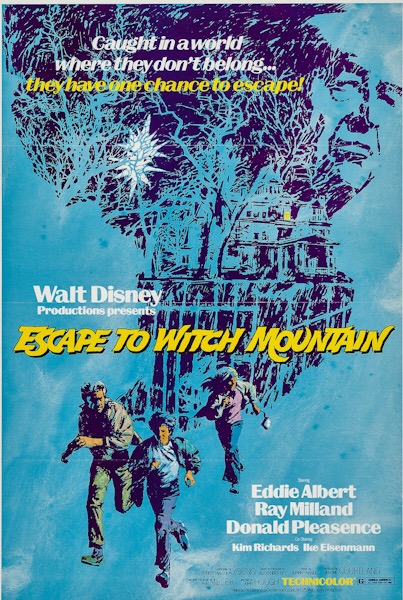
Escape to Witch Mountain

Kids with psychic powers have become a bit of a theme on Mewsings, one that often goes hand in hand with kids-as-aliens (The Midwich Cuckoos), kids-plus-aliens (Chocky), kids-from-the-future (Sky), and kids-as-the-next-stage-in-human-evolution (The Tomorrow People). If nothing else, kids with psychic powers are often treated as aliens (or less than human, anyway) because of their differences (The Institute, Stranger Things, The Morrow books), and as a result their stories are often about a quest for a new home where they truly belong (The Chrysalids, Morrow) or at least an escape from the dehumanising situation where they’re being held (The Institute, Stranger Things).

I realised recently that my first encounter with the idea of psychic kids was probably Disney’s 1975 film Escape to Witch Mountain. It’s an adaptation of Alexander Key’s 1968 novel of the same name, and was a fairly successful film at a time when, I’ve read, Disney was in a bit of a creative and commercial slump. Certainly, it’s fondly remembered, and coming out as it did a short while before Star Wars would have meant it was a science-fictional kids’ film on hand to feed a generation of suddenly science-fictionally hungry kids, which must have helped.

I’ve long thought of the kids-with-psychic-powers “boom” of the 70s and 80s as being driven by the youth-centred social revolutions of the late 60s, as the theme packs in so many hippie ideas, ideals, and preoccupations, from the (literal) empowerment of the young and the villainisation of the establishment, to a belief in dormant psychic powers, beneficent aliens, and the desire to escape from a materialistic society. The theme was around before then (John Wyndham’s The Chrysalids was 1955, Zenna Henderson’s People stories were in magazines from 1952), but I think of it as being driven into the wider culture of films and TV thanks to creators inspired by, or at least touched by, those late-60s ideals.

I don’t really associate Disney with revolutionary ideas, though (the exceptions seem to be more about the fight against individual tyrants than criticising the socially-sanctioned tools tyrants use, such as King John’s exorbitant taxation in Robin Hood, or the Master Control Program’s restrictive security policies in Tron). And I don’t think either of the first two Witch Mountain films (Escape was followed by Return from Witch Mountain in 1978) have much in the way of social comment to make, and by the time of the 2009 reboot, Race to Witch Mountain, any elements that were once revolutionary (the fact that the government is the film’s main villain, for instance) had by then become so established as to be conventions rather than convictions. But they’re fun films, and still contain almost all of the elements of the other kids-with-psychic-powers stories I’ve mentioned.

This may make it look like Return from Witch Mountain is somewhat hauntological… It’s not.

Escape to Witch Mountain starts with siblings Tony and Tia (Ike Eisenmann and Kim Richards) arriving at an orphanage after the death of their adoptive parents. Tony can move things with his mind (though he generally has to be playing the harmonica to do it), while Tia can communicate telepathically with Tony, and with animals, and has precognitive flashes. Although they have a conversation about the need to hide their powers so as not to be ostracised, they don’t make much of an attempt to do so. Confronted by a bully and surrounded by the other kids in the orphanage, Tony thinks nothing of blatantly using his powers to win the fight. And none of the kids (except the defeated bully) seems to care much. But the film isn’t really about the alienation of being different, it’s about how fun it would be to have special powers. The main villain, greedy millionaire Aristotle Bolt, wants to use Tia’s precognitive powers to increase his already excessive wealth, but it’s only towards the end of the film, when the kids’ flight has led them to more rural areas, where a hick sheriff and hunting-mad locals think that because the kids are headed for Witch Mountain they must be witches and can be shot rather than captured, that there’s any real sense of danger.

In the book, Tony and Tia are more evidently different. Both have light-coloured hair, olive skin, and dark blue eyes. Their story in the book is a bit more grim (the orphanage is run by a cynical matron, and the fight with the bully involves a home-made knife), the main villain isn’t a rich capitalist but a communist agent, and Tia can’t speak except telepathically to her brother and animals. They are helped first by a nun, then by a Catholic priest, Father O’Day (who is turned into widower-with-a-camper-van Jason O’Day in the film).

Tony and Tia’s powers seem to have no limits in the films. There’s none of the sense, as with Stranger Things’ Eleven’s nosebleeds, that using their powers takes something out of them, and by the second film Tony is using his telekinesis to keep multiple people and heavy objects flying in different orbits all at once, as well as lifting trains and trucks and a massive weight of gold, and can even perform technically demanding tasks such as meddling with electronic circuitry, or making a car window reflect enough sunlight to blind his pursuers.

Although released in 1975, Escape to Witch Mountain feels like an early 60s film. The kids are trusting of all adults, are sweetly innocent (left to themselves, they use their powers to put on a telekinesis-powered puppet show), and the perils are mild. There’s a reassuringly trustworthy adult to parent them through most of their journey. Return from Witch Mountain feels a bit more 70s, though largely in the surface details (the music — funky wah-wah’d guitar and rock flute — and the fashions — Tia’s very sharp, very red, short trouser suit — for instance), and the few touches of 70s grit are highly Disneyfied. (Tia, for instance, is helped not by a reassuring adult but a denim-clad street gang of kids, though they’re a gang who only think of themselves as tough and streetwise, while clearly being anything but, and are quick to realise that really they want to go to school.) Both films were directed by John Hough, who also directed Twins of Evil for Hammer (and in the second film he’s joined by Hammer actors Christopher Lee and Bette Davis as his villains).

Things have certainly changed by the time of the 2009 remake of Return, Race to Witch Mountain. The idea of alien visitors with psychic powers has picked up too much cultural baggage, and this is very much a post-X-Files, post-Close Encounters film, with hazmat suits, media interest, plenty of references to conspiracy culture, and a Terminator-style alien robot assassin to make up for the lack of visual cool in the two alien kids looking just like humans. The main difference in feel to the previous two films is that the kids — called Seth and Sarah this time — feel very much like aliens. They speak in stilted English, know a lot more than the humans that help them, and are emotionally distant for most of the film. (They also have different powers from Tony and Tia. Sarah can read anyone’s mind, while Seth can alter his molecular density, to pass through solid objects or become solid enough to stop a car. He doesn’t have telekinesis, though.) The point of audience identification now isn’t the kids, but what the SF Encyclopaedia calls the “action hero as exasperated dad”, in the form of harassed cab driver Jack Bruno, played by Wayne “The Rock” Johnson. This film isn’t about being a kid who’s different and has cool super powers, it’s about being a single dad, having to juggle a low-paid job, a regrettable mob past, and a pair of demanding teenagers (alien teenagers, no less). It feels less like a kids’ movie, more a movie about having kids.

The Witch Mountain films (and there were a few other TV remakes, including one intended as a pilot for a series that never got made, as well as a jokey Blair Witch take-off directed by Ike Eisenmann (Tony from the original films)) don’t really say anything new or profound about the kids-with-psychic-powers theme, and in fact do a very good job of not including any of the deeper or more painful aspects of these stories (that it’s all a metaphor for being a sensitive, alienated child in a world that doesn’t really care, as exemplified by Carrie). But they were certainly part of the popularising of the idea, preparing a generation of kids to absorb the deeper themes of the likes of Chocky, ET, and perhaps from them to The Midwich Cuckoos, The Chrysalids, and so on.

^TOP

The Raven by Edgar Allan Poe

Edgar Allan Poe, around 1849

Poe wrote his most famous poem in 1844, around the time he moved from Philadelphia to New York. He seems to have first offered it to his friend and former employer, George Rex Graham, editor of Graham’s American Monthly Magazine of Literature and Art. Graham turned it down, but felt so bad about rejecting it, he paid Poe $15 as an apology. It’s easy to feel Poe might have started to have doubts about the poem when his friend basically paid him not to publish it, which may be why, when he then placed it with The American Review (for which he was paid somewhere between five and ten dollars — less than for its non-appearance in Graham’s), he used the pseudonym “Quarles”, a reference to Francis Quarles (1592–1644), whose most famous work, Emblems, is a series of poetic meditations on scripture. (Poe later wrote that he wanted the raven in his poem to be “emblematical of Mournful and never ending Remembrance”.) The tale of The Raven’s first publication took a further twist when Poe then placed it with a different paper, The Evening Mirror, this time under his own name, which came out before The American Review, at the end of January 1845.

The Raven was an immediate success, being reprinted in countless journals and newspapers for decades after (for which Poe mostly wasn’t paid). And not only reprinted, but parodied. Because of its characteristic rhythm and rhyming scheme, and the comic potential of its central situation (a maudlin poet addressing an obdurate, monosyllabic interlocutor), Poe’s Raven was repurposed for a variety of ends, from straightforward comedy to political satire (Britain’s Lord Dunraven must have rued the day it was written), as well as more serious pastiches, including tributes to Poe himself, sequels, “channelled” poems dictated by Poe from the afterlife, fake precursors, and poems that used the style of The Raven as a framework for imparting a moral (“The Owl”, for instance, is a pro-temperance version). The best of these imitations, though, are pure comedy, such as “The Parrot”, “The Pole Cat” (praised by Abraham Lincoln), and “Chateaux D’Espagne” (whose narrator becomes infatuated with an actress in the titular play). (I became so sidetracked looking into parodies and pastiches of The Raven whilst doing this research, that I ended up adding a whole new section to my website dedicated to them.) In effect, The Raven was a nineteenth century meme, taken up and played with because it was so instantly recognisable and adaptable.

Detail of an illustration by Manet for The Raven

Poe did receive some benefit from the poem’s success. In June 1845, his first book in five years, Tales, was published by Wiley and Putnam, followed by The Raven and Other Poems in November. And, in April the following year, he had an essay published (by a no doubt still contrite George Rex Graham), “The Philosophy of Composition”, about how he wrote the poem.

“The Philosophy of Composition” is a peculiar piece of puffery, in which Poe attempts to convince his reader that pretty much everything about The Raven was derived by logic, not poetic inspiration. If we’re to believe him, the first thing Poe decided upon was the length of the poem, before he even knew what it was going to be about. That length — about a hundred lines, he decided — was the best length for a poem, as it could be read in a single sitting, while being long enough to make a strong impression. Next, he chose the effect he wanted to make on his reader, selecting “beauty”, whose highest manifestation, he says, is melancholy. And the death of a beautiful woman, of course, is the purest expression of such melancholy. Working from there, he step-by-step outlined the scheme of his poem. Realising he wanted a refrain, for instance, he chose the word “Nevermore” because of its containing “the most sonorous vowel” (a long “o”), and “the most producible consonant” (the letter “r”, apparently). And who would speak this refrain? Not a human, as it is so repetitive. A speaking beast, then. Which beast? Poe would have us believe he briefly considered a parrot before settling on a raven. The rest followed with — or so he seems to imply — nothing but logic, until he arrived at his finished paean to “Mournful and never ending Remembrance”.

It’s tempting to take “The Philosophy of Composition” as a sort of humble bragging (“Oh, it all seemed perfectly logical to me”), or perhaps even a hoax (after all, some of his tales began as hoaxes), but I can’t help feeling Poe himself was the main person he was trying to convince. His young wife Virginia showed the first signs of consumption in 1842; she died in 1847. The death of a beautiful woman can’t help but have been on his mind. Perhaps he didn’t want to admit what he knew was going to happen, and had to make his poem a thing of the intellect, not of the emotions, so he could deal with it. He was clearly a man of both strong intellect and troubled emotions, and the two can’t have avoided being in conflict within him to some degree. But, by attempting to convince his readership that The Raven was the result not of intense feeling but cold ratiocination, he was surely undermining its most poetic qualities, making it sound like it had been created by some versifying algorithm, something its tight rhythm and rhyming scheme already suggested to some. Emerson called Poe “the jingle man” for this very reason, and Yeats later dismissed The Raven as “insincere and vulgar… a rhythmical trick”.

Elizabeth Barrett Browning

A poet who took a different critical tack was Elizabeth Barrett Barrett (later Browning), to whom Poe dedicated his 1845 collection. Poe had reviewed Elizabeth Barrett Barrett’s Poems in 1844, making a point of criticising it in detail — as a compliment, oddly enough, because he started the review saying how women poets tended to be praised in sugary terms and not taken as seriously as their male counterparts, who were assumed to be able to take harder knocks. One poem he singled out for praise was “Lady Geraldine’s Courtship”, whose line:

“With a murmurous stir uncertain, in the air, the purple curtain…”

many critics found echoed in The Raven’s:

“And the silken sad uncertain rustling of each purple curtain…”

In her letters, Elizabeth Barrett said The Raven had “produced a sensation—a ‘fit horror’ here in England”, but to her future husband Robert Browning she wrote, after reading Poe’s “Facts in the Case of M. Valdemar”:

“…you shall… decide whether the outrageous compliment to me [i.e., the dedication of The Raven and Other Poems] or the experiment on M. Vandeleur [sic] goes furthest to prove him mad.”

In another letter, to a different correspondent, she wrote:

“As to The Raven… There is certainly a power but it does not appear to me the natural expression of a sane intellect in whatever mood…”

It is, then, a poem that seems at once overly clever and in the grip of unstable emotion.

The reason Poe’s poem attracts the “jingle man” type of criticism is that we expect poetry to be about emotion, sensation, nuance, and so on, but The Raven feels so tightly controlled, so narrowly confined by its rhythm and its rhyming scheme — by its cleverness — we’re left feeling emotion has been sacrificed for showy-off technique. In “The Philosophy of Composition”, Poe seems to take pains to point out how not in the grip of any personal emotion he was. But, I’d say this reliance on cleverness isn’t a limitation of the poem. Rather, it’s what the poem is about. The poetry of The Raven is what escapes this strict matrix of rhythm and rhyme — what comes through despite the control and cleverness, and in contrast to it.

The Raven is about the trap of being stuck in intellect, unable to grieve. It’s about a poet suffering from cleverness when he ought to be feeling feelings. The raven, emerging from the storm (i.e., the roil of emotions the narrator thinks he has shut out by holing himself up in his study), represents the thing that cannot be confronted with mere cleverness: the dark emotion, eyeing him beadily from the corner of the room, relentless in its insistence. It speaks one word, because it is emotion, not thought, and that one word has all the meaning it needs to convey. It’s a word that speaks of deep and unfaceable loss. And still the narrator can’t accept it, but has to interrogate the one-worded beast, and arrive at the emotion through a long and avoidant path, turning the expression of personal grief into a ritual of self-torture. After which, the raven remains (still is sitting), unassuaged and unbanished, like that other bird of Romantic poetry, the albatross around the neck of Coleridge’s Ancient Mariner.

The Raven is easily parodied and can seem overblown, melodramatic, nothing but a “jingle” or a “rhythmical trick”, but at the same time it’s about a pitiable and very human situation: a lone man hiding from the storm of his own overpowering emotions, obsessively talking himself into a confrontation with the one ineluctable fact that he cannot face: the death of his beloved.

It’s a favourite with the more grandiloquent kind of actor, the sort who make it big in a certain type of old horror film: Vincent Price, Christopher Lee, Basil Rathbone, Christopher Walken. (James Earl Jones does a good version, too.) It doesn’t quite fit in with the other long fantasy poems I’ve covered in this blog — The Hashish Eater, Goblin Market, Childe Roland and so on — as it isn’t strictly fantasy, but at the same time, it doesn’t quite not fit in. (It certainly echoes Wilde’s The Sphinx, for instance.) Perhaps its divisiveness — the way it seems to be so unpoetic whilst clinging so tightly to poetic form — underlines its archetypal power as a poem about the limits of intellect, the confrontation with difficult emotion, and so, ultimately, the need for poetry.

^TOP

The Wise Friend by Ramsey Campbell

Patrick Semple, the narrator of Ramsey Campbell’s new novel, is a divorced English Literature teacher/lecturer whose aunt, Thelma Turnbill, was a painter working in a mixed surrealist/mystical vein, somewhat in the mode of Leonora Carrington. Patrick’s fifteen-year-old son becomes interested in Thelma and her work when Patrick shares her journal with him, in which she left some cryptic notes about rural locations she’d got a weird sort of inspiration for her paintings from. Patrick and Roy visit one — the wood behind the house where Thelma used to live — but Roy later starts visiting them all in turn, and not with his father, but his new girlfriend Bella, whom he met at an exhibition featuring Thelma’s work. Patrick starts to worry about his son’s involvement with the occult elements that began to preoccupy his aunt towards the end of her life, and as he investigates what may be driving Roy and (even more) Bella in their quest, he starts to realise he has to find a way to stop them.

coverThe title of this novel, The Wise Friend, made me think of Campbell’s 2012 novel of faerie horror, The Kind Folk, at first because of the propitiatory air of the title — the “Kind Folk” being anything but kind, just as the “Wise Friend”, you can tell, is going to turn out to be something other than a friend. The two books share other elements, though, too: both feature trips to a series of weird rural locations, both feature a cryptically-worded journal, and both are about the relationship between a father and son.

Exploring that relationship between a parent and a child is a perennial Campbell theme — in particular, looking at how being a parent means walking a line that can stray from protection into control. Patrick’s aunt, Thelma, with whom he often stayed, was a lot more lenient than his mother. She allowed him, for instance, to read Hunter Thompson’s Leaving Las Vegas, which shocks his mother when she finds out, because it’s about drugs. Once he’s a parent himself, Patrick is keen to make sure his son Roy knows about the dangers of drugs, but nevertheless encourages (at first) his son’s interest in Thelma’s art, something Patrick’s mother didn’t do.

But if this is a novel about that difficult line between parental protection and stifling control, then the most stifled child of all is the titular “Wise Friend”, a being created to be entirely of use to others, and to have no agency of its own, but who is determined to win that freedom, and with a vengeance.

And perhaps it’s a novel about loss, too. Patrick, after all, has lost his wife through divorce, and his aunt through her death, and perhaps the thought of losing his son, even if it’s just because Roy has quite naturally become more keen on spending time with Bella, his first girlfriend, is one loss too many. Is Patrick’s interference in Roy and Bella’s relationship inappropriate control or necessary protection? It’s one of the great strengths of Campbell’s supernatural fiction that the supernatural and the psychological are so tightly interwoven that his protagonists are usually helpless to convince anyone they’re not just having a breakdown, or (perhaps, in Patrick’s case) some sort of midlife crisis.

The Wise Friend is classic Campbell, an understated but sometimes hallucinatorily spooky exploration of the folkish occult, the dark edges of creativity, and the subtle power of the themes that weave through family generations. It’s amazing how Campbell continues to find fresh lodes of horror to mine, along with a continued inspiration in themes that have been present in his work from (or near) the beginning.

How does he do it? Perhaps Campbell’s own words can explain it best:

“Yet the mind of the mage is not restful, nor shall it sleep…”

You can read more about Campbell’s latest novel at the publisher’s site, Flame Tree Press. It’s out on April 23rd.

^TOP
